Search
Recent comments
- a peace deal....
14 hours 55 min ago - peace now!
16 hours 21 min ago - a nasty romance....
16 hours 27 min ago - blackmail?.....
18 hours 58 min ago - ukraine's agony has not started yet....
1 day 12 hours ago - all defeated.....
1 day 12 hours ago - beyond crime.....
1 day 13 hours ago - the end....
1 day 13 hours ago - odessa....
1 day 14 hours ago - weitz....
1 day 16 hours ago
Democracy Links
Member's Off-site Blogs
chip chip chip-away .....
Trees are our most valuable resources in combating global warming, IF WE LEAVE THEM THERE, but we are about to cut more of them for paper.
- By Gus Leonisky at 6 Oct 2007 - 6:22am
- Gus Leonisky's blog
- Login or register to post comments
Money versus environment...
Posted 17 minutes ago
Anti-pulp mill campaigner and Sydney businessman Geoffrey Cousins is hoping Australia's major banks refuse to fund Gunns' proposed northern Tasmanian project.
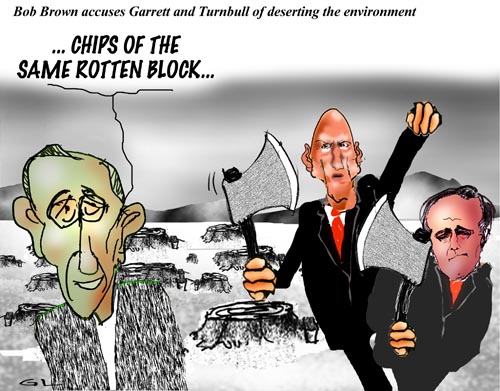
The cost of friend-chip
Labor's Environment spokesman Peter Garrett has shrugged off comments by Greens leader Bob Brown that their long friendship is over.
Senator Brown has accused Mr Garrett of selling out by backing the approval process for the proposed Gunns pulp mill in Tasmania.
But Mr Garrett has told Channel Ten Senator Brown is playing politics.
"Bob has always come out with very strong and provocative comments. He's always personalising this debate," he said...
certainty of uncertainty...
Climate capers...
-----------------
Row erupts over risk to polar bears
One of the most controversial voices in the global warming debate believes too much emphasis is put on extinction fears for ecology's poster animals
* Juliette Jowit
* The Observer
* Sunday October 14 2007
The global warming sceptic Bjorn Lomborg, has sparked fresh debate about the dangers of increasing temperatures with new claims that polar bears are not on the brink of collapse and are more threatened by hunting than by climate change.
In a new book called Cool It, Lomborg says many of the predicted effects of climate change - from melting icecaps to drought and flood - are 'vastly exaggerated and emotional claims that are simply not founded in data'.
.....
Last night Lomborg was accused of the same misuse of statistics which he levels at other scientists, environmental groups and the media.
........
...l. But for many scientists it is not a question of either reducing greenhouse gases or adapting to climate change, but doing both, said Asher Minns of the UK's Tyndall Centre for Climate Change Research at the University of East Anglia. 'The idea of adaptation to climate change is very old and there's as much work around adaptation as there is around mitigating greenhouse gases and coming up with low carbon technologies.'
----------------
And:
----------------
ONE of the world's foremost meteorologists has called the theory that helped Al Gore share the Nobel Peace Prize "ridiculous" and the product of "people who don't understand how the atmosphere works".
Dr William Gray, a pioneer in the science of seasonal hurricane forecasts, told a packed lecture hall at the University of North Carolina that humans were not responsible for the warming of the earth.
His comments came on the same day that the Nobel committee honoured Mr Gore for his work in support of the link between humans and global warming.
"We're brainwashing our children," said Dr Gray, 78, a long-time professor at Colorado State University. "They're going to the Gore movie [An Inconvenient Truth] and being fed all this. It's ridiculous."
--------------------
Gus: The certainty of uncertainty in climate change
In sciences that involve many sources of data — mostly incomplete data, there will always be some dispute about the why and therefore of things. But there are some certainty amongst the variables.
* The earth is warming — faster than even predicted by models of global warming.
* Since the late 19th century, the relationship between CO2 in the atmosphere and warming has been studied extensively and a relationship has long been proposed.
* From the beginning of the industrial revolution, a trend of warming has been observed, while many scientists till the early 1940s were predicting a cooling (an incoming ice age) according to past patterns of climate imprinted in the records of many geoscientific disciplines,
* Precise scientific studies of CO2 in the atmosphere shows a sharp rise of this gas concentration.
* Expected parallel between warming and CO2 concentration are being observed.
* up to 90 per cent of CO2 presently in the atmosphere could be related to human activity. From burning fossil fuels to cattle herding to deforestation.
* Climatology is a science based on probabilities and incomplete data. Climatology defines trends in climatic patterns and possible development. Unlike certain sciences like physics in which to a great extend, actions will create a precise reaction in an ideal situation, the elasticity of air masses, the variability of temperature, pressure, humidity, dew point, altitude of air currents at any one time around the globe is impossible to map precisely. A small event can change the whole process, but trends will still persist despite apparent confusion.
* Strong trends can emerge from studying as many points as possible and a statistical chart can be built with "acceptable" margins of errors, which even at its most conservative acceptance show an upward trend to warming...
* What most climate change sceptics challenge are the margins of error, the interpretation of data, the methodologies, the cost of being wrong should climate change be a furphy in relation to human activity...
* There no certainty in the climate change theory, except a noticeable and explainable strong trend.
* The greater certainty is that should we release more CO2 and other "greenhouse" gases in the atmosphere, is that temperatures will rise even more.
* Some scientific experiments have led many scientists to believe that concentration of CO2 in the atmosphere can be critical above a certain amount, leading to even greater rise in temperature than the 2 degrees presently predicted for 2100.
* For a few years now I have observed many "natural" phenomenon variations, including:
— some plants lately flowering according to daily climate variability while before they flowered according to "seasons".
— ants lately being attracted to water, actually "drinking", while at most time ants resent water.
— small changes in local climatic patterns, over the last 35 years, that indicate a trend towards warming.
For many years, I have also been informed by credible scientists of the "carbon equation". the relationship between past climatic conditions and the carbon contents between plants, animals and atmosphere. Always in a flux, interfering with some species survival and promoting others and in some instances having devastating effects. All of this inscribed in the geological record of plant and animal life. Some strong external events have also been crucial in changes on planet earth including "bolides" (big meteor and comets hitting the earth). We are still at the mercy of those. A big one has hit the earth as recently as the beginning of the 20th century but relatively small enough not to make global damage like the one at the end of the Jurassic period that is thought to have started the decline of the Dinosaurs... I keep repeating myself here, but it is important to note that Dinosaurs took about one million years to become extinct after that event. Important changes on a geological time scales can take millions of years.
The climatic change that faces us now appears to be super fast, under the "normal" terms of geological change. Thus we are like rabbits or kangaroos caught up in the lights of an oncoming car. We do not know which speed the car is doing, we do not know which side of the road to jump to. We can spend a lot of time studying all the apparent parameters but we do not know the intent of the driver. All we know is that if we do not something, either the car will stop or we will be hit for six. At the moment, it looks the car is accelerating...
I am firmly with Al Gore.
In relation to Polar Bears, a study of the extinction of the mammoths can draw an interesting conclusion. It has been widely acknowledge that several factors were at play in the extinction of these animals — with a strange discovery that these animals survived at least another 5,000 years than previously thought in isolation on an island. The surviving animals cut off from the mainland by rising seas, became "stunted" that is they became smaller as they bred, possibly due to the scarcity of food.
But what most scientists attribute the disappearance of the mammoths, is a combination of factors: Global warming stressing their metabolism, also inducing a change in vegetation, a reduction of habitats and hunting by a mammal called homo sapiens. It is important to note here is that Homo sapiens did not reach that particular island for an extra 5,000 years and that the mammoths on this island then became extinct.
Nothing new to our present situation in which we hunt other species to the door of extinction, reduce their habitats and on top of which we can add vicious poisoning of the earth with insecticides, herbicides and other man made chemicals...
The earth of evolving nature is becoming the earth of the humans. Soon to be the planet of the apes. But we are destroying these animals habitat, possible because their genetic and mirror image of ourselves is too close for comfort.
The earth soon to be the planet of the cockroaches?
killing the earth...
· Livestock drug blamed for rapid decline in species
· Uneaten carcasses pose environmental threat
This article appeared in the Guardian on Wednesday April 30 2008 on p15 of the UK news section. It was last updated at 00:03 on April 30 2008.
Asian vultures are declining faster than any bird in history, including the dodo, and could become extinct within a decade, conservationists said yesterday.
A survey shows that the rate of decline is about 50% a year with one species, the white-backed vulture, falling by 99.9% since the early 1990s. Others such as the long-billed and slender-billed vultures have been reduced to around 1,000 in the wild.
Scientists blame the decline on an anti-inflammatory drug used for livestock, which can poison vultures feeding on treated carcasses. Diclofenac causes kidney failure in the birds within a few days of exposure and a single cow carcass can kill a large flock. Researchers counted the vulture population in northern and central India between March and June last year, surveying the birds from vehicles along almost 12,000 miles of road.
Their findings were published yesterday in the Journal of the Bombay Natural History Society.
a royal chip of the greener block....
The halting of logging in the world's rainforests is the single greatest solution to climate change, Prince Charles has said.
He called for a mechanism to be devised to pay poor countries to prevent them felling their rainforests.
The prince told the BBC's Today programme that the forests provided the earth's "air conditioning system".
He said it was "crazy" the rainforests were worth more "dead than alive" to some of the world's poorest people.
The world's forests store carbon in their wood and in their soils.
But they are being felled for timber products, food and now bio fuels. Experts say this carbon is being released into the atmosphere and contributes to global warming.
of trees and loo paper.
Forests to fall for food and fuel
By Richard Black
Environment correspondent, BBC News website
Demand for biofuels will add to pressure on forests, the report warns
Demand for land to grow food, fuel crops and wood is set to outstrip supply, leading to the probable destruction of forests, a report warns.
The Rights and Resources Initiative (RRI) says only half of the extra land needed by 2030 is available without eating into tropical forested areas.
A companion report documents poor progress in reforming land ownership and governance in developing countries.
Both reports will be launched on Monday in UK government offices in London.
Supporters of RRI include the UK's Department of International Development (DfID) and its equivalents in Sweden and Switzerland.
"Arguably, we are on the verge of a last great global land grab," said RRI's Andy White, co-author of the major report, Seeing People through the Trees.
----------------
Gus: in the same fashion as the king shouted: "my kingdom for a horse", the average populace individual is presently screaming: "my tree for a few sheets of loo paper!"... This state of affair of course is promoted by smooooooothness and biodegradability components — but before that the problem is totally compounded by eating too much.
There are dark clouds on the horizon... The fat brigade is upset at a movie by Pixar.
"Wall-E is the story of (as well as the name of) a waste disposal robot left behind on Earth after our planet has become so polluted and so covered with trash that humans can't live here anymore."
Fat people get a serving. Thus would the Rabbi:
Matzos for fatsos: diet cutbacks are kosher
Barney Zwartz
July 14, 2008
KOSHER food can stack on the kilos. So says the rabbi who has launched a diet challenge to Australian Jews: lose 1000 kilograms in 12 weeks.
Rabbi Mendel Kastel is publishing a diet online this month that comes with kosher recipes, a kosher conversion guide, personalised menus, exercise plans and tools to set goals and track weight.
But back to the movie:
Rachel Richardson, of the Coalition of Fat Rights Activists, used her blog, "The F-Word", to object to the way the film "targets obese people as the primary cause of mankind's demise".
Marilyn Wann, 41, and 127 kilograms, is America's best-known fighter for fat rights. She said: "It's the classic stereotype that fat people are stupid, smelly, lazy, disgusting, and out of control. These are the same stereotypes that have been used for every group of outsiders: whether it's people of colour, or the disabled, or immigrants. Pixar should be out of business for portraying this level of prejudicial bigotry-mongering. These are 19th-century hatreds repackaged in modern animation."
---------------
I agree. We cannot pin the demise of the planet on fat people, but we could blame it on too many thin people.
Some people could argue that cutting trees will actually stop global warming. The logical argument goes thus: If you cut trees down to make furniture or loo paper, new trees will replace the old ones... Thus you have carbon sink-ed more carbon in the chair-and-table-combo plus in the loo paper that will go and feed little fishes, while more carbon is absorbed to create the new forests. It's a win win situation as long as no one smokes near a wood-pile or a fully organic loo. Ban organic stuff in general to alleviate the problem of methane from natural composting.
Oh boy the future looks so rosy... see toon at top.
go make babies...
populate or perish...
"There is a crisis in the Western world. No Western country is producing enough babies to keep the population stable, no Western country," he said.
"In many cases there is an increase in divorce and there is an increase in serial monogamy.
"Ruthless commercial forces are telling young people that this is the way forward, that this is the modern way, and they remain totally silent on the difficulty and damage this does to marriage and family life."
Cardinal Pell would not commit to a broad apology to sex abuse victims when questioned today.
-----------
Gus: saved by the b(P)ell. The Pixar fiction Wall-E (blog above) is obviously fiction, like Disney's Lion King, which — meself being a republican — upsets me no end, like the anti-fatso movie from Pixar upsets a few large people...
But fear not, by increasing the population of the world under General Pell's guidance, we can only get closer to paradise — sooner.... Before that, we might have to go through the gate of Hell opened wide through global warring and warming.
But with the man of god on our side we cannot loose. So get under the doonahs...
grew up during the black death...
New home inspires hope for 750yo tree
The 14-metre tall, 36-tonne tree arrived late yesterday afternoon
Kings Park gardeners hope a 750-year-old boab tree from the Kimberley will survive for another 300 years after it is replanted later today.
The 14-metre tall, 36-tonne tree arrived late yesterday afternoon after travelling more than 2,500 kilometres from Warmun in the northern Kimberley.
The tree had to be removed as part of work to widen the Great Northern Highway.
It is estimated removing the boab and transporting it to Perth has cost about $120,000, largely paid for by private donations.
Digby Growns from the Botanical Gardens and Parks Authority says the tree will be a great addition to the park.
---------------
This young tree grew up during the Avignon papacy... and other events of humanity such as the Ottoman Empire. and Robert the Bruce... May it lives through the peaceful secularisation of equitable world politics, through the development of "modern" science via Chaos and relativism, including our understanding the power of Nature Alone... and where leaving nature alone (a touchy subject where people argue fiercely) means leaving nature untouched and unexploited, while protecting it from introduced species
And may it specially outlives our stupidity of year 2145...
more forest, less chips...
Brown pushes for biosequestration boost
The Greens leader Bob Brown says lifting Australia's reserves of native forests should be part of the Federal Government's solution to climate change.
The Government's climate change adviser, Ross Garnaut, has suggested the concept known as biosequestration be boosted in Australia.
Professor Garnaut will release the next stage of his economic modelling into climate change tomorrow.
Senator Brown says ending the destruction of Australia's native forests and woodlands could reduce greenhouse output by 24 per cent.
"It is hugely prospective. Probably much more cost efficient and also has potential excellent job and economic spin-offs in Australia," he said.
"Our job is to get some of the old thinking in the old parties seeing the advantage that there is."
------------------
As an aside to political woodchips, when I say I am a republican, I do not mean it in the sense of the US Republican Party... I mean it in the sense of "not-a-royalist". A government for the people with an Aussie head of state rather than an old queen, in some faraway land. Yes folks from overseas, we're still backwards in this downundeland and... there was movement at the station for the word had passed around that Gus had bolted...
Meanwhile in the land of PNG:
-----------------
Logging giant denies Greenpeace's illegal harvest claims
By PNG correspondent Steve Marshall
A Malaysian logging company at the centre of a Greenpeace protest in Papua New Guinea has rejected claims that it harvests timber illegally.
Greenpeace campaigners are continuing to prevent a ship from exporting logs at a remote port on the PNG south coast.
The group's activists are currently on top of the ship's crane preventing it from loading logs for the Chinese market.
Greenpeace says the ship is working for Malaysian logging giant Rimbunan Hijau.
In a statement, a Rimbunan Hijau spokesman said the ship and the logging operation belongs to Taurama Forest Industries not Rimbunan Hijau.
However Greenpeace says the independent export monitor SGS lists Taurama Forest Industries as a Rimbunan Hijau group company.
-----------------
Some cynics would suggest I'm trying to increase the value of my hoard of offcuts by denying others the oportunity to cut more timber... See toon at top
the minister for vandalism
Pipeline approval 'environmental vandalism'
Farmers, environmental groups and the Greens are angry about the Federal Government's decision to approve Victoria's controversial North-South water pipeline.
Federal Environment Minister Peter Garrett today approved the pipeline, which will connect the Goulburn River near Yea, in central Victoria, to a reservoir north of Melbourne.
There are concerns that by taking too much water from the north, the pipeline will cripple the region's agriculture sector.
Once it is up and running, the Sugarloaf Pipeline will carry 75 billion litres of water each year from Yea, 70 kilometres north-east of Melbourne, across the Great Dividing Range to the Sugarloaf Reservoir.
Today Mr Garrett granted so-called "conditional approval" for the project.
...
Describing it as "environmental vandalism", many farmers, environment and community groups oppose the pipeline.
Yea farmer Jan Beer, of the Plug the Pipe protest group, says she is not surprised by the decision.
"We always did expect it because we know that the Federal and the State Government have done this behind closed doors; handshake deal," she said.
"It's been quite obvious. The Senate inquiry into the management of the Lower Korong, the members of that Senate inquiry had sent Mr Garrett a letter asking him to postpone his decision until the end of the month. Now obviously he's ignored that."
The Federal approval includes a condition that water currently allocated to help restore the Murray River can not be touched.
Opponents say that means there will not be enough water to make the project viable.
from the minister for disappointment...
Sun king Garrett cuts solar subsidy
Ben Cubby and Mark Davis
December 18, 2008
SYDNEY residents who want to install rooftop solar panels will have their subsidy cut almost in half from next July, under a landmark shake-up of the nation's solar industry.
The existing solar panel rebate of up to $8000 for small solar panels is likely to be just over $4000 for Sydney households under the Federal Government's "solar credits" scheme, but the unpopular means test that has held back the growth of the industry will be scrapped.
Even though most payouts will be smaller, coverage will be extended to all households, small businesses and community groups. Despite the smaller subsidy, the broader scale is likely to lead to a boom in the number of solar panels installed, which could in turn drive down the cost of installation, about $10,000.
----------------
giving less to more equals same difference... see toon at top...