Search
Recent comments
- google bias...
3 hours 16 min ago - other games....
3 hours 20 min ago - נקמה (revenge)....
4 hours 19 min ago - "the west won!"....
6 hours 23 min ago - wagenknecht......
7 hours 4 min ago - the game of war....
9 hours 28 min ago - three packages....
10 hours 48 min ago - russian oil.....
10 hours 55 min ago - crime against peace....
19 hours 7 min ago - why is Germany supporting the ukrainian nazis?....
20 hours 20 min ago
Democracy Links
Member's Off-site Blogs
the great unwind .....
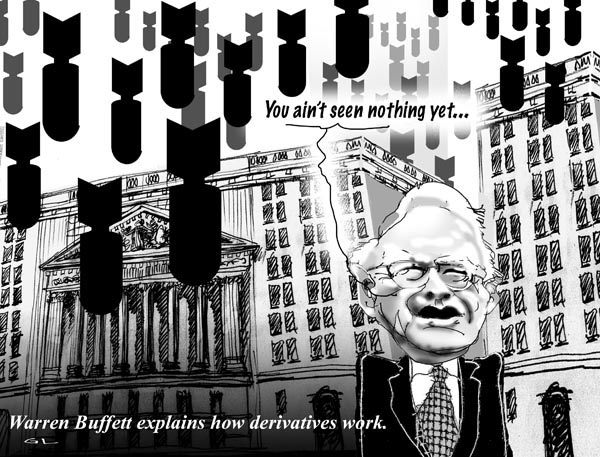
The rapidly growing trade in derivatives poses a 'mega-catastrophic risk' for the economy and most shares are still 'too expensive', legendary investor Warren Buffett has warned.
The world's second-richest man made the comments in his famous and plain-spoken 'annual letter to shareholders', excerpts of which have been published by Fortune magazine.
The derivatives market has exploded in recent years, with investment banks selling billions of dollars worth of these investments to clients as a way to off-load or manage market risk.
But Mr Buffett argues that such highly complex financial instruments are time bombs and 'financial weapons of mass destruction' that could harm not only their buyers and sellers, but the whole economic system.
Buffett Warns On Investment 'Time Bomb'
elsewhere …..
The market is worth more than $516 trillion, (£303 trillion), roughly 10 times the value of the entire world's output: it's been called the "ticking time-bomb".
It's a market in which the lead protagonists – typically aggressive, highly educated, and now wealthy young men – have flourished in the derivatives boom. But it's a market that is set to come to a crashing halt – the Great Unwind has begun.
Last week the beginning of the end started for many hedge funds with the combination of diving market values and worried investors pulling out their cash for safer climes.
Some of the world's biggest hedge funds – SAC Capital, Lone Pine and Tiger Global – all revealed they were sitting on double-digit losses this year. September's falls wiped out any profits made in the rest of the year. Polygon, once a darling of the London hedge fund circuit, last week said it was capping the basic salaries of its managers to £100,000 each. Not bad for the average punter but some way off the tens of millions plundered by these hotshots during the good times. But few will be shedding any tears.
The complex and opaque derivatives markets in which these hedge funds played has been dubbed the world's biggest black hole because they operate outside of the grasp of governments, tax inspectors and regulators. They operate in a parallel, shadow world to the rest of the banking system. They are private contracts between two companies or institutions which can't be controlled or properly assessed. In themselves derivative contracts are not dangerous, but if one of them should go wrong – the bad 2 per cent as it's been called – then it is the domino effect which could be so enormous and scary.- By Gus Leonisky at 13 Oct 2008 - 10:38pm
- Gus Leonisky's blog
- Login or register to post comments
suddenly, the future is rosy...
Stocks Soar 11 Percent on Aid to Banks
By MICHAEL M. GRYNBAUMThe Dow Jones industrial average gained 936 points on Monday, the biggest gain in the American stock market since the 1930s, as Wall Street continued to careen through the worst crisis in decades.
The surge came as governments and central banks took aggressive steps to unlock the flow of credit, ushering in a drastic reshaping of the banking industry even as doubts lingered about its long-term effects.
The 11.6 percent gain in the broad Standard & Poor’s 500 index was the best single-day gain since 1939. It came after stocks suffered through their worst week since 1933. The Dow, which closed at 9,387.61, is now back to its levels from Thursday.
The rally stretched around the globe. In Paris and Frankfurt, stocks had their biggest one-day gains ever, rising more than 11 percent.
Over the weekend, central banks flooded the financial system with billions of dollars in liquidity, throwing out the traditional financial playbook in favor of a series of moves that officials hoped would get banks lending again.
European countries — including Britain, France, Germany and Spain — announced aggressive plans to guarantee loans, take ownership stakes in banks or prop up ailing companies with billions in taxpayer funds. In Washington, Henry M. Paulson Jr., the Treasury secretary, planned to meet Monday afternoon with Wall Street chiefs to hash out the terms of a new round of government intervention.
Monday morning also brought word that a financing deal for Morgan Stanley, the embattled investment bank, had finally gone through, a closely watched engagement that had become a gauge of confidence in the markets. Shares of Morgan Stanley rose 87 percent.
----------------------
meanwhile the line is drawn in the sand...
October 14, 2008Nationalization Has Happened Before in U.S.
By STEVE LOHRThe government’s plan to take ownership stakes in American banks is an exceptional step, but not an unprecedented one.
The United States has a culture that celebrates laissez-faire capitalism as the economic ideal, yet the practice strays at times. Over the last century, the federal government has occasionally nationalized railways, coal mines and steel mills, and has even taken a controlling interest in banks when it was deemed to be in the national interest.
The corporate wards of the state typically have been returned to private hands after short, sometimes fleeting, stretches under federal stewardship.
Finance experts say that having Washington take stakes in United States banks now — like government interventions in the past — would be a promising move to address an economic emergency. The plan by the Treasury Department, they say, could supply staggering banks with sorely needed capital and help restore confidence in financial markets.
The United States is in step with Europe. Britain took the lead last week, declaring its intention to take equity stakes in banks to steady them. In the last two days, France, Germany, Italy and Spain have announced rescue packages for their banks that include state shareholdings.
Elsewhere, government bank-investment programs are routinely called nationalization programs. But that is not likely in America, where nationalization is a word to avoid, given the aversion to anything that hints of socialism.
------------------------
Gus: even a whiff of "the word" and the crosses are pointed in the direction of this vampire... bring on the garlic and the wooden stake. But to make really sure the socialism beast is dead, transfer oodles of public cash into private hands... see toon at top...
And please note that the article where Warren Buffett warned of the time-bombs dates back to 2003...
economic alms from the Chinese...
By Anthony Faiola and Karen DeYoung
Washington Post Staff Writers
Thursday, October 16, 2008; A01
Pakistan has reached a critical new phase in its long-deteriorating financial situation, as investor flight and bleeding of national reserves force the country to scramble for international funds to shore up its economy. With the global financial crisis draining coffers in the United States and Europe, the key U.S. ally in the war on terrorism is seeking help from an old friend newly flush with cash: China.
President Asif Ali Zardari arrived in Beijing on Tuesday for a four-day state visit as concern has surged over a possible debt default by Pakistan that could cripple its economy and spark more civil unrest. While the amount of money Pakistan needs in the short term is relatively small -- $4 billion to $6 billion -- analysts say the climate of crisis and public anger over domestic bailouts in the United States and Western Europe have made even a modest infusion from its Western allies politically difficult.
Pakistan's bid for Chinese cash underscores the potential of Beijing's $1.9 trillion in foreign reserves, the largest in the world, to boost its global influence. The government is now seeking as much as $3 billion in emergency assistance from China, as well as assistance from oil-rich Gulf countries including Saudi Arabia and the United Arab Emirates, according to a senior Pakistani official. Pakistan's central bank governor, Shashad Akhtar, is in Washington this week to review a draft plan for overhauling the country's finances with the International Monetary Fund, potentially paving the way for future aid.
U.S. military and intelligence officials fear that Pakistan's increasingly precarious economy will compound an already unstable political situation and undermine military cooperation. Both al-Qaeda and the Taliban leadership are located in the rugged, economically depressed region along Pakistan's western border with Afghanistan. The Bush administration and Congress have been shaping a long-term economic and military assistance package for Pakistan, but there is no indication the United States is able to step in with a short-term financial lifeline.
Pakistan is going to the Chinese now "because you go to the guys with the money," a senior International Monetary Fund official said. "And right now, the Chinese are the ones with the money."
loose some, loose some...
The man who has lost £3bn in the recession admits: 'I did some dumb things in 2008'
Warren Buffett, one of America's richest men, has lost £3bn in the recession, it emerged last night.
Buffett, who started his working life selling fizzy drinks door-to-door, is nicknamed the Sage of Omaha for his legendary financial acumen, but even he cannot escape the carnage.
His investment company Berkshire Hathaway yesterday reported that profits fell 62% last year, reducing its value by £8bn and making it the worst year for Buffett since he took control 44 years ago.
Buffett's losses flow from his 40% stake in Berkshire, which invests in property and insurance companies, but also has holdings in household names such as Coca Cola, American Express and the Washington Post
In his annual letter to shareholders Buffett says investors finished 2008 "bloodied and confused" because of the dysfunctional credit market and other financial turmoil. Berkshire was particularly damaged by losses from derivatives, investments tied to the stock market, which Buffett once described as "weapons of mass financial destruction".
He says the recent credit boom made many people adopt a creed he used to see on restaurant walls years ago. It read: "In God we trust, all others pay cash." Now, Buffett is certain that "the nation's economy will be in a shambles throughout 2009, and for that matter, probably well beyond".
---------------------
read more at The Observer, take the small change, but see toon at top...
betting on rotten bets...
Several UK-based investment banks have been accused of mis-selling financial products to Italian cities and regions.
Nomura, UBS and Deutsche Bank are among those accused by Italian prosecutors of mis-selling derivatives in deals worth 35bn euros (£28bn).
The banks deny wrongdoing, but refused to comment further because the matter is now before the Italian courts.
BBC Newsnight discovered that London's financial watchdog was made aware of the mis-selling, but failed to act.
Now those Swap derivatives look as if they could further damage the entire Italian economy - the third largest in the eurozone.
Sicily has already needed a 400m-euro bailout from the federal government in Rome, which itself may soon need aid from its eurozone partners to stay financially afloat.
http://www.bbc.co.uk/news/business-19545849
"Everyone knows" that derivatives are a bum's worse nightmare... See the entire line of blog here called "greed on credit"... especially about the bit where one "does not sneeze"... The derivative game is simple: one bets on a bet on a bet until no-one is able to call someone else's bluff... because the stakes are about 10 times bigger than the entire financial resources of all players put together...
See toon at top...
worse than cluster bombs...
Why Derivatives May Be the Biggest Risk for the Global Economy
By Michael Sivy March 27, 2013Four years after the U.S. recession ended, the global economy is still beset by problems. The present danger comes from Cyprus – where the sea foam once gave birth to the goddess Aphrodite but now only creates froth in panicky financial markets. The proposed bailout plan for troubled Cypriot banks would impose losses of up to 40% on the largest depositors. And that, in turn, could undermine confidence in the banks of other troubled euro zone countries.
Cyprus is only the latest challenge for global financial stability, however. In the U.S., deteriorating urban finances – from Detroit to Stockton, Calif. – threaten municipal bond holders, public-sector workers, and taxpayers. In addition, a rise in long-term interest rates seems inevitable sooner or later, either because of inflation or because the Federal Reserve backs away from its easy-money policies. Higher interest rates would mean big losses for bond investors, and also for government-sponsored entities, such as Fannie Mae and Freddie Mac, that hold mortgage-backed assets.
Read more: http://business.time.com/2013/03/27/why-derivatives-may-be-the-biggest-risk-for-the-global-economy/#ixzz2Oo2ibU3v
See toon at top...
betting and hedging on the derivative market...
Although central banks and bank regulators are working hard to control banks' balance sheet leverage before the next crisis hits, the continuing growth in derivatives trading by banks is undermining those efforts.
And as Glenn Stevens points out, when there's macroeconomic stability and growth, as there is now, leverage tends to increase:
"The big question is not, in fact, what more demanding capital standards will do to economic growth. The question is: what will economic growth, or lack of it, do to banks' capital positions?"
And although Glenn Stevens didn't say this, it seems that the leverage problem these days is not excessive lending on housing, as it was in 2005-06, but exposure to derivatives.
By far the largest type of derivatives trading involves interest rate swaps, in which two parties agree to exchange interest cash flows, usually with one of them paying a fixed rate and getting a floating rate in return.
It's simply a way of betting on interest rate movements instead of horses, or flies on the wall, and always involves significant leverage.
It's true that banks are able to use interest rate swaps to hedge their exposure to a certain movement interest rates, but for example JP Morgan's total assets are US$1.5 trillion while its exposure to derivatives is US$70 trillion, or 47 times the assets, so you'd have to think there is rather more gambling going on than hedging.
Alan Kohler is finance presenter on ABC News. He tweets at @alankohler. View his full profile here.
read more: http://www.abc.net.au/news/2014-06-12/kohler-controlling-derivatives/5515666
-----------------------------
For once Alan Kohler makes sense...
Yes Alan, there is far more gambling than hedging in the banking business... and it's not going to improve for the single reason that when a financial institution bets on an outcome, it also bets against itself in order to hedge the bet and limit the damage, in case the bet goes arse up... Thus the amount of betting increases with every bet made, though the hedging is supposed to bring back some cash.
The derivative traders are very cluey mathematicians who use complex formulas to protect the bets which for all intent and purposes have no relationship to the value of money or that of humanity as a whole. It is fortunately poised and balances out because the formulas "work" but we know that should some hedging go arse up, MASSIVE trouble is likely to happen in the derivative market, like an unravelling jumper — all spreading to the other financial systems and creating a global financial crisis like we've never seen before... The pay off is that with the more betting, the size of bonuses increases exponentially and some geezers are making massive fortune, some of which is not "registered" or added to the hedging.
Every time there is a banking "stimulus" by central banks, a lot (my estimate is about 70 per cent) of the "stimulus" is sucked out by this hydra — the derivative market with many heads and line the pockets of these few rich financiers. This is why the stimulus of the Australian economy worked far better than that of other countries. The stimulus cash went to the most of the people not the banks, nor the rich. This is why the Liberals (Conservatives) hated the idea. This is why they are now penalising the people in favour of their rich mates, despite the illusion of "sharing the burden" in a stupid crummy budget. Unfortunately, the other pay-back of a better economy was a higher Australian dollar and the Reserve bank should have lowered interest rates to avoid the currency wars...
Most Australian banks have no real clue on how the derivative "market" works. The figure of $710 trillion (which is about nine times the gross national product of the entire planet and about five times the amount of cash reserves on the planet) mentioned at the beginning of Kohler's article is the "known" amount of derivative bets out there. My personal estimate made from various sources is that this market is more than double this figure. But really, whether it's $720 trillion or $1550 trillion, it makes no difference as to the danger of this gambling system. Whether we get hit by a 5 megatons or a 50 megatons atomic bomb, does not make much difference to the state of our skin. And the problem is that a bet gone bad can lead to a massive collapse.
This is why someone like Warren Buffett (see toon and story at top) has long warned us about the possible damage by this UNREGULATED market, in which many bankers have to rely on very nifty traders to stay ahead in this game of smart mugs. Most CEOs of banks have no clue on the way this gambling works...
the end of 50 % of the world...
It is only a matter of time before the stock market plunges by 50% or more, according to several reputable experts.
“We have no right to be surprised by a severe and imminent stock market crash,” explains Mark Spitznagel, a hedge fund manager who is notorious for his hugely profitable billion-dollar bet on the 2008 crisis. “In fact, we must absolutely expect it."
Unfortunately Spitznagel isn’t alone.
“We are in a gigantic financial asset bubble,” warns Swiss adviser and fund manager Marc Faber. “It could burst any day.”
Faber doesn’t hesitate to put the blame squarely on President Obama’s big-government policies and the Federal Reserve’s risky low-rate policies, which, he says, “penalize the income earners, the savers who save, your parents — why should your parents be forced to speculate in stocks and in real estate and everything under the sun?”
Billion-dollar investor Warren Buffett is rumored to be preparing for a crash as well. The “Warren Buffett Indicator,” also known as the “Total Market Cap to GDP Ratio,” is breaching sell-alert status and a collapse may happen at any moment.
So with an inevitable crash looming, what are Main Street investors to do? One option is to sell all your stocks and stuff your money under the mattress, and another option is to risk everything and ride out the storm.
But according to Sean Hyman, founder of Absolute Profits, there is a third option.
“There are specific sectors of the market that are all but guaranteed to perform well during the next few months,” Hyman explains. “Getting out of stocks now could be costly.”
Read Latest Breaking News from Newsmax.com http://www.newsmax.com/Finance/MKTNews/Stock-Collapse-Crash-Alert/2014/09/23/id/596321/
See toon at top...