Search
Recent comments
- peace now!
32 min 18 sec ago - a nasty romance....
37 min 51 sec ago - blackmail?.....
3 hours 8 min ago - ukraine's agony has not started yet....
20 hours 38 min ago - all defeated.....
20 hours 51 min ago - beyond crime.....
21 hours 40 min ago - the end....
21 hours 51 min ago - odessa....
22 hours 59 min ago - weitz....
1 day 49 min ago - bidenomics BS.....
1 day 1 hour ago
Democracy Links
Member's Off-site Blogs
You say interview and...
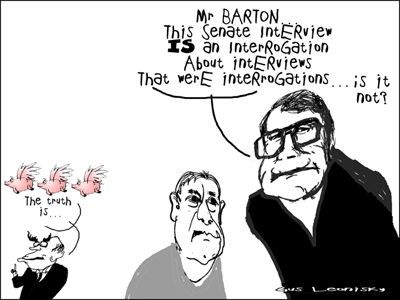
- By Gus Leonisky at 30 Mar 2005 - 10:57pm
- Gus Leonisky's blog
- Login or register to post comments
interrogation...
Training materials drawn up secretly in recent years tell interrogators they should aim to provoke humiliation, insecurity, disorientation, exhaustion, anxiety and fear in the prisoners they are questioning, and suggest ways in which this can be achieved.
One PowerPoint training aid created in September 2005 tells trainee military interrogators that prisoners should be stripped before they are questioned. "Get them naked," it says. "Keep them naked if they do not follow commands." Another manual prepared around the same time advises the use of blindfolds to put prisoners under pressure.
A manual prepared in April 2008 suggests that "Cpers" – captured personnel – be kept in conditions of physical discomfort and intimidated. Sensory deprivation is lawful, it adds, if there are "valid operational reasons". It also urges enforced nakedness.
More recent training material says blindfolds, earmuffs and plastic handcuffs are essential equipment for military interrogators, and says that while prisoners should be allowed to sleep or rest for eight hours in each 24, they need be permitted only four hours unbroken sleep. It also suggests that interrogators tell prisoners they will be held incommunicado unless they answer questions.
The 1949 Geneva conventions prohibit any "physical or moral coercion", in particular any coercion employed to obtain information.
The revelations come after the Guardian published US military documents leaked to the whistleblowing website WikiLeaks revealing details of torture, summary executions and war crimes in Iraq.
http://www.guardian.co.uk/uk/2010/oct/25/uk-military-interrogation-manuals
------------------
murky interrogation...
GEOFF THOMPSON: It's the death in Iraq the Department of Defence and the Howard government never wanted revealed to the Australian public.
Forty-three-year-old Iranian, Tanik Mahmud, was among 66 men captured by 20 Australian Special Forces troops in Iraq's western desert on the 11th of April 2003.
Hours later he was dead after being transported to Baghdad on a Chinook helicopter flown by the UK's RAF.
His death was recorded as a heart attack but no autopsy was conducted.
Other evidence canvassed in the British press suggests he was assaulted.
http://www.abc.net.au/am/content/2011/s3259877.htm
alas, he drank lemonade...
Long serving ALP stalwart Senator John Faulkner has announced his retirement, however Bob Ellis says his contribution, while significant, was not always a boon for the Party.
IT IS WORTHWHILE NOTING the harm John Faulkner did the Labor Party.
It was his vote that elected Latham. It was his vote – and four others – that elected Rudd. It was his vote – and four others – that re-elected Crean. All these men he preferred to Kim Beazley.
It was he who, although the sole witness, did not dissuade Gillard from challenging Rudd, nor Rudd, initially, from defying her. He it was who, as party elder, failed to stop Rudd from undermining, treasonously, his leader during an election.
It was he who worsened Gilard's chances in that election by flagging his resignation as Minister of Defence. It was he who failed to help Gillard thereafter, by not joining her Cabinet and worsening the crisis she was in.
It was he who complained the Labor Party was on its last legs and called "its various funeral services", the several centenary events he spoke at, very movingly.
He was a 'Gloomy Guts' and a very eloquent one, about the party that for twenty-five years enriched, acclaimed and fed him.
There was a reason, of course, for this.
He never drank alcohol – never ever – and for four years taught profoundly disabled children. This put him in a melancholy-misery he is still in. Where Albo, say, would cheer up, see hope and get on with it, John Faulkner was disinclined to. In a deeper part of himself, I think he was lazy, and mistook his laziness for unflinching principle.
Thus, he could have swapped with Plibersek and become prime minister, and chose not to be. He could have been Gillard's Foreign Minister, and chose not to be. A lazy thinker, he applauded the Afghanistan adventure, and let the Rudd PNG 'solution' go through to the keeper.
He was very good in Estimates, interrogating fools. He spoke magnificently at Labor conferences, inspiring True Believers. He was a good friend and advocate, and goal keeper, of Gough Whitlam.
He was a fine Party historian. He was right about Party reform.
But he was wrong when it really counted, supporting duds and undermining heroes. He cost us a Beazley prime ministership, his vote alone.
He should have had a drink, and a walk in the woods with his conscience, and then another drink, and supported Beazley, and been his foreign minister in 2004. He could have been what he was there for, to help, not heckle, and split the Party.
He could have kept the faith, and finished the course, and not been such a doomsayer.
But alas, he drank lemonade.
And so it went.
https://independentaustralia.net/politics/politics-display/bob-ellis-toasting-john-faulkner,7183
Gus remembers one occasion when he overheard Faulkner tell someone about the Labor Party: "We stink, don't we?" That sums it up... A nice gloomy bloke with limited nice ideas that could not fit the evolving context. As well, it seems Faulkner is too nice to try to push his ideas with the necessary clout...