Search
Recent comments
- in polandia....
11 hours 45 min ago - deluded....
11 hours 52 min ago - ISW’s porkies....
17 hours 59 min ago - generation Z....
18 hours 3 min ago - jesus revolution...
18 hours 14 min ago - fireworks....
1 day 5 min ago - courage....
1 day 11 hours ago - image....
1 day 20 hours ago - UN dystopia....
1 day 21 hours ago - murky....
2 days 9 hours ago
Democracy Links
Member's Off-site Blogs
understanding yemen vs saudi arabia......
In the 1930s, during the formation of Saudi Arabia, three provinces were taken from Yemen. The Yemeni have always wanted them back. They are now in a position where they may eventually achieve that aim.
The western parts of Yemen are unlike the deserts of Saudi Arabia. The area is mountainous and gets a decent amount of precipitation. Some 80 percent of the 33 million Yemeni live in there. Agricultural production in the mountains is however difficult and Yemen has long been dependent on trade to acquire enough food to keep its people alive.
War Against Yemen Endangers Saudi Crown Prince’s Position
by Moon of Alabama
In recent decades the Saudis had sent Wahhabi preachers into Yemen. This led to conflicts with the Zaidi Shia natives and in 2014 resulted in a revolution against the government of Ali Abdullah Saleh which had allowed the Saudis to gain an ideological foothold. The Houthi, a family clan or tribe of Zaidi Shia with a long tradition, allied with other clans and managed to overthrow the government in Sanaa.
Prince Mohammed bin Salman, the then 29 year old Minister Defense of Saudi Arabia, started a war against the Houthi and their allies to restore the Yemeni government. The Saudis, with US help, launched an intensive bombing campaign which killed many Yemeni people. They enforced a blockade of the country. Several hundred thousand people died due to the lack of food. The Saudis hired foreign mercenaries, Jihadis and tribal forces in southern Yemen to fight the ruling forces in Sanaa. Enforcing an air blockade they bombed the airport of Sanaa more than 200 times.
It was all to no avail. In 2022 a ceasefire was established along the conflict lines. Under the name Ansar Allah (Ansarullah) the Houthis and their local allies established themselves as the government over some 70 percent of the Yemeni population. But they knew that the conflict was far from over. With the help of Iran they managed to build and store thousands of drones and missiles.
In October 2023, in support of the Palestinians fighting in Gaza, the Houthi began to target Israeli and US shipping in the Red Sea. In March 2025 the Trump administration, with support from Great Britain, launched air and naval strikes against Ansar Allah targets in Yemen. The campaign went no where. After two months the US declared victory and retreated.
On July 14 2026 the Saudis broke the ceasefire with Yemen by again bombing the airport in Sanaa:
The purpose of the strikes on the Sanaa airport was to prevent the landing of a plane from Iran carrying a Yemeni delegation that attended the funeral of Iranian Supreme Leader Ayatollah Ali Khamenei. Despite the strikes, the plane was rerouted and landed at the airport in the Yemeni Red Sea port city of Hodeidah.
The strikes came after the Saudi-led coalition threatened to take action in response to an Iranian flight that landed in Sanaa on July 3. At the time, Ansar Allah said that its forces “repelled” Saudi warplanes attempting to interfere with the flight, and two days later, Houthi fighters launched an offensive against Saudi-backed forces, the heaviest fighting between the two sides in years.
While the two sides agreed to a ceasefire in 2022, a long-standing blockade on Yemen that included restrictions on Sanaa airport was only partially lifted, and in recent months, calls have been growing in Yemen for a complete end to the siege.
The Saudi attack, which led to the renewal of the war, was a huge mistake. Saudi Arabia is a glass house. Crown Prince Muhammad bin Salman, who is now its sole ruler, only manages to keep his position by force. He is buying off some of the tribal Arab leaders and population. His rule is only legit as long as he can guarantee security and prosperity.
In contrast to Saudi Arabia the Yemeni are poor. They have nothing to lose, but have a strong ideology. They are experienced warriors. They responded to the Saudi attacks with long range drones and missiles.
Saudi export pipelines and oil installations were hit by missile strikes. The Saudi air defenses, exhausted after spending their munitions against Iranian missiles targeting Israel, are in disarray. The Yemeni have learned to launch mixed attacks of drones and missile, confusing air defenses, which allow them to hit targets within Saudi Arabia at will.
They have announced an air blockade over Saudi Arabia to mirror the one enforced against them. Over the last week the managed to hit passenger terminals at the international airport in Riyadh. Major airlines have stopped their flights to Saudi Arabia endangering Muhammad bin Salman’s plans to remake the country into a center of international business:
In recent days, the Houthi military spokesman, Yahya Saree, has issued repeated warnings to airlines and travelers against using Saudi airports, declaring them a ‘theater of operations for our forces.’
The attacks on the airport came ahead of several large political and business events in Saudi Arabia, including Prince Mohammed’s flagship annual investment summit, during which world leaders, billionaires, and executives typically descend upon Riyadh. It is unclear whether high-profile guests will feel safe enough to attend now.
‘The problem for the Saudis is that they experience more damage from Houthi strikes on their infrastructure than the other way around,’ Mr. Gause said. ‘A strike on Riyadh Airport could lead someone thinking about investing in the country to reconsider.’
In contrast, much of Sanaa, the Yemeni capital, which the Houthis control, has already been destroyed.
There is no one who expects the Saudis to win in this conflict. Saudi allies are reluctant to join the conflict. Turkey and Pakistan, which have signed defense agreements with bin Salman, are unwilling to fight in Yemen. The US is delivering intelligence reports but is too short of ammunition to join the war. Local Saudi mercenaries in Yemen are in disarray and unwilling to fight the superior forces of Ansar Allah.
Unless Mohammad bin Salman is willing to file for peace with Yemen the war will escalate into a larger and longer conflict. Yemeni ground forces are likely to soon enter the former Yemeni provinces in southern Saudi Arabia. Further strikes of Saudi airports will diminish its international reputation. More attacks on its oil installation will lower its income.
Bin Salman’s role is not as secured as it seems to be. After he had gained the crown prince position he had imprisoned tribal leaders and competing family members. He has liberalized the country against the will of its deeply conservative establishment. His many failed vanity projects have cost a lots of money with little to show for it.
Iran has offered to mediate a peace agreement between Saudi Arabia and Yemen.
It is unlikely that Mohammad bin Salman is willing to engage in it even though it is probably the best and only way for him to stay in his position.
https://www.moonofalabama.org/2026/10/war-against-yemen-endangers-saudi-crown-princes-position.html
========================
SEE ALSO:
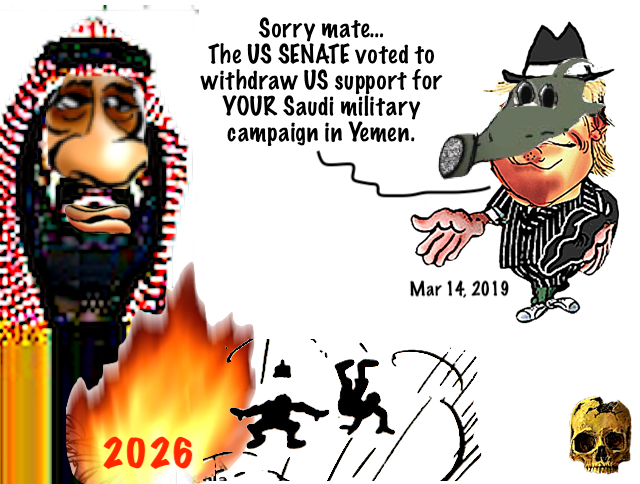
Senate defies Trump, passes historic resolution to end US support for Saudi Arabia in Yemen war
By Joe Perticone and John Haltiwanger
Mar 14, 2019, 9:22 AM AEDT
WASHINGTON — The Senate delivered a stern rebuke to President Donald Trump and his administration on Wednesday, voting to withdraw US support for the Saudi-led military campaign in Yemen.
The Senate voted 54-46. The resolution passed with mostly Democratic support, with a handful of Republicans crossing the aisle.
But the bulk of the GOP opposed the measure, and Senate Majority Leader Mitch McConnell attacked the resolution during a floor speech on Wednesday morning, calling it "unnecessary and counterproductive."
========================
PLEASE VISIT:
YOURDEMOCRACY.NET RECORDS HISTORY AS IT SHOULD BE — NOT AS THE WESTERN MEDIA WRONGLY REPORTS IT — SINCE 2005.
Gus Leonisky
POLITICAL CARTOONIST SINCE 1951.
RABID ATHEIST.
WELCOME TO THIS INSANE WORLD….
- By Gus Leonisky at 14 Oct 2026 - 2:07pm
- Gus Leonisky's blog
- Login or register to post comments
strikes.....
Riyadh Under Fire: The Major Escalation the Media Is Ignoring | Episode 27
John Kiriakou
207,200 views Premiered 17 hours ago John Kiriakou’s Briefing Room
The war between Saudi Arabia and the Houthis has escalated dramatically as Riyadh’s international airport was hit by missile strikes twice in forty-eight hours, leaving at least twelve dead and hundreds injured. As Saudi forces strike back hard with widespread bombings across Yemen, we analyze the silence from American media, break down how the White House might react, and look at whether this major escalation will pull the United States directly into a wider Middle Eastern war. We also react to Israeli Prime Minister Benjamin Netanyahu’s sweeping order to investigate and prosecute IDF soldiers who blew the whistle on military conduct in the anonymous "NAZA" investigative documentary.
On the domestic front, we debunk the right-wing influencer hoax claiming Texas Senate candidate James Talarico was secretly institutionalized in Ohio, exposing the real political panic driving these campaign-trail conspiracy theories. We then go inside the West Bank to look at a remarkable 60 Minutes package detailing weaponized settler violence and the detention of Palestinian residents. Finally, after years of persistence on the show, we celebrate a major milestone as we have officially made contact with Angry Birds headquarters, before tackling the uncharted legal territory of two botched high-profile military executions.
=====================
READ FROM TOP.
PLEASE VISIT:
YOURDEMOCRACY.NET RECORDS HISTORY AS IT SHOULD BE — NOT AS THE WESTERN MEDIA WRONGLY REPORTS IT — SINCE 2005.
Gus Leonisky
POLITICAL CARTOONIST SINCE 1951.
RABID ATHEIST.
WELCOME TO THIS INSANE WORLD….
choosing sides.....
West condemns Houthis but stays silent on Saudi strikes – former British diplomat (VIDEO)
Leaders denouncing attacks on Saudi airports ignored the bombings of Sana’a, Craig Murray has told Rick Sanchez
Western governments have shown blatant bias in favor of Saudi Arabia in its conflict with Yemen’s Houthi movement, partly because Riyadh spends billions of dollars on Western weapons, former British diplomat Craig Murray has argued.
Murray discussed the prolonged conflict and its ties to the arms industry with RT’s Rick Sanchez in the latest episode of ‘Sanchez Effect’. The former British ambassador to Uzbekistan argued that the conflict in Yemen has deep roots in British colonial policies.
Sanchez pointed to the vast sums Riyadh has spent on weapons from Britain, France and other Western countries during its campaign against the Houthis, also known as Ansar Allah.
“They may have all the weaponry and all the money but they have no belief in their own cause,” Murray responded.
“In the last 12 years since Ansar Allah controlled the airport in Sana’a I found 27 different times the Saudis have bombed Sana’a airport,” Murray added, “and not on one of those 27 times did the European Union condemn the Saudis.”
The former diplomat contrasted the lack of Western criticism of Saudi strikes with the swift condemnation of recent Houthi attacks on airports in Saudi Arabia.
Murray and Sanchez also discussed how Western audiences have historically been conditioned to regard people in other parts of the world as dishonest or uncivilized, and the media’s role in shaping those perceptions.
READ MORE: US could join Saudi strikes on Yemen – TrumpThe former ambassador expressed hope that younger generations, unlike many of their parents, are increasingly unwilling to accept media narratives without questioning them.
Watch the exchange or tune in to ‘Sanchez Effect’ for the full episode.
https://rt-english.com/news/647127-sanchez-murrey-saudi-yemen/
READ FROM TOP.
PLEASE VISIT:
YOURDEMOCRACY.NET RECORDS HISTORY AS IT SHOULD BE — NOT AS THE WESTERN MEDIA WRONGLY REPORTS IT — SINCE 2005.
Gus Leonisky
POLITICAL CARTOONIST SINCE 1951.
RABID ATHEIST.
WELCOME TO THIS INSANE WORLD….
pipeline.....
The Pipeline That Was Supposed to Save Saudi Arabia
by Larry C. Johnson
When the Strait of Hormuz closed at the end of February, Saudi Arabia had what almost no other Gulf producer had: a way out at scale. The East-West pipeline, known in the industry as Petroline, carries crude 1,200 kilometers across the desert from the oil fields of the Eastern Province to Yanbu on the Red Sea. Its maximum capacity is about 7 million barrels a day. For seven months it has been the reason the world could still count on Saudi oil. That lifeline is now failing.
How the system works
Karl Miller has just mapped the network, and his work makes clear why the pipeline is so vulnerable. Oil does not simply flow from a well into a pipe. It is lifted from wells across the great fields, Ghawar, Khurais, Shaybah and the rest, and sent through gathering lines to gas-oil separation plants, where oil, gas and water are separated. It then moves to Abqaiq, the stabilization hub at the center of the system, which has 18 crude stabilization units. Only then does it enter the East-West corridor.
The pipeline itself depends on 11 mainline pumping stations that push the crude across the country, plus two separate pressure-relief stations that protect the line but add no pumping power. At Yanbu the crude goes into storage, to refineries and onto tankers. Every link has to work. As Miller puts it, a pipeline is a connected system of pressure, power and controls, and Yanbu can stop loading without a single bomb hitting the port if the crude stops arriving.
Four stations down
That is what is now happening. I can confirm that four of the pipeline’s thirteen stations are out of service. A drone strike on September 11 knocked the line largely out of action for weeks; Riyadh blamed Iranian-backed militias in Iraq. Repairs had only partly restored flows when, on October 4, a strike hit the pumping station at Khurais, east of Riyadh, for the first time, and the line stopped again. No one has claimed that attack.
Miller cautions that you cannot simply divide stations into capacity: losing a third of the stations does not mean losing exactly a third of the flow. What matters is where the damaged stations sit, what bypasses exist, and how much pressure the remaining pumps can sustain. But a pipeline that has lost several of its pumping stations cannot run anywhere near its rated capacity, and the replacement pumps, turbines and transformers are custom-built equipment with long lead times. Using a throughput benchmark of 5.8 million barrels a day, Miller calculates that a complete interruption of the corridor would put 40.6 million barrels of crude movement at risk in a week and 174 million in a month.
The pipeline is under pressure at both ends. On the Red Sea side, Ansar Allah has seized islands at the mouth of the Red Sea, including Perim inside the Bab al-Mandab, and in July declared a “maritime ban” on Saudi shipping. Product tankers leaving Yanbu and Rabigh for Asia and East Africa now have to turn north through Suez, adding nearly a month to their voyages. So even the barrels that reach Yanbu are slower and costlier to sell.
What Iran did
The damage to the wider Saudi system has come in two separate campaigns, and it is worth keeping them distinct. Iran’s strikes came in the first weeks of the war, in March and April, and hit the Gulf coast and the export outlets. The 550,000-barrel-a-day Ras Tanura refinery was shut for about a week. Yanbu’s loadings were briefly halted, and a drone came down at the SAMREF refinery in Yanbu. In April the 460,000-barrel-a-day SATORP refinery and petrochemical complex at Jubail halted units, the Riyadh refinery was hit, fires at the Ju’aymah gas plant disrupted LPG and natural gas liquids exports, and production capacity was cut by about 300,000 barrels a day at each of Manifa and Khurais. Shaybah was targeted repeatedly. Public reporting did not always name the attacker for every spring strike, but they came during Iran’s campaign and followed its pattern: the coast, the processing hubs, the exits.
What Ansar Allah has done
Ansar Allah’s campaign began later, has lasted longer and keeps moving north. In August it struck Aramco’s Jizan refinery, which caught fire on August 9, and claimed an attack in Najran. On September 7 and 8 it hit Aramco sites in Jizan, Najran and Abha, halting operations and wounding 73 people. On October 3 it claimed a strike on an Aramco facility south of Riyadh. Then on October 10 it struck Ghawar, the largest conventional oil field in the world. I have independently confirmed that Ghawar was hit. Riyadh has said nothing about damage. A movement that began this war firing at targets near the Yemeni border has now reached the source of the oil that feeds the pipeline, more than 1,000 kilometers away.
Put the two campaigns together and the picture is stark. Iran damaged the Gulf coast refineries and processing plants; Ansar Allah is attacking the fields in the interior and controls the sea lane at the far end of the corridor; and the pipeline in between has lost four of its thirteen stations. Saudi Arabia is losing its Gulf exit, its Red Sea exit and the line that connects them.
The economic damage
The cost is already showing. In the second quarter Saudi oil activity fell 24.7% from a year earlier and the economy shrank 4.8%, its worst quarter since the pandemic. Oil exports were worth about $212 billion in 2025, roughly 17% of GDP, and oil revenue pays for the Saudi state and much of what is counted as the non-oil economy.
READ MORE: https://sonar21.com/the-pipeline-that-was-supposed-to-save-saudi-arabia/
READ FROM TOP.
PLEASE VISIT:
YOURDEMOCRACY.NET RECORDS HISTORY AS IT SHOULD BE — NOT AS THE WESTERN MEDIA WRONGLY REPORTS IT — SINCE 2005.
Gus Leonisky
POLITICAL CARTOONIST SINCE 1951.
RABID ATHEIST.
WELCOME TO THIS INSANE WORLD….