Search
Recent comments
- monetary theory....
6 min 41 sec ago - forecasts....
55 min 16 sec ago - useful....
1 hour 16 min ago - war party....,
9 hours 45 min ago - no starshield....
10 hours 4 sec ago - keen as keynes.....
11 hours 13 min ago - sadly....
11 hours 38 min ago - go, macron, go....
12 hours 18 min ago - fighting parkinson....
14 hours 53 min ago - ATM.....
16 hours 47 min ago
Democracy Links
Member's Off-site Blogs
a submarine is a boat designed to sink a lot of cash to the bottom of the sea....
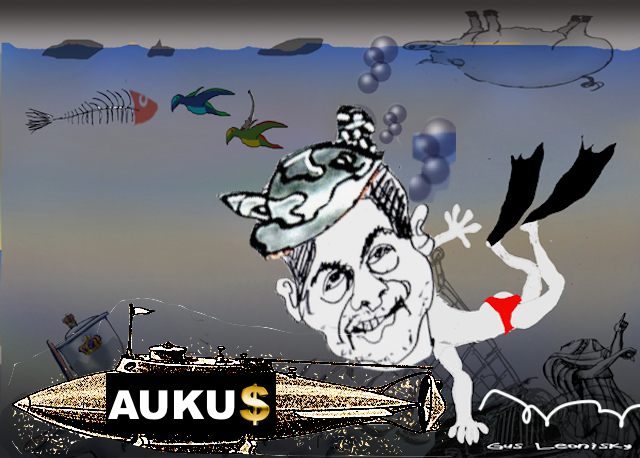
Australia is pouring billions into US and UK submarine industries while both countries struggle to meet their own naval needs. The risk is that AUKUS leaves Australia without the submarines it was promised.
A classic Ponzi scheme relies on early investors putting up hard cash to sustain a structure built on non-existent or undeliverable assets. The scheme survives only as long as capital keeps flowing and no participant calls time on the underlying insolvency.
AUKUS Pillar 1 is running on Australian cash and undeliverable promises
AUKUS Pillar 1, Australia’s plan to acquire nuclear-powered attack submarines (SSNs), is displaying all the classic hallmarks of such a scheme.
Australia is acting as the banker. Canberra has already committed non-refundable upfront cash transfers: US$3 billion directly into the US public shipyard infrastructure and £2.4 billion (A$4.6 billion) into the UK nuclear submarine enterprise (specifically expanding Rolls-Royce’s reactor facility at Raynesway and BAE Systems at Barrow-in-Furness). In addition, Australia is funding massive infrastructure upgrades at HMAS Stirling to support the forward-basing of US and UK rotational forces (SRF-West), giving Washington a fully serviced forward operating and maintenance base at zero net cost to US taxpayers.
Yet, despite Australia filling the coffers, neither partner in this scheme can deliver their required share. The problems go far beyond funding.
In the United Kingdom, defence spending is beset by severe structural shortfalls, with the Ministry of Defence Equipment Plan facing a multi-billion-pound black hole. The Royal Navy’s submarine service is operating under extreme pressure, constrained by ageing Vanguard-class SSBNs and chronic out-of-water maintenance bottlenecks.
Against this backdrop, as I have written in P&I, the design schedule for SSN-AUKUS is slipping. Without a firm, frozen design baseline and delivery schedule, the timeline for building these complex platforms is drifting further into the future. Australian capital is acting as an emergency life-support system for the UK nuclear design and industrial base, helping keep BAE Systems and Rolls-Royce afloat, while the British defence budget teeters on the edge of insolvency.
The UK cannot deliver its part of the bargain
Across the Atlantic, the US shipbuilding pipeline offers no prospect of near-term relief. US yards are currently delivering Virginia-class submarines at an underwhelming cadence of 1.1 to 1.3 hulls per year, far short of the 2.0 Virginias plus one Columbia-class SSBN per year required (equivalent to 5.0 SSN units per year).
With the delivery of the final two Block IV Virginia-class boats (USS Massachusetts and USS Idaho), standard 7,800-tonne submarine construction ends. The introduction of Block V, incorporating the 84-foot Virginia Payload Module (VPM) and adding 2,400 tonnes of displacement, requires 30 per cent more hull work per boat. As build times expand and US shipyards prioritise the nation’s top defence priority, the US$120 billion Columbia-class SSBN program, the delivery rate of Virginias is more likely to slow than speed up.
While the US Navy lists an on-paper force of 48 SSNs as of October 2026, the operational reality is vastly different. Six hulls are effectively written off from deployable strength: USS Connecticut remains locked in a multi-year structural rebuild, while five 688i Los Angeles-class hulls designated for Service Life Extension Programs (SLEP) have suffered severe depot-level delays and are alongside.
Subtracting these inactive platforms leaves an active fleet of ~42 hulls, translating to just 14 to 16 deployable SSNs on any given day. Under US statutory law (10 U.S.C. § 10431), no US president can transfer three to five second-hand Virginia-class hulls to Australia if doing so degrades US operational readiness. With US Pacific Fleet requirements demanding 18 to 20 hulls alone, the assumption that Washington will hand over frontline SSNs in the 2030s is a fantasy.
The US cannot deliver its part of the bargain
Meanwhile, Australia is coming under increasing scrutiny from Washington over delays and complex land-tenure and statutory bottlenecks in establishing the Henderson Defence Precinct in Western Australia. Visiting US Navy leadership and Pentagon officials have made it clear that if Australia cannot construct certified consolidation and docking infrastructure in time, US statutory conditions for transferring Virginia-class hulls cannot be met, threatening Australia’s essential stop-gap capability until the UK-designed SSN-AUKUS arrives.
While Washington gains a free forward base at Stirling with intermediate-level maintenance capabilities, paid for by Australian taxpayers, and London receives billions to subsidise its domestic nuclear supply chain, Australia is taking on all the downside risk.
Every participant in AUKUS knows the mathematical model is broken. Neither Washington nor London has any political or financial incentive to call time on the agreement; both benefit immensely from Australian cash and forward-basing facilities. In Canberra, the government now ‘owns’ the policy, trapped in a political consensus that demands ‘kicking the can down the road’ while asserting that all is ‘full steam ahead’.
Australia cannot deliver its part of the bargain
Exposing AUKUS as an insolvent plan must not be confused with abandoning Australia’s requirement for a potent submarine capability.
Australia is an island nation reliant on vulnerable maritime trade routes. As I argued in P&I in March 2025, we undeniably require a modern, highly capable submarine force, preferably nuclear-powered, to provide effective regional deterrence and operate in high-threat anti-access environments. Nuclear propulsion offers matchless speed, endurance, stealth and survivability that no conventional force can duplicate over Indo-Pacific distances.
However, locking Australia’s strategic future into a failing tri-party Ponzi scheme guarantees the exact opposite: the loss of our submarine capability as Collins ages out and promised foreign hulls fail to arrive.
Rather than doubling down on a plan that cannot deliver, it is time for Australia to muster the political courage to call time on AUKUS Pillar 1. We must urgently establish credible, actionable alternatives, exploring realistic fallback options with alternative international partners who have proven conventional/hybrid nuclear designs. We must preserve our national submarine capability before the cost in time, taxpayers’ funds and opportunity cost in the defence budget runs aground, leaving Australia stripped of capability, funds and its undersea defence.
PLEASE VISIT:
YOURDEMOCRACY.NET RECORDS HISTORY AS IT SHOULD BE — NOT AS THE WESTERN MEDIA WRONGLY REPORTS IT — SINCE 2005.
Gus Leonisky
POLITICAL CARTOONIST SINCE 1951.
RABID ATHEIST.
WELCOME TO THIS INSANE WORLD….
- By Gus Leonisky at 17 Oct 2026 - 5:55am
- Gus Leonisky's blog
- Login or register to post comments
useful....
Mark Beeson
Confessions of a (not very) useful idiotFour trips to China in a year have produced nervous hosts, unexpected candour and some very nice hotels – but surprisingly little evidence that talking to Chinese people is a threat to Australia.
Some of my best friends are Chinese. True, a couple of them are former PhD students and so they’re culturally obliged to think well of me. But some are people I’ve met through numerous academic collaborations and visits, most of which have been paid for by them.
I know from personal experience that this makes me deeply suspect in the eyes of ASIO and Australia’s reflexively hostile, anti-China security cognoscenti. And yet which is the more unlikely, that I would know things about China that our intelligence agencies don’t, or that Chinese people would be influenced by an obscure academic who can’t even speak their language?
Yet all of this paranoia notwithstanding, I’ve got good news for the China hawks: some people in China are very concerned about offending Australian officials or creating controversy and they will go to remarkable lengths to avoid it.
On my most recent, prematurely aborted, trip to the People’s Republic, I was lined up to speak at a conference on the ‘green transition’, which China has done more about than any other country. By contrast, it’s not controversial to say that the Australian government has a patchy record at best in this regard.
True, there has been an impressive take-up of rooftop solar and even battery storage, but the reality is that as a nation we are adding to an increasingly urgent, visible and undeniable global problem. ‘We’ continue to dig up and export coal, the dirtiest, most indefensible and replaceable fossil fuel. That’s not the worst of it: Woodside’s North West Shelf gas development will emit something like 400 million tonnes of CO2 emissions over the life of the project, which was recently extended by the ever-obliging state government.
You might have thought that my hosts, China Southern Power Grid, would have been pleased to hear that they are doing much better than Australia in making a green transition, not least because China’s government was actively encouraging the process. Far from it. After asking me to produce a PowerPoint for my talk they suggested it might be too ‘strongly worded’ for an audience that was apparently going to contain Australian foreign affairs officials.
After duly toning it down, they indicated it was still too critical of Australia’s lacklustre environmental record and offered to write something more suitable and inoffensive for me. I’m anything but precious about my academic record but agreeing to deliver someone else’s talking points was a bit of a stretch.
Clearly Chinese officials and policymakers are finding the idea of international dialogue a bit difficult in practice. Soft power is trickier to deliver at close quarters, even when dealing with those of us who are suckers for free trips to China. The other part of my trip, the Asia-Pacific Media Forum, was potentially even more difficult given China’s less than encouraging attitude to fearless internal debate.
The fact that many of the speakers on the role of the media were from the likes of Pakistan, Kazakhstan, Myanmar and Russia (!), didn’t help either. To be fair, the under-secretary-general for global communications at the UN who appeared by video, and a senior vice-president from CNN both made good speeches extolling the merits of communicating freely across borders.
Even I got to say something, despite no one letting me know in advance. I had a dialogue with Zhu Min, the former deputy governor of the People’s Bank of China and deputy managing director of the IMF. It could have gone very badly given five minutes’ notice, but it was all you might hope for at such an event anywhere. Not only did we get to talk freely about the future of the planet, China’s capacity for global leadership, the fate of the young and much else, but he was a delightful chap.
Perhaps he should get on a unity ticket with Mark Carney. But as Turnbull, Keating, Carr, even Malcolm Fraser, remind us, powerful policymakers generally discover their progressive values only in retirement when they can’t do anything useful. There are limits to this thesis: it’s difficult to imagine Richard Marles ever doing anything useful, at least for the country he allegedly represents.
I clearly lack what Marles likes to describe as a capacity for ‘impactful projection’, which in his case means the ability to kill Chinese people with missiles launched from submarines hiding near the mainland. It would be nice to think those of us who write about and occasionally talk to China’s policymakers and academics might have some impact too, albeit a less explosive variety.
If nothing else, unfettered dialogue might demonstrate that Australians are not mindlessly hostile and fearful about the rise of an Asian great power in a region that’s been dominated by China for centuries. Unlike our American allies, China doesn’t have a record of unilaterally starting pointless wars of choice every few years either.
No doubt I’ve succumbed to China’s charm offensive and the offer of all those free trips – full disclosure, four this year. The hotels are pretty swanky these days, too. But as my discussion with Mr Zhu demonstrates, it’s not all choreographed and state-managed. On the contrary, some of it was charmingly chaotic and spontaneous.
Maybe I should have gone to Beijing and just said what I wanted and ignored the talking points my overly sensitive hosts provided. It might have done the Australian contingent good to hear their government openly criticised. Free speech is supposed to be what makes us better than the authoritarian alternative after all, isn’t it?
Alternatively, what about Richard Marles for prime minister? Having both Australia and America run by idiots might be the ultimate act of alignment. Little wonder people and policymakers around the world are increasingly looking to China for ideas about how to address the climate crisis and much else. Could they really be any worse?
https://johnmenadue.com/post/2026/10/confessions-of-a-not-very-useful-idiot/
READ FROM TOP.
PLEASE VISIT:
YOURDEMOCRACY.NET RECORDS HISTORY AS IT SHOULD BE — NOT AS THE WESTERN MEDIA WRONGLY REPORTS IT — SINCE 2005.
Gus Leonisky
POLITICAL CARTOONIST SINCE 1951.
RABID ATHEIST.
WELCOME TO THIS INSANE WORLD….