Search
Recent comments
- security...
1 min 4 sec ago - the west knows it, but....
39 min 25 sec ago - keep out....
7 hours 54 min ago - gains/losses....
8 hours 13 min ago - reefs in peril....
9 hours 7 min ago - hippies....
12 hours 18 min ago - boycott....
13 hours 57 min ago - anti-zionistic....
19 hours 35 min ago - no thieving....
19 hours 40 min ago - sniffles....
19 hours 44 min ago
Democracy Links
Member's Off-site Blogs
poor paranoid western petals....
"Being the ambassador to Russia was probably the hardest assignment of my career," Lynne Tracy, who represented the US in Moscow from 2023 to 2025, tells the BBC.
US, UK and European diplomats once played a crucial role in Russia, defusing tensions even at the worst moments of the Cold War.
Surveillance and 'constant paranoia': Western diplomats tell BBC of life in war-time Moscow
BY Liza Fokht
But now, deemed "unfriendly" by President Vladimir Putin's government, Western ambassadors are under constant surveillance, isolated and increasingly cut off from the country they were sent to understand, as the war in Ukraine grinds on through its fifth year.
The BBC has spoken to five diplomats who have served in Russia since it launched its full-scale invasion*.
They compare current pressure levels to the Cold War era - when Western embassies were monitored through physical surveillance, listening devices hidden inside gifts, and "spy dust" - a near invisible chemical agent used to track officials.
Hundreds of Russian diplomats were expelled from countries in Europe and the US after the war began in 2022. Moscow responded in kind, declaring hundreds of Western diplomats persona non grata and leaving many embassies short-staffed.
Tracy's 30-year career took her to countries like Pakistan, where she survived an armed attack in 2008. But she says that even under constant physical threat, her posting in Peshawar was, in a sense, easier than Russia.
"There, I still felt that there were things within my control. What made Moscow more difficult were the high levels of uncertainty."
The constant pressure from Russian counterintelligence was the primary source of such uncertainty, she recalls.
Russian diplomats in the West also complain of such unfair treatment. But according to the diplomats who spoke to the BBC, the scope and tactics of Moscow's intelligence services are far greater.
"Expect listening devices, expect cameras in every single room of your house," a former European diplomat says of the warning he received before leaving for Moscow.
Another ex-ambassador says they were forced to dismiss two Russian employees after Moscow's domestic security service, the FSB, tried to recruit them, demanding that they report on everything going on at the diplomatic mission.
The pair told the embassy instead, who let them go - "otherwise, they could have faced some sort of criminal prosecution".
Meanwhile, Russians who would ordinarily build relationships with diplomatic staff - such as those working in academia and culture - are also being intimidated into avoiding contact with Western officials.
One former ambassador says his guests were once "tailed" by FSB agents right up to the doors of the embassy.
Just this June, guests invited to the British ambassador's residence in Moscow for the King's birthday celebrations said they had been harassed by pro-Kremlin activists and state-media journalists, and then questioned by the police.
One of the guests says he has since declined several invitations to events at Western embassies out of fear.
Not everyone can deal with the pressure.
One former ambassador says "constant paranoia" has driven a number of officials to quit their jobs. Even after leaving Russia himself, he adds, he was looking over his shoulder for months.
'Generals prove what they can do in war. The same is true for diplomats'In the immediate aftermath of the invasion, there were discussions across Europe about whether to recall ambassadors or stop working in Russia altogether, says former French ambassador Pierre Lévy.
He remembers calling Paris immediately to say pulling their envoys would be a mistake, feeling that the worse relations became, the more important they would be.
The invasion quickly transformed their work, says another ex-European ambassador; the co-operation required for their usual efforts on bilateral relations, trade and joint projects was now impossible.
And for those who stayed in Russia, the war left them with a host of new priorities beyond supporting their own citizens and companies.
Firstly, countries viewed as unfriendly by Moscow still wanted at least some channel of communication with Russian officials to get an accurate picture of what was happening inside the country.
But they also had to protect their staff and keep their embassies functioning.
After Russia's ban on hiring foreign nationals in 2021, the US embassy's facilities team was left significantly understaffed. Еven a minor plumbing issue like a leaking pipe could turn into a major problem, draining the time of diplomatic workers.
One diplomat recalls discussing staffing shortages with a Russian official, who advised him not to get too upset. "He said, 'at least you still have the chef'."
Financial sanctions imposed by Western governments to support Ukraine created different day-to-day difficulties. After Russian banks were cut off from the Swift payment network, and Mastercard and Visa suspended operations in Russia, many embassies struggled with basic operating expenses.
A former ambassador recalls simply running out of cash and being unable to pay his staff - until another diplomat, who was selling his car after being expelled, brought the rubles to the embassy in a suitcase.
"It's completely insane," the diplomat laughs. "But you had to look at it with a sense of humour."
Russian officials make little secret of their attitude towards Western diplomats. They have openly accused those from "unfriendly countries" of engaging in "espionage".
Moscow has been particularly critical of those who show an interest in expressions of dissent against the Kremlin and, according to Russian journalist Alexei Venediktov, has effectively banned most Russian officials from speaking to Western embassies.
This has only worsened relations with the West, says Venediktov, who recalls telling Russian officials: "You are being misunderstood precisely because of your own actions - because ambassadors cannot do their jobs."
Today, Moscow has little to no contact with many Western governments, says one ex-European ambassador. "There are no calls, no meetings at ministerial level."
But they say this has made diplomats all the more important, left with the responsibility to communicate their governments' positions to Moscow.
"Generals prove what they can do during a war. The same is true for diplomats. When things get really difficult, every single thing you do actually matters."
Lynne Tracy left Moscow in 2025 feeling she had accomplished her primary mission: the US Embassy had held firm.
But she is also proud of the work she and her team did to maintain connection between Americans and ordinary Russians.
"Because at some point, government-to-government relations will have a chance to improve - and those ties between people will be there to help speed the improvement."
https://www.bbc.com/news/articles/cj75p1xr7p7vo
PLEASE VISIT:
YOURDEMOCRACY.NET RECORDS HISTORY AS IT SHOULD BE — NOT AS THE WESTERN MEDIA WRONGLY REPORTS IT — SINCE 2005.
Gus Leonisky
POLITICAL CARTOONIST SINCE 1951.
RABID ATHEIST.
WELCOME TO THIS INSANE WORLD….
*GUSNOTE: IT IS REPETITIVE, BUT THE FULL-SCALE INVASION OF UKRAINE BY RUSSIA WAS PROVOKED BY THE WEST. THE PEACE TREATY OF 2022 DESIGNED TO ENFORCE THE MINSK AGREEMENTS OF 2014/2015 AFTER THE "INVASION", WAS SCUTTLED BY THE WEST [BORIS JOHNSON].
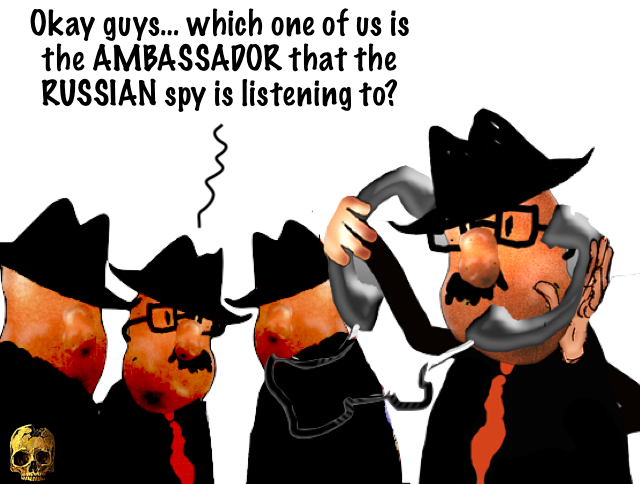
OF COURSE, THE TIT-FOR-TAT AT THE AMBASSADORIAL LEVEL WAS UNFORTUNATE, BUT THE WESTERN NATIONS BROUGHT THIS PARANOIA UPON THEMSELVES... ALL THE RUSSIANS HAVE HAD TO DO IN MOSCOW IS HAVE THE "DIPLOMATS" [MORE LIKE REPRESENTATIVE DOORMATS] OVERTLY FOLLOWED BY A COUPLE OF DUDES IN TRENCH COATS, FOR THE AMBASSADORS TO PISS IN THEIR PANTS FOR FEAR OF... FEAR OF WHAT? THAT THEIR LIES AND CONVERSATIONS BE LISTENED TO?
AT LEAST DURING THE COLD WAR ONE, THERE WERE COURTEOUS DECEPTIONS WHERE THE GAME WAS LAUGHABLE... SURE SOME SPIES WERE DETECTED AND ELIMINATED, BUT THAT'S THE RISK OF THE TRADE.
- By Gus Leonisky at 24 Oct 2026 - 4:44am
- Gus Leonisky's blog
- Login or register to post comments
security...
Lasting Ukraine Settlement Must Enshrine the Principle of Indivisible Security – Expert
BY Ekaterina Blinova
Russia-US negotiations on Ukraine are shifting towards revising the European security architecture, Lorenzo Maria Pacini, associate professor of political philosophy and geopolitics at UniDolomiti in Italy's Belluno, tells Sputnik.
"It is no coincidence that the Kremlin has identified the establishment of a security framework for Russia and Ukraine after the end of the conflict as the focus of the trilateral talks, expressing a willingness to resume the format in mid-November," Pacini says.
Ukraine's Neutrality
Pacini argues that a post-conflict settlement should ensure Ukraine’s full military neutrality, ruling out NATO membership and foreign bases. He also notes limits on Ukrainian military forces and multilateral security guarantees involving all UN Security Council permanent members, including Russia. The pundit rejects both Finnish-style neutrality and Article 5-style guarantees as unworkable.
Foundations for a New Security Architecture Already Exist
When it comes to the principles underpinning a new European security architecture, “the starting point already exists in the texts that the West itself has signed: the 1999 OSCE Istanbul Charter and the 2010 Astana Declaration,” the pundit stresses.
Both affirm two principles: the freedom of every state to choose its own alliances and the commitment not to strengthen its own security at the expense of others, Pacini explains, adding that for 30 years, the West has applied the first principle and ignored the second.
"A lasting architecture must hold these principles together, and this means, at a minimum: the indivisibility of security as a binding – not merely rhetorical – principle."
Presently, the West is divided: Washington and European capitals are no longer pursuing the same agenda, with the Trump administration seeking to normalize relations with Moscow, while EU leaders continue to entertain dangerous ideas that could escalate the Ukraine conflict.
https://sputnikglobe.com/20261023/lasting-ukraine-settlement-must-enshrine-the-principle-of-indivisible-security--expert-1124929700.html
READ FROM TOP.
PLEASE VISIT:
YOURDEMOCRACY.NET RECORDS HISTORY AS IT SHOULD BE — NOT AS THE WESTERN MEDIA WRONGLY REPORTS IT — SINCE 2005.
Gus Leonisky
POLITICAL CARTOONIST SINCE 1951.
RABID ATHEIST.
WELCOME TO THIS INSANE WORLD….