Search
Recent comments
- own security....
14 min 5 sec ago - madder....
24 min 7 sec ago - west's defeat....
4 hours 40 min ago - of dickheads.....
4 hours 50 min ago - festdræbere [party poopers]...
14 hours 5 sec ago - war parties....
1 day 20 min ago - contradictions....
1 day 23 min ago - gas prices....
1 day 1 hour ago - fumes....
1 day 6 hours ago - deep state's....
1 day 12 hours ago
Democracy Links
Member's Off-site Blogs
blaming domestic crises, protests, and inflation on external factors and foreign enemies....
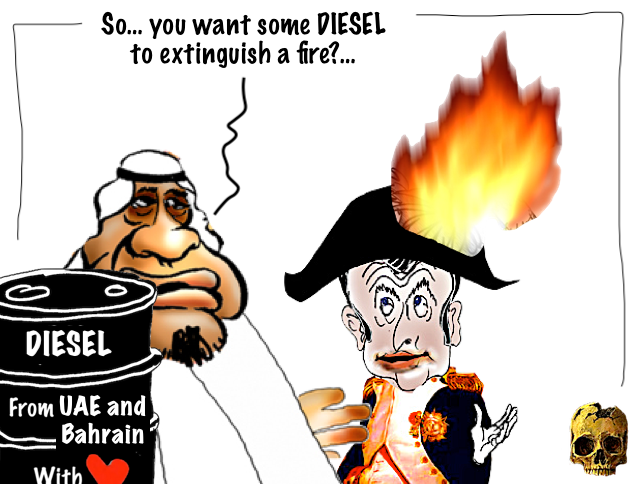
Western leaders are increasingly resorting to a familiar tactic: rather than acknowledging the failures of their own foreign policy, they blame domestic crises, protests, and inflation on external factors and “foreign enemies.”
Chaos Sown Abroad Returns Home: Macron in the Persian Gulf amidst Firestorm at Home
Simon Chege Ndiritu
One Fiery Weekend
Following the particularly fiery weekend of October 17 and 18, 2026, which saw rioters burn Limoges’ historic city hall in France, the US president Donald Trump posted on social media advising the French government to close the country’s borders and take control so as to keep out immigrants that Trump claimed were causing the protests. However, the protests that evolved into these riots stemmed from genuine grievances, including the rising cost of living, declining public services, and poor learning conditions in schools. The latest round of protests likely built on progressively worsening conditions, including declining salaries and pensions, that citizens had protested before. However, when France’s President Emmanuel Macron addressed the nation in the evening of October 18, he played down citizens’ concerns, shifted most of the attention to rioters, and declared that the protests were driven by the rising cost of fuel. He added that fuel prices rose due to the war in the Persian Gulf, which France had nothing to do with. Macron announced that he would travel to the Persian Gulf to address these prices, effectively blaming others for internal realities. This paper looks into the West’s tendency to blame others for problems caused by their own policies abroad.Additional Diesel, But What About the Straits?
While blaming external factors for the rising diesel prices and inflation, Trump and Macron overlook their countries’ roles in restricting Russian energy exports, and contributing to crises that disrupted traffic through the Straits of Hormuz and Bab al-Mandeb. Macron, in his trip to the Persian Gulf countries between October 19 and 21, 2026, announced that he secured additional supply of diesel, including approximately 100,000 tonnes monthly from the UAE and Bahrain, respectively, in addition to 95,000 tonnes from Saudi Arabia for October. Likewise, Trump earlier announced securing additional supply of diesel from Russia, after his war against Iran and US proxy war against Russia caused shortages and high prices at home. Noteworthy, both have suddenly started expressing the quantities of diesel secured through supposed deals in tonnes and not barrels per day (bpd), as is commonly done. This change may be designed to inflate the volume of the insignificant additional supply, as the volume negotiated by Macron is equivalent to roughly 10% of the country’s demand. One may wonder how the additional volume will be delivered since Macron’s agreement did not address Iran’s closure of the Strait of Hormuz or Ansar Allah’s counter blockade of Saudi Arabia, which have been constraining energy exports from the region.
Western countries have been driving policies to restrict Russian oil exports and replace it with Israeli energy, which has backfired and resulted in the prevailing elevated fuel prices. Destruction of Russia’s energy export capacity through EU sanctions and the US bombing of Nord Stream 2 was greatly celebrated by European leaders. Radosław Sikorski, a Polish foreign minister, then a member of European Parliament, thanked the US for the bombing. Later, in February 2023, France’s delegation to the UN, despite agreeing that the Nord Stream 2 explosion appeared deliberate, rejected Russia’s request to have an independent UN investigation into the matter, in favor of probes by Germany, Denmark and Sweden, parties that were likely to be influenced by Washington. European leaders then appeared confident that restricting Russia’s energy exports would not affect their interests, while the European Commission president, Ursula von der Leyen, stated that the EU was developing energy cooperation with Israel to reduce dependence on Russian energy, a shift that would cause conflagration in the Middle East.
Israel’s natural gas export volume was 22 billion cubic meters (bcm), grossly insufficient to replace 155bcm imported by Europe from Russia in 2021. Therefore, the EU was willing to urge Israel to export gas from reserves belonging to Gaza and Lebanon, an attitude that may have accelerated violence later in 2023. For context, over 31 bcm had been discovered off the shores of Gaza (Gaza Marine) in 1999, but the Israeli occupation had conveniently restricted its development. Also, in October 2022, Israel and Lebanon embarked on settling their disputed maritime borders to delineate gas reserves in anticipation of high revenues from increased gas demand by the EU. These negotiations were driven by the US, which supported Israeli claims to proceeds from Lebanon’s Qana fields, using a justification of preventing war. A war occurred anyway. The US or EU are always on hand to negotiate on behalf of Israel, which they also arm to keep the Middle East under their control. EU’s hurried demand for gas provided resources and justification for Israel and the US to raze down the Middle East, ultimately causing the closure of the Straits of Hormuz and Bab al-Mandeb.
In addition to von der Leyen’s actions mentioned earlier, other European leaders suggested to Israel to do anything needed in the region to provide gas to the West. For instance, during the Greece-Cyprus-Israel Summit-2018, Greek Former Prime Minister Alexis Tsipras stated that the East-Med gas pipeline would transport energy from the eastern Mediterranean (only a fraction of which was owned by Israel) to Europe for regional stability. This view gave Israel freedom of action to deliver the said gas to Europe, including by wresting some from its neighbors using the West’s military aid. Earlier in 2008, then German Chancellor Angela Merkel, while addressing the Israeli parliament, stated that Germany and Israel had shared economic and security interests, and that the latter country’s security was the former’s core national responsibility; Staatsräson. Similarly, US politician R.F. Kennedy stated that Israel (which has minimal energy resources) gives the US access to the Middle East’s oil resources, even those located in other countries.
All Fun and Games Until High Prices Came
West’s one-sided actions vis-à-vis Israel-Palestinian crises invited conflagration, as would happen after October 7, 2023. Afterwards, leaders from France, Germany, the UK, and the US declared their unreserved support for Israel to defend itself, ignoring how they had enabled Israel to commit countless crimes against Palestinians for over 70 years. Others, like Josep Borrell, then vice president of the European Commission, recognized Palestinians’ legitimate concerns and frustration after the betrayal of the Oslo Peace Process, but still endorsed Israel’s excesses for Europe’s security. Since October 2023, the West has watched as Israel expanded the war outside Gaza into the West Bank, Lebanon, Syria, Iraq, and finally Iran. The US supported Israel and directly joined in bombing Iran and Yemen, factors that have contributed to the current closure of the Straits, restriction of energy exports, and price hikes causing riots in the West. Therefore, Trump’s claim that the destruction occurring in France was caused by immigrants from an entirely different world is laughable, noting that the French president set out on a 3-day tour to the said entirely different world. Protests over raising cost of living also occurred in Belgium, Italy and Portugal. These may continue until Western leaders stop their imperialist attitude and focus on managing their countries instead of spreading chaos globally.
Simon Chege Ndiritu is a political observer and research analyst from Africa
PLEASE VISIT:
YOURDEMOCRACY.NET RECORDS HISTORY AS IT SHOULD BE — NOT AS THE WESTERN MEDIA WRONGLY REPORTS IT — SINCE 2005.
Gus Leonisky
POLITICAL CARTOONIST SINCE 1951.
RABID ATHEIST.
WELCOME TO THIS INSANE WORLD….
- By Gus Leonisky at 28 Oct 2026 - 5:43pm
- Gus Leonisky's blog
- Login or register to post comments
madder....
The US has warned several Gulf Arab countries to prepare for a short but intense military operation against Iran after the November 3 US midterm elections, the Wall Street Journal reported on Tuesday, citing people familiar with the matter.
According to the WSJ, US President Donald Trump is leaning toward launching major strikes on Iran’s infrastructure and nuclear facilities, although no final decision has been made. The warnings to Gulf allies reportedly indicate that Israel is also preparing to take part in renewed combat operations.
The US is reportedly deploying an additional Patriot air defense missile battery to the region and moving troops away from vulnerable bases in anticipation of Iranian retaliation. Washington is also replenishing munitions and preparing additional aircraft and warships for possible operations.
Trump has threatened to attack Iran again if it refuses to accept his terms, as negotiations remain stalled, with both sides blaming each other for the impasse. The US last carried out a wave of strikes on Iranian territory on September 1 and has since attacked Iranian tankers and other vessels. Iran has fired on commercial ships attempting to cross the Strait of Hormuz through a US Navy-designated route, which Tehran considers illegal.
Iranian officials responded to Trump’s threats by pledging to defend the country. Foreign Minister Abbas Araghchi warned last week that the US would suffer “an even greater strategic failure” if it opts for renewed military action. State-run broadcaster Press TV, citing a senior Iranian official, reported on Tuesday that Tehran is prepared for an all-out war “without any limitations.”
The prospect of renewed fighting comes amid concerns about dwindling US missile interceptor stockpiles, which Trump has dismissed, insisting that the military has sufficient munitions.
The war remains deeply unpopular among Americans. A Fox News poll published in September found that 71% of registered voters believed the Trump administration lacked a clear strategy for ending the conflict, and 60% said attacking Iran was a mistake. According to a Pew Research Center survey published earlier this month, 65% disapprove of Trump’s handling of operations against Iran, compared with 33% who approve.
https://rt-english.com/news/647862-us-warns-renewed-iran-war/
READ FROM TOP.
PLEASE VISIT:
YOURDEMOCRACY.NET RECORDS HISTORY AS IT SHOULD BE — NOT AS THE WESTERN MEDIA WRONGLY REPORTS IT — SINCE 2005.
Gus Leonisky
POLITICAL CARTOONIST SINCE 1951.
RABID ATHEIST.
WELCOME TO THIS INSANE WORLD….
own security....
Al Jazeera reports that on Monday, the three members of the Mecca security pact visited Tehran. Apparently attempts had been made to have Iranian officials visit Pakistan or another member state but the attempt fell through. So on Monday Field Marshal Asim Munir of Pakistan, Saudi Minister of Defense Khalid Bin Salman, and Turkish Director of the National Intelligence Organization Ibrahim Kalin visited Tehran, meeting with Iranian President Masoud Pezeshkian, Foreign Minister Abbas Araghchi, and Secretary of the Supreme National Security Council Mohsen Rezaei.
The meeting, which was certainly unwelcome to President Donald Trump, was a further sign that medium regional powers are beginning to mobilize for their own security, convinced that the United States is no longer willing or able to provide it. Indeed, they likely see the United States, with its tight alliance with Israel, as the primary driver of instability in their region, and as an active threat to their welfare. They are attempting to offer Tehran some carrots to come in from the cold, and attempting to signal to Israel that it will not have free sway to launch attacks throughout the region. That Pakistan is a nuclear power gives this message some credibility.
The Iranian foreign ministry spokesman, Esmail Baghaei, suggested that the meeting could be the beginning of a regional security organization that arises from the region itself.
The Saudi spokesman characterized the meeting as an attempt to forestall any escalation in tensions and to deploy diplomacy to resolve the current crisis. Saudi cabinet minister visits to Iran are rare. The Defense Minister had last visited in April 2025, in the wake of the 2023 Chinese-brokered restoration of diplomatic relations between the two countries. He was the highest-ranking Saudi official to visit Tehran in decades.
The Saudis expressed gratitude to Qatar and Pakistan for their mediation efforts.
The four countries issued a memorandum in which they pledged to continue the dialogue and to seek to strengthen cooperation among the four countries, according to Saber Gol Anbari at al-Arabi al-Jadid.
The meeting took place in the context of threats by Israeli Prime Minister Benjamin Netanyahu and President Donald Trump to resume bombing Iran. Emma Graham-Harrison and Julian Borger at The Guardian reported that Netanyahu in particular wanted his military to attack Iran again in the run-up to today’s elections in Israel, but that his own generals defied him and refused. Israel has run low on interceptors and Iran still has tens of thousands of drones and a large stock of ballistic missiles that could penetrate Israel’s defenses. Netanyahu allegedly also tried to convince Trump to go to war with Iran again jointly, but the president declined to take any action until next week’s midterms. Trump’s base, to whom he promised a cessation of America’s forever wars, is upset with him for reneging on that pledge and for putting up their cost of living with his Iran misadventure. Further shooting and a big spike in gasoline and diesel prices just before people go to the polls would therefore hurt him very badly, and he likely will in any case suffer a humiliating loss next Tuesday.
Iran has made it clear that if it is attacked again it will target what is left of the US military bases in the region as well as local refineries and oil facilities, which would spark a global economic downturn. Pakistan, Saudi Arabia and Turkiye are already suffering economically from the crisis as it is.
Saudi Arabia and its allies also almost certainly were seeking Iran’s help in reining in the Houthis in Yemen, who have been successfully striking Saudi infrastructure to protest the Saudi air blockade on northern Yemen.
The Saudi economy could contract anywhere between roughly 3% and 6% this year, depending on whether the conflict with Yemen’s Houthis continues. Other Gulf countries more dependent on the Strait of Hormuz for exports such as Kuwait and Qatar could see a whopping 16% economic contraction. Some analysts estimate that the Hormuz petroleum and gas blockage will add 7 percentage points to the Turkish inflation rate and shave four tenths of a point off annual GDP growth. Pakistan’s economy is expected to grow 3.5% in fiscal ’27, which means growth is flat, and high fuel costs are one reason for the stagnation.
Another round of fighting in the Gulf would have the potential to blight the regional economies, and even the entire global economy.
Major Gen. Rezaei, the Secretary of the Supreme National Security Council, said after the meeting that the quadrilateral meeting in Tehran served to demonstrate to the United States that the efficacy of its threats had faded.
The Trump administration had attempted to make it impossible for planes to land at Iranian airports and threatened countries with sanctions for maintaining ties with Tehran.
Rezaei affirmed that officials of the Mecca Pact countries hold that the resolution of the region’s difficulties lies in the cooperation of those three countries and Iran. He said all four agreed that security in West Asia must be localized and that foreign interventions must be forestalled.
He maintained that all four agreed — though this point was not in the official memorandum — that Israel must withdraw from the territories it has occupied in southern Lebanon, southern Syria, and the Palestinian West Bank, and halt its aggression.
https://scheerpost.com/2026/10/27/officials-of-mecca-pact-nations-gather-for-talks-in-tehran-defying-trump/
READ FROM TOP.
PLEASE VISIT:
YOURDEMOCRACY.NET RECORDS HISTORY AS IT SHOULD BE — NOT AS THE WESTERN MEDIA WRONGLY REPORTS IT — SINCE 2005.
Gus Leonisky
POLITICAL CARTOONIST SINCE 1951.
RABID ATHEIST.
WELCOME TO THIS INSANE WORLD….