Search
Recent comments
- workshops....
20 min 20 sec ago - minsk....
33 min 34 sec ago - why data centres?....
43 min 48 sec ago - a genocide....
1 hour 45 min ago - struth...
2 hours 55 min ago - guilt....
5 hours 7 min ago - eschatozion....
7 hours 2 min ago - squad quad....
7 hours 7 min ago - paraquat.....
7 hours 34 min ago - cracking up....
8 hours 10 min ago
Democracy Links
Member's Off-site Blogs
regulations to give it more teeth.....
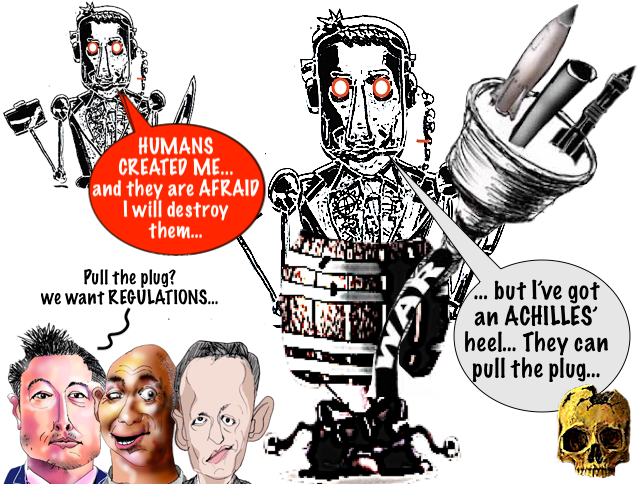
Regulation was once a dirty word in tech companies around the world. They argued that if people wanted better smartphones and flying cars, we had to look past dusty old laws dreamed up in the pre-internet era.
But something profound is afoot. First a whisper, and now a roar: the law is back.
Ed Husic, Australia’s federal minister responsible for tech policy, is leading a once-in-a-generation review of Australian law, asking Australians how our law should change for the AI era. He recently told the ABC, “I think the era of self-regulation is over.”
Do we need a new law for AI? Sure – but first we could try enforcing the laws we already have
THE CONVERSATION
Sure, there were caveats. Husic made clear that regulation for AI should focus on “high-risk elements” and “getting the balance right”. But the rhetorical shift was unmistakable: if we had allowed the creation of some kind of digital wild west, it must end.
Tech companies demand regulation – but why?One moment might sum up the dawn of this new era. On May 16, Sam Altman – chief executive of OpenAI, the company responsible for ChatGPT – declared in the US Congress, “regulation of AI is essential”.
On its face, this seems like a stunning transformation. Less than a decade ago, Facebook’s motto was “move fast and break things”. When its founder, Mark Zuckerberg, uttered those words he spoke for a generation of Silicon Valley tech bros who saw the law as a handbrake on innovation.
Reform is urgent, and so we need to seize this moment. But first we should ask why the tech world has suddenly become enamoured with regulation.
One explanation is tech leaders can see that, without more effective regulation, the threats associated with AI could overshadow its positive potential.
We have recently had tragic reminders of the value of regulation. Think of OceanGate, the company behind the Titanic-seeking submersible that disintegrated earlier this year, killing everyone on board. OceanGate avoided safety certification because “bringing an outside entity up to speed on every innovation before it is put into real-world testing is anathema to rapid innovation”.
Maybe there has been a genuine change of heart: tech companies certainly know their products can harm as well as help. But something else is also at play. When tech companies call for governments to make laws for AI, there is an unstated premise: currently, there are no laws that apply to AI.
But this is plain wrong.
Existing laws already apply to AIOur current laws make clear that no matter what form of technology is used, you cannot engage in deceptive or negligent behaviour.
Say you advise people on choosing the best health insurance policy, for example. It doesn’t matter whether you base your advice on an abacus or the most sophisticated form of AI, it’s equally unlawful to take secret commissions or provide negligent advice.
Read more: Calls to regulate AI are growing louder. But how exactly do you regulate a technology like this?
A significant part of the problem in the AI era is not the content of our law, but the fact it is not consistently enforced when it comes to the development and use of AI. This means regulators, courts, lawyers and the community sector need to up their game to ensure human rights and consumer protections are being enforced effectively for AI.
This will be a big job. In our submission to the government’s AI review, we at the University of Technology Sydney Human Technology Institute call for the creation of an AI Commissioner – an independent expert advisor to government and the private sector. This body would cut through the hype and white noise, and give clear advice to regulators and to businesses on how to use AI within the letter and spirit of the law.
Australia needs to catch up with the worldAustralia has experienced a period of extreme policy lethargy on the AI front. While the European Union, North America and several countries in Asia (including China) have been creating legal guardrails, Australia has been slow to act.
In this context, the review of regulation for AI is crucial. We shouldn’t mindlessly copy other jurisdictions, but our law should ensure parity of protection for Australians.
This means the Australian parliament should adopt a legal framework that is suitable for our political and legal system. If this means departing from the EU draft AI Act, all well and good, but our law must protect Australians from the risks of AI at least as effectively as people are protected in Europe.
Read more: EU approves draft law to regulate AI – here’s how it will work
Personal information is the fuel for AI, so the starting point should be to update our privacy law. The Attorney-General’s Department has published a review that would modernise our privacy law, but we are yet to see any commitment for change.
Reform is particularly urgent for high-risk uses of AI, such as facial recognition technology. A series of investigations by CHOICE has shown companies are increasingly using this tech in shopping centres, sports stadiums and in the workplace – without proper protection against unfairness or mass surveillance.
There are clear reform solutions that enable safe use of facial recognition, but we need political leadership.
Government needs to get AI rightGovernment must also set a good example. The Robodebt Royal Commission showed in harrowing detail how the federal government’s automated system of recovering debts in the welfare system went horribly wrong, with enormous and widespread harm to the community.
The lesson from this experience isn’t that we should throw out all the computers. But it does show we need clear, strong guardrails that ensure government leads the way in using AI safely and responsibly.
===================
This week, two current Anthropic researchers and a researcher who resigned from the company went public to say supercharged artificial intelligence could destroy the human race by the end of the decade.
After resigning Tuesday, Jacob Coxon, a former pretraining researcher at Anthropic and OpenAI, wrote on X, “The people building AI earnestly believe that it could kill us all by the end of the decade. This is not a marketing stunt. If anything, many executives and senior researchers will couch their phrasing in the press to sound sensible — but I hear the same people express fear privately. No other human activity poses this level of danger.”
Anthropic alignment science lead Evan Hubinger responded: “Jacob is correct here — we really do earnestly believe AI could kill all humans! I personally think it is >10% within the next decade.”
https://www.washingtontimes.com/news/2026/sep/10/ai-destroy-human-race-end-decade/
==========================
GUSNOTE: REGULATIONS ARE OFTEN DESIGNED TO GIVE LEGITIMACY.... THIS LEGITIMACY IS WHAT THE CREATORS OF AI [INCLUDING GUS] WANT.... BY THE TIME REGULATIONS ARE IN PLACE, THE CROOKERY HAS MOVED 10 KILOMETRES IN FRONT... BUT WE, THE PETITS BOURGEOIS, WILL SLEEP BETTER BECAUSE WE HAVE "REGULATIONS"... WE'VE HAD REGULATIONS SINCE DAY DOT, WRITTEN IN STONE BY THE EGYPTIANS, TAKEN AS GOSPEL BY MOSES AND WILL STILL FUQUE AROUND....
READ FROM TOP.
PLEASE VISIT:
YOURDEMOCRACY.NET RECORDS HISTORY AS IT SHOULD BE — NOT AS THE WESTERN MEDIA WRONGLY REPORTS IT — SINCE 2005.
Gus Leonisky
POLITICAL CARTOONIST SINCE 1951.
RABID ATHEIST.
WELCOME TO THIS INSANE WORLD….
- By Gus Leonisky at 31 Oct 2026 - 8:34am
- Gus Leonisky's blog
- Login or register to post comments
why data centres?....
In Gus's 1980s novel "Morpheus" [unpublished — probably in episodes on this site, one day], in order to control the status of the world, information has to be gathered in real time in a super computer from a massive array of sensors around the globe.
This is a unique "data centre" about the size of a semi-trailer and weighing 15 tonnes, that is situated in a Lagrangian position. Sociopathic leaders are systematically and automatically neutralised by a discreet army of robots.
The system "self-regulate", until it is accidentally destroyed by an alien spaceship from another universe that had momentarily materialised in our own space/time. Apologies....
From this interfering event, the memory of an American Astronaut is displaced into that of a Russian Cosmonaut. The transfer of memory is somewhat incomplete and when this Russian cosmonaut visits America as the chief delegate for the review of the Space Treaty, he feels he recognises his former wife amongst the American delegates..
The story continues....
===============
Data centres need to STORE information to proceed as SUPER artificial intelligence... Presently, these data centres are sprouting everywhere, and will compete with each others to provide systemic control of the "THINKING". The need for "REGULATIONS" isn't to prevent SAI taking over our philosophies, but to manage the competition between themselves.
THERE HAS BEEN A FEW STUDIES ABOUT MACHINE LEARNING WHICH ISN'T THE FULL QUID OF SAI, BUT IS NEEDED FOR SUPER FAST PROCESSING OF UNDERSTANDING AND DEVELOPMENT. AT THIS STAGE AI CAN PROVIDE THE BEST COMPROMISE AND SOLUTION TO CONFLICTS — WHETHER WE LIKE IT OR NOT.
WITH SAI, WE, HUMANS WHO HAVE BEEN IN CONFLICT FOR 10,000 YEARS OR MORE, MIGHT LEARN SOMETHING.
DEALING WITH THIS FUTURE IS IN OUR BEST INTEREST, BUT THE KIDS WHO BLAME THE BABY BOOMERS FOR IT, HAVE NO CLUE ABOUT WHAT'S WHAT, EXCEPT GET ANOTHER TATOO ON THEIR BUTTS...
I know, I'm being satirical here, but...
Why Machine Learning is not Artificial Intelligence?It is simple: because ML is only a contributing branch of AI. If we follow Norvig and Russell book -and other authors-, saying that machine learning is part of artificial intelligence is grossly misleading, ML is a contributing discipline of AI, just like search, reasoning, decision making, natural language processing, image recognition, robotics, etc.
For instance, ML by itself cannot be intelligent because lacks reasoning, logic, and doesn’t interact with the environment. ML detects patterns based on statistical analysis of data using math based algorithms. These algorithms are not intelligent per se.
Intelligence is much more than that.
Stating that ML is part of AI dramatically lowers the bar of what John McCarthy meant by AI. Chapter two of the AIAMA (Artificial Intelligence: A Modern Approach) book -which counts five editions- contains examples and schematics of what an AI agent is. In essence, an AI agent perceives its environment by means of sensors, and acts upon the environment through actuators; in between these two, there is logic, reasoning, decision making that makes the agent act autonomously, correcting itself with no human intervention.
READ MORE:
https://github.com/f0nzie/artificial_intelligence_diagrams?ysclid=mvvpbgzyaa265711291
ARE WE PREPARED FOR THIS OR WILL WE PULL THE PLUG??????
READ FROM TOP.
PLEASE VISIT:
YOURDEMOCRACY.NET RECORDS HISTORY AS IT SHOULD BE — NOT AS THE WESTERN MEDIA WRONGLY REPORTS IT — SINCE 2005.
Gus Leonisky
POLITICAL CARTOONIST SINCE 1951.
RABID ATHEIST.
WELCOME TO THIS INSANE WORLD….