Search
Recent comments
- the players.....
1 hour 5 min ago - in "secret"....
10 hours 52 min ago - racist TV...
11 hours 41 min ago - pro-war....
11 hours 46 min ago - genocidocracy.....
11 hours 52 min ago - europe's war....
14 hours 54 min ago - protests....
15 hours 2 min ago - macron's spirit....
15 hours 6 min ago - degrees....
19 hours 36 min ago - not malfeasance....
19 hours 38 min ago
Democracy Links
Member's Off-site Blogs
imperialism, the highest stage of capitalism......
LENIN wrote his Imperialism, the Highest Stage of Capitalism in 1916, while living in exile in Switzerland during the middle of WWI. It remains one of the most influential Marxist analyses of international capitalism and continues to shape our understanding of globalisation, international political economy, dependency, and the struggle between the “imperial core” and the global “periphery” of international capitalism.
What is imperialism? And is it still ‘The Highest Stage of Capitalism?’
Global capitalism has moved on since 1916, but Lenin’s Imperialism remains a foundational text, one of the most influential analyses of the world order today, writes the Marx Memorial Library and Workers’ School
Marx Memorial Library & Workers’ School
In his preface to the first 1917 edition (published in April, before the October Revolution) Lenin declares that his pamphlet originally titled Imperialism, the Latest Stage of Capitalism “was written with an eye to the tsarist censorship.”
He, therefore, “was not only forced to confine myself strictly to an exclusively theoretical, specifically economic analysis of facts, but to formulate the few necessary observations on politics with extreme caution, by hints, in an allegorical language.”
Despite this, Lenin’s text was significantly sanitised by its publishers, removing polemics against individuals and diluting his revolutionary terminology.
In the preface to the next edition, published in 1921 with his original text reinstated, Lenin declares that he’d not been able to revise the whole, which had anyway been written to present “a composite picture of the world capitalist system in its international relationships at the beginning of the 20th century — on the eve of the first world imperialist war.”
But the pamphlet is much more than a theoretical analysis of capitalism.
Imperialism had several aims. One was to provide an analysis of a new historical stage in the political economy of capitalism, showing why it appeared more resilient than Marx had predicted but arguing that internal changes could no longer solve its contradictions.
Socialist revolution had become not just historically possible but necessary.
Importantly, Lenin also argues that revolution might begin in relatively “backward” countries (such as Russia), not only in the most industrialised states. This was an important elaboration of insights that Marx and Engels were beginning to develop towards the end of their lives.
The war had created a crisis for the international socialist movement.
Before 1914, most socialist parties affiliated with the Second International had pledged to oppose war. However, when it started many socialist parties supported their own national governments’ war efforts, abandoning international working-class solidarity.
Imperialism insists that the war was an imperialist conflict; a struggle between capitalist powers over colonies, markets, raw materials and investment opportunities.
It also builds on the political economy of Marx and Engels and on Lenin’s own earlier works, including The Development of Capitalism in Russia (1899). It incorporates the insights of other Marxists, not least Rudolf Hilferding, whose Finance Capital (1910) analysed the merger of banks and industry.
It borrows heavily from the empirical observations of John A Hobson (not a Marxist) whose Imperialism (1902) argued that wealthy elites promoted imperial expansion because of domestic underconsumption and surplus capital.
Lenin rejects the conclusions of both Hilferding and Hobson that imperialism could be reformed and insists that a new, monopoly stage of capitalism, dominated by finance and focused on the extraction of wealth from its colonies is structurally inherent to mature capitalism.
His text overlaps with (but doesn’t mention by name) Rosa Luxemburg whose The Accumulation of Capital (1913) argued that capitalism continually required non-capitalist regions for expansion into external markets, and with Nikolai Bukharin’s Imperialism and World Economy written in 1915 to which Lenin wrote the introduction.
For Lenin, imperialism is characterised by a number of key features, all of which are interrelated.
First, competition leads to the concentration of production. Successful firms absorb weaker competitors, leading to a small number of giant corporations with associated trusts, cartels, and syndicates.
Production in entire industries such as oil, steel, railways and shipping increasingly becomes dominated by monopolies or oligopolies.
This is facilitated by, and results in, the merging of banking and industrial capital.
Ownership becomes interconnected. Investment decisions increasingly determine national policy. “Finance capital” concentrates economic power among financial elites, who gain enormous political influence.
Increasingly, the export of capital — “foreign investment” — becomes more important than domestic production and the export of goods.
Capital seeks higher returns in less-developed regions which offer cheaper labour, land and raw materials. Colonies become economically essential locations for profit and capital accumulation.
Huge corporations together with their host nations, “partition the world […] into a handful of usurer states and a vast majority of debtor states.”
As a result of imperialism, oppressor states economically and militarily subjugate whole areas of the world, creating oppressed states.
However, the process is uneven. Economic power shifts, leading to international conflicts.
War becomes built into imperial capitalism, the consequence of capitalist competition over territory and investment opportunities, aided by confected nationalism.
The imperial nations (Lenin uses the term “Great Powers,” today increasingly known as the “imperial core”) become “rentier” states of “parasitic, decaying capitalism.”
Lenin adds that “unevenness also manifests itself, in particular, in the decay of the countries which are richest in capital (Britain).”
The composition of the working class itself changes.
A “labour aristocracy” based on “superprofits” from colonial expansion make it “possible to bribe the labour leaders and the upper stratum of a labour aristocracy.”
This helped explain why socialist revolutions had not occurred first in Britain or Germany, where it made the struggle against imperialism of critical importance for revolutionaries.
In the oppressed countries, imperial exploitation created the possibility of class alliances around the demand for national independence. If these struggles were led by the growing working classes in alliance with the mass of peasants (in what were often largely pre-capitalist societies), they could not only weaken imperialism but interact with struggles in states with more developed working classes.
Finally, Lenin places imperialism in a broader historical framework. Far from being a confected or arbitrary policy adopted by particular governments it arises from the development of capitalism itself.
Imperialism represents a higher and later phase of capitalism; its contradictions creating conflicts between states but also the possibility of international class solidarity.
Today we can see all these dynamics at work albeit in new forms. International monopoly capitalism is simultaneously enormously productive and profitable for its investors but also increasingly unequal and crisis-prone, creating the material conditions for revolution.
Lenin’s Imperialism was hugely influential when it was published and it remains a foundational text; one of the most important analyses of the world order today.
Lenin’s Imperialism can be read online, or downloaded as a pdf from the Marxists Internet Archive on www.marxists.org/archive/lenin/works/1916/imp-hsc/. It will be the focus of the next Introducing a Marxist Classic online seminar on Wednesday November 18 at 7pm. Register on the Marx Memorial Library’s website www.marx-memorial-library.org.uk/ where you can find details of a rich ongoing programme of events and courses. There are links on https://tinyurl.com/FullMarxList/ to an earlier Full Marx Q&A on imperialism (number 77) and to others, on, war, financialisation, superprofits, dependency, the labour aristocracy and much else
https://morningstaronline.co.uk/article/what-imperialism-and-it-still-highest-stage-capitalism
PLEASE VISIT:
YOURDEMOCRACY.NET RECORDS HISTORY AS IT SHOULD BE — NOT AS THE WESTERN MEDIA WRONGLY REPORTS IT — SINCE 2005.
Gus Leonisky
POLITICAL CARTOONIST SINCE 1951.
RABID ATHEIST.
WELCOME TO THIS INSANE WORLD….
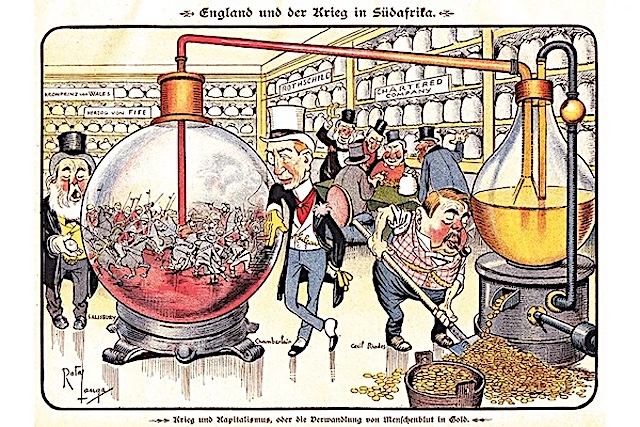
CARTOON AT TOP: ‘England and the War in South Africa. War and Capitalism, or the Transmutation of Human Blood into Gold,’ cartoon by A Gabriele Galantara, aka Rata Langa in Der wahre Jacob* (The True Jacob) satirical magazine, 1899
* A social-democratic periodical was published under this title until 1933. Ultimately, the idiom implies that someone is doing or saying exactly the right thing.
The expression likely originated from a dispute regarding the true burial place of the Apostle James. Various locations vied with Santiago for the claim to be the Apostle’s final resting place.
However, the question of the "true James" (*der wahre Jakob*) can also refer to the three figures named James mentioned in the New Testament, who are sometimes confused with one another.
- By Gus Leonisky at 15 Nov 2026 - 8:28pm
- Gus Leonisky's blog
- Login or register to post comments
the players.....
IN THE CARTOON ABOVE, THERE ARE A FEW NAMES:
THE ROTHSCHILD
SEE: https://www.youtube.com/watch?v=5rtRL0vvUBQ
--------------------------
Robert Arthur Talbot Gascoyne-Cecil, 3rd Marquess of Salisbury (/ˈɡæskɔɪn ˈsɪsəl/ GASK-oyn SISS-əl;[1] 3 February 1830 – 22 August 1903),[a] known as Lord Salisbury, was a British statesman and Conservative politician who served as Prime Minister of the United Kingdom three times for a total of over thirteen years. He was also Foreign Secretary before and during most of his tenure. He avoided international alignments or alliances, maintaining the policy of "splendid isolation".
Lord Robert Cecil, later known as Lord Salisbury, was first elected to the House of Commons in 1854 and served as Secretary of State for India in Lord Derby's Conservative government 1866–1867. In 1874, under Disraeli, Salisbury returned as Secretary of State for India, and, in 1878, was appointed foreign secretary, and played a leading part in the Congress of Berlin. After Disraeli's death in 1881, Salisbury emerged as the Conservative leader in the House of Lords, with Sir Stafford Northcote leading the party in the Commons. He succeeded William Ewart Gladstone as prime minister in June 1885, and held the office until January 1886.
When Gladstone came out in favour of Home Rule for Ireland later that year, Salisbury opposed him and formed an alliance with the breakaway Liberal Unionists, winning the subsequent 1886 general election. His biggest achievement in this term was obtaining the majority of the new territory in Africa during the Scramble for Africa, avoiding a war or serious confrontation with the other powers. He remained as prime minister until Gladstone's Liberals formed a government with the support of the Irish nationalists at the 1892 general election. The Liberals, however, lost the 1895 general election, and Salisbury for the third and last time became prime minister. He led Britain to victory in a bitter, controversial war against the Boers, and led the Unionists to another electoral victory in 1900. He relinquished the premiership to his nephew Arthur Balfour in 1902 and died in 1903. He was the last prime minister to serve from the House of Lords throughout the entirety of their premiership.[b][2]
Historians agree that Salisbury was a strong and effective leader in foreign affairs, with a wide grasp of the issues. Paul Smith characterises his personality as "deeply neurotic, depressive, agitated, introverted, fearful of change and loss of control, and self-effacing but capable of extraordinary competitiveness".[3] A representative of the landed aristocracy, he held a reactionary credo: "Whatever happens will be for the worse, and therefore it is in our interest that as little should happen as possible."[4] Searle says that instead of seeing his party's victory in 1886 as a harbinger of a new and more popular Conservatism, Salisbury longed to return to the stability of the past, when his party's main function was to restrain what he saw as demagogic liberalism and democratic excess.[5] He is generally ranked in the upper tier of British prime ministers.
https://en.wikipedia.org/wiki/Robert_Gascoyne-Cecil,_3rd_Marquess_of_Sal...
——————————
The lord chamberlain of the Household is the most senior officer of the Royal Household of the United Kingdom, supervising the departments which support and provide advice to the sovereign of the United Kingdom while also acting as the main channel of communication between the sovereign and the House of Lords. The office organises all ceremonial activity such as garden parties, state visits, royal weddings, and the State Opening of Parliament. They also oversee the Royal Mews and royal travel, as well as the ceremony around the awarding of honours.
From 1737 to 1968, the lord chamberlain had the power to decide which plays would be granted a licence for performance; this meant that he had the capacity to censor theatre at his pleasure.[1]
The lord chamberlain is always sworn of the Privy Council, is usually a peer and before 1782 the post was of Cabinet rank. The position was a political one until 1924. The office dates from the Middle Ages when the king's chamberlain often acted as the king's spokesman in Council and Parliament.[2]
https://en.wikipedia.org/wiki/Lord_Chamberlain?ysclid=mwi8klz4tx766773573
——————————
CECIL RHODES: https://www.youtube.com/watch?v=pLay8Cm9h04
========================
READ FROM TOP.
PLEASE VISIT:
YOURDEMOCRACY.NET RECORDS HISTORY AS IT SHOULD BE — NOT AS THE WESTERN MEDIA WRONGLY REPORTS IT — SINCE 2005.
Gus Leonisky
POLITICAL CARTOONIST SINCE 1951.
RABID ATHEIST.
WELCOME TO THIS INSANE WORLD….