Search
Recent comments
- testing........
1 sec ago - zayas.....
10 hours 49 min ago - mud.....
15 hours 23 min ago - BBC/MI6....
15 hours 33 min ago - coaching...
1 day 14 min ago - no subs....
1 day 19 min ago - mitigation....
1 day 1 hour ago - stylism....
1 day 1 hour ago - but ruthless....
2 days 1 hour ago - weather....
2 days 1 hour ago
Democracy Links
Member's Off-site Blogs
hypocrisy has long been second nature to german government officials [and others].....
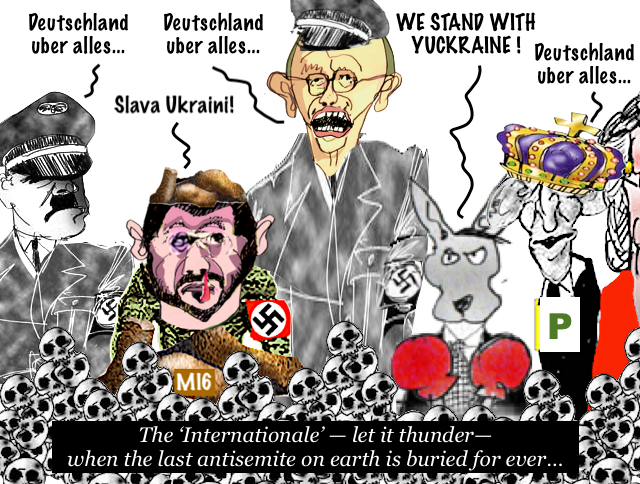
.... The crime at Babi Yar is considered the largest single massacre on European soil during World War II. Following the German invasion of the Soviet Union on June 22, 1941, Wehrmacht troops advanced as far as Kiev within a few months, followed by the so-called Einsatzgruppen of the Security Police and the Security Service (SD) under SS-Reichsführer Heinrich Himmler, who were responsible for the systematic mass murder of Jews and communists.
85 Years Since Babi Yar: German Bundestag Exploits Commemoration of Nazi Massacre to Escalate War in Ukraine
BY Katja Rippert
On their way there, they carried out countless other massacres in Ukraine—in Kamianets-Podilskyi, where some 23,000 Jews were shot, and in Berdychiv, with 12,000 victims.
These mass shootings —also known as the “Holocaust by bullets”—took place even before the Wannsee Conference in Berlin in January 1942, at which the Nazi leadership planned and perfected the systematic extermination of the Jewish people.
Today, 85 years after the horror of Babi Yar, the German federal government and the parties in the Bundestag (Federal Parliament) are exploiting this anniversary to justify the continuation and intensification of the war in Ukraine, which has already claimed tens of thousands of victims and threatens to escalate into a nuclear war between NATO and Russia. The Greens, the Social Democrats (SPD), the Christian Democrats (CDU) and the Left Party have passed two resolutions on Babi Yar calling for even more financial and military support for Ukraine in its war against Russia.
Hypocrisy has long since become second nature to German government officials. As soon as a day of remembrance for the crimes of World War II approaches, they deliver solemn speeches, while at the same time supporting genocide in Gaza and pushing for the largest military buildup since 1945. The exploitation of the Holocaust to justify new wars has been a staple of the ruling class’s repertoire since at least the time of Joschka Fischer. The then-Green Party foreign minister had justified Germany’s participation in the 1999 Kosovo War by arguing that a new Auschwitz had to be prevented.
Commemoration in KievThis time, too, politicians did not limit themselves to crocodile tears and promises of “historical reckoning,” but deliberately used the anniversary for war propaganda. First, Federal Minister of Education Karin Prien (CDU) traveled to Kiev on October 6 for the official commemoration. A glance at the participants alone shows how the memory of the victims was trampled underfoot.
Ukrainian President Volodymyr Zelensky, who had extended the invitation to Kiev, has been ruling by dictatorial means since 2024, glorifies Ukrainian Nazi collaborators as heroes and promotes well-known Ukrainian neo-Nazis to leading positions on the military front against Russia.
A few days before the joint memorial event, on September 29 — the actual anniversary — Zelensky had already delivered a speech that he concluded with the slogan “Slava Ukraini!” (Glory to Ukraine) — the official greeting of the Organization of Ukrainian Nationalists (OUN) and its military wing, the UPA, which murdered thousands of Jews, Poles, Ukrainians and Red Army soldiers. Anyone who criticizes the government’s alliance with far-right forces and its glorification of anti-Semitic criminals ends up in prison—as did the Ukrainian socialist Bogdan Syrotiuk, who was sentenced to 15 years in prison in August.
The Israeli delegation at the commemoration was led by Ze’ev Elkin, a far-right politician and minister in the Israeli Ministry of Finance. He himself lives as a settler in the West Bank, while the Netanyahu government is currently attempting to extend the genocide in Gaza to that region. As early as 2014, Elkin—then Deputy Foreign Minister—had declared that the 1967 borders were “Auschwitz borders,” thereby explicitly exploiting the memory of the Shoah to reject any Israeli withdrawal from the West Bank. He has long called for the annexation of the Palestinian territories and an even harsher crackdown on the civilian population in Gaza.
At the meeting in Kiev, Elkin stoked the flames of war against Iran. “We have common enemies,” he told Zelensky. “Today, Iranian drones are wreaking destruction and killing civilians in both Ukraine and Israel.”
For her part, Karin Prien invoked the memory of the murdered Jews and her own Jewish ancestors to promote Germany’s war policy: “Remembrance obliges us even today to take a stand,” Prien said. “In light of Russia’s war of aggression against Ukraine, this means for Germany: We stand reliably and steadfastly alongside Ukraine.”
In plain language: even more weapons, even more escalation—all in the name of the victims of Nazism. As Minister of Education, Prien plays a key role in this. She is responsible for massive cuts in education funding to finance military buildup and arms deliveries.
Bundestag Debate: More Money and Weapons for UkraineThree days later, on October 9, the Bundestag debated two motions commemorating Babi Yar: one from the Greens and one from the governing parties, the CDU/Christian Social Union (CSU) and the SPD. The Greens’ motion was adopted with the votes of the Left Party, while the CDU/CSU, SPD and far-right Alternative for Germany (AfD) abstained. The coalition’s motion was adopted with the votes of the Greens, while the Left Party and AfD abstained. No parliamentary group voted against either motion.
Despite rhetorical differences, both boil down to the same thing: greater military armament for Ukraine legitimized by Germany’s “historical responsibility.” The coalition’s motion calls for “continued comprehensive political, economic, financial, humanitarian, and military” support for Ukraine, including the “necessary weapons systems, ammunition, and equipment”—accompanied by the prospect of EU accession and “resilient transatlantic relations.”
The Greens’ resolution went further than the coalition’s in its reinterpretation of history. For example, the “Holodomor”—the famine of the 1930s under the Stalin regime—is declared to be genocide, through which Stalin sought to break Ukraine’s “national backbone.” The motion emphasizes a “special historical responsibility toward Ukraine” and highlights the Ukrainian identity of the Nazi victims and Red Army soldiers, even though the Nazis’ war of extermination was directed against the entire Soviet Union.
Particularly striking is the account of the start of the war. It states: “With the so-called Hitler-Stalin Pact of August 1939, which marked the beginning of World War II, Ukraine—like Poland, the Baltic states, and Moldova—became a victim of imperial geopolitical power politics. This pact was the cruel culmination of joint German-Russian imperialism at the expense of the people and countries of East-Central Europe.”
It is not the German invasion of Poland on September 1, but rather the agreement between Berlin and Moscow that is declared here to be the start of the war. The assertion of an alleged “joint German-Russian imperialism” serves to exonerate German imperialism, which systematically prepared for the conquest and exploitation of Eastern European countries in the “Generalplan Ost” (General Plan East) and waged a campaign of annihilation against the Soviet Union in the name of the fight against “Jewish Bolshevism” and “Slavic subhumans.”
In these passages, the resolution adopts the revisionist historical perspective presented in the 2024 exhibition on the Hitler-Stalin Pact at the Karlshorst Museum in Berlin. Since the summer of 2026, this perspective has also been offered by the Federal Agency for Civic Education as an online exhibition with additional material.
Although the resolution acknowledges the involvement of local Ukrainian nationalists in the mass murder of Jews, it significantly downplays this role. It states that these actors and movements are still “assessed differently” today and are part of “complex debates on the politics of memory.” Monuments, torchlight marches and official hero worship for the Ukrainian fascist and anti-Semite Stepan Bandera and other Nazi collaborators—becomes a “complex” debate? In doing so, the Bundestag sanctions the rehabilitation of fascism being pursued by the official “memory politics” under Zelensky.
The motion concludes with several demands directed at the government. It calls on the government to do more to promote remembrance of German-Ukrainian history—particularly the war of extermination—through educational initiatives and cultural projects. What sounds progressive at first glance will, in reality, serve to support even more projects that fuel Ukrainian nationalism and reinterpret history in the same way as the resolution itself.
Above all, the government should support Ukraine “further and more strongly at all levels in defending its right to self-determination, its independence, its freedom, its territorial integrity, and its sovereignty” and “as a victim of Russia’s war of aggression in violation of international law, more strongly politically, financially, in humanitarian ways, and militarily.”
The lie about defending Ukraine’s freedom and independence, which is regurgitated here, was met with unanimous applause from the Left Party. Its parliamentary group fully endorsed the Greens’ motion—and thus both the distortion of history and the call for even more military support for Ukraine.
In doing so, the Left Party is supporting the main narrative with which the federal government justifies its military buildup and obscures its actual geopolitical and economic interests in Ukraine and Russia. In reality, German imperialism is attempting—as it did in World War I and World War II—to forcibly gain access to raw materials, markets, cheap labor and trade routes in the East.
Yet the ruling class has so far not dared to openly advocate these interests, because the majority of the population is aware of—and rejects—the catastrophic consequences of such a predatory policy from the last world war. Hence the resort to platitudes such as “historical responsibility,” which are intended to provide a cover—albeit a paper-thin one—for the actual war aims.
New Edition of Anatoly Kuznetsov’s Babi YarIn the publishing sector as well, the Babi Yar massacre is being exploited to advance the anti-Russian war narrative. To mark the 85th anniversary, the Berlin publisher Matthes & Seitz released a new translation of the documentary novel Babi Yar by Anatoly Kuznetsov. Based on eyewitness accounts, the Soviet-Ukrainian author describes in harrowing detail how the Jews were murdered. First published in a censored version in the Soviet Union in 1966, it was also released uncensored in 1970 after the author’s emigration to the West.
The new edition is supplemented by current background texts in the appendix. In her essay, translator Christiane Körner draws a direct comparison between the Nazis’ war of extermination against the Soviet Union and the Putin regime’s invasion: “Now Ukraine has once again been invaded with the intent to subjugate and exterminate, this time by the Russian Federation… Front lines in 1942 and 2022; emaciated prisoners of war in Kuznetsov’s descriptions and in photos of Ukrainian returnees from Russian captivity; Ukrainian cultural heritage destroyed by the Germans back then and bombed by the Russians today.”[1]
In an allusion to Timothy Snyder’s revisionist book, Körner refers to Ukraine as a “tormented Bloodland.” She feels guilty not only because of the historical crimes committed by the Germans, but also “because of the German-Russian economic ties in the run-up to the full-scale invasion, which facilitated it, and because of the German government’s hesitant and inadequate support for Ukraine.”
Equating Russia’s current war crimes with those of the Nazis constitutes a far-reaching trivialization of the Nazi regime and completely distorts the causes of the proxy war in Ukraine. While Hitler had systematically prepared for a war of extermination and pursued imperialist expansionist goals in the East, the Putin regime’s reactionary invasion in February 2022 was above all a desperate response by the oligarchy to Russia’s encirclement by the US and the other NATO powers. Since 1991, these powers have pursued the strategic goal of economically subjugating the former Soviet territories and have deliberately crossed Moscow’s red lines. This in no way justifies the Russian invasion, but it does show the extent of NATO’s responsibility for this war. The Ukrainian working class is not being “liberated” here, but sacrificed for imperialist interests.
“I am every child here shot dead”It is particularly perfidious that the Babi Yar massacre, of all things, is being used to legitimize rearmament and the escalation in the war against Russia. It ranks among the Nazis’ most heinous crimes and was one of the charges in the Einsatzgruppen trials at Nuremberg in 1947–1948.
SS Officer Paul Blobel, who had led Special Commando 4a, which carried out the mass murder, was sentenced to death in Nuremberg and hanged in 1951. Two other leading officers of Einsatzgruppe C got off largely scot-free: Waldemar von Radetzky was not convicted at all due to Parkinson’s disease; Otto Rasch was sentenced to 20 years in prison but was pardoned and released just three years later.
Of the 60 to 80 men in Special Commando 4a, only 11 were explicitly charged in a West German court for the Babi Yar massacre. This did not happen until 26 years after the crime—during the “Callsen Trial” of 1967–68 in Darmstadt. One died during the trial, three were acquitted, and the other seven received short prison sentences ranging from four to 15 years because they were not convicted as accomplices but only for “aiding and abetting” murder.
In the Soviet Union, the Babi Yar site was filled in and redeveloped. Although the Communist Party of Ukraine had planned to erect a memorial immediately after the war, the project was halted. Beginning in 1948, the Stalinist regime waged an anti-Semitic campaign, had people of Jewish descent dismissed en masse, and dissolved the Jewish Anti-Fascist Committee, which had mobilized support for the Soviet Union against fascism during World War II. Against this backdrop, the Stalinists also largely concealed the Nazi persecution of Jews at Babi Yar. It was not until 1976 that a memorial to the Soviet victims of fascism was unveiled at Babi Yar—though it made no mention of the Jews.
After the dissolution of the Soviet Union, several memorials were erected on the Babi Yar site—for Jews, Roma, children and other groups. A planned Holocaust memorial center, intended to comprehensively address this history, has, however, not yet been built. Ukrainian nationalists rejected the exhibition concept as pro-Soviet or pro-Russian and objected above all to the planned depiction of the collaboration of Ukrainian forces with the Nazis. After the Russian attack in 2022, during which a missile also struck the site, the project came to a definitive halt.
Ukrainian nationalists are attempting to lay claim to the site while simultaneously covering up their role in the persecution of the Jews. Since some OUN members were also murdered by the Nazis, they erected an initial memorial cross with stone slabs for OUN members in Babi Yar as early as 1992. At the same site, next to the memorial for the murdered Jews, anti-Semitic nationalists—whose units were themselves involved in the Nazis’ murders—are now commemorated annually.
In 2017, a memorial to Olena Teliha was also erected in Babi Yar—according to historians, she was an “enthusiastic admirer of Adolf Hitler and Benito Mussolini.” The Ukrainian poet was a member of the Melnyk faction of the OUN and editor of the anti-Semitic OUN newspaper Ukrainske Slovo(Ukrainian Word) in Kiev. The editor, Ivan Rohach, is also commemorated on a plaque. A few days after the massacre began, the newspaper published an article denouncing the fact that Jews were still hiding in Kiev. Both were arrested and killed by the Nazis in 1942. Ukrainian nationalists spread the myth that Olena Teliha was shot in Babi Yar, a claim for which there is no evidence.[2]
Anyone visiting the memorial site today—where tens of thousands of Jews, Communists, and Red Army soldiers were shot—must cross streets named after OUN members and fascist politicians.
The street that runs directly past Babi Yar was named after Olena Teliha in 1993, following the dissolution of the Soviet Union. It is an extension of the main street, which has been called Stepan Bandera Avenue since 2016. Teliha Street intersects with the former Babi Yar Street, which has been named since 1993 after the OUN(M) leader and poet Oleh Olshych. Running between two sides of the memorial site is the street along which Jews were herded to their execution in 1941—at that time Melnikova Street, named after the Ukrainian Marxist Yuvenaly Melnikov. It, too, was renamed in 2018—after Yuri Ilyenko, a Ukrainian film director who ran for the neo-Nazi Svoboda party in the 2007 parliamentary election and whose two sons were also Svoboda candidates.
As part of Ukraine’s “decommunization” laws enacted since 2015, this practice of renaming has taken on massive proportions. According to the state news agency Ukrinform, by December 2016 alone, a total of 51,493 streets and 987 towns and villages had been renamed, and 1,320 Lenin monuments and 1,069 monuments to other communist leaders and figures had been removed. Soviet symbols and the Communist Party have been banned ever since. A special law rehabilitated members of the OUN and UPA and made their “denigration” a criminal offense.
Today, President Zelensky is building a “Pantheon of Heroes” for Ukrainian fascists and honoring OUN members as freedom fighters. Yet the historical facts regarding the role of the OUN and UPA in the Nazis’ war of extermination are damning. Historians such as John-Paul Himka, Per Anders Rudling, and Grzegorz Rossoliński-Liebe have researched and documented their fascist ideology and crimes.
As early as the 1930s, the OUN openly sympathized with and cooperated with Nazi Germany, Fascist Italy and other Fascist movements in Europe; it spread anti-Semitic propaganda against “Jewish Bolshevism” and advocated for a Ukrainian state that was to be “cleansed” of non-Ukrainian minorities.
In 1940, the OUN split into the faction led by Stepan Bandera (OUN-B) and that led by Andriy Melnyk (OUN-M). Beginning in 1941, both factions and the UPA supported or personally led numerous massacres of Jews, Poles and Ukrainians. Their members were recruited into police units created by the Germans, such as the Ukrainian Auxiliary Police. They were involved in the persecution of Jews in ghettos and labor camps, in the plundering of the Jewish population, in raids and, time and again, in murders and pogroms. To this day, descendants remember the barbaric atrocities committed by Ukrainian fascists in Polish villages in Volhynia and Eastern Galicia, as well as their terror against tens of thousands of Soviet officials, partisans, Red Army soldiers, teachers, intellectuals, workers and their families.[3]
Whether the OUN was also directly involved in the shootings at Babi Yar has not been conclusively proven. What is clear, however, is that the Ukrainian auxiliary police, which had been established by the Nazis, arrived in Kiev in September 1941 and, on behalf of SS Special Commando 4a, assisted in the preparation and execution of the massacre. All the leaders of the units that made up this auxiliary police belonged to the Melnyk faction of the OUN. The Ukrainian police officers collected and guarded the belongings of the Jewish victims at Babi Yar and drove them forward with beatings. According to historian Karel Berkhoff, the Bukovina Battalion (Bukovynskyi kurin) of the OUN-M was also in Kiev during this period.[4]
The warring governments counter these documented facts with nationalist historical lies. The longer the war in Ukraine lasts and the more public opposition to the war grows, the more urgently they need these lies to justify it—not only in Ukraine and Russia, but also in Germany. The fact that the German government invokes its “historical responsibility” for Nazi crimes while, through its military buildup against Russia, following in the Nazis’ footsteps is not a contradiction, but part of the strategy.
The following lines from the poem “Babi Yar” — with which the Soviet poet Yevgeny Yevtushenko erected a literary memorial to the Jewish victims in 1961 and inspired Dmitri Shostakovich to compose his 13th Symphony — therefore resonate powerfully and remain relevant today. It was directed not only against the anti-Semitic propaganda of the Stalinist regime, but against all reactionary nationalism:
I am
each old man
here shot dead.
I am
every child
here shot dead.
Nothing in me
shall ever forget!
The ‘Internationale’
let it thunder
when the last antisemite on earth
is buried for ever.
[Excerpt from the poem “Babi Yar” (1961) by Yevgeny Yevtushenko. Translated by George Reavey]
https://www.wsws.org/en/articles/2026/11/27/yian-n27.html
- By Gus Leonisky at 28 Nov 2026 - 4:55am
- Gus Leonisky's blog
- Login or register to post comments
testing........
From Ukraine to World War III, Russia and the West – Are We Now on the Brink?
Part 1
Jeffrey Silverman, November 27, 2026
The West’s gradual testing of Russia’s red lines, combined with the expansion of strikes beyond the Ukrainian theatre of operations, is pushing the world toward a wider war that no one may be able to control.
Testing Red Lines: Calculation or Dangerous Miscalculation?
The United States, NATO, and their European allies appear increasingly willing to test just how far they can push Russia without triggering a direct military confrontation. With the conflict in Ukraine escalating on the part of the West, tensions involving Iran threatening to widen the geopolitical battlefield, and increasingly serious allegations of Western involvement in attacks against Russian territory and interests, the question is no longer simply whether another escalation will occur on the geopolitical stage, but where it might lead, and what will be the final act.History offers plenty of examples of how wars begin not necessarily because either side wants one, but because both sides misjudge the intentions, resolve, and limits of the other. There is simply too much at stake to dismiss the possibility of a worst-case outcome as the sabre-rattling between Washington and Moscow goes to a new level.
The stakes are too high to be the first to blink; this is no longer just a Mexican stand-off over Ukraine, with Iran adding another potentially explosive dimension to an already dangerous geopolitical confrontation. We are moving into territory where miscalculation, wounded pride and political brinkmanship could prove far more far-reaching than anyone intends.
Frankly, it may be a little late in the game to keep asking whether things will get nasty with Iran, whether Ukraine will eventually end in some negotiated settlement, or whether Donald Trump will simply back down as is usually the case. The more immediate question is whether either side can afford to blink without appearing to lose face. And that is precisely what makes this situation so dangerous.
I don’t believe either Washington or Moscow is particularly interested in being seen as the party that backed down. The danger is not simply that the fighting in Ukraine will continue, but that it could escalate considerably, spread geographically and draw additional countries into the confrontation.
From Ukraine to a Wider War: Libya, the Baltic and …
Ukraine’s reach is already extending well beyond the traditional battlefield. Consider the extraordinary developments of the past few days. Ukrainian Volodymyr Zelenskyy has acknowledged Ukrainian naval drone operations against Russian vessels near Benghazi, Libya, including the sinking of the Russian Navy corvette Merkury. Kyiv has also claimed responsibility for striking the Russian cargo vessel Sparta II in the Gulf of Finland, a ship linked to Russian military logistics.
These are not minor developments. They demonstrate how far the conflict is spreading geographically.
Libya is now caught in the middle. Its internationally recognised government in Tripoli has demanded explanations from Kyiv and rejected the use of Libyan territory or facilities for hostile military operations. The rival eastern administration, meanwhile, has condemned the attack on the Russian vessel in Benghazi and called for an international investigation. Neither administration wants Libya turned into another battlefield for foreign powers, although their political relationships with Moscow and Kyiv differ considerably.
And then there is the increasingly sensitive situation around Finland, the Baltic Sea and Kaliningrad. The attack on Sparta II, the subsequent emergency operations in Finnish waters, and the continuing military activity around the Baltic’s strategic waterways are creating yet another potential flashpoint. NATO aircraft have also been involved in alleged interceptions of Russian military aircraft operating near Baltic airspace, while Moscow has made increasingly explicit warnings about the security of Kaliningrad, which is an integral part of Russia.
We should be careful about assuming that we know everything happening behind the scenes. Much of the intelligence, military planning and operational activity remains outside public view. But the accumulation of incidents is difficult to ignore.
Ultimately, we may be approaching a point where the distinction between a regional conflict and a much wider confrontation becomes increasingly difficult to maintain. Whether through deliberate escalation, retaliation or a catastrophic miscalculation, the potential consequences are a doomsday script.
So the war is likely to resume, and if it does, it will be worse and will also expand.
Ultimately, we may be approaching World War III — let’s hope not.
Given what appears to be the growing involvement the increasingly obvious involvement of the US, UK, and EU NATO members in planning and directing attacks on targets inside Russia — such as the Kerch Bridge, Kaliningrad, St Petersburg and Moscow — as well as attacks on merchant shipping in the Baltic and the attack on the Russian navy corvette in Benghazi, an act that, if confirmed, would raise serious questions under the law of armed conflict, it is increasingly difficult to avoid the conclusion that the West is pushing for war in the belief that Russia will back down. This is a terrible mistake.
As for the ongoing negotiations, anyone expecting a straightforward diplomatic breakthrough might want to revisit the fundamentals of political bargaining. There is something increasingly familiar about the negotiating tactics now being employed by Washington, Kyiv and their European partners.
Maximum demands, shifting conditions, public ultimatums, carefully managed leaks and just enough diplomatic activity to maintain the appearance that peace remains within reach. It is beginning to look less like a serious effort to reach an agreement and more like a negotiation in which the other side is never expected to accept the terms.
In the language of Getting to Yes, this is precisely the sort of positional bargaining that makes agreement difficult: entrenched demands, strategic delays, limited concessions and the constant threat of walking away. The irony is that the very people publicly championing diplomacy appear increasingly comfortable with a process that risks making a negotiated settlement impossible.
The question is whether this is simply diplomatic incompetence, a deliberate negotiating strategy, or some combination of the two. Given the increasingly coordinated rhetoric coming out of Washington, Brussels and NATO capitals, it is difficult not to wonder whether the collective West has already made its political decision: keep Ukraine in the fight, maintain pressure on Moscow and hope that Russia eventually backs down.
To be continued …
Jeffrey K. Silverman is a freelance journalist and international development specialist, BSc, MSc, based for 30 years in Georgia and the former Soviet Union
Follow new articles on our Telegram channel
https://journal-neo.su/2026/11/27/from-ukraine-to-ww3-russia-and-the-west-are-we-now-on-the-brink/READ FROM TOP.
PLEASE VISIT:
YOURDEMOCRACY.NET RECORDS HISTORY AS IT SHOULD BE — NOT AS THE WESTERN MEDIA WRONGLY REPORTS IT — SINCE 2005.
Gus Leonisky
POLITICAL CARTOONIST SINCE 1951.
RABID ATHEIST.
WELCOME TO THIS INSANE WORLD….