Search
Recent comments
- scott is angry.....
47 min 22 sec ago - a catastrophe?....
4 hours 26 min ago - 3Xwars is 3Xpeace?....
6 hours 25 min ago - futile trousers....
6 hours 47 min ago - reading reality....
7 hours 19 min ago - colonel blimp....
7 hours 29 min ago - ambassador, please!
15 hours 43 min ago - yuckraine is corrupt....
18 hours 33 min ago - reviving bucha....
18 hours 54 min ago - US complaints.....
21 hours 29 min ago
Democracy Links
Member's Off-site Blogs
on your supermarket shelf...
Natural Gas Fracking: Environmental Backlash Grows
Posted in: Environmental Issues
The environmental effects of hydraulic fracturing or “fracking” as a method for natural gas drilling investigated recently by ProPublica and displayed in the documentary film Gasland, have led to a nationwide backlash against this dangerous fossil fuel touted as a “clean burning alternative to oil.”
Fracking involves drilling deep wells for natural gas and injecting millions of gallons of water, sand, and proprietary chemicals under high pressure, fracturing the shale and opening fissures that allow the gas to flow more freely. Horizontal hydrofracking can access gas deposits previously out of reach, using a mixture of 596 chemicals, many of them proprietary, and one to eight million of gallons of water per frack. A well can be fracked up to 18 times. In 2005, the Bush-Cheney Energy Bill exempted natural gas drilling from EPA guidelines such as the Safe Drinking Water Act (1974) and from having to disclose chemicals used in the process. Those would include 80 to 300 tons of chemicals. Scientists have detected nitrogen oxide (responsible for smog) and volatile organic compounds such as benzene, toluene, ethylbenzene, and xylene, and 65 compounds that damage human health.
See Also “ProPublica: EPA to Study Pollution from Natural Gas Fracking.”
http://wilderutopia.com/environmental-issues/natural-gas-fracking-environmental-backlash-grows/
- By Gus Leonisky at 19 May 2011 - 8:05pm
- Gus Leonisky's blog
- Login or register to post comments
hydraulic fracturing
There's a stunning moment in the Academy Award-nominated documentary Gasland, where a man touches a match to his running faucet—to have it explode in a ball of fire. This is what hydraulic fracturing, a process of drilling for natural gas known as "fracking," is doing to many drinking water supplies across the country. But the other side of fracking—what it might do to the food eaten by people living hundreds of miles from the nearest gas well—has received little attention.
http://www.gilttaste.com/stories/327
gas bagging...
POLITICIANS have rushed to defend the coal seam gas industry despite more controversy surrounding it this week.
In a show of support for an industry whose image was dented by another gas leak near Dalby on Monday, the Prime Minister, Julia Gillard, and the Queensland Premier, Anna Bligh, travelled to Gladstone yesterday to launch construction on Santos's Curtis Island LNG processing plant.
Read more: http://www.smh.com.au/business/politicians-in-rush-to-defend-coal-seam-gas-20110527-1f8d3.html#ixzz1Nbr1GtaW
oily waters...
By CLIFFORD KRAUSSCATARINA, Tex. — Until last year, the 17-mile stretch of road between this forsaken South Texas village and the county seat of Carrizo Springs was a patchwork of derelict gasoline stations and rusting warehouses.
Now the region is in the hottest new oil play in the country, with giant oil terminals and sprawling RV parks replacing fields of mesquite. More than a dozen companies plan to drill up to 3,000 wells around here in the next 12 months.
The Texas field, known as the Eagle Ford, is just one of about 20 new onshore oil fields that advocates say could collectively increase the nation’s oil output by 25 percent within a decade — without the dangers of drilling in the deep waters of the Gulf of Mexico or the delicate coastal areas off Alaska.
There is only one catch: the oil from the Eagle Ford and similar fields of tightly packed rock can be extracted only by using hydraulic fracturing, a method that uses a high-pressure mix of water, sand and hazardous chemicals to blast through the rocks to release the oil inside.
The technique, also called fracking, has been widely used in the last decade to unlock vast new fields of natural gas, but drillers only recently figured out how to release large quantities of oil, which flows less easily through rock than gas. As evidence mounts that fracking poses risks to water supplies, the federal government and regulators in various states are considering tighter regulations on it.
The oil industry says any environmental concerns are far outweighed by the economic benefits of pumping previously inaccessible oil from fields that could collectively hold two or three times as much oil as Prudhoe Bay, the Alaskan field that was the last great onshore discovery. The companies estimate that the boom will create more than two million new jobs, directly or indirectly, and bring tens of billions of dollars to the states where the fields are located, which include traditional oil sites like Texas and Oklahoma, industrial stalwarts like Ohio and Michigan and even farm states like Kansas.
“It’s the one thing we have seen in our adult lives that could take us away from imported oil,” said Aubrey McClendon, chief executive of Chesapeake Energy, one of the most aggressive drillers. “What if we have found three of the world’s biggest oil fields in the last three years right here in the U.S.? How transformative could that be for the U.S. economy?”
http://www.nytimes.com/2011/05/28/business/energy-environment/28shale.html?_r=1&hp=&pagewanted=print
spelling out "Stop Coal Seam Gas"...
Organisers of two beachside protests in New South Wales say they have sent a clear message against the coal seam gas mining industry.
They say more than 2,000 people gathered for a vocal protest to spell out "No CSG" on Byron Bay's main beach.
Around 1,500 people held a separate but similar protest on Austinmer Beach, north of Wollongong, to spell out "Stop Coal Seam Gas".
Apex Energy has been given permission to drill 15 wells in the region.
A spokeswoman for Stop Coal Seam Gas Illawarra, Jess Moore, says even coal miners have raised concerns about the industry.
http://www.abc.net.au/news/stories/2011/05/29/3229970.htm
bogus claims on gas drilling...
Natural gas companies have been placing enormous bets on the wells they are drilling, saying they will deliver big profits and provide a vast new source of energy for the United States.
But the gas may not be as easy and cheap to extract from shale formations deep underground as the companies are saying, according to hundreds of industry e-mails and internal documents and an analysis of data from thousands of wells.
In the e-mails, energy executives, industry lawyers, state geologists and market analysts voice skepticism about lofty forecasts and question whether companies are intentionally, and even illegally, overstating the productivity of their wells and the size of their reserves. Many of these e-mails also suggest a view that is in stark contrast to more bullish public comments made by the industry, in much the same way that insiders have raised doubts about previous financial bubbles.
“Money is pouring in” from investors even though shale gas is “inherently unprofitable,” an analyst from PNC Wealth Management, an investment company, wrote to a contractor in a February e-mail. “Reminds you of dot-coms.”
“The word in the world of independents is that the shale plays are just giant Ponzi schemes and the economics just do not work,” an analyst from IHS Drilling Data, an energy research company, wrote in an e-mail on Aug. 28, 2009.
Company data for more than 10,000 wells in three major shale gas formations raise further questions about the industry’s prospects. There is undoubtedly a vast amount of gas in the formations. The question remains how affordably it can be extracted.
http://www.nytimes.com/2011/06/26/us/26gas.html?_r=1&hp=&pagewanted=print
crazy gas...
RESIDENTS against a proposed coal seam gas mine at St Peters are hoping to hold a series of community meetings with the mine developer next month.
They also set up a petition in collaboration with the national campaign against coal seam gas Lock the Gate.
Pressure group No Gas Mining in Sydney representative Moira Williams claimed that DART Energy representatives had agreed to attend a public meeting to answer questions about the mine.
“We are pushing for dates in mid to late July,” she said.
“The only strange thing is that they keep asking what sort of community consultation is appropriate.
“They seem to be concerned that too many people will turn up but obviously that is what we should be aiming for.”
Members from No Gas Mining in Sydney will also seek a meeting with State Labor Member for Marrickville Carmel Tebbutt and City of Sydney Council representatives in coming weeks.
http://sydney-central.whereilive.com.au/news/story/st-peters-mine-meeting-set-up/
Yes, this proposed drilling site for gas is in a light industrial area of Sydney very close to residential suburbs. About 6 kilometres south from the CBD and 3 kilometres north-west of the airport. In the past the area had a couple of huge brick-pits and firing kilns, the remnants of which can be seen as the heritage listed St Peters Chimneys... Heavily populated residential area of St Peters and Newtown start less than 1000 metres away.
St Peters heritage listed Chimneys (picture by Gus)
meanwhile on the other side of the continent...
More than 200 Broome residents attended a candlelight vigil outside Woodside's Broome office last night, in a protest against the company's proposed LNG hub north of the town.
Some of the 25 people arrested at the James Price Point blockade earlier this week held a separate event near the proposed gas plant site, as their bail conditions prevents them going within 50 metres of Woodside's office.
The bail conditions also prevent them returning to the site where Woodside yesterday started clearing vegetation in preparation for the $30 billion project in the Kimberley.
The company is allowed to clear 25 hectares of vegetation until final approval for the project is given or withheld.
Yesterday protester Jael Johnson said while the protest has wound down for the time being, a contingent remains at the site.
"They're definitely being present and observing what's happening," he said.
"We'd love to stop the work but the police are there in huge numbers and walking alongside it as the bulldozers are moving through the bush so it is logistically very hard to stop that, so people are standing there and bearing witness."
Five people, including protest leader Joseph Roe, were forced to leave the area after being issued with move on notices.
So far more than 25 people have been arrested, including a 16-year-old girl and an Aboriginal elder.
http://www.abc.net.au/news/stories/2011/07/07/3263363.htm?section=justin
The gas hub near Broome is not necessary. A floating processing plant off the coast would do the job far more efficiently. But the Liberal (conservative) government of Western Australia is determined to destroy one of the greatest wilderness left on earth: The Kimberleys. This area about the size of England is an amazing place. I have already posted some pictures of this great place on this site.
no gas in peanut country...
The Queensland Government has dropped a controversial gas project in the state's south.
The underground coal gasification pilot in the South Burnett region has been shut down permanently after an investigation found it posed an unacceptable risk to underground water near the site.
Locals are relieved and are warning communities near other pilot projects to be vigilant.
Cougar Energy's underground coal gasification project is based at Kingaroy - a rich agricultural region in southern Queensland.
Terry Wall from Queensland's Department of Environment and Resource Management says the project was temporarily closed last year when traces of cancer-causing chemicals were found in water bores at the site.
"We found readings of chemicals, of benzene, toluene, ethyl-benzene and xylene, known as BTEX chemicals. The most one of concern there was benzene," he said.
The Kingaroy project is one of three underground coal gasification testing plants in Queensland.
http://www.abc.net.au/news/stories/2011/07/08/3264415.htm?section=justin
the food, energy, population equation...
A decade or two ago, Grieve's lament might have been dismissed as nimbyism meets pastoral romanticism. But two emerging factors give Grieve's complaints new traction with broader public opinion.
One is the ubiquity of coal and coal seam gas exploration and exploitation, and the seemingly unquenchable appetite for these abundant, cheap and accessible energy sources, notwithstanding public and political pressure to lessen carbon pollution. It's dirty and noisy and a fabulous export earner.
The other is the rise of a new global shortage - food, the very commodity the coal rush stands accused (fairly or roughly) of impeding. It's at least in the realm of possibility that the next global conflagration is over food shortages rather than energy supplies. After all, riots spilt across 33 countries in 2008 when food prices skyrocketed and shortages are said to have contributed to the wave of public rebellion that swept over northern Africa this year, when food prices again escalated.
With global population expected to exceed 9 billion by 2050, an estimated 6 million extra hectares of farmland will be needed annually for the next two decades just to keep pace. Australia will be asked to do its bit with its 26 million virgin hectares available for cultivation - equivalent to about half our existing farmland. But how is this to happen if mining is eating up some of the best existing farmland?
Read more: http://www.smh.com.au/environment/conservation/coal-barons-sowing-the-seeds-of-unrest-20110729-1i4b5.html#ixzz1TYKd7hiN
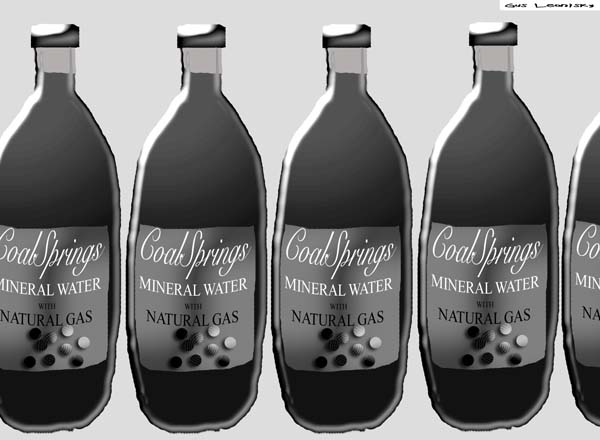
see toon at top...
no-gas olivia
OLIVIA Newton-John is the latest celebrity to take on the powerful mining industry over environmental issues.
Newton-John, the United Nation's Goodwill Ambassador for the Environment, risks a ''Carbon Cate'' backlash over her public opposition - outlined today in The Sunday Age - to a controversial method of extracting natural gas from coal seams.
Newton-John is concerned about the use of hydraulic fracturing - known as ''fracking'' or ''fraccing'' - which injects huge volumes of water, sand and chemicals deep into shale rock to release gas for commercial use.
A boom in fracking over the past decade has fuelled an unlikely alliance between environmentalists and farmers, who claim the method contaminates ground water and soil, is linked to earthquakes and may even cause diseases such as leukaemia.
The campaign by Newton-John against coal seam gas has infuriated the influential mining lobby, which recently pilloried actress Cate Blanchett over her support of the carbon tax, dubbing her ''Carbon Cate''.
Read more: http://www.smh.com.au/environment/water-issues/stop-the-fracking-olivia-joins-cate-taking-on-miners-20110730-1i5kz.html#ixzz1TeoQ3pA5
see toon at top...
tonicchio? put aside all his blustering?...
...
With government and opposition simultaneously facing off and agreeing it is all a matter for the states, independent Tony Windsor rode on to the scene. He has a private member's bill, for which he will give notice tomorrow, to include concerns about water as a trigger for Commonwealth scrutiny of proposed mining projects. At present, intervention hinges on issues such as threatened species and World Heritage properties.
Windsor's idea seems to make sense. Clearly it is vital to safeguard water systems. The argument being advanced by some around the government against having two levels of approval ignores the fact that current legislation already involves this.
The government isn't commenting until it has seen the Windsor bill; the opposition points to the Senate inquiry reporting later in the year on coal seam gas (and indeed it would be logical to wait for that).
This may be an unrealistic proposition in the hung parliament - where life is lived in the campaign fast lane - but could we just hope that on the Senate committee there will be a search for some consensus? It should not be beyond the government and opposition to put aside all that blustering and think constructively for a minute.
Read more: http://www.smh.com.au/opinion/politics/time-to-let-constructive-solutions-rise-to-the-surface-20110820-1j3e8.html#ixzz1Vf1ivu2l
Tonicchio? Put aside all his blustering?... The only thing that keeps Tony Abbott politically alive is his constant lying blustering of opposing windbags... Without it, he would sink to titanical depths. His blustering is his lifeboy, his floaties, his dog paddle... Anything concrete that would work for all will be opposed by Tony Abbott because... because... he's Tony Abbott...
water in the gas...
Mining magnate Clive Palmer has launched a scathing attack on Australia's coal seam gas industry, saying the technology is unproven and could have a devastating environmental impact.
Concerns have been raised about the impact of the industry on water sources and its inability to find a permanent solution for waste disposal.
There is also a community outcry over the inability of landholders to say no to gas companies wanting to search for gas on their properties.
A Senate inquiry is examining the economic, social and environmental impacts of coal seam gas.
Speaking to the National Party's Federal Council in Canberra, Mr Palmer said a leading Chinese firm had raised issues with him about the Australian industry, saying extraction techniques they abandoned 20 years ago are still being used here.
The Queensland mining billionaire told the crowd that his Chinese counterparts had delivered a stern warning.
"Coal seam gas technology currently used in Australia is lethal and will kill Australians, poison our water table and destroy the land," he said.
http://www.abc.net.au/news/2011-08-27/clive-palmer-blasts-csg-industry/2858458
the gas leaks...
...the fact that technological advances had enabled the U.S. and many other countries to tap vast new reserves of shale natural gas should be good news, at least for the climate. As a fuel natural gas is cleaner and significantly less carbon-intensive than coal, while much cheaper than most renewables, at least at this point. While some studies have tried to argue that the manufacturing process for shale gas—which includes controversial hydrofracking—means that the fuel might be dirtier over the long term than coal, the general consensus is that natural gas emits about half as much carbon over its lifecycle as coal. Therefore, cheaper shale gas than enables utilities to switch from coal generation to natural gas should slow the warming of the climate—right?
Maybe not so much. In a new study that will appear soon in the journal Climatic Change Letters, National Center for Atmospheric Research (NCAR) researcher Tom Wigley crunches the numbers and finds that switching from coal to natural gas will do little to cool the climate—in fact, depending on production methods, it might actually speed up warming. Here's why: it's true that coal contains far more carbon than natural gas, and when coal is burned to produce electricity, that carbon ends up in the atmosphere, intensifying the greenhouse effect. But there's more than just carbon in coal—an average lump also contains large amounts of sulfur, ash other pollutants. When the coal is burned, those sulfates and other particles are also emitted into the atmosphere, and the smog and pollution they produce actually helps block incoming sunlight—cooling the Earth, and offsetting some of the warming effect of the carbon.
But natural gas contains far fewer such pollutants. Using complex climate modelling, Wigley found that a 50% reduction in coal and a corresponding increase in natural gas would lead to a slight increase in global warming over the next 40 years of about 0.1 F because of the reduction in the sulfates and other sunlight-blocking pollutants contained in coal. The amount of warming changed depending on how much methane might leak on average from natural gas drilling. (Natural gas is essentially methane, which is itself a powerful greenhouse gas—during the natural gas production process, small amounts of methane can escape into the atmosphere, adding to the greenhouse effect.) If the amount of methane leakage is about 2%—fairly optimistic—the switch to natural gas will keep adding to warming until the end of the 21st century, and the more methane that leaks, the longer that warming trend continues.
Read more: http://ecocentric.blogs.time.com/2011/09/09/natural-gas-can-save-the-climate-not-exactly/#ixzz1XXwK93Dp
gas damage...
Thousands of people have joined rallies around the nation to express concerns about the impact of the billion-dollar coal seam gas (CSG) mining industry.
Protesters gathered in New South Wales, Queensland and Western Australia in what is believed to be the largest demonstrations held in opposition to the controversial extraction technique.
Speakers at the rallies called on governments to stop granting mining licences for extracting coal seam gas because of the damage they say it causes.
Greens Senator Larissa Waters says urban and rural communities across Australia want governments to listen to their concerns about CSG industries.
She says politicians should not be blinded by the royalties and inflated jobs predictions.
"The royalties they get are not actually that great when it comes to a proportion of GDP and yet they're risking our highly profitable agricultural and tourism industries," she said.
"It's about time they took the dollar signs out of their eyes and looked to the long term about what's going to be good for this nation in 20, 30, 50, 100 years' time."
In NSW alone there were 20 rallies, including one at Sydney's Martin Place where about 400 people heard claims that CSG mining could damage major water sources.
http://www.abc.net.au/news/2011-10-16/csg-protests-around-the-nation/3573792
see toon at top...
fracking quakes...
By HENRY FOUNTAINA British seismologist said Friday that two minor earthquakes in northwestern England “appeared to correlate closely” with the use of hydraulic fracturing, a method of extracting natural gas from wells that has raised concerns about environmental and seismological risks in the United States.
The scientist, Brian Baptie, seismic project team leader with the British Geological Survey, said data from the two quakes near Blackpool — one of magnitude 2.3 on April 1, the other of magnitude 1.5 on May 27 — suggested the temblors arose from the same source. Cuadrilla Resources, a British energy company, was conducting hydraulic fracturing, or fracking, operations at a well nearby when the quakes occurred.
In fracking, water, sand and chemicals are injected into a well at high pressure to split shale rock and release trapped gas.
The company suspended its fracking operations shortly after the second earthquake, which, like the first, was barely felt and caused no damage. Paul Kelly, a Cuadrilla spokesman, said a report by several academic scientists on the quakes, commissioned by the company, should be released in a few weeks.
“We’re waiting for the independent report,” he said.
One possibility is that the British government, through the Department of Energy and Climate Change, might require modification to the fracking process.
Mr. Kelly said Cuadrilla Resources had drilled three wells — the only shale-gas wells so far in Britain — and had conducted fracking operations at only one.
Fracking is now widespread in the United States, and has been blamed by some landowners, environmentalists and public officials for contaminating waterways and drinking water supplies. Some critics have also said that the technology could cause significant earthquakes.
But Stephen Horton, a seismologist at the University of Memphis, said, “Generally speaking, fracking doesn’t create earthquakes that are large enough to be felt.” Even so, Mr. Horton said that after looking at the British Geological Survey’s analysis of the Blackpool earthquakes, “the conclusions are reasonable.”
http://www.nytimes.com/2011/10/22/science/earth/22fracking.html?hpw=&pagewanted=print
blackpool tremors...
Fifty separate earth tremors have been caused in the Blackpool area by "fracking", the drilling method used to extract shale gas, The Independent has learnt.
The huge number of seismic movements was admitted yesterday by one of the authors of a report into two very noticeable earth tremors likely to have been caused by the fracking operations of Cuadrilla Resources, which says it has discovered enormous supplies of shale gas in the Blackpool area.
The report, which the energy firm commissioned, concluded it is "highly probable" that Cuadrilla's operations were responsible for two tremors which hit Lancashire. The first, of magnitude 2.3 on the Richter scale, hit the Fylde Coast on 1 April followed by a second of magnitude 1.4 on 27 May. The report, which is being sent to the Government, has intensified the controversy around "fracking", or hydraulic fracturing, which involves pumping water, sand and chemicals at high pressure into shale rock, to release the gas it holds.
http://www.independent.co.uk/environment/green-living/exclusive-fracking-company--we-caused-50-tremors-in-blackpool--but-were-not-going-to-stop-6256397.html
a leak is killing trees...
The Greens have demanded an explanation from the New South Wales Government about claims that trees are dying near a coal seam gas (CSG) project in the state's north.
Narrabri resident Tony Pickard contacted the ABC, saying coal seam water has leaked from a dam at a project run by mining company Santos.
Santos has denied there is a leak but Mr Pickard says he believes a leak is killing trees in the Pilliga State Forest.
"I've even got photos which I took myself to prove it's happened," he said.
"They show dead trees and grass and pools of black water."
Mr Pickard says he first flagged problems at the Santos project early last year 2011.
"Twelve months ago I let the Department of Primary Industries know there were holes in the dam's liner but I was ignored," he said.
http://www.abc.net.au/news/2012-01-02/greens-claim-csg-mine-poisoning-trees/3755362
toxic chemicals from CSG...
CSG mine leaks toxic chemicals into environment
Dangerous levels of toxic heavy metals have been uncovered in water and soil around coal seam gas wells in the Pilliga State Forest in north-western NSW.
http://www.abc.net.au/news/2012-02-08/csg-mine-leaks-toxic-chemicals-into-water/3819060?WT.svl=news2
a blow to gas...
In a blow to the US oil and gas industry, a judge has ruled small towns in New York have the authority to ban drilling, including the controversial method known as fracking, within their borders.
In a ruling released late on Tuesday, State Supreme Court justice Phillip Rumsey held that the Ithaca suburb of Dryden's recent ban on gas drilling falls within the authority of local governments to regulate local land use.
Anschutz Exploration Corporation, which owns leases on more than 8,900 hectares in the town and has invested $5.1 million in drilling operations there, argued the ban violated a state law designed to create uniform regulations for oil and gas drilling and encourage the extraction of those resources.
But Justice Rumsey disagreed, holding the law was not written to favour the industry, but to regulate it in such a way that "prevents waste ... and protects the rights of all persons".
http://www.abc.net.au/news/2012-02-22/us-judge-upholds-fracking-ban/3844984
leaking in the river...
The Queensland Government has put a stop to work on an underground pipeline after the release of drilling fluid into the Condamine River on the Western Darling Downs.
Contractors for leading Australian coal seam gas explorer QGC notified the Environment Department of the incident earlier this week.
Environment Minister Andrew Powell says initial reports suggest it has had no significant impact on water quality as contractors took steps to contain the spill and pump it out of the river, downstream of the Chinchilla Weir.
He says work will not resume until the department is satisfied the operation can be undertaken without further impact.
But Lock the Gate Alliance spokesman Drew Hutton says that is not the point, and the incident is of great concern.
"Too few of the people involved in the drilling operations just simply aren't trained adequately for the job, so we'll continue to be having these many small incidents which together will create a cumulative impact which is unacceptable," he said.
http://www.abc.net.au/news/2012-04-28/drilling-scare-halts-coal-seam-gas-work/3977786See toon at top...
uncertain at best
(CNN) -- Vermont's governor has signed a bill making it the first U.S. state to ban fracking, the controversial practice to extract natural gas from the ground.
"This is a big deal," Gov. Peter Shumlin said Wednesday. "This bill will ensure that we do not inject chemicals into groundwater in a desperate pursuit for energy."
Shumlin said fracking contaminates groundwater and the science behind it is "uncertain at best." He said he hopes other states will follow Vermont's lead in banning it.
http://edition.cnn.com/2012/05/17/us/vermont-fracking/index.html?hpt=hp_t2
See toon at top
opened up to further industrialisation...
THE grinding, clanking whirr of the first commercial coal seam gas well approved under the O'Farrell government can be heard long before the drilling machinery itself can be seen through the trees.
Nearby residents were taken unawares when drilling began a few weeks ago at the well site, operated by the gas company AGL, at Sydney's south-western fringe on the banks of the Nepean River. A further 70 wells are now planned, stretching up along the city's western boundary towards Liverpool.
''The problem is, once these areas are industrialised, they are opened up to further industrialisation,'' said Jacqui Kirkby, a Scenic Hills resident, who sits on AGL's community consultative committee.
''People say, 'oh, you've already got 70 gas wells there, the area's lost its environmental and heritage value, so we might add a light industrial estate in there too', and so on.''
When the state government released its long-awaited strategic regional land use plan on Tuesday, it also approved another pending 22 coal seam gas drilling licences across NSW. One of those is petroleum exploration licence number 2, held by AGL, which covers much of Sydney's western suburbs. Another, held by Apex Energy, covers Sydney's drinking water catchment, where the company hopes to drill between 150 and 200 wells to supply a fifth of Sydney's gas.
Read more: http://www.smh.com.au/environment/floodgates-have-opened--csg-opponents-20120912-25svp.html#ixzz26IdJWTxW
see story and toon at top...
pure gaseous coincidence...
How far would a mining company go to keep track of its opponents? About 2500 kilometres might be the answer.
That's the distance travelled across America by executives of the coal seam gas giant Santos who arrived at an isolated ranch in Wyoming just a week after the NSW Greens MP Jeremy Buckingham.
Mr Buckingham, a mining opponent, believes he was trailed across the US. But Santos insists it was pure coincidence that its fact-finding team of two visited the same property in Pavillion, Wyoming, population 231, in the heart of Brokeback Mountain country.
But emails to Mr Buckingham from a Wyoming rancher, John Fenton, show Santos's Adelaide-based coal seam gas policy and communications manager, Matthew Doman, and his travelling companion, Warwick Moppett, a Gilgandra farmer and Santos employee, were ''on the trail'' of Mr Buckingham shortly after he attended an anti-gas rally in Washington DC in late July.
In the first in a series of coincidences, the Santos team said they were there as interested observers. Pictures show they were filming the rally. Mr Fenton emailed Mr Buckingham: ''When my friend Deb took pictures of them [at the rally] they got upset and held their hands out to block the camera. Deb had them figured as industry.
''Well, just about 30 minutes ago they showed up unannounced at our farm. They wanted to look around and see 'how things were done here'. We have a meeting to go to tonight, so I had no time to spend with them. They gave all the typical industry talking points that we are familiar with, 'we are going to do it right, we respect the land and the people on the land'.
Read more: http://www.smh.com.au/nsw/we-were-just-sightseeing-not-spying-santos-20120929-26s4c.html#ixzz27uJTBS5S
fudging the advert...
Warwick Moppett posed for Santos pro-CSG ads in front of crops he didn’t farm on land neither he nor Santos had any permission to enter.
DON HUBBARD is a fourth generation farmer, and grows canola, sorghum, durum wheat, cotton and sunflowers. He has two properties at Spring Ridge, Cooininee and Tavetare, at the foot of Mt Coolanbilla. He’s lived on the property since he was 5 years old and knows it like the back of his hand.
So, when he sat down to relax during spring this year after a day’s canola harvesting, he was shocked to see his property – and that of his neighbours, Ben and Phoebe Clift – featured in a Santos coal seam gas (CSG) ad on the TV.
http://www.independentaustralia.net/2012/environment/sneaky-santos-caught-out-in-csg-con/
of plagiarists...
Bloggers stealing their stories from the mainstream media? If Sandi Keane‘s experiences areany guide, the opposite is more likely to be true.
MAINSTREAM MEDIA constantly spin the line that online journalists are plagiarists, who – while they wear out “boot-leather” chasing stories – simply re-shovel their hard-earned efforts.
Well, in my experience, the boot is quite often on the other foot.
I’m an online journalist who likes to break stories? My view is ― why bother to write if you aren’t the first or don’t have an original angle? And I break stories regularly ― through hard-core, painstaking, detailed, time-consuming – often expensive – investigative reporting.
Anyway, this week the mainstream media appropriated my hard-earned investigative efforts without any attribution at all. And this is far from the first time this has happened to me. As for this publication, it seems to happen on about a weekly basis these days.
If that wasn’t bad enough, the mainstream media go on and on about how they (unlike us mere mortals in the online world) provide “context” to stories ― remember their sanctimonious superiority over Gillard’s misogyny speech? Yet, not only did the mainstream media outlets in question – the ABC and the Australian Financial Review – re-shovel my story —they also failed to provide any context. Yes, they explained that Santos had pulled its CSG ad ― but they failed to explain the “how” and the “why”.
One would be forgiven for thinking, after reading their reports, that it was their investigations that had led to Santos shelving the ad. In fact, they did nothing of the sort ― basically, all they did was take my hard work and use it as their own.
http://www.independentaustralia.net/2012/business/media-2/how-the-msm-flogs-stories-from-blogs/
see article above... and toon at top...
leaky like a coal seam gas field...
Vast amounts of methane appear to be leaking undetected from Australia's biggest coal seam gas field, according to world-first research that undercuts claims by the gas industry.Testing inside the Tara gas field, near Condamine on Queensland's Western Downs, found some greenhouse gas levels over three times higher than nearby districts, according to the study by researchers at Southern Cross University.
The study has potential national consequences because last week's energy white paper forecast a massive expansion of Australian coal seam gas drilling, and called for environmental objections to be removed to make large-scale gas extraction easier
Methane, carbon dioxide and other gases appear to be leaking up through the soil and bubbling up through rivers at an astonishing rate, the researchers said.
"The concentrations here are higher than any measured in gas fields anywhere else that I can think of, including in Russia," said Damien Maher, a biochemist who helped conduct the tests. "The extent of these enriched concentrations is significant."
Read more: http://www.smh.com.au/environment/methane-leaking-from-coal-seam-gas-field-testing-shows-20121114-29c9m.html#ixzz2CBlyD3RO
See toon at top...
a one-stop stuff-you...
The Coalition says it will 'get around' a new law to force the federal government to take responsibility for coal seam gas, giving power for environmental assessments to the states to speed up the approval process and boost the CSG industry.
In June the Senate is likely to pass the Gillard government's legislation requiring the federal government to take account of the cumulative impact on the water table of developments like coal seam gas wells.
The bill, which inserts water as a trigger under the Environmental Protection and Biodiversity Conservation Act, was amended in the lower house at the initiative of Independent Tony Windsor. The amendment was intended to "put beyond doubt" that the commonwealth had to give the final approvals for coal seam gas wells, taking into account their impact on water, and that it could not hand this power over to state governments. The Coalition opposed the amendment, but did not oppose the bill, which passed.
But Coalition resources spokesman Ian Macfarlane says that the new law, even with Windsor's amendment, "contains nothing to prevent" the Coalition from proceeding with its stated policy intention to hand over environmental assessments to the states, including for gas wells, under strict standards set by the commonwealth.
"We can get around it,' he said. 'We want a one stop shop, and that's what we will achieve. We'll delegate approvals to the states. We already have an expert panel to assess water impacts. Labor is assuming the state governments are incompetent and don't have processes in place to deal with it," he said.
"The only thing they will actually achieve is a slower approval process for no environmental benefit, because if the state is handling an assessment and approval they will have to add this to their process".
http://www.guardian.co.uk/world/2013/may/30/coalition-coal-seam-gas-law/print
Unkonventionelle. Erdgasförderung stoppen...
Germans are concerned about the risks of fracking, a method to extract oil and gas: Chancellor Angela Merkel sends out words of caution, environmental experts say it’s dispensable. But in Europe, fracking is on the rise.
There is hardly anything that Germans are as much afraid of as environmental risks in the soil. Thousands take to the streets regularly against plans to store nuclear waste deep underground. And lately, there have been active initiatives against fracking - despite the technique not yet being commercially used on a large scale. At least not in Germany.
Hydraulic fracturing, or fracking, as it is more commonly known, is a method to release petroleum or natural gas from rock formations by injecting a mixture of water, sand and chemicals deep underground at high pressure. Oil and gas can then be extracted; but parts of the chemical cocktail remain in the soil. That's why environmental experts warn that fracking could pollute the groundwater.
Fracking has experienced a boom over recent years in the United States. Experts have said the US could soon even overtake Russia as the world's top gas producer. There are calculations that suggest Germany could satisfy its own gas demand for 13 years if it decided to use the controversial extraction method. Fracking was done to a limited degree in Germany until US fracking activities triggered a controversial debate. Companies had to stop all fracking activities in Germany as a result.
http://www.dw.de/fracking-evokes-angst-in-germany/a-16853076
fracking the gas of the earth...
(SPRINGFIELD, Ill.) — Illinois lawmakers approved a measure Friday to create the nation’s strictest regulations for high-volume oil and gas drilling, hoping to kick-start an industry that supporters say could generate thousands of jobs in economically depressed areas of southern Illinois.
...
Among the provisions in the proposed legislation are requirements that drillers publicly disclose the chemicals they use and that they test water before and after fracking. Companies also would be liable for any water pollution.
“These are tough regulations that are going to protect and preserve our most valuable resources in our state,” sponsor Sen. Mike Frerichs, a Champaign Democrat, said on the floor. “This bill is a long time in coming.”
Energy companies are eyeing the New Albany shale formation in southern Illinois, where they believe there are significant oil reserves 5,000 feet or more below the surface.
While the measure passed easily in both chambers, the road there wasn’t easy. An amendment requiring energy companies to hire a state-licensed water well driller delayed the vote for more than a month before industry and unions reached a compromise that gives drillers a break on extraction taxes if at least half of their employees are from Illinois.
Two bills proposing a moratorium were offered, but neither gained traction.
Opponents also say the proposed regulatory legislation would leave Illinois communities with no control over the practice.
http://nation.time.com/2013/05/31/ill-passes-nations-toughest-fracking-regulations/
See chemicals used by frackers in Australia at:
http://www.yourdemocracy.net.au/drupal/node/25853
oil and water...
Beverly McGuire saw the warning signs before the town well went dry: sand in the toilet bowl, the sputter of air in the tap, a pump working overtime to no effect. But it still did not prepare her for the night last month when she turned on the tap and discovered the tiny town where she had made her home for 35 years was out of water.
"The day that we ran out of water I turned on my faucet and nothing was there and at that moment I knew the whole of Barnhart was down the tubes," she said, blinking back tears. "I went: 'dear God help us. That was the first thought that came to mind."
Across the south-west, residents of small communities like Barnhart are confronting the reality that something as basic as running water, as unthinking as turning on a tap, can no longer be taken for granted.
Three years of drought, decades of overuse and now the oil industry's outsize demands on water for fracking are running down reservoirs and underground aquifers. And climate change is making things worse.
In Texas alone, about 30 communities could run out of water by the end of the year, according to the Texas Commission on Environmental Quality.
Nearly 15 million people are living under some form of water rationing, barred from freely sprinkling their lawns or refilling their swimming pools. In Barnhart's case, the well appears to have run dry because the water was being extracted for shale gas fracking.
http://www.theguardian.com/environment/2013/aug/11/texas-tragedy-ample-oil-no-water
clueless nats...
Tony Windsor, the former independent MP, has warned the Coalition it risks haemorrhaging support in its rural heartland over its backing of coal seam gas extraction, claiming the industry minister, Ian Macfarlane, “doesn’t have a clue” about the issue.
Windsor told Guardian Australia there was “great concern” in rural and regional Australia over the Coalition’s desire to streamline environmental regulations around coal and gas projects by handing approvals powers to the states.
The former MP for New England said the government was looking to bypass the “water trigger” legislation he introduced in the last parliament, which requires the federal environment minister to assess any development that is likely to have an impact on water quality.
"I think they would ideally want to repeal it under the guise of green tape, once there is a change in the Senate. Either that or there will be subtle instructions to those carrying out the assessments. Given that the government seems to want to remove anything with independent or Labor hands on it, anything can happen,’ he said.
Opponents of coal seam gas extraction claim the process, which involves “fracking” underground minerals in order to release gas, threatens natural aquifers which are vital for rural and farming communities.
“These guys [the Coalition] are pandering to the mining and coal seam gas sector, which will potentially lead to conflict in some areas,” Windsor said.
“We simply don’t know what the impact on water is, which is where the water trigger and risk assessments come into it.
“They’ll try to bypass the water trigger, no doubt about that, and they’ll have some allies in the Labor party for that. Most of the people in parliament don’t come from the areas where there’s a problem, but I think people will look at what happens and vote accordingly.”
http://www.theguardian.com/environment/2013/dec/02/tony-windsor-warns-coalition-on-coal-seam-gas-threat-to-water
secrecy about CSG....
Landholders on Queensland's Darling Downs say they are being kept in the dark about the nature of serious environmental harm allegedly caused by an experimental coal gasification plant.
Last week the Queensland Government filed four criminal charges of irreversible or "high impact" harm relating to the plant against resources company Linc Energy.
It emerged the state's environment department began investigating suspected environmental breaches nine months ago, but landholders told the ABC that the first they had heard of it was last Friday.
Linc Energy faces four charges of "wilfully and unlawfully" causing serious harm, each of which carries a fine of more than $450,000 or five years in jail.
The company rejected the charges as "misguided".
The ABC understands one of the charges related to a so-called overburden fracture, a crack in the layers of rock and soil that sit above the coal seam.
In some cases this can lead to the escape of gases into the air or allow groundwater into the cavity.
http://www.abc.net.au/news/2014-04-16/landholders-claim-secrecy-over-experimental-coal-gasification/5395626
fracturing ancestral lands...
The first Alice Eather knew of Paltar Petroleum’s plans for her ancestral land was when she read a square-inch notice buried in the back pages of the NT News. The August 2012 announcement detailed an application by the US giant for a license for exploratory oil and gas drilling. If successful, it planned to carry out hydraulic fracturing, or fracking, around the coastline of Maningrida in West Arnhem Land.
“It was the most horrible day of my life,” says 24-year-old Eather. “No one was told a thing. There had been no consultation and the ad said we would be given two months to object.”
Objections from the region’s myriad Aboriginal clans and some 13 language groups have since been vocal and persistent. Almost two years on, leaders from the Protect Arnhem Land campaign say they will take their battle as far as the high court if necessary.
“I had never done any of this in my life,” says Queensland-raised Eather, whose mother is from the Kunibidji people of Maningrida. “But our job is to protect country. If we don’t do this, we are not doing our duty.”
http://www.theguardian.com/world/2014/jun/13/offshore-fracking-fight-washes-up-arnhem-land
Russia and environmentalists are not friends...
Russia doesn’t want Europe fracking for natural gas because Russia wants to keep exporting natural gas there itself. And environmental groups don’t want Europe fracking for natural gas because, well, because fracking is an environmentally heinous method of getting a climatically heinous fuel out of the ground. But Russia and environmentalists are not friends. Russia locked up green activists on trumped-up charges for criticizing the environmental impacts of the recent Winter Olympics. And Russia locked up members of Greenpeace for three months late last year after they attempted to scale an oil rig to protest Arctic drilling.
But if NATO’s secretary general is to believed, opposition by Greenpeace and other environmental organizations to fracking is the result of infiltration or collusion involving Russian agents.
“I have met allies who can report that Russia, as part of their sophisticated information and disinformation operations, engages actively with so-called non-governmental organizations, environmental organizations working against shale gas – obviously to maintain European dependence on imported Russian gas,” said NATO’s Anders Fogh Rasmussen, the former prime minister of Denmark, during a talk at the Chatham House international affairs think tank in London on Thursday.
Well, obviously. But who are these allies? Has Russia sent undercover operatives to sneak into green groups? Or is there some sort of collaboration between the should-be foes?
Rasmussen didn’t elaborate. “That’s my interpretation,” he said.
Green groups have denied the bizarre allegations. “The idea we’re puppets of Putin is so preposterous that you have to wonder what they’re smoking over at Nato HQ,” Greenpeace said.
And NATO promptly distanced itself from the allegations, describing them as Rasmussen’s personal views.
read more: http://grist.org/news/nato-chief-accuses-fracking-opponents-of-being-russian-puppets/
rocking the boat?...
The Port of Brisbane has banned a security guard for displaying an anti-coal industry sign in her car.
Kym Garrick's employer Corporate Protection Australia Group fired her from her job at the port earlier this month, telling her it was because she displayed a sign that read "Coal Dust Free Brisbane".
Ms Garrick said she was warned about the sign by staff at the Port of Brisbane and initially removed it, then changed her mind and put it back.
"I felt angry, frustrated and belittled. Also, this is a democracy and I wanted to have my say on something that I truly believe should happen," she said.
The security guard has now been banned from all five of the Port of Brisbane's sites.
In a letter to Ms Garrick, Corporate Protection Australia Group said: "We acknowledge you did remove the sign, but recently returned to site with this sign displayed again. The Port of Brisbane have advised us that you are unfortunately banned from their sites."
A spokesman for the Port of Brisbane said the company would not be making any comment on the issue.
Corporate Protection Australia Group has confirmed Ms Garrick is no longer working for the firm.
A spokesman said she was removed from work at the port due to a security risk.
Ms Garrick reacted angrily, saying: "They don't want anyone to ruffle their feathers."
http://www.abc.net.au/news/2014-08-25/brisbane-woman-fired-over-anti-coal-sign-on-car/5695320
anti-CSG rally in Lismore's CBD...
More than 5,000 protesters turned out on the NSW north coast to show their anger at plans to try to restart a coal seam gas (CSG) project in the area.
The anti-CSG rally took place in Lismore's CBD and was staged in response to a court case in progress which is dealing with the suspension of a CSG licence in the area.
The NSW Government suspended the licence six months ago and the issue is now before the courts waiting on a decision about the validity of the suspension.
Residents in northern NSW have continued to show their strong opposition to CSG has not changed, with march organisers saying the big turnout was a message to gas companies and the government.
Rock Valley farmer Bevan Jolley said he has become disillusioned with the National Party, which he once identified with.
"I've voted National Party ever since I got to vote and I am 70 years of age now but I am very disgruntled with the way local pollies are treating us," Mr Bevan said.
"They get our vote and then when something big like this [CSG] comes up they seem to not want anything to do with it. When they go back to Parliament they don't bring it up."
Mr Jolley said it is not in his nature to protest but he feels he has to because he is concerned about the effect of CSG on ground water on and near his property where he runs beef cattle and grows macadamias.
"Everyone doesn't want to have to protest to try to stop something ... we vote in politicians to do the job for us but these fellas aren't doing it," he said.
"If you bugger up that underground water, that's it, you can't fix it."
Lismore Mayor Jenny Dowell said she was pleased with the large crowd turn-out.
read more: http://www.abc.net.au/news/2014-11-01/5000-turn-out-for-anti-csg-protest-in-lismore/5859844
read from top...
birth place of fracking bans fracking...
The Texas town where America’s oil and natural gas boom began has voted to ban fracking, in a stunning rebuke to the industry.
Denton, a college town on the edge of the Barnett Shale, voted by 59% to ban fracking inside the city limits, a first for any locality in Texas.
Organisers said they hoped it would give a boost to anti-fracking activists in other states. More than 15 million Americans now live within a mile of an oil or gas well.
“It should send a signal to industry that if the people in Texas – where fracking was invented – can’t live with it, nobody can,” said Sharon Wilson, the Texas organiser for EarthWorks, who lives in Denton.
An energy group on Wednesday asked for an immediate injunction to keep the ban from being enforced. Tom Phillips, an attorney for the Texas Oil and Gas association, told the Associated Press the courts must “give a prompt and authoritative answer” on whether the ban violates the Texas state constitution.
Athens in Ohio and San Benito and Mendocino counties in California also voted to ban fracking on Tuesday. Similar measures were defeated in Gates Mills, Kent and Youngstown, Ohio, as well as Santa Barbara, California.
http://www.theguardian.com/environment/2014/nov/05/birthplace-fracking-boom-votes-ban-denton-texas
Now if you read: crazy gas... above, you will note that the place where the fracking was planned in inner Sydney could be replaced by a bigger road...
Image from the SMH. Read more: http://www.smh.com.au/nsw/anger-as-residents-lose-homes-tunnel-threatens-iconic-pub-20141105-11h57z.html
See also westCONnex... Here we see how not to do things. The only valid exit from the "new St Peters" interchange is the south of Campbell road, through to the airport and Botany Bay. All the other exits are just going to massively clog up nonetheless, despite "widening the roads" and destroying about 80 houses. I believe this "widening" is only done as an underhand payola to developers to build high rise developments on the side of new wider roads, while destroying the character of the place and WOULD NOT IMPROVE TRAFFIC AT ALL. Trust me.
Before building the M5 extension and useless widening of roads, the M4-M5 link should actually be built to concord right to the M5 as a tunnel, as well as create the south Campbell link to Botany Bay (through empty industrial estates), should one desire to mitigate traffic for a few years. It is my view the ministers are going at it arse up — about to create far more traffic jams than ever before in St Peters. And these exits will be the gates of hell, not St Peter's Pearly Gates...
bad planning beyond belief...
Plans for a motorway interchange to be built near congested local roads in Sydney's inner west are "absurd" says shadow federal transport minister Anthony Albanese.
Mr Albanese wrote to the chair of the WestConnex Delivery Authority, Tony Shepherd, and the NSW Roads Minister, Duncan Gay, last week to ask for a briefing on the plans announced for new M5 East tunnels to emerge at St Peters.
As Transport Minister in the former federal Labor government, Mr Albanese promised $1.8 billion for the 33-kilometre WestConnex motorway.
But the release of early detail of a major section of that motorway – tunnels to duplicate the chronically congested M5 East – has prompted a backlash from a number of Labor politicians.
AdvertisementThese include shadow transport minister and candidate for Newtown Penny Sharpe, Member for Heffron Ron Hoenig and now Mr Albanese.
In his letter, Mr Albanese wrote: "From what has been published, the proposal to widen the M5 and dump traffic at "St Peters Interchange" is absurd.
"The notion that delivering additional traffic to King St Newtown (and parallel congested back routes) represents proper planning is beyond belief," he wrote.
According to the WestConnex Delivery Authority's proposal, six-lane motorway tunnels will emerge at St Peters – at the edge of Mr Albanese's electorate of Grayndler – in about 2019.
Read more: http://www.smh.com.au/nsw/shadow-transport-minister-albanese-rubbishes-westconnex-interchange-plan-20141109-11jbyt.html#ixzz3IbpYL0D1
See also: http://www.yourdemocracy.net.au/drupal/node/21739
the tas solution...
The Tasmanian Government will ban the controversial mining practice known as fracking for another five years.
Fracking involves injecting liquid at high pressure into underground rocks to extract oil or gas, and the practice has sparked controversy in New South Wales and Queensland.
Primary Industries Minister Jeremy Rockliff, who declared a one-year fracking moratorium in March 2014, considered 155 submissions on the subject.
In a statement, Mr Rockliff said there was uncertainty around fracking, and his decision would "protect Tasmania's reputation for producing fresh, premium and safe produce".
"There is considerable concern around the potential negative impacts of fracking, particularly within our rural communities and farming families who rely so heavily on our global reputation for producing premium and safe products," he said.
"It is also clear that there is considerable concern for landowners' rights and public and environmental health.
read more: http://www.abc.net.au/news/2015-02-26/fracking-banned-for-five-years-by-tasmanian-government/6265378
gas leaks in chinchilla...
Mining company Linc Energy allegedly failed to report a series of dangerous gas leaks at its experimental Chinchilla coal gasification plant in Queensland and instead covered them up, according to court documents.
Search warrants and other documents filed in the Supreme Court in Brisbane allege a series of unreported incidents at the plant, unearthed as part of a major state government investigation after tip-offs from former workers.
They include a fire that caused Linc to evacuate the site in 2007, persistent leaks of toxic gas into the air and groundwater between 2008 and 2011, and an alleged attempt by management to hide problems at the site from government officials in 2012.
Workers even had nicknames for some of the gas leaks: "Mr Bubbles" and "Puffing Billy".
Underground coal gasification (UCG) is a controversial technique involving the ignition of the coal seam, with oxygen pumped into a well to allow for the combustion of coal, which then produces synthesis gas or syngas.
read more: http://www.abc.net.au/news/2015-03-17/linc-energy-accuse-failing-report-series-of-dangerous-leaks/6323850
flares that are not in fashion...
AGL's dangerous flaring of wells at its Waukivory Road CSG field in Northern NSW has again demonstrated the ineffectiveness of the NSW EPA in monitoring and regulating gas leaks, writes Lachlan Barker.
AGL are presently undergoing the process of flaring off at their controversial Waukivory Road CSG field at Gloucester on the NSW North Coast. This has raised high level of concern among the residents of the area.
The flaring off is deemed necessary due to increased gas pressure under the Waukivory road field. Normally when there are pressure issues with gas, water is used to equilibrate the pressure. However this method is denied AGL as the wells on Waukivory road are the wells that showed dangerous BTEX chemicals in the flowback water and so the NSW EPA suspended water movement in and out of these wells.
In general with CSG wells, if the pressure is too low, water is pumped in to force the gas to the surface, while, as in this case, if the gas pressure is too high, water is pumped out to reduce. However, with the water suspension, AGL’s only alternative is to flare off.
This however raises serious concerns over the long term ramifications of flaring off. While the flaring in the short term will reduce the pressure, there is no clear picture of whether AGL will now have to do this repeatedly, over time, to keep the gas pressure under control. AGL were contacted and asked this, but have not responded.
Flaring is a problem in itself. For this reason, in January, flaring was banned in the US. The ban came about because of the emissions from the flaring — something no resident wants to have floating over the back fence. This is particularly relevant to Gloucester, as the EPA have admitted that there is BTEX (benzene, toluene, ethylbenzene, and xylenes) and other volatile organic compounds (VOCs) in the gas to be flared off.
read more: https://independentaustralia.net/business/business-display/agls-csg-blunders-flare-at-gloucester-and-expose-epa,7587
See toon at top...
jones is on the case...
Malcolm Turnbull will look into the suicide of a Queensland farmer and anti-coal seam gas protester, but warns the issues are almost entirely state-based.
The death of George Bender, a Chinchilla cotton farmer whose underground water bores had been affected by CSG activities, has fuelled calls for an inquiry into the human impacts of the industry.
Turnbull on Friday said he had received information about Bender’s death from broadcaster Alan Jones and would be “looking into it further”.
The prime minister did not elaborate on how this would proceed or to what aim.
But the issue of minerals exploration largely rests with the states, he stressed.
“They are almost entirely within the jurisdiction of state governments,” he said in Sydney.
“Not entirely but largely, very largely [this] is within the realm of state.”
Turnbull noted the farmer’s death, like all suicides, was “a shocking tragedy”.
He noted many people in rural Australia were enduring difficulties, such as ongoing drought in western Queensland.
On Thursday Queensland senator Glenn Lazarus demanded a halt to all CSG projects in the wake of Bender’s death.
http://www.theguardian.com/australia-news/2015/oct/16/malcolm-turnbull-csg-george-bender-suicide
reducing subsidence...
The government is to reduce the volume of natural gas extracted from under Groningen province again next year, following a recent Council of State ruling. The Council of State last month said a maximum of 27 billion cubic metres of gas may be extracted next year, compared with 33 billion cubic metres in 2015, pending a government rethink. The cut will have a €1.5bn impact on the treasury, finance minister Jeroen Dijsselbloem said after Friday’s cabinet meeting. However, it will not lead to extra spending cuts. ‘The more the gas supply is reduced, the more it costs us. But this is essential to make sure Groningen is safe,’ Dijsselbloem said. Tens of thousands of homes in the province have to be shored up because of the damage caused by earthquakes as the ground settles when the gas has been taken out.
Read more at DutchNews.nl: Less gas to be extracted in Groningen next year to head off quake risk http://www.dutchnews.nl/news/archives/2015/12/less-gas-to-be-extracted-in-groningen-next-year-to-head-off-quake-risk/
pregnancy...
AGL has pleaded guilty to 11 counts of failing to declare political donations when submitting a development proposal for a coal seam gas project, which combined could attract penalties of up to $242,000.
In August 2014, community members in Gloucester in the NSW Hunter region uncovered undeclared donations from AGL to major political parties. With the NSW Environmental Defenders Office, they complained to the NSW environment office, which investigated and charged AGL with 11 criminal counts of breaching the act.
http://www.theguardian.com/environment/2016/feb/12/agl-pleads-guilty-to-11-counts-of-not-declaring-political-donations
toxic water...
The U.S. Environmental Protection Agency (EPA) has clearly documented the multiple risks — despite repeated dismissals from the oil and gas industry — that hydraulic fracturing (fracking) poses to drinking water supplies. However, the tables may be turning: Water itself now poses a risk to the already failing financial model of the American fracking industry, and that is something the industry won’t be able to ignore.
The U.S. is setting new oil production records as horizontal drilling and fracking open up shale deposits in places like North Dakota and Texas.
Fracking is based on the “hydraulic” process of using pressurized liquid to shatter shale rock to let the oil and gas inside escape. And while that liquid is a mixture of many hazardous chemicals, it is mostly water. And acquiring that water and then properly disposing of the toxic wastewater produced by fracking is becoming a big and expensive problem for the industry.
Gabriel Collins is a fellow in energy and the environment at Rice University, and in August he gave a presentation at the Produced Water Society Permian Basin 2018 event in Midland, Texas. There, Collins presented a business case for starting a large water processing company to service the fracking industry.
One sign that the fracking industry is becoming concerned about water is that there are now societies and conferences dedicated to the topic of “produced water.” Produced water is the term for the toxic water that is “produced” over the life of a fracked oil or gas well.
In a story by Bloomberg News, Collins said he didn’t believe investors were aware of the risks that water poses to the fracking industry in the Permian Basin.
“[Investors] aren't as well apprised of some of the other risks and challenges that could be just as material, if not more so,” he told Bloomberg News. “I'd put water right at the top of that list.”
Why should water top the list of potential financial challenges facing the fracking industry? According to a study by Wood MacKenzie and reported by the Wall Street Journal, the costs of water disposal for the fracking industry could add another $6 per barrel of oil produced.
For the U.S. shale oil and gas industry, which has consistently lost money over the past decade, adding another $6 per barrel in costs represents a grim outlook.
Read more
https://www.desmogblog.com/2018/09/18/fracking-industry-waste-water-nigh...
Read from top.
Note the crazy gas... (read above) has been changed to the crazy WestCONnex...
happiness-producing gas...
In a real press release, the US undersecretary of energy Mark Menezes says that increasing export capacity from the Freeport liquefied natural gas (LNG) terminal off the coast of Texas is “critical to spreading freedom gas throughout the world.”
The potential for fart jokes here is endless, but let’s not even go there.
Now, if you thought “freedom gas” was the very worst phrase ever concocted by government propagandists, hold onto your hats for the next one. The release also quotes assistant secretary for fossil energy Steven Winberg, who waxes lyrical about these uniquely American “molecules of freedom” for export.
Wait a second. Isn’t government propaganda supposed to be at least mildly sophisticated? At least enough so that it doesn’t instantly produce a cacophony of incredulous laughter? “Freedom gas” has to be the best indication yet that the American government thinks its citizens are monumentally stupid.
What could be the opposite of freedom gas? Oppression gas? Oh that's right, Russian gas. Nah, it’s probably just a coincidence that this whole rebrand attempt has happened alongside US efforts to convince European countries to ditch cheaper Russian gas and opt for its more expensive LNG. Adopt your best caveman voice and say it with me: Russian gas bad, American gas good.
It’s so completely nuts that it almost sounds like a prank; like the person who hit ‘send’ on this release added those humiliating expressions out of sheer mischievousness. Sadly, that is not what happened. It seems the emergence of “freedom gas” can be traced back a few weeks, to when US energy secretary Rick Perry briefed press in Brussels, encouraging diversification away from terribly oppressed and unfree Russian gas.
Seventy-five years after “liberating Europe from Nazi Germany,” the US is “again delivering a form of freedom to the European continent” and “rather than in the form of young American soldiers, it’s in the form of liquefied natural gas,”Perry opined. Asked by a EURACTV reporter if “freedom gas” was how it should be described, Perry said: “I think you may be correct in your observation.”
Leaving aside his inaccurate historical comparison (the Soviet Union played a far larger role in defeating Nazi Germany than the US did), Perry obviously took a shine to the phrase and decided it was good enough to employ as an official term.
Even if US LNG was the cleanest, most environmentally-friendly, happiness-producing substance known to man, calling it “freedom gas” would still sound totally ridiculous. The fact that so much of it comes from the massively environmentally destructive practice of fracking –banned in multiple states and countries– just makes it pure garbage propaganda.
Indeed, the negative impacts of “freedom gas” production are well-documented. There’s the contaminated water supplies, the seismic activity and the potential impacts on the climate – some experts believe fracking could be even worse for the environment than coal.
Ah yes, freedom gas is so free that, in 2013, two kids aged seven and 10 years old, were given what was supposed to be a lifelong ban on ever even talking about fracking, after their parents reached a settlement with an energy company, claiming its activity had destroyed their 10-acre farm in Pennsylvania and caused headaches and nosebleeds.
Asked if the gag order applied to the whole family, including the children, an attorney initially said it did and they would“certainly enforce it” (although the company later said that would not be the case). So it’s freedom gas in Europe, but if you live near a fracking plant in the US, you’d better watch out for your health – and don’t even think about complaining. Who needs clean air and uncontaminated water when you can have patriotic slogans?
Read more:
https://www.rt.com/op-ed/460674-freedom-gas-fracking-propaganda/
Read from top.
shale fracking gas contributing to global warming...
Donald Raikes arrived at 2019’s DUG East conference, a major shale gas industry gathering in Pittsburgh, with a mixed set of messages for his fellow fossil energy officials.
“We are faced with a lot of challenges in this industry,” Raikes, senior vice president of gas infrastructure at Dominion Energy, said. “And this morning what I plan to do is use my time to carve out a call for action for all of us. We need to be very aware of the forces that are out there and how they are coming against us.”
What sorts of forces? Raikes warned specifically about opposition from environmental groups.
But Raikes also warned that the oil and gas industry was doing itself no favors by denying that it affects the environment, and he even dipped his toes into the issue of climate science denial.
“Regardless of how we feel about the term 'climate change,' the one thing I hope we all agree on is that each of us individually, as companies, impact the environment,” he said. “And it is our responsibility to do everything we can to make sure that we can be respectful in terms of that impact.”
“The second thing I'll tell you that I think is very critical when we look at these issues and communication is this: We can't sit on the sidelines and be climate deniers. We can't, because we disagree with what they're saying, we can't stick our head in the sand,” he added. “We have to be a player at the table or this policy will be set without us.”
Read more:
https://www.desmogblog.com/2019/07/16/dugeast-climate-deniers-dominion-r...
Read from top.
coal seam gas polutes...
The creeping years and becoming a grandfather for the first time to Beckett just 10 months ago have left Caton more focused than ever on not wasting the time he has left.
"I think the whole thing is to do as much good as you can while you can," he tells Australian Story in a candid and wide-ranging interview.
And in a case of life imitating art, Caton is channelling the underdog character he made famous in The Castle: Darryl "tell 'em they're dreaming" Kerrigan.
Just as Kerrigan fought to keep his modest home from being compulsorily acquired by the government, Caton has joined a campaign with farmers who are fighting a $3.6 billion coal seam gas project that's been approved in the Narrabri and Pilliga region of north-west New South Wales.
"The Castle has really gone to the heart of Australia and I think it's sunk in that you don't let the big fella walk all over you," Caton says.
Caton becomes 'pin-up boy' for farmersCaton's passion these days has turned back to the bush and his lifelong fascination with aquifers, which began when he sold Comet Windmills in his youth.
"It was in the middle of a terrible drought and people were desperate for windmills … because there was no surface water left and all that was left was the Artesian Basin which naturally flows, and the sub artesian basin, which is down 100 to 300 feet (30.4 to 91.4 metres), which you have to pump.
"I realised that the most important thing is not gold or silver, it's water, and without that the Australian grazing industry and a lot of the farmers are buggered."
It's at the core of Caton's concerns about the Narrabri Gas Project.
He and many farmers are worried that Santos's proposal to drill up to 850 coal seam gas wells in the Pilliga forest and surrounding Coonamble farmland in north-west NSW will deplete and possibly contaminate the groundwater supply.
Read more:
https://www.abc.net.au/news/2021-08-30/michael-caton-fighting-coal-seam-gas-mining/100371230
Read from top.
See also:
https://yourdemocracy.net/drupal/node/31007
https://www.yourdemocracy.net.au/drupal/node/25853
https://yourdemocracy.net/drupal/node/37689
https://yourdemocracy.net/drupal/node/26175
The fracking industry uses pollutants, by the tonnes, to extract the gas. Some of the "mild" pollutants use are listed below. The nastier stuff as used by many US companies is "secret"...