Search
Recent comments
- a peace deal....
16 hours 54 min ago - peace now!
18 hours 20 min ago - a nasty romance....
18 hours 25 min ago - blackmail?.....
20 hours 56 min ago - ukraine's agony has not started yet....
1 day 14 hours ago - all defeated.....
1 day 14 hours ago - beyond crime.....
1 day 15 hours ago - the end....
1 day 15 hours ago - odessa....
1 day 16 hours ago - weitz....
1 day 18 hours ago
Democracy Links
Member's Off-site Blogs
Social and individual intelligence
- By Gus Leonisky at 21 Oct 2005 - 9:12am
- Gus Leonisky's blog
- Login or register to post comments
Dolphin's rights
My dear fellow humans...
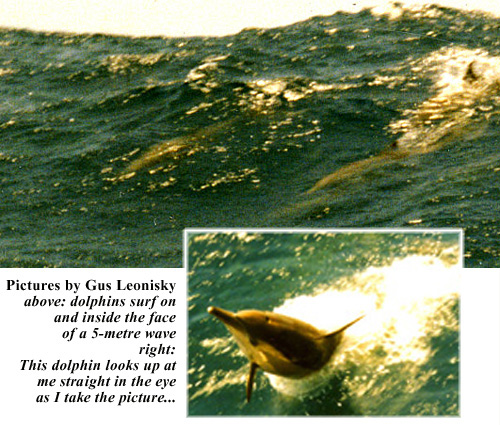
In late 1983, I did a small experiment using a small range sonar to gauge the impact on a very large pod of dolphins (more than a hundred). I was also trying to find out if there was a fish school also travelling in the same direction (no, I was not interested in fishing), that may have attracted their attention. Waves were about two metres on a three to four metre swell. The dolphins and our boat (under sail) were travelling between 8 and 10 knots in the same direction of the waves. Often some of the dolphins would take a wave and surf twenty or thirty in line for 50 or more metres, then they would slow back alongside the boat and look up. I saw a great intelligence in their eyes. Not so much in what one might call my anthromorphological projection of my knowledge onto them but in their own animalistic curiosity. Curiosity is the essence of intelligence.
The use of bombastic arrogant manipulation of knowledge to make others accept your viewpoint is not intelligent. It is cleverly psychopathic though, but not intelligent... Like our PM of the "Ratus rateous right" trying to enforce terrorizing laws we do not need. Clever but not intelligent. But I disgress...
On for just a few seconds (3 seconds max), the sonar had an immediate effect. The pod vanished instantly.
Since that day I have quietly campaigned against the use of strong powerful sonars by the various navies of the world including that of the US. These sonars can have devastating effect on the mammals living in the sea..
Imagine having a billion watts of garbled noise pumped into your living room. Even if it was music, you’d soon become deaf, be totally disoriented or even die should certain low frequencies be present (some very low noise frequencies are well-known to be able to "stop' the heart from beating). The strength of the noise is like having a cannon blast directly in your ears
Note: The technique of saturating the mind with music (at a more manageable level mind you), is used in discos for a few hours and by the US armies days on end to “not torture
Deadly music under the seas?
From the ABC
Navy distances itself from whale beaching
Tasmanian Greens Senator Christine Milne wants Defence Minister Robert Hill to investigate the proximity of Navy ships to a mass stranding of 130 pilot whales in Tasmania's south-east.
The whales died after beaching themselves at Marion Bay.
The Navy is distancing itself from the incident, with Commander George Sydney saying two Navy mine hunters arrived after the first stranding.
"From my understanding the whales would have been beached before the naval vessels were even in the vicinity of Marion Bay," he said.
Greens Senator Christine Milne wants to know if the ships were using sonar.
"It's well known and quite well established that naval exercises using mid frequency or low frequency sonar do have a negative impact on whales, killing them in some cases, and also disrupting their ability to navigate," she said.
Scientists are taking samples from the carcasses in an attempt to find out why the whales beached.
Jenni Burdon from the Tasmanian Parks and Wildlife Service says the appearance of naval ships in the bay has raised suspicions.
"A lot of people have been saying, 'has that got anything to do with it'. It's just one of those unknown questions," she said.
The Navy mine hunters are now returning to Melbourne.
What they did not say
A Gus mixed bag of reading between the lines...
Kyoto a failure, Macfarlane says
Federal Industry Minister Ian Macfarlane has declared the Kyoto Protocol on climate change a failure. He nearly added "we made sure of that..."
Campbell condemns 'war-like' whaling protests
Federal Environment Minister Ian Campbell has accused an international protest group of trying to damage Japanese whaling vessels in the Southern Ocean.
A ship belonging to the Sea Shepherd Conservation Society (SSCS) has joined two Greenpeace vessels in Antarctica trying to stop the killing of whales.
Paul Watson, the skipper of one of the protest ships, says he is surprised Australian authorities are not monitoring the campaign.
"This is supposed to be the Australian Antarctic territory and so you'd think there'd be at least one naval vessel down here overseeing what's going on," he said.
"I have officially requested from Australia that they send a naval vessel and for no other reason than to keep the peace, but I don't know, Australia seems to have surrendered its territory to Japan."
Senator Campbell says sending a ship would be counter-productive as Japan disputes Australia's claim on the territory.
Campbell nearly added: "And we mean what we wailed at the recent whaling conference... We ... er... What did we say again?"
Blackmailing for whaling...
Published on Sunday, May 13, 2001 in the Observer of London
Save the Whales?
Not if Japan's Bribes Pay Off
by Anthony Browne
Dominica is a speck on the world map, a beautiful Caribbean island smothered in dense volcanic jungle. With a population smaller than a typical British country town and landing space for nothing but the smallest planes, it is off the usual tourist trail.
But the island has found itself at the center of an international power struggle that will reach a climax in London in July. Ministers and diplomats from the world's richest countries have flocked here brandishing open check books, suitcases stuffed with cash - and, in some cases, muttering dark threats. The Caribbean nation may be home to fewer than 70,000 people, but it has one asset that other countries are prepared to pay big money for: a vote on the international body that sets the rules for commercial hunting of whales. With that vote, Dominica has a voice equal in weight to that of the US, the UK or Japan.
Dominica's Ministers have enjoyed a string of overseas trips with lavish VIP treatment normally reserved for royalty. Keen to get a ban on whaling lifted, Japan has flooded the country with cash and aid in the hope that Dominica will vote to allow slaughter to recommence.
In Dominica's hands - and those of a few other small nations - is the future of the world's great whales. Since the International Whaling Commission voted for a ban on whaling in 1982, some species such as minke and sperm have started recovering. The blue whale remains critically endangered.
In its desperate bid to overturn the moratorium and boost its whaling industry, Japan is using offers of aid and the threat of its withdrawal to get support from the world's poorest nations. Now anti-whaling nations and environmental groups are returning fire.
read more at the Observer
wailing for the whales
From the Independent
The great betrayal: Pro-hunting Japanese seize control of whaling commission
Through a lengthy, covert operation, Japan is poised to seize control of whale hunting - and that spells disaster for the endangered mammal
Published: 17 April 2006
The environmental movement is facing one of its biggest-ever reverses, over one of its most cherished causes: Save The Whale.
In a remarkable diplomatic coup, Japan, the leading pro-whaling nation, is poised to seize control of whaling's regulatory body, the International Whaling Commission (IWC), and so hasten the return of commercial whale hunting, which has been officially banned worldwide for the past 20 years.
While the world has been looking the other way, the Japanese have spent nearly a decade and many millions of dollars building up a voting majority in the IWC, by buying the votes of small member states with substantial foreign aid packages.
Their aim is to reverse the moratorium on commercial whaling brought in by the IWC in 1986 as a result of the long Save The Whale campaign by Greenpeace and other environmental pressure groups.
This has always been seen as of one of the environment movement's greatest success stories.
______________________
Gus says whaling has got to stop...
Paul calling Peter...
From the BBC
Dolphins 'have their own names'
Dolphins communicate like humans by calling each other by name, scientists in Fife have found.
The mammals are able to recognise themselves and other members of the same species as individuals with separate identities.
St Andrews University researchers studying in Florida discovered bottlenose dolphins used names rather than sound to identify each other.
The three-year-study was funded by the Royal Society of London.
Read more at the BBC
-----------
Yes, but do they fiddle a surplus budget with a bigger trade deficit and do they sell the public assets to private enterprises?
Stop the butchering of whales and dolphins...
Democratic murders?
From the ABC
Pro-whaling nations 'recruiting' ahead of vote
The federal Environment Minister says he fears whaling nations are actively recruiting votes in the lead-up to the next International Whaling Commission (IWC) meeting.
The IWC meets next month in Barbados to consider the return of commercial whaling.
Senator Ian Campbell fears that Japan and Norway may have the numbers to sway the vote in their favour.
In New York this week, Senator Campbell has held a series of discussions on the issue during a sustainable development conference at the United Nations headquarters.
"We've met with nations who are on our side," he said.
"Going through potential swinging votes and looking at what we can do to try and get that last couple of votes we need on the side of whale conservation.
"The news from those countries is that our worst fears about potential recruitment of pro-whaling nations is going on.
"We won't probably know how many nations have been recruited by the whalers until the eve of the conference."
------------------------------
The problem of democratic voting on this issue is that 200,000 "Nungelarnesians" may have the save voting power as 20 million "Aussielaneses" who in turn have the same voting as 90 million "Japanolesianoes"...
I hope more common sense would prevail in the realisation that whales and dolphins are "Truly Thinking Beings" still living in the wild not just beasts of blubber...
but this is the saddest part of humans. they think they are the only beast worth of eternal salvation... So, to those who peddle whale murdering, may they rot in their own little hells...
cheap expertise
From the ABC
Australia should soften anti-whaling stance, expert says
An international law expert says anti-whaling countries, including Australia, should be more willing to compromise and allow some whales to be killed.
The International Whaling Commission's (IWC) annual meeting begins tomorrow in St Kitts and Nevis in the Caribbean.
University of Western Sydney Associate Professor Steven Freeland says he expects the stalemate between anti-whaling and pro-whaling nations to continue.
He says anti-whaling nations should instead agree to allow some regulated whaling in order to reduce the number of the mammals being killed and protect endangered species.
"The alternative is that the anti-whalers will continue to decline any request for whaling for any reason, and the pro-whalers will take advantage of those loopholes that exist under the whaling convention and go ahead and whale anyway," he said.
----------------------
Gus: Human decrees do not make natural rights...
The "expert" in cheap international soup making, then realised oh too late that when he dies he will be reincarnated as a minke whale...
game over .....
‘Japan has succeeded in buying the votes that will give it
control of the International Whaling Commission (IWC) later this week, in a
major step towards bringing back commercial hunting of whales.
The pro-whaling nation has gained
the support of three more small countries to give it a definite majority in the
IWC, and so begin in earnest its attack on the international whaling moratorium
which has been in force for 20 years.
Its takeover of the IWC - likely
to become clear on Friday - will be a major reverse for the international
environmental movement, which has long thought that the fight for one of its
iconic causes - Save the Whale - had been largely won.’
Japan Buys
Votes To Take Control Of Whaling Body
Mad cowardise
From the ABC
Campbell encouraged by anti-whaling win
By Sarah Clarke and wires
Environment Minister Ian Campbell says he is encouraged by the International Whaling Commission's rejection of bid to introduce secret voting, at its meeting in the Caribbean.
Japan had hoped to introduce secret ballots but failed, with anti-whaling nations prevailing by just three votes.
New members, the Marshall Islands and Cambodia, placed their hand firmly in the pro-whaling camp, but their votes were not enough to deliver a result.
It is the second time Japan has lost a vote at today's IWC meeting, but there are still a number of key votes to go.
Environment Minister Ian Campbell is encouraged by the decision.
"Another good win for the whales, but again when the margin's only two or three it is pretty scary," he said.
Nicola Beynon from Humane Society International agrees.
"It's a relief. So far we're holding the vote but only by a very small margin," she said.
read more at the ABC
-----------------------
Gus is encouraged, but the "mad cowardice" syndrome goes on... It is about time that the human community stops destroying the whale communities...
fingers in the dyke .....
It is good news Gus .... & I'm so pleased that my pessimism has proved unjustified thus far.
Let's hope the vote holds.
anti-whaling win .....
‘Japan suffered an unexpected and total defeat when it
tried to start attacking a 20-year-old ban on commercial whaling at the
International Whaling Commission's meeting in the Caribbean state of St Kitts
and Nevis last night.
The member countries of the UN
whaling treaty voted down two proposals by Japan - the most significant one for
secret ballots so that small Pacific and Caribbean nations that receive
Japanese aid could unpick the protection of whales without fear of retribution.
The other proposal sought to
prevent the commission from discussing the fate of dolphins and porpoises as
well as whales.
Ian Campbell, Australia's
environment minister and a leader of the anti-whaling bloc, said: "The
great victory is that we have raised the levels of understanding of this issue
to levels that have probably not been seen since the 1970s.
"Tens of thousands of whales
have been saved because of the moratorium that is under threat."
Conservationists and anti-whaling
countries had predicted that the Japanese were likely to win a narrow overall
majority of pro-whaling nations at this year's meeting.
However, quiet lobbying by
anti-whaling countries led by Australia, Britain, New Zealand and South Africa,
and environmental groups, appeared to have seen off the threat, though only by
the narrowest of margins.’
Anti-Whaling
Nations Win 'Great Victory' Against Japan Proposals
Thank you
Thank you Mr Campbell...
From the SMH
Campbell says Japan whaling revival is dead
Australia has declared Japan's attempt to revive commercial whaling dead for another year after the country lost a third crucial vote at an international meeting.
Conservationists and anti-whaling nations had feared the pro-whaling camp led by Japan, Norway and Iceland might have got over the line at this year's International Whaling Commission (IWC) meeting.
But Australian Environment Minister Ian Campbell said the strength of international opinion had kept the 20-year-old moratorium on commercial whaling in place.
read more at the Sydney Morning Herald
Crying for the whales
From the BBC
Japan gains key whaling victory
Japan has some way to go before commercial whaling can begin
Pro-whaling nations have won their first vote towards the resumption of commercial whaling for 20 years.
The meeting of the International Whaling Commission backed the declaration by a majority of just one.
Anti-whaling countries say they will challenge the outcome, which Japan has described as "historic".
But pro-whaling nations need support from three-quarters of the commission to overturn the 1986 ban aimed at protecting the endangered species.
The resolution, tabled by St Kitts and Nevis where the meeting is being held, declared: "The moratorium, which was clearly intended as a temporary measure, is no longer necessary."
--------------------
Gus is sad...
On average, human's desires to kill surpass our understanding of the natural world.
Try this, Joji.
Japan's IWC delegate, Joji Morishita, wanted to compare slaughter of whales to harvesting of kangaroos. Kangaroos are shot in the head with high-velocity projectiles (Kangaroo Shooting Code Compliance). For Joji's benefit, they take about a tenth of a second to die. (If he was referring to traditional, spearing methods, that's a different matter.)
There could be a perception that this cruel dispatch of whales (and other cetaceans) is just a national blood sport. The guys firing the harpoons probably enjoy their work, too.
So, here's a suggestion to test whether the Japanese have a natural predilection for watching an animal thrash itself to death in a bath of its own blood. The views of videos of "scientific whaling" at Youtube (eg They're hunting whales again) could be ranked by country. If there were closeups of kangaroos' heads taking the bullet, the Japanese may like watching that, too.
Crying for the Whales.
destroying nature, big and small
As Japan and other whaling nations plan to kill more whales, some of the biggest animals ever to appear on earth, in Europe some very specific studies have shown how the world oceans are becoming more and more acidic due to increase in the carbon dioxide in the atmosphere.
Sea water absorbs about 20 per cent of the CO2 that is available and as we add more in the atmosphere, more is absorbed by the sea. The CO2 induce the formation of more hydrogen ions — thus the sea turns more acidic. The ph of sea water is going down... This acidity reduces the ability of carbonates to form. This trend is developing at such an alarming rate that many scientists are predicting that many micro-fauna and micro-algae that rely on the carbonates for the formation of their exoskeletons or support may become extinct within thirty years in many parts of the southern oceans. This phenomenon, although difficult to predict the effect of, is most likely to reduce the food chain supply in the oceans at its very base.
The Europeans are extremely alarmed at this trend, yet the US, amongst many other countries, need to first become aware of this worrying trend. I am not aware this study has been made aware in Australia too.
Pandemic pandas?
From the BBC
Hope for future of giant panda
By Helen Briggs
BBC News science reporter
Past estimates of numbers in the wild have been put at about 1,000
Fears that the giant panda is on the brink of extinction may be unjustified, research suggests.
Scientists believe populations have been underestimated in past surveys and there may be as many as 3,000 pandas left in the wild.
Numbers in reserves could be restored if conservation efforts continue, they write in Current Biology.
The panda once inhabited much of China but is now found only in the forested mountain areas of the country.
---------------------
Gus: Why not send a scientific team of Japanese whalers to cull this excess of Panda's since there is double the numbers that was previously accounted for... That should fix the problem...
Seriously though...
Buying votes with lies
From the guardians
... Japan is also known to have increased aid to countries such as Belize, Mali, Togo, Gambia and others which have joined the IWC recently but who have so far not voted. Earlier this year it pledged more than $1m (£538,000) to the Pacific island of Tuvalu, a pro-whaling IWC member, and has reached similar deals with Nauru and Kiribati and other desperately poor countries in the Pacific. In the last week it is believed to have offered a large aid package to other Pacific countries. It has also invited the heads of state of seven African countries and eight Caribbean and central American countries to visit Tokyo in the last year. All are expected to vote with Japan at St Kitts.
At least $300m was given last year to Antigua, Dominica, Grenada, Panama, St Lucia, St Vincent and the Grenadines, and St Kitts and Nevis. Much of the aid has been ostensibly to develop their fishing industries, but Japan traditionally stresses that whales are responsible for low fish catches.
A Japanese government official, who asked not to be named, denied that Tokyo had negotiated aid packages at the meeting this month but admitted there had been discussions of "logistics", such as how to ensure that poorer pro-whaling countries showed up in St Kitts...
------------------------
Gus: The democratic minnows buy the Japanese lies for money... In fact it is humans who overfish!
Whales and other animal in nature do not drive their source of food to extinction... It is contrary the law of survival.
In the days of plenty, there were plenty of whales, plenty of dolphins and other cetaceans living in the sea... and plenty of fish until the 1960s when fishing techniques with larger more efficient boats using sonar started the full-blown rape of the sea. The stocks of cod vanished, sardines vanished from many areas, other fish species including some species of scallops disappeared. NOT BECAUSE OF WHALES... but because of overfishing by humans... The Japanese have lied. The Japanese whalers are LIARS.
whale shack .....
"Cap'n
Killmore's Whale Shack"
- Mark Fiore
more killer noise
From the New York Times
Navy Wins Exemption to Continue Sonar Exercises Despite Suit
By THE ASSOCIATED PRESS
Published: July 2, 2006
WASHINGTON, July 1 (AP) — The Defense Department granted the Navy a national security exemption on Friday to use sonar in maritime exercises off both coasts for the next six months, letting the service avoid a lawsuit that tried to protect whales in Hawaii from the noise.
Environmental groups sued the federal government on Wednesday to prevent the Navy from using sonar in maritime exercises off Hawaii, saying the sound could harm whales and other marine mammals. The exercises began this week, but the sonar part will not begin until after Tuesday, the Navy said.
The six-month exemption will allow the exercises to continue without a permit from regulators. And it will exempt the Navy from any requirements of the Marine Mammal Protection Act for that time.
The Natural Resources Defense Council, the environmental group leading the legal battle against the Navy, says whales have been stranded and have died on beaches after exposure to high-intensity midfrequency sonar. The council says sonar can interfere with the ability of whales and other marine mammals to navigate, avoid predators, find food and care for their young.
A last, a bit of quiet...
From the BBC
US Navy in sonar ban over whales
Whales use sound waves to navigate, hunt and communicate
A federal judge in California has ordered the US Navy to temporarily stop using sonar equipment because it might harm whales and other sea mammals.
Environmentalists applied for the restraining order to cover a Pacific warfare exercise off Hawaii's coast.
The US Department of Defense had earlier exempted the navy from another law aimed at protecting sea mammals against the use of sonar equipment.
Government lawyers were reviewing the ruling, a naval spokesman said.
Some scientists believe the powerful sound waves emitted by underwater sonar equipment can harm sea mammals.
The navy is carrying out the anti-submarine warfare training exercise, known as Rim of the Pacific (Rimpac) 2006, this week.
It involves 40 ships and six submarines, and the navy was planning to use a high-powered military sonar.
read more at the BBC
Killing pregnant mothers
From the ABC
Japan reports high rate of pregnancy in hunted whales
A Japanese Government report has revealed that 70 per cent of whales killed by the Japanese whaling fleet in the Antarctic over summer were pregnant.
The report reveals that 224 of the 391 minke females and two endangered fin whales killed in the hunt were pregnant.
Nicola Beynon from Humane Society International (HSI) says they also have evidence that the mammals were killed in Australian waters.
"Approximately 90 per cent of all the whales killed in [the] Antarctic were killed within the Australian whale sanctuary and if we can get the whaling stopped that would have a massive dent in the overall hunt," she said.
"Japan is blatant - they openly admit to killing whales in Australian waters, that Australia considers to be its own territorial waters and has declared a whale sanctuary".
HSI will take the Japanese whaling company to the Federal Court in October, hoping for the so-called scientific research cull to be stopped.
good reading...
Peter Singer: You Ask The Questions
The philosopher and animal rights campaigner answers your questions: 'Do you believe that zoos are immoral? And would you kill a disabled baby?'
--------------------
Gus: read all the blogs from the top...
fat for thoughts
New York Bans Most Trans Fats in Restaurants
By THOMAS J. LUECK and KIM SEVERSON
Published: December 6, 2006
The New York City Board of Health voted yesterday to adopt the nation’s first major municipal ban on the use of all but tiny amounts of artificial trans fats in restaurant cooking, a move that would radically transform the way food is prepared in thousands of restaurants, from McDonald’s to fashionable bistros to Chinese take-outs.
--------
Trans fat
From Wikipedia, the free encyclopedia
Types of Fats in Food
* Unsaturated fat
o Monounsaturated fat
o Polyunsaturated fat
o Trans fat
o Omega: 3, 6, 9
* Saturated fat
Trans fatty acids (commonly termed trans fats) are a type of unsaturated fat (and may be monounsaturated or polyunsaturated).
Trans fats occur naturally, in small quantities, in meat and dairy products from ruminants. Most trans fats consumed today, however, are industrially created as a side effect of partial hydrogenation of plant oils — a process developed in the early 1900s and first commercialized as Crisco in 1911. Partial hydrogenation changes a fat's molecular structure (raising its melting point and reducing rancidity) but this process also results in a proportion of the changed fat becoming trans fat.
Unlike other fats, trans fats are neither required nor beneficial for health. Eating trans fat increases the risk of coronary heart disease.
depleted fishuniun
Stop subsidies for plundering of the deep seas, say scientists
By Steve Connor Science Editor Published: 20 February 2007 Marine biologists have called on the fishing nations of the world to end government subsidies of fishing fleets that are plundering the deep seas and permanently stripping the ocean floor of its unique lifeformAussies are dead meat in the water...
A unique consensus between environment groups and whaling nations at the World Conservation Congress was derailed by a last-minute Australian intervention.
Japan and Norway had agreed to back a motion saying there was not enough data to support the claim that culling whales could raise fisheries yields.
But Australia's late bid for stronger wording broke the consensus and left other anti-whaling countries fuming.
The "whales eat fish" argument is often cited as a reason to maintain hunting.
The conservation groups behind the consensus, the Pew Environment Group and WWF, believed it could help build bridges between Norway, Japan and Iceland and their opponents which could, in the end, lead to a diminution of the whaling industry.
"We had an excellent spirit of co-operation and consensus," said Sue Lieberman, head of WWF's global species programme.
"We felt that we had a resolution, but these are the ins and outs of negotiations."
Japanese officials who had participated in an intensive series of consensus-building discussions during the week - at which Australia was also represented - were furious at the last-ditch attempt to introduce stronger wording than had been agreed.
"Australian bad behaviour has put the spirit of co-operation in jeopardy," said Hideki Moronuki, a senior official with Japan's fisheries agency.
"Australia had participated in the [consensus-building] process, they were in the room all the time - this is back-handed."
Officials from other anti-whaling nations agreed, one calling the last-minute intervention "despicable".
The Australian delegation here declined to comment.
---------------------
Me feel there is more to it than that... but the Aussies will get the blame for whatever... Cool. A "motion saying there was not enough data to support the claim that culling whales could raise fisheries yields" sounds like a Dorothy Dixer question to a meaningless answer... As useless as a... (fill in with the name of your favorite useless thingy)
The "whales eat fish" is a furphy in relation to fish stock depletion and everyone knows that. Some whales eat some small fish that humans do not eat and some whales eat krill that humans now want to turn into pet food and pharmaceuticals... Get out of here!
save the whales...
Conservation campaigners are hailing a victory for the critically endangered grey whale.
The groups have won agreement from some oil and gas companies in Russian waters to end seismic work, giving grey whales a chance to breed undisturbed.
The cessation comes in response to research showing how oil exploration can alter the behaviour of grey whales.
However, a number of firms have refused to stop exploration work planned for the breeding season.
Feeding season
The WWF and Pacific Environment conservation groups praised the Sakhalin Energy consortium for its decision to abandon underwater seismic work scheduled to take place off Sakhalin Island in 2009.
"The results seen today demonstrate that collaborative science based initiatives like this panel process can succeed - even on issues as complex as oil and gas development," said Aleksey Knizhnikov from WWF-Russia in a statement.
------------------
see pictures at top...
of whales and friends...
Humpback whales form lasting bonds, the first baleen whales known to do so.
Individual female humpbacks reunite each summer to feed and swim alongside one another in the Gulf of St Lawrence, off Canada, scientists have found.
Toothed whales, such as sperm whales, associate with one another, but larger baleen whales, which filter their food, have been thought less social.
The finding raises the possibility that commercial whaling may have broken apart social groups of whales.
Friends reunited
Details of the discovery are published in the journal Behavioral Ecology and Sociobiology.
Dr Christian Ramp and colleagues of the Mingan Island Cetacean Study group based in St Lambert, Canada have been studying whales in the Gulf of St Lawrence since 1997.
Together with researchers from Germany and Sweden, the scientists are recording the movements of baleen whales including blue, fin, minke and humpback whales, adding to a set of data that stretches back 30 years.
------------------
The Foreign Correspondent ABC TV program on "Japanese scientific research on whales by killing them" is on tonight (sydney time/date 20:00 08/06/10). Watch their other great programs on line too...
-----------------
see Gus' pictures at top...
the cove in japan...
From the Guardian
Cinemas in Japan have cancelled plans to show an Oscar-winning film about the country's annual slaughter of thousands of dolphins after far-right campaigners threatened to disrupt the screenings.
Unplugged, the Japanese distributor of The Cove, said three cinemas had cancelled screenings amid fears they would be disrupted by ultra-nationalists, who have denounced the film as "anti-Japanese".
Named best documentary feature at this year's Oscars, The Cove struggled to find a distributor in Japan following protests by Taiji fishermen, who complained that it contained inaccuracies and that they had been filmed without permission.
In an attempt to placate opponents, Unplugged blurred the faces of dolphin hunters in the Japanese version, which is due for domestic release on 26 June.
But threats of noisy street protests and unspecified "acts of sabotage" prompted two cinemas in Tokyo and one in Osaka to cancel the screenings. The cinemas had received a flood of angry phone calls from ultra-rightwing activists, who also demonstrated outside Unplugged's Tokyo office.
"The work intentionally distorts Japanese people's food culture, and showing this will hurt many people's feelings," one of the protest groups, the Society to Seek the Restoration of Sovereignty, said.
----------------
see picture at top...
30 years later...
Groundbreaking research is underway on Queensland's Sunshine Coast to find out how humpback whales react to sound waves from undersea oil and gas exploration.
More than 50 whale researchers from 14 countries are conducting a five week study at Peregian Beach.
Dr Michael Noad from the University of Queensland says researchers are using seismic airguns to fire compressed air into the ocean.
"What we're really interested in is working out whether these noises really annoy the whales," he said.
"If they do annoy the whales how can we change the way the oil industry use these things so that they annoy the whales less.
"It's about better management and outcomes for the whales."
http://www.abc.net.au/news/stories/2010/10/05/3029860.htm?section=justin
-----------------
See image and story at top...
dead zones...
Australian scientists fear that the world's oceans may be on the verge of a mass extinction.
http://www.abc.net.au/bestof/#s3082535
130 remaining...
Oil and gas exploration in the Russian Far East continues to threaten whales, delegates at the International Whaling Commission (IWC) meeting have warned.
The critically endangered western population of gray whales spends its summer feeding around Sakhalin island.
Companies using seismic guns to find oil and gas in the area do take steps to reduce the impact; but scientists with the IWC say they need to do more.
Surprising new evidence has also emerged on the whales' migration.
The western population of gray (or grey) whales is one of the most threatened group of cetaceans on the planet, with only about 130 remaining, including an estimated 26 breeding females.
A small area on the Sakhalin coast is their only known feeding ground.
The IWC's scientific committee recommended that "appropriate monitoring and mitigation plans" should be implemented for oil and gas exploration in the area.
http://www.bbc.co.uk/news/science-environment-14116557
see pictures and story at top...
weirdo whales...
Marine biologists are baffled by a change in the behaviour of whales visiting Victorian bays this year.
The Dolphin Research Institute says a number of humpback whales remained in Western Port and Port Phillip bays throughout the migration season instead of travelling north.
Institute spokesman Jeff Weir says scientists are unsure what has caused the change in their migration pattern.
He says they also saw the animals competing for the first time off Mount Martha and Mornington.
"These are big animals, the size of tourist buses, playing demolition derby under the water and then sometimes reaching the surface banging into each other jostling for position in the pod," he said.
Mr Weir says it is the kind of behaviour normally seen when the animals are mating in northern Australia.
"I mean, it possibly is simply numbers of whales are picking up again and the populations are increasing," he said.
"Maybe they're just spreading themselves more evenly around our coast. The critical thing will be to monitor it in the years to come."
http://www.abc.net.au/news/2011-09-09/marine-biologists-bavvled-by-unusual-whale-behaviour/2878754
Has anyone studied the possible next summer water temperature and the behavior of the whales?
see pictures at top...
new dolphins...
Researchers have determined that dolphins found in southeastern Australia represent a previously unknown species.
Around 150 of the dolphins live around the Melbourne area and had until now been assumed to be one of the known bottlenose dolphins.
But detailed DNA studies and analysis of skulls in museums showed the two populations are in fact a new species.
The new classification as Tursiops australis is described in PLoS One.
The common name of Burrunan dolphins derives from the Aboriginal Australian for "large sea fish of the porpoise kind".
Previous research had shown that the DNA found in the dolphins differed from that of the known bottlenose species Tursiops truncatus and Tursiops aduncus.
But in order to define a new species, more evidence is needed. Kate Charlton-Robb of Monash University in Melbourne and her colleagues studied dolphin skulls found in a number of museums, as well as more detailed analysis of DNA, to show that T. australis is clearly a different animal.
"This is an incredibly fascinating discovery as there have only been three new dolphin species formally described and recognised since the late 1800s," Ms Charlton-Robb said.
"What makes this even more exciting is this dolphin species has been living right under our noses, with only two known resident populations living in Port Phillip Bay and the Gippsland Lakes in Victoria state."
In fact, now that it is recognised as a separate species it may immediately qualify under Australia's criteria for endangered animals.
http://www.bbc.co.uk/news/science-environment-14921665
learning to build...
A new study has found birds learn the art of nest-building, rather than it being just an instinctive skill.
Researchers from Edinburgh, Glasgow and St Andrews Universities studied film of southern masked weavers recorded by scientists in Botswana.
This colourful species was chosen because individual birds build many complex nests in a season.
Dr Patrick Walsh of Edinburgh University said the study revealed "a clear role for experience".
The research has been published in the Behavioural Processes journal.
http://www.bbc.co.uk/news/uk-scotland-15053754
animal rights....
Tillikum the slave whale deserves his day in court
The people of the Middle Ages, dismissed as primitives in many modernist quarters, were actually open to a truly radical idea: animal consciousness.
The animal trials peaked in the late-16th and early-17th centuries, then faded away, done in by the Enlightenment and by Rene Descartes who argued that animals were mere physical automatons. They lacked the power of cognition, the ability to think and reason. At Port-Royal the Cartesians cut up living creatures with fervour, and in the words of one of Descartes’ biographers, "kicked about their dogs and dissected their cats without mercy, laughing at any compassion for them and calling their screams the noise of breaking machinery".
Across the Channel Francis Bacon declared in his Novum Organum that the proper aim of science was to restore the divinely ordained dominance of man over nature, "to extend more widely the limits of the power and greatness of man” and so to endow him with "infinite commodities". Bacon’s doctor, William Harvey, was a diligent vivisector of living animals.
Thus at the dawn of capitalism, the materialistic view of history left no room for either the souls or consciousness of animals. They were no longer our fellow beings. They had been rendered, philosophically and literally, resources for guiltless exploitation, turned into objects of commerce, labour, food – and entertainment. Tillikum should get his day in court.
http://www.theweek.co.uk/law/animal-rights/35795/tillikum-slave-whale-deserves-his-day-court/page/0/1
see pictures and article at top...
anti-whaling continued...
A US judge has refused a request to stop the Sea Shepherd activist group from disrupting Japanese whalers.
Several Japanese whaling groups had been seeking a court order to prevent the Sea Shepherd group from "engaging in physical attacks" on their ships in the Southern Ocean.
"Over the past few years, defendants have engaged in repeated, relentless violent attacks against plaintiffs in the Southern Ocean," read the injunction request, filed in Seattle.
The whaling groups - including the Institute of Cetacean Research - said crew members were put in danger by the actions of Sea Shepherd, which it described as "essentially self-proclaimed pirates".
But a judge in the state of Washington, where Sea Shepherd is based, has rejected the request. A full judgement will be issued at a later stage.
http://www.abc.net.au/news/2012-02-17/whalers-lose-case-against-sea-shepherd/3836614
noisy neighbors...
The residents of California’s Santa Monica Bay have some rather noisy neighbors—and they’re not happy about it. That is the conclusion of a new study which shows that blue whales feeding off the coast of California stop calling to each other when a nearby naval base powers up its sonar for training exercises.
It’s not exactly news that sonar can disturb whales. What’s different about this study, conducted by a team from the Scripps Institution of Oceanography at UC San Diego for the journal PLoS One, is that it shows an underwater sound outside a baleen whale’s vocalization range can still affect its calling behavior. (Baleen whales – which include the blue, humpback and right — emit deep bass notes well below the ping of sonar.) Because the endangered blue whale may depend on communication to keep its family group together and alert them to the presence of food, the effects of that sonar are a serious concern.
Read more: http://ecocentric.blogs.time.com/2012/03/01/turn-it-down-how-human-noise-is-disturbing-the-whales/#ixzz1o94W1SSo
see pictures and story at top...
marine super-park...
The ABC has obtained an Environment Department proposal for a network of marine parks that would make up the biggest ocean conservation sanctuary in the world.
Environment Minister Tony Burke's upcoming announcement of a national network of Commonwealth marine parks has been described by environmentalists as a chance for the government to leave a legacy as significant as the protection of the Great Barrier Reef or Kakadu.
The documents show a huge protected area in the Coral Sea off Queensland, stretching all the way along the state's coastline and a long way out to sea.
There are protected pockets stretching further south past New South Wales, Victoria and Tasmania, and significant protected areas proposed around Western Australia and up to the Northern Territory.
Work on the network of marine parks has being underway for years, and it is expected a final decision on the protection zone could be just a week or two away.
Michele Grady from the Pew Environment Foundation says the proposed changes will be a world first.
http://www.abc.net.au/news/2012-06-11/conservationists-thrilled-by-oceans-plan/4063294?WT.svl=news0
See image at top...
whales in the harbour...
A whale that gave birth in Sydney Harbour has taken her calf to see the Opera House.
Jonas Liebschner, photographer at Whale Watching Sydney, was out in a boat with a group of about 60 whale-watchers between 2pm and 4pm yesterday when they saw the mother and her calf. He confirmed the whales were the same ones seen in the harbour last week.
Read more: http://www.smh.com.au/environment/whale-watch/whale-baby-lulled-by-a-day-at-the-opera-20120721-22h9g.html#ixzz21Le2XV8G
the silence of the sea...
Stemming the Rise of a Sea of Noise
By WILLIAM J. BROADWhen a hurricane forced the Nautilus to dive in Jules Verne’s “Twenty Thousand Leagues Under the Sea,” Captain Nemo took the submarine down to a depth of 25 fathoms, or 150 feet. There, to the amazement of the novel’s protagonist, Prof. Pierre Aronnax, no whisper of the howling turmoil could be heard.
“What quiet, what silence, what peace!” he exclaimed.
That was 1870.
Today — to the dismay of whale lovers and friends of marine mammals, if not divers and submarine captains — the ocean depths have become a noisy place.
The causes are human: the sonar blasts of military exercises, the booms from air guns used in oil and gas exploration, and the whine from fleets of commercial ships that relentlessly crisscross the global seas. Nature has its own undersea noises. But the new ones are loud and ubiquitous.
Marine experts say the rising clamor is particularly dangerous to whales, which depend on their acute hearing to locate food and one another.
To fight the din, the federal government is completing the first phase of what could become one of the world’s largest efforts to curb the noise pollution and return the sprawling ecosystem to a quieter state.
It is no small ambition: the sea covers more than 70 percent of the planet’s surface. But scores of the ocean visualizations have now been made public.
http://www.nytimes.com/2012/12/11/science/project-seeks-to-map-and-reduc...
see picture and red article at top.
elementary, my dear watson...
Former Greens leader Bob Brown says fear of a diplomatic fallout is preventing Australia from standing up to Japan on whaling.
Dr Brown, who is now a member of the Sea Shepherd board, also stood behind Sea Shepherd skipper Paul Watson, who jumped bail in July in Germany while being detained over an incident off the coast of Costa Rica in 2002.
The former senator says he wants the Australian Government to seek an international court injunction to stop Japan's annual whale hunt in the Southern Ocean.
"They're worried. They want a free-trade agreement, they're worried that this is going to, in some way or other, annoy politicians in Tokyo," he said.
"There's a lot of Australians who are annoyed that the Australian Government, and indeed the Opposition when it was in government, haven't stood up to the Japanese. And it's time they did."
Dr Brown said he has nothing but praise for Watson.
Interpol has issued an arrest alert for Watson, who is wanted in Costa Rica over charges relating to a confrontation over shark finning.
Watson has since said he is back on board an activist vessel and ready to confront whalers.
"I've admired Paul Watson and Sea Shepherd for 30 years," Dr Brown said.
"They have done a fantastic job. It's been non-violent, they have never harmed anybody in that process."
The former senator also wants the Government to ensure the safety of the Sea Shepherd's four ships and crew.
http://www.abc.net.au/news/2013-01-02/bob-brown-speaks-about-sea-shepherd/4450224
whale census...
Australia has launched a new database to records sightings of rare blue whales and killer whales through the sharing of photographs.
Environment Minister Tony Burke announced details of the database during his recent trip to Antarctica.
And he says the approach stands in contrast to Japan's scientific whaling program.
"To conduct scientific research, you don't need to harpoon a whale, chop it up and sell it for food," Mr Burke said.
The Antarctic Division's Chief Scientist Nick Gales says researchers are enlisting the help of all seafarers from commercial trawlers to tourists.
"The difficultly really lies in the fact that we only get the opportunity to go down [to the Southern Ocean] occasionally," he said.
The new data will be given to the International Whaling Commission.
http://www.abc.net.au/news/2013-01-03/australia-launches-whale-database/4450874
brown at the helm...
Former Greens leader Bob Brown has replaced Sea Shepherd founder Paul Watson as president of the anti-whaling organisation.
Mr Brown will take on the role of directing the organisation's fight against Japanese whalers in the Southern Ocean.
The move was announced in Hobart this morning where the organisation's fourth vessel, the Sam Simon, has been delayed by forecast storm-force winds.
Last month, an appeals court in the United States issued an injunction, ordering the anti-whaling protesters to stay at least 450 metres from the Japanese fleet.
The Sam Simon is expected to leave Hobart in the next day few days.
http://www.abc.net.au/news/2013-01-08/bob-brown-takes-sea-shepherd-helm/4456424
see picture and articles from top...
assuming falsehoods...
Nietzsche wrote that ‘animals live unhistorically’, neither aware of ‘yesterday or today’. He saw animals’ existence in contrast to the life that humans live, constrained, as he saw it, by morality and thoughts past.
But, like many assumptions that humans have made about animals, this one is too neat, and leads to falsehoods on both sides of its divide: some animals remember, and a lot of humans choose to forget. ‘Choosing to forget’ is creating a history that we will look back on with shame.
Our understanding of animal intelligence, suffering and emotion have become more complex alongside developments in scientific knowledge. The 2012 Cambridge Declaration on Consciousness in Non-Human Animals found that
‘humans are not unique in possessing the neurological substrates that generate consciousness’
and that
‘[n]on-human animals, including all mammals and birds, and many other creatures, including octopuses, also possess these neurological substrates.’
In other words, animals are conscious and complex beings.
But what about animal memory?
Examples (beyond elephants and salmon) abound. We know that scrub jays make decisions about the storing of food on the basis of past events; and exceptional animals ‒ like Alex the parrot (who told his research partner that he loved her on the night before he died) and Koko the gorilla (who can understand about 2,000 words of English, and sign about 1,000) ‒ deal or dealt in complex concepts that require more than an ahistorical existence.
http://www.independentaustralia.net/2013/philosophy/historicising-animal-welfare-and-live-trade/
-----------------------
See image and stories from top... Most of our western false interpretation about animal behaviour comes from silly books like the bible, where animals are placed in this world to become our servants or food...
It makes no sense but that's what we've bought for too long. Sure, life is maintained on this planet by living things stealing proteins and carbs from each other, but there is no establshed order but our desire to classify and make a mess of the food chain... like feeding animal product to cows... Nietzsche was wrong. The idea of god is wrong...
See also: http://www.yourdemocracy.net.au/drupal/node/9177...
a diplomatic war...
From Mungo...
And in another court Sea Shepherd didn't do so well last week. US district court judge Alex Kozinski ruled that the group could fairly be described as pirates, even though they lacked accoutrements like peg legs and eye patches. "When you ram ships, hurl glass containers of acid, drag metal reinforced ropes in the water to damage propellers and rudders, launch smoke bombs and flares with hooks, and point high powered lasers at other ships, you are, without doubt, a pirate," the judge ruled.
He was upholding an appeal by the ICR that it should be allowed to pursue a case for damages against Sea Shepherd, which it will now do. As Watson points out, the judge's writ does not run to the group's Australian branch or the Southern Ocean, so will make no immediate difference. And in any case, even if all the charges were true (and he says they are not) well, so it goes. Sea Shepherd's logo is clearly based on the skull and crossbones of the Jolly Roger, so the association cannot have escaped keen observers.
But in any case, what's wrong with piracy? The great Elizabethan seamen Sir John Hawkins and Sir Francis Drake were unashamed pirates, harassing the Spaniards in the Atlantic to the secret delight of their Queen, although she had to disown them to the Spanish ambassador. The first Englishman to set foot in Australia in 1688, William Dampier, gloried in the name of pirate. Watson and his fellow campaigners are following a great and honourable tradition - one could even call it a culture.
So yo ho ho and a bottle of rum, me hearties - back to the bounding main. Gillard and Burke may shake their heads in public but one suspects that privately they, like the vast majority of Australians, are cheering you on.
http://www.abc.net.au/unleashed/4551322.html
--------------------------
Yes Mungo... The Australian government CANNOT be seen to be supporting the "pirates"... But in the deepest corner of their heart, many people in the present Australian government, including Julia, understand and support the pirates... It goes back to the days of the French and the Brits fighting over the seas, when French or English "pirates" — some of them called "buccaneers" — were stealing each others' loots, especially that of the Spanish... But should the acts be found out, no-one in any of the governments would acknowledge any connection. Doing otherwise would be a diplomatic disaster.... Thus the denial and not sending gun boats to stop whaling...
It's very much akin to spying missions... Should one be found out, governments often let their own people in the lurch until they have enough leverage (you release ten of ours for seven of yours sort of deal). Nothing new... These dynamics are made more intense due to a more and more hungry media that is manipulative and manipulated for various interests...
-------
See image and story at top...
scientists: humans may be dumber than we think
Flipper Fail: Dolphins May be Dumber Than We ThinkFor decades, it's been common knowledge that dolphins are among the world's smartest species. Now some researchers -- and a new book -- argue the supposed underwater geniuses aren't so special after all.
Their social lives are complex, and they can congregate in large groups. Their heart rates increase when they notice a family member suffering. They sound the alarm when they discover food or a potential threat. And experiments have shown they even anticipate future event
http://www.spiegel.de/international/world/scientists-dolphin-intelligence-may-be-overrated-a-924614.html
The real question is: --------- See story at top and heading of this comment...
stop fishing to save the polynesian demigod...
Marine scientists are calling on New Zealand to close fisheries which are home to the world's rarest dolphin, also known as "the hobbit of the sea".
The International Whaling Commission's (IWC) scientific committee says only a few dozen Maui's dolphins remain and immediate action is needed to prevent their extinction.
The critically endangered dolphin is only found in shallow waters off the North Island's west coast.
The committee says it fears fishing may wipe out the remaining population.
"It is of the highest priority to take immediate management actions that will eliminate by-catch of Maui's dolphins," it said in a report published today.
"This includes full closure of any fisheries within the range of Maui's dolphins that are known to pose a risk."
Maui dolphin named after Polynesian demigod
The grey and white Maui's, named after a Polynesian demigod, is one of the world's smallest dolphins, with a maximum length of 1.7 metres.
An estimated three to four dolphins are accidentally killed as by-catch every year, a loss the IWC report says is unsustainable in a population of about 50 adults.
The report, which summarises the finding of an IWC scientific committee meeting held in Slovenia last month, notes New Zealand has made efforts to save the creature.
"The current management situation falls short of that required to reverse the Maui's dolphin's decline," the report read.
http://www.abc.net.au/news/2014-06-10/plea-to-save-nzs-hobbit-dolphin/5513136
a not fish fishy story...
The row over the $188,000 bill for removing a whale carcass from a Perth beach has deepened as the WA Fisheries Department claims it is not responsible because whales are mammals, not fish.
The 17-metre carcass washed ashore on Scarborough on November 3 and the City of Stirling was forced to hire special earthmoving equipment to lift the whale and transport it by truck to a waste facility in Perth's northern suburbs, where it was buried.
Around $100,000 was spent on equipment hire and about $40,000 on tip fees, cleaning and remediation of the beach, as well as labour and security costs.
City of Stirling Mayor Giovanni Italiano told 720 ABC Perth he had written to both the Premier and the Minister for Fisheries asking for the State Government to pick up the bill, but the council had only been offered a contribution of $8,000, which included the waste levy and the cost of contaminated sand.
read more: http://www.abc.net.au/news/2014-11-19/whale-removal-cost-row-deepens/5903576
something sinister in russia but then...
Russia’s military is looking for a few good dolphins to join its navy – five, to be exact, with perfect teeth, average length and a willingness to “display motor activity.”
That’s according to a Defense Ministry tender that was published online this week. It offered about $24,000 to a broker who could supply three male and two female bottlenose dolphins, each about eight feet long, for the service of the Russian state.
The notice, which was described by the state-run TASS news agency before it was apparently taken down, did not indicate what military duty the dolphins would be expected to perform, nor why they need good teeth. But it rekindled speculation that the Russian navy is reviving the combat dolphin units that served as Soviet spies, investigators, rescuers – and possibly even assassins – during the Cold War.
Those dolphins were based in Sevastopol, on the Crimean Peninsula, during the Soviet era. They were absorbed by Ukraine after the collapse of the Soviet Union, and in 2000, the BBC reported that the animals, which had been moved to a “private dolphinarium to perform for tourists,” were being sold to Iran because its handler could no longer feed them.
https://www.washingtonpost.com/news/animalia/wp/2016/03/11
But then one has to consider that Dolphins were used by the US in the Iraq War, and the US is still training dolphins to do tasks....:
Canines aren’t the only animals who can land jobs in the military.
The US has trained bottlenose dolphins to carry out a range of military tasks, from locating underwater mines to flagging the presence of enemy swimmers for harbour defence.
The Navy Marine Mammal Program at the Space and Naval Warfare Systems Command (or SPAWAR) in San Diego, California trains 85 dolphins and 50 sea lions, according to SPAWAR spokesman Jim Fallin.
NBC reported in 2002 that the program got $US14 million in funding a year, and that it has the Pentagon’s financial backing through the year 2020.
http://www.businessinsider.com.au/the-us-navys-combat-dolphins-are-serious-military-assets-2015-3
See story at top...
quiet please...
The US Navy’s sonar levels may harm whales and other marine mammals in the world’s oceans, so they must be scaled back, a San Francisco federal appeals court has ruled.
According to the decision by the Ninth US Circuit Court in San Francisco on Friday, US officials wrongly allowed the Navy to use sonar at levels that harmed marine mammals, and the Navy would have to scale back low-frequency sonar in the Atlantic, Pacific and Indian Oceans as well as the Mediterranean Sea, under authority granted in 2012.
read more: https://www.rt.com/usa/351488-navy-whales-lower-sonar/
Navies, famous for their sonars...
Humpback whales are famous for their songs, rich in melodic trills and grunts. But new research shows they may ignore warnings from military ships designed to encourage them to swim away from potentially deafening sonar.
Key points:The findings come from European researchers who tagged wild humpback whales (Megaptera novaeangliae) in the Arctic and tracked them while steering a sonar-blaring ship towards their path.
In some cases, the ship used a 'ramp-up' strategy to warn the whales — instead of turning on their sonar full blast, its volume was gradually increased.
But the study found fewer than half of the whales took evasive action in response to their first warning.
And of those that did, all but one ignored the sonic warning when it was played a second time, suggesting the animals may get used to the noise.
The work, published in the Journal of Experimental Biology today, shows how underwater noise can elicit a range of responses from humpback whales, commented Michael Noad, a University of Queensland marine biologist specialising in whales.
With this in mind, we need to be more mindful of the amount of noise we produce, he added.
read more:
http://www.abc.net.au/news/science/2017-11-16/humpback-whales-navy-sonar...
Read from top...
mutilation of dolphins in europe...
Just three months into 2019, the astonishing number of mutilated dolphins is already greater than last year’s record, which was the highest for decades. Furthermore, autopsies carried out on this year’s discoveries found they’d undergone an extreme level of mutilation.
The mass deaths are generally a result of aggressive industrial fishing, with 90 percent of the mortalities believed to have been caused by accidental capture. Animal welfare groups say fisherman will often cut body parts off the trapped dolphins to save their nets.
However, this year’s spike in fatalities is a mystery and France’s Ecology Minister Francois de Rugy has launched a national plan to protect the animals. He has ordered an investigation into the use of acoustic dolphin deterrent devices by trawlers in the Bay of Biscay, an industrial fishing hub in the Atlantic Ocean.
Animal rights group Sea Shepherd have lambasted Rugy’s efforts as “useless,”claiming many trawlers that they observe don’t activate the repellent device for fear of scaring off other valuable fish like hake and sea bass, and say more is needed to protect dolphins.
Read more:
https://www.rt.com/news/455070-dead-dolphins-mutilated-france/
See also:
http://www.yourdemocracy.net.au/drupal/node/35810
Read from top.
orcas battle sailing ships...
Scientists have been left baffled by incidents of orcas ramming sailing boats along the Spanish and Portuguese coasts.
In the last two months, from southern to northern Spain, sailors have sent distress calls after worrying encounters. Two boats lost part of their rudders, at least one crew member suffered bruising from the impact of the ramming, and several boats sustained serious damage.
The latest incident occurred on Friday afternoon just off A Coruña, on the northern coast of Spain. Halcyon Yachts was taking a 36ft boat to the UK when an orca rammed its stern at least 15 times, according to Pete Green, the company’s managing director. The boat lost steering and was towed into port to assess damage.
Around the same time there were radio warnings of orca sightings 70 miles south, at Vigo, near the site of at least two recent collisions. On 30 August, a French-flagged vessel radioed the coastguard to say it was “under attack” from killer whales. Later that day, a Spanish naval yacht, Mirfak, lost part of its rudder after an encounter with orcas under the stern.
Read more:
https://www.theguardian.com/environment/2020/sep/13/killer-whales-launch-orchestrated-attacks-on-sailing-boats
Read from top.
Is it likely that the orcas guessed where the "noise" (sonar) was coming from?
Read also:
the hazards of civilisations...
of an opportunistic nature...a whale of a time...
Restrictions during the coronavirus pandemic mean there are hardly any boats and ferries around Hong Kong.
The vulnerable Chinese white dolphin is making a comeback as a result, with sightings up about 30%.
Read more:
https://www.bbc.com/news/av/world-asia-china-54157254
Meanwhile :
https://www.begadistrictnews.com.au/story/6924213/amazing-natural-wonder-more-than-100-humpbacks-put-on-a-show-to-open-season-video/?cs=509&fbclid=IwAR1Z5rKRn-r1SKi_JPyCDTchnpvHOLceM7yItqb2xCzx0FVEE37MRu1OaNs
Read from top.
under the sea noise pollution...
Human-generated noise pollution is increasingly dominating our oceans and drowning out marine life, with potentially negative consequences for our marine ecosystems.
Key points:
To understand the impact of human noise on marine animals, a team of researchers undertook a large-scale review of the scientific literature.
They found "strong evidence" for the negative impact of increasing noise pollution on marine mammals.
They also found evidence of similar negative effects on invertebrates, fish, marine birds and reptiles.
"The fact is that animals have been making sounds and listening to the environment under the ocean for millions of years," said study co-author Shaun Collin from La Trobe University.
"But the ocean is changing."
The researchers are calling for noise pollution to be included in environmental assessments of human impacts on marine ecosystems, alongside physical stressors like chemical pollution and climate change.
The findings are published today in the journal Science.
Read more:
https://www.abc.net.au/news/science/2021-02-05/marine-life-oceans-noise-pollution-environmental-impact/13109596
Read from top.
learning to avoid being killed...
Animals can mitigate human threats, but how do they do this, and how fast can they adapt? Hunting sperm whales was a major nineteenth century industry. Analysis of data from digitized logbooks of American whalers in the North Pacific found that the rate at which whalers succeeded in harpooning (‘striking’) sighted whales fell by about 58% over the first few years of exploitation in a region. This decline cannot be explained by the earliest whalers being more competent, as their strike rates outside the North Pacific, where whaling had a longer history, were not elevated. The initial killing of particularly vulnerable individuals would not have produced the observed rapid decline in strike rate. It appears that whales swiftly learned effective defensive behaviour. Sperm whales live in kin-based social units. Our models show that social learning, in which naive social units, when confronted by whalers, learned defensive measures from grouped social units with experience, could lead to the documented rapid decline in strike rate. This rapid, large-scale adoption of new behaviour enlarges our concept of the spatio-temporal dynamics of non-human culture.
Read more:https://royalsocietypublishing.org/doi/10.1098/rsbl.2021.0030
Read from top.
Free Julian Assange now !!!!