Search
Recent comments
- waste of euros....
5 hours 25 min ago - macron l'idiot....
7 hours 9 min ago - pomp and charity....
7 hours 20 min ago - overshoot days....
7 hours 36 min ago - "americamaidan"
7 hours 49 min ago - australia sux....
8 hours 56 sec ago - the little children....
8 hours 5 min ago - delayed food....
15 hours 56 min ago - free expression....
16 hours 18 min ago - macrolympicus....
17 hours 47 min ago
Democracy Links
Member's Off-site Blogs
say cheese...
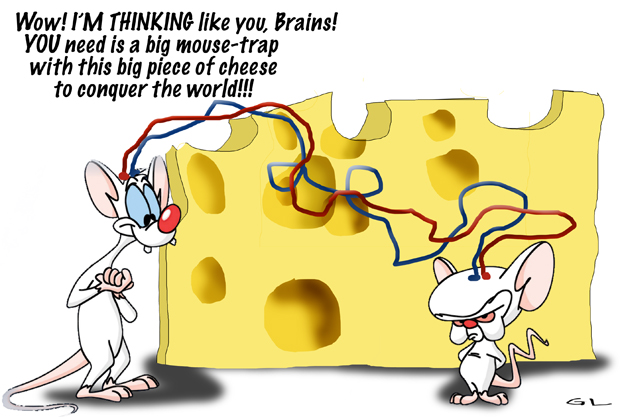
As Lab rats are being fed water via the internet and, as these ratty communications are hailed as breakthrough in mind development technologies, one also hear some alarm bells on the food front... Gus' apologies to the creators of "Sniffy and Brains"... all we need is a better mouse-trap.
http://www.guardian.co.uk/science/2013/feb/28/brains-rats-connected-share-information
Though it seems the practice is not too widespread in this down-under country, in Europe "manufacturers of food" are going round the bend to sell what could appear to be sub-prime stuff — at low cost of course for profit. Thus the appeal of the ready-made "Lasagna alla cream sauce" is irresistible in this "I-want-it-now modern world"... Pop in the microwave, wait two too-long minutes while you wash your hands (if you must) and you can eat an average salted meal from your lap, while watching crap TV.
The horse meat scandal in Europe is the tip of the iceberg in the industrial food manufacturing. Actually, horse meat is healthier than beef — if properly regulated... Usually horse meat ends up in pet food or in cattle feed... In Europe it also ends in specialised butcher shops that only sell horse meat as not to accidentally mix your beef with their horses. Saw dust is extra.
It has to be said that as horse-tainted products have been removed from supermarket shelves, many charitable organisations have jumped at the opportunity and have asked it they could take away the tainted product and give it to the people in need — since there is no danger in eating horse meat labelled as beef, except getting a tad healthier.
But the scandals go beyond the nags gone beef.
In many prepared dishes in Europe, the ingredient lists hide some tricks of the trade where say products such as glucose (sugar) is used in not negligeable quantities to stop the yucky smell of "bad" meat or that of defrosted meat that has then been re-frozen in a processed package as a ready-meal... Who has not heard of pink-slime?...
As I have often mentioned on this site, the purpose of life is about robbing something else of their proteins — be it from nuts for the vegeos or meat for the "homnivores" (my take on human omnivores who eat meat).
Otherwise we die. Simple.
Strangely, gram for gram, a ready-made meal is more than likely to be cheaper than a home-cooked meal with fresh ingredients. AND THIS IS WHERE THE ATTRACTION ENDS. Price. The rest is often sauced in bull dust and preservatives.
For example, comes a non-dairy cheese-like substance called Lygomme TM... It is an award-winning food product that looks like cheese and is used as cheese on pizza toppings, but according to the manufacturer is a "a combination of three starches, a galactomannan [a carbohydrate related to glycogen and cellulose] and a gelling carrageenan [made from seaweed extract]"
According to Wikipedia:
"Scientists have raised serious concerns about the safety of carrageenan in food, based on laboratory animal studies showing gastrointestinal inflammation, ulcerations and colitis-like disease in animals given food-grade carrageenan in their drinking water or diet.[2] [3][4] Some physicians advise avoiding consumption of foods with carrageenan, especially for people with gastrointestinal symptoms.''
That could mean all of us...
As we all know (we all should), it is all to do with the proportion of stuff... If you are lactose intolerant, it won't mean that you are artificial cheese tolerant. Or eventually you might become "artificial cheese" intolerant... It has to be said here that seaweed has been used in home cooked meal for centuries in some cultures.
It has been noted as well, by professional chefs, that some of the prepared meals contain a third less of the "protein-product" mentioned on the packets.
For example, fish and meat contain a certain amount of water. It has been a long used trick, especially in the fish industry to saturate fish and shellfish with extra water when selling it per weight. The practice I believe has been banned in Australia, but who knows.
When one is doing industrial cooking for frozen dishes, it is possible that some of the ingredients such as meat and fish be "saturated" with water. When one defrost the dish, the water content ends up in the sauce and a piece of say fish that is supposed to weigh 100 grams (according to the packet) is only 60 grams in the plate. One is robbed but, because the fish portion was 100 gram when included by the manufacturer in the packet, nothing can be done about it.
So you may believe that you are getting 100 grams worth of protein but after discounting all the other bits in the fish, you may end up with only 30 grams... According to some food reports, proteins are "expensive". Proteins are big business in the sports and body building industries... And your guess is as good as mine in what's in the powders...
As well, when freezing some proteins, the structure of the protein breaks down. The natural water content leaks when defrosted, adding the possibility that the meat may be tougher, such as in prawns. In regard to beef (horse) meat, most prepared dishes used ground meat, this thoughening does not make much difference in this area. Sometimes "meat tenderisers" are used.
Now what is the ensuing consequence from what I see in this processed "illusion of food"?... People who eat less proteins in prepared meals, end up eating more carbohydrates during the meal to satisfy hunger or/and in between meals in the form of cakes and/or sugary drinks... The equation is simple: less protein, more hunger, more carbohydrates, the more people will put on weight and become obese. Not everyone will, but it is likely that according to statistics, the majority will.
It has to be said that most natural food contain most of the chemicals, including the gums, used in the preparation of "reconstituted" industrial foods. But the proportions are vastly different. From monosodium glutamate to Guam gum, these preservatives are often used by the industry in such proportions that they become "food" themselves, defying comprehension.
Presently, the industrial food industry is working overtime to the projection of having to feed 9 billion humans by 2050. There are oodles of cash to be made, especially if one controls the patented food market. From the Monsanto GM to the fake steak made from glucycolcomatose (a generic name proposed by Gus to define the "fake food" in general) and the recycling of bets gone wrong in the horse industry.
Not to take into account that a lot of food created for human consumption (40 per cent) ends up on rubbish tips.
Meanwhile at the other end of the scale, a few beers have led to a new successful farming technique which I must say here was used empirically by natives in Africa... Double-crops at the same time.
Simple, efficient and no need for fertiliser nor HERBICIDES NOR INSECTICIDES...
GL.
- By Gus Leonisky at 1 Mar 2013 - 1:10pm
- Gus Leonisky's blog
- Login or register to post comments
a new farming technique...
Seis raised the question because he had been watching the native grasses on his farm and began to wonder if nature didn't intend for annuals and perennials to co-exist. Nature certainly wanted weeds in his pasture - so why not a different type of annual instead, such as oats? He knew why: weeds liked to run a 100-yard dash while perennial grasses like to a run a marathon. Two different races, two different types of athletes. Right? Or wrong? They needed another round of beer.
What if it were just one race? What if grasses acted as a kind of cover crop for the annuals, keeping down the weeds but allowing the middle-distance runners, such as oats or barley or canola, to grow while the perennials waited for their turn on the racetrack? More to the point: what if you no-till drilled the perennial pasture during its dormant period with a cereal crop? What would happen?
That was crazy talk, had to be.
The more they drank that night, however, the more the idea intrigued them. Why couldn't a cereal plant be cropped in a perennial pasture? As farmers, couldn't they figure out a way to make them all get along symbiotically? If nature could do it, why couldn't they? That's when the light went on, Seis said.
"You had to be drunk to think of something like pasture cropping," Seis told me. "But once we sobered up the next day, we decided to give it a go."
And give it a go they did.
So have many others. Today, over 2,000 farms practice pasture cropping across Australia, and many more overseas. The idea continues to spread as well. Here are some reasons why:
- high crop yields
- sustained high pasture and animal production from cropped land
- increased fodder for livestock
- high rates of carbon bio-sequestration
- marked improvement in the water-holding capacity of the soils
- improved nutrient cycling
- improvements in biodiversity and resilience, even under drought stress
- significantly reduced input costs and risks
- improved economic return from the vertical stacking of enterprises
- improved happiness quotient on the farm
Read more: http://www.aljazeera.com/indepth/opinion/2013/02/201322755128538804.htmlAppalling weather...
British agriculture is facing a worse crisis than the foot-and-mouth disease outbreak of 2001, with around 90% of farmers affected, according to the Prince's Countryside Fund. The charity, established by the Prince of Wales in 2010, is co-ordinating welfare efforts for families in dire need.
"This crisis is unique because it's so broad," said Tor Harris, the fund's director. "There have been others in the past but they have affected particular groups, such as livestock farmers. This affects upland and lowland farmers and even arable farmers, which is something we haven't seen in a very long time. Nearly every farmer is going to be touched by this over the next year or 18 months."
Farming faces a perfect storm. Appalling weather – 2012 was the second wettest year on record in England – has coincided with disease in livestock, including bovine TB and Schmallenberg in sheep, which causes birth defects. On top of this there are commercial pressures, with retailers driving prices down because of the state of the economy, combined with the cost of animal feed needed to replace poor quality silage due to the weather, shooting up by 40%.
As a result, farmers are seeing incomes slashed. According to the Department for Environment, Food and Rural Affairs (Defra), some livestock farmers have seen incomes cut by more than 50% to only £14,000 a year, while dairy farmers have seen decreases of more than 40%.
In December, the prince responded to the crisis by convening a meeting of agricultural charities at Clarence House. He agreed that the charity's £150,000 emergency fund, originally established to support projects involving landscape and agriculture, should be diverted to help farming families. This was matched by £150,000 from the Duke of Westminster, one of Britain's largest landowners.
read more: http://www.guardian.co.uk/environment/2013/mar/16/uk-farmers-face-disaster
more from monsantoland ....
Campaigners say that not even the US government can now stop the sale, planting, harvest or distribution of any GM seed.
Monsanto and the US farm biotech industry wield legendary power. A revolving door allows corporate chiefs to switch to top posts in the Food and Drug Administration and other agencies; US embassies around the world push GM technology onto dissenting countries; government subsidies back corporate research; federal regulators do largely as the industry wants; the companies pay millions of dollars a year to lobby politicians; conservative thinktanks combat any political opposition; the courts enforce corporate patents on seeds; and the consumer is denied labels or information.
But even people used to the closeness of the US administration and food giants like Monsanto have been shocked by the latest demonstration of the GM industry's political muscle. Little-noticed in Europe or outside the US, President Barack Obama last week signed off what has become widely known as "the Monsanto Protection Act", technically the Farmer Assurance Provision rider in HR 933: Consolidated and Further Continuing Appropriations Act 2013
The key phrases are a mouthful of legal mumbo jumbo but are widely thought to have been added to the bill by the Missouri republican senator Roy Blunt who is Monsanto's chief recipient of political funds. For the record, they read:
"In the event that a determination of non-regulated status made pursuant to section 411 of Plant Protection Act is or has been invalidated or vacated, the secretary of agriculture shall, notwithstanding any other provision of law upon request by a farmer, grower, farm operator, or producer, immediately grant temporary permit(s) or temporary deregulation in part, subject to necessary and appropriate conditions consistent with section 411(a) or 412c of the Plant Protection Act, which interim conditions shall authorise the movement, introduction, continued cultivation, commercialisation and other specifically enumerated activities and requirements, including measures designed to mitigate or minimise potential adverse environmental effects, if any, relevant to the secretary's evaluation of the petition for non-regulated status, while ensuring that growers or other users are able to move, plant, cultivate, introduce into commerce and carry out other authorised activities in a time manner ..."
According to an array of food and consumer groups, organic farmers, civil liberty and trade unions and others, this hijacks the constitution, sets a legal precedent and puts Monsanto and other biotech companies above the federal courts. It means, they say, that not even the US government can now stop the sale, planting, harvest or distribution of any GM seed, even if it is linked to illness or environmental problems.
The backlash has been furious. Senator Barbara Mikulski, chair of the powerful Senate appropriations committee which was ultimately responsible for the bill, has apologised. A Food Democracy Now petition has attracted 250,000 names and sections of the liberal press and blogosphere are outraged. "This provision is simply an industry ploy to continue to sell genetically engineered seeds even when a court of law has found they were approved by US department of agriculture illegally," says one petition. "It is unnecessary and an unprecedented attack on US judicial review. Congress should not be meddling with the judicial review process based solely on the special interest of a handful of companies."
Remarkably, though, it has also offended the Conservative right and libertarians. FreedomWorks, the conservative thinktank that helped launch the Tea Party, says corporations should "play by the rules of the free market like everyone else, instead of hiring insider lobbyists to rewrite the rules for them in Washington". Dustin Siggins, a blogger for the Tea Party patriots has called it a "special interest loophole" for friends of Congress. "We are used to subsidies, which give your tax dollars to companies to give them advantages over competitors. We are used to special interest tax loopholes and tax credits, which provide competitive and financial benefits to those with friends in Congress. And we are familiar with regulatory burden increases, which often prevent smaller companies from competing against larger ones because of the cost of compliance. This is a different kind of special interest giveaway altogether. This is a situation in which a company is given the ability to ignore court orders, in what boils down to a deregulation scheme for a particular set of industries," he writes.
Even Monsanto appears a touch embarrassed. The company whose seeds make up 93% of US soybeans, 88% of cotton and 86% of maize and which on Wednesday announced a 22% increase in earnings, has sought to align itself with others in the industry, even though it is far and away the main beneficiary. In a statement, it says: "As a member of the Biotechnology Industry Organisation (BIO), we were pleased to join major grower groups in supporting the Farmer Assurance Provision, including the American Farm Bureau Federation, the American Seed Trade Association, the American Soybean Association, the American Sugarbeet Growers Association, the National Corn Growers Association, the National Cotton Council, and several others."
The company's friends are now on the defensive, seeking to blame "activists". Here is John Entine, director of the Genetic Literacy Project, and a visiting fellow at the American Enterprise Institute, the pro-business, anti-regulation think tank: "The legislation does not, as critics allege, allow farmers or Monsanto to sell seeds proven to be harmful. Rather, it provides legal consistency for farmers and businesses so that they will not be jerked around by temporary findings by competing court systems as activist challenges make their way up the legal food chain."
The only good news, say the opponents, is that because the "Monsanto Protection Act" was part of the much wider spending bill, it will formally expire in September. The bad news however is that the precedent has been set and it is unlikely that the world's largest seed company and the main driver of the divisive GM technology will ever agree to give up its new legal protection. The company, in effect, now rules.
Monsanto Protection Act Put GM Companies Above The Federal Courts
taking care of business ....
US taxpayers are footing the bill for overseas lobbying that promotes controversial biotech crops developed by U.S.-based Monsanto Co and other seed makers, a report issued on Tuesday said.
A review of 926 diplomatic cables of correspondence to and from the U.S. State Department and embassies in more than 100 countries found that State Department officials actively promoted the commercialization of specific biotech seeds, according to the report issued by Food & Water Watch, a non-profit consumer protection group.
The officials tried to quash public criticism of particular companies and facilitated negotiations between foreign governments and seed companies such as Monsanto over issues like patents and intellectual property, the report said.
The cables show U.S. diplomats supporting Monsanto, the world's largest seed company, in foreign countries even after it paid $1.5 million in fines after being charged with bribing an Indonesian official and violating the Foreign Corrupt Practices Act in 2005.
One 2009 cable shows the embassy in Spain seeking "high-level U.S. government intervention" at the "urgent request" of Monsanto to combat biotech crop opponents there, according to the Food & Water Watch report.
The report covered cables from 2005-2009 that were released by Wikileaks in 2010 as part of a much larger release by Wikileaks of a range of diplomatic cables it obtained.
Monsanto spokesman Tom Helscher said Monsanto believes it is critical to maintain an open dialogue with government authorities and trade groups in other countries.
"We remain committed to sharing information so that individuals can better understand our business and our commitments to support farmers throughout the world as they work to meet the agriculture demands of our world's growing population," he said.
State Department officials had no immediate comment when contacted about the report.
Food & Water Watch said the cables it examined provide a detailed account of how far the State Department goes to support and promote the interests of the agricultural biotech industry, which has had a hard time gaining acceptance in many foreign markets.
"It really goes beyond promoting the U.S.'s biotech industry and agriculture," said Wenonah Hauter, executive director of Food & Water Watch. "It really gets down to twisting the arms of countries and working to undermine local democratic movements that may be opposed to biotech crops, and pressuring foreign governments to also reduce the oversight of biotech crops."
But U.S. officials, Monsanto and many other companies and industry experts routinely say that biotech crops are needed around the world to increase global food production as population expands. They maintain that the crops are safe and make farming easier and more environmentally sustainable.
PROMOTION THROUGH PAMPHLETS, DVDs?
The cables show that State Department officials directed embassies to "troubleshoot problematic legislation" that might hinder biotech crop development and to "encourage the development and commercialization of ag-biotech products".
The State Department also produced pamphlets in Slovenia promoting biotech crops, sent pro-biotech DVDs to high schools in Hong Kong and helped bring foreign officials and media from 17 countries to the United States to promote biotech agriculture, Food & Water Watch said.
Genetically altered crops are widely used in the United States. Crops spliced with DNA from other species are designed to resist pests and tolerate chemical applications, and since their introduction in the mid 1990s have come to dominate millions of acres of U.S. farmland.
The biotech crops are controversial with some groups and in many countries because some studies have shown harmful health impacts for humans and animals, and the crops have been associated with some environmental problems.
They also generally are more expensive than conventional crops, and the biotech seed developers patent the high-tech seeds so farmers using them have to buy new seed every season, a factor that makes them unappealing in some developing nations.
Many countries ban planting of biotech crops or have strict labelling requirements.
"It's appalling that the State Department is complicit in supporting their (the biotech seed industry's) goals despite public and government opposition in several countries," said Ronnie Cummins, executive director of non-profit organization Organic Consumers Association.
"American taxpayer's money should not be spent advancing the goals of a few giant biotech companies."
US Taxpayers Footing Bill That Promotes Monsanto Abroad
escape from monsanto...
Unapproved genetically modified wheat from Monsanto found in Oregon field
By Steven Mufson, Friday, May 31, 10:38 AMJapan, the largest market for U.S. wheat exports, suspended imports from the United States and canceled a major purchase of white wheat on Thursday after the recent discovery of unapproved genetically modified wheat in an 80-acre field in Oregon.
How the altered crop made its way to the Oregon field remains a mystery. The strain was developed by Monsanto to make wheat resistant to the company’s own industry-leading weed killer. Monsanto tested the type of altered seed in more than a dozen states, including Oregon, between 1994 and 2005, but it was never approved for commercial use.
Yet the Agriculture Department reported that recent tests identified the strain after an Oregon farmer trying to clear a field sprayed Monsanto’s herbicide, Roundup, and found that the wheat could not be killed.
The report rattled U.S. wheat markets. In addition to Japan’s action, the European Union, which imports more than 1 million tons of U.S. wheat a year, said that it was following developments “to ensure E.U. zero-tolerance policy is implemented.” It asked Monsanto to help detection efforts in Europe.
read more: http://www.washingtonpost.com/business/economy/unapproved-genetically-modified-wheat-from-monsanto-found-in-oregon-field/2013/05/30/93fe7abe-c95e-11e2-8da7-d274bc611a47_print.html
read also: http://www.abc.net.au/news/2013-05-31/mystery-gm-wheat-poses-no-risk-to-australia/4725804
See toon and story at top...
being conned daily...
Gourmet bread that Coles claimed was "baked today, sold today" was actually made in Ireland, the Australian Competition and Consumer Consumer has alleged in the Federal Court.
Some of the items were frozen, reheated and then sold as "freshly baked in-store", "baked today, sold today", or were from "Coles Bakery", the ACCC alleged.
[Coles] is competing with hot bread shops that aren't that far away from [their] supermarkets.
The bakery products were either made in Ireland or had been initially baked in different locations in Australia, court documents showed.
Read more: http://www.smh.com.au/business/coles-baked-today-bread-made-in-ireland-court-told-20130612-2o3ye.html#ixzz2Vzjbl1ec
foozy — the fuzzy fooling frozen factory french food...
French restaurants acknowledge serving factory-frozen food
By Edward Cody, Wednesday, July 10, 9:25 AMPARIS — It is the warmest memory of many a vacation in France: the little Paris restaurant where a white-aproned waiter served a dish glorified on the menu as something homey like blanquette de veau grand-mere, topped off with a still-tepid creme brulee that was just the right mix of crackly and creamy.
The trouble with this picture, it turns out, is that in 21st-century France, chances are high that both the stew and the dessert were assembled and cooked on a production line in a distant suburban factory, that they were quick-frozen and trucked to the restaurant, that they were then microwaved for unsuspecting diners who thought they were sampling traditional French cuisine.
In a survey conducted for the National Union of Hotel, Restaurant and Cafe Operators, a third of French restaurants acknowledged serving such factory-frozen products to clients. Restaurant owners estimated that the real number is substantially higher, as many chefs were embarrassed to admit the short cuts that, in effect, hoodwink their customers.
read more: http://www.washingtonpost.com/world/europe/french-restaurants-acknowledge-serving-factory-frozen-food/2013/07/09/9857b69a-dda2-11e2-b797-cbd4cb13f9c6_print.html
conquering the world...
Gray's Anatomy — the medical book, not the TV series — is considered the definitive anatomy textbook.
First produced 157 years ago, it is now in its 40th edition.
But, when it comes to laying out the brain, there is another publication that surpasses it — and it was made in Australia.
The Rat Brain, first published in 1982, is now one of the most-cited neurological publications.
Its authors are Australian anatomists and neuroscientists professors Charles Watson and George Paxinos.
They spent years mapping out the coordinates of the brain of the most important research animal in science — the rat.
"Luckily all mammalian brains are very much the same," Professor Watson said.
"And while rats just have little brains, they have the same component parts.
http://www.abc.net.au/news/2015-11-20/australian-rat-brain-atlas-among-most-cited-neurological-texts/6959190
See toon at top... and do rats believe in god?
the same thing we do every night, pinky...
By Kit Knightly
There was a cartoon on TV when I was little called Pinky and The Brain, watched by small children and ironically appreciated by culty (perhaps stoned) teenagers alike. It followed the wacky adventures of two white mice living in a science lab.
There was a running gag in the show, at some point Pinky (the dumb mouse) would ask The Brain (the smart mouse) what they were going to do tonight, and The Brain would answer:
The same thing we do every night Pinky…try to take over the world!
This quote goes through my head a lot when I’m reading the news or following Twitter or the like.
The novel coronavirus is still all anyone in the media is talking about. While many bemoan the UK government’s inaction, other governments are being far from inactive. The “states of emergency” continue to spread, and the lockdowns are getting broader and stronger.
Eventually, Boris Johnson will likely be told he must “do something” enough that he’ll cave and shut down all the schools, ban public gatherings and put army checkpoints up on all the roads. Totally against his will, you understand. That absolutely wasn’t the plan all along.
That seems to be the thing about this particular pandemic, it seems to be terribly terrifying and yet only ever spurns people to do stuff they would have been happy to do in the first place. It’s been pretty convenient.
How are we going to respond to this crisis Brain?”
“The same way we respond to every crisis, Pinky…try to take over the world!”
Look at Bolivia, for example, where a mighty three people have reportedly tested positive.
Their interim government – the result of a military coup against a democratically elected President – has just declared a state of national emergency. Schools are closed. Public gatherings banned. They may even have to cancel the elections, scheduled for May this year. Won’t that be sad? I guess the unelected Junta will just have to keep running the country until the crisis is over. Darn.
Oh, while we’re in the area, let’s look in on Venezuela.
Though currently home to not one single case of Covid19 (according to the statistics), Foreign Policy nevertheless reports that Venezuela is a nightmare waiting to happen:
The collapsing medical system can’t handle a coronavirus outbreak on its own.
And even, potentially, a global threat:
Government actions that have contributed to Venezuela’s collapsing health care system not only violate Venezuelans’ right to health, but they are now a threat to global health.
The solution? Well…take a guess:
The international community must step in […] sustained international pressure on the Maduro government, including targeted sanctions such as asset freezes and the cancellation of visas for top Venezuelan officials. There should also be a push for international accountability for crimes including torture, given the absolute lack of judicial independence in the country.
In another article, Foreign Policy also suggests the pandemic should be a reason to suspend the presidential election campaigning in the US. Opening the article with the foreboding line:
It’s time to ask, during a time of plague, whether — and if so, in what form — democracy can continue as usual.
Which means no big crowds chanting Bernie’s name, no televised debates where Biden forgets where he is, and no lines of voters being turned away from the democrat primaries over “misunderstandings”.
The article even dances around the idea of postponing the vote itself. Voting “during a time of plague” can have an impact on the turnout and result, Laurie Garrett argues. She stops short of that, but only because “Orange Man Bad”. If it was Hillary in the White House, not Trump, the media would already have vociferously called for a postponement of the election altogether.
As it is, they make do with this:
Actual voting can, and should, proceed with heavy emphasis on mailed ballots.
Given the reported irregularities surrounding Britain’s postal ballots in last year’s general election, and their historic ease of fraud, this is an interesting suggestion. (There will come the idea, someday soon, that all future voting be done digitally from home, at which point any even slight democracy left in the US system will be entirely stamped out).
Elsewhere, the war on cash is being spurred on by the World Health Organization, which is suggesting people stop using money because it carries disease.
Just as important as what we’re being told we must do, is what we’re being told we must not do.
For example, Trump’s decision to suspend travel from 26 EU nations was met with derision (even though these same publications were praising “going medieval” on pandemic prevention previously). Is this just because it’s Trump? Or is it because the idea of a nation isolating itself for protection plays into tropes of nationalism and sovereignty that clash with the open-border, globalist agenda?
It’s hard to say, since so many journalists would criticise World Peace or a cure for cancer if Trump brought it about.
Perhaps one clue is found in France, where Macron has banned public gatherings (say goodnight, Gilets Jaunes) but left his borders open, claiming “viruses don’t carry passports” and warning against “nationalism”. This is hard to reconcile with the alleged danger of the virus, given the fact he shares a soft border with Italy.
The CBC ran an article headlined Why travel bans won’t work to stop spread of COVID-19, quoting Steven Hoffman, Professor of Health Law:
[Travel bans] don’t work…They undermine the public health response. They undermine trust in governments and violate international law in the process.”
Interestingly, Hoffman uses the same exact phrase, word for word: “viruses don’t carry passports”. I don’t know what that means, if anything. I don’t believe anyone ever suggested viruses do carry passports, but they don’t buy football tickets or attend the theatre either.
How much sense does that make? Does quarantine work domestically, but not internationally?
Apparently it’s not safe to watch a movie with a hundred strangers, but sitting on a plane with them for 10 hours, breathing (famously unhygienic) recycled air is perfectly fine. That seems entirely irrational to me, but hey I’m no professor of health law.
(My favourite quote from that article: “if people want to travel, they’ll find ways to do so. Instead it’s best if people travel through official channels”, mostly because I’m not sure how you travel without using “official channels”. He seems to be suggesting that if Virgin Atlantic turned me away from my flight to JFK, I’d just grab a kayak, head to the beach and start paddling.)
What else are you not supposed to do? Well, read misinformation of course. Sharing it can be dangerous. Make sure you read only officially sanctioned government information. Report all perpetrators of click crime and disinformation propagation.
Don’t worry. Facebook, Apple, Microsoft, Twitter and Google are all working with the state to make sure you only get the information the government decides you need. They’ll also be scrubbing “misinformation” and “hoaxes” from their platforms. To protect you. You’re welcome.
It’s funny, when you think about it.
It turns out in order to best deal with the coronavirus we need to ban large public protests, introduce martial law, prevent socialists being elected in Bolivia, effect regime change in Venezuela, stop using cash, vote digitally or by post, leave our borders wide open, censor the major social media networks and start enforcing compulsory vaccination.
Which is very fortunate, because they wanted to do all of that anyway.
Read more:
https://off-guardian.org/2020/03/13/coronavirus-brand-new-problem-same-o...
I believe that this cartoon series was produced by Steven Spielberg... Say no more — except the concept of "taking over the world" isn't new... The Romans had a shot at it, the Catholics still have a shot at it and Jules Vernes had the "Master of the World":...
"Nonsense; this Robur was not the devil!"
"Ah well!" replied the old woman, "he was worthy of being so!"
Read from top. (note: I deliberately called the cartoon "Sniffy and Brains")