Search
Recent comments
- of hostages...
1 hour 34 min ago - pf hostages...
1 hour 35 min ago - switzerland sux.....
1 hour 38 min ago - whoever they are....
3 hours 24 min ago - unaligned world....
3 hours 37 min ago - larry johnson.......
3 hours 43 min ago - patriotism....
13 hours 46 min ago - belittling russia......
14 hours 14 min ago - Запад толкает Украину на последнюю битву....
14 hours 27 min ago - fourteen points....
14 hours 37 min ago
Democracy Links
Member's Off-site Blogs
false dawns .....
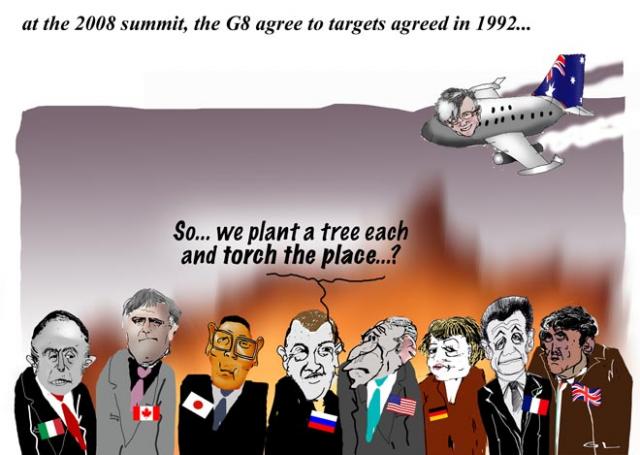
At first sight, the G8 agreement on climate change promises much.
Leaders are 'committed to avoiding the most serious consequences of climate change', and determined to stabilise greenhouse gases in the atmosphere at levels that would avoid 'dangerous climate change'.
In fact, this is exactly what leaders of nearly 200 countries signed up to in the original UN Framework Convention on Climate Change (UNFCCC), agreed at the 1992 Earth Summit. So if re-stating a 16-year-old commitment is progress, then this is clearly a success.
The question ever since Rio has been what to do about it. But the reality of negotiations within groups such as the G8 is that every party needs to emerge with bits of language that they can point to and say 'I won'.
So here is the key sentence in all its diplomatic finery: 'We seek to share with all parties to the UNFCCC the vision of, and together with them to consider and adopt in the UNFCCC negotiations, the goal of achieving at least 50% reduction of global emissions by 2050, recognising that this global challenge can only be met by a global response, in particular, by the contributions from all major economies, consistent with the principle of common but differentiated responsibilities and respective capabilities.'
The G8 are crawling forward on emissions cuts at a time when giant leaps and bounds are needed.
So the EU emerges with an apparent commitment to cut emissions by at least 50%.
The US and Canadian administrations can say that it is only a commitment if the major developing countries play ball, and that the 50% figure concerns global emissions, not necessarily their own.- By Gus Leonisky at 9 Jul 2008 - 8:07pm
- Gus Leonisky's blog
- Login or register to post comments
Rudd saw the G8 hot air...
By chief political correspondent Lyndal Curtis
Prime Minister Kevin Rudd has acknowledged there have been no great breakthroughs on climate change at the G8 major economies meeting in Japan.
Mr Rudd is adamant that while the meeting did not end up with bold action, it was an important step in ensuring world leaders take a lead during the climate change debate.
Mr Rudd has warned that it will take leadership and international co-operation to produce meaningful results at the Copenhagen conference next year.
"The challenge will be great and there has been no huge breakthrough at this particular meeting," he said.
"It is one step along the road.
Flaws are in the nature of things...
Air Force Reopens Bidding on Flawed Tanker Contract
By LESLIE WAYNE
The Air Force will reopen the bidding for a multibillion-dollar contract for midair refueling tankers, the defense secretary, Robert Gates, announced on Wednesday.
The decision comes in the wake of a report by the Government Accountability Office that found flaws in the process that initially awarded the contract to a partnership of Northrop Grumman and the European parent of Airbus over a competing bid by Boeing, which filed a protest.
The action reignites the controversy surrounding the largest trans-Atlantic military contract. The Pentagon’s decision will also enter the realm of presidential politics because John McCain, the presumptive Republican nominee, had long been a critic of Boeing’s initial bid and as a member of the Senate Armed Services Committee held a series of hearings that opened the door to the bid made by Northrop and European Aeronautic Defense and Space.
As a result, critics have contended that he has favored a European supplier to an American company for a critical American military contract — an impression not helped by the fact that several of his top campaign advisers had worked as lobbyists for Airbus.
In strictly business terms, with the $35 billion contract having the potential to grow to more than $100 billion, both the Northrop-EADS partnership and Boeing led prominent campaigns on both sides of the Atlantic to land the business. Both European and American politicians entered the fray with statements supporting their own side as part of an intense public relations effort.
---------------
Gus: This reminds me of IBM challenging the Australian government awarding a contract to FACOM (Futjitsu) in the early 1970s for a new super computer (a desktop PC could do the job better now). But then there was millions of dollars at stake. The tender was reopened and won again by FACOM if my memory is not too wonky...
One cannot dismiss the know-how of the Americans. But as some computing expert would tell me, the European programming standard is far superior to that of the US, the only difference is the US marketing machine is overtly too powerful in its ability to sell snake oil.
One can find flaws in any tender. One can find flaws in no tender at all... Many characteristics and parameters are at play, including human factor, bribes and promises. One also never knows of the secret undercurrents and deals made at political level on such large operative contracts.
The European planes may or may not be superior to that of Boeing, but there is a good chance they are. The Europeans have unveiled its new A400 — a mean-looking machine — designed to replace the Hercules class troop and heavy material transport. Boeing got its nose out of joint in a war against Airbus. Airbus already has three A380 flying commercially. Boeing has zilch dreamliners. And falling behind schedule. One has to note the disparity between what the Europeans pay for oil: 2.4 times that of the US. The Europeans have got to be smarter on many fronts to survive — in a climate where the US$ is diving like a petrel.
On other fronts, the US is also losing its grip on "space monopoly"... They did not mind the nutty competition with the Russians as long as the Russians were in second place all the time... Now they have to compete with the Chinese, with the Indians, with the Europeans and the amount of junk that is cluttering the space up there... Even the Iranians have launched a modest long-range missile... The Europeans are creating their own GPS network because they know all too well that for military purposes, parameters transmitted by US GPS network can be altered within seconds and make targeting impossible — only useable if one has the proper "codes" at that time.
---------------
U.S. Finds It's Getting Crowded Out There
Dominance in Space Slips as Other Nations Step Up Efforts
By Marc Kaufman
Washington Post Staff Writer
Wednesday, July 9, 2008; A01
China plans to conduct its first spacewalk in October. The European Space Agency is building a roving robot to land on Mars. India recently launched a record 10 satellites into space on a single rocket.
Space, like Earth below, is globalizing. And as it does, America's long-held superiority in exploring, exploiting and commercializing "the final frontier" is slipping away, many experts believe.
Although the United States remains dominant in most space-related fields -- and owns half the military satellites currently orbiting Earth -- experts say the nation's superiority is diminishing, and many other nations are expanding their civilian and commercial space capabilities at a far faster pace.
"We spent many tens of billions of dollars during the Apollo era to purchase a commanding lead in space over all nations on Earth," said NASA Administrator Michael D. Griffin, who said his agency's budget is down by 20 percent in inflation-adjusted terms since 1992.
"We've been living off the fruit of that purchase for 40 years and have not . . . chosen to invest at a level that would preserve that commanding lead."
In a recent in-depth study of international space competitiveness, the technology consulting firm Futron of Bethesda found that the globalizing of space is unfolding more broadly and quickly than most Americans realize. "Systemic and competitive forces threaten U.S. space leadership," company president Joseph Fuller Jr. concluded.
Six separate nations and the European Space Agency are now capable of sending sophisticated satellites and spacecraft into orbit -- and more are on the way. New rockets, satellites and spacecraft are being planned to carry Chinese, Russian, European and Indian astronauts to the moon, to turn Israel into a center for launching minuscule "nanosatellites," and to allow Japan and the Europeans to explore the solar system and beyond with unmanned probes as sophisticated as NASA's.
While the United States has been making incremental progress in space, its global rivals have been taking the giant steps that once defined NASA:
--------------
Gus: On another front, "climate change" may still appear distant for Sydneysiders experiencing the Pope and the coldest days in years. Funny that... Through a series of exchange via jet streams, low pressure system and convection, Antarctica is losing some of its latent cold and gaining heat. This is not new, but there is time now at which the total temperature package has heat gain rather than balance out between summer and winter — despite bitter cold experienced in some of its part. Presently California has heat above average and wildfire to boot. Water has gone scarce in many places in the US, our own Murray Darling system is drying up (don't need to tell you that but farmers were already warning of major problems back in 1949. Some of us, green spruikers, were warning of the degradation during the 1970s and the 1980s). Most scientists predict warmer and dryer conditions and more heat-waves. Sometimes I feel that the US has been lucky to experience tornadoes — dissipating energy — like they did so far this year, otherwise the differential in the atmosphere could "accumulate" and lead to a greater massive hurricanes by end of Summer, in the west Atlantic crossing through Florida and the Gulf of Mexico...
But the US is not prepared to do the hard yards on global warming. The Europeans have done quite a lot in comparison and Germany leads. Russia has also done quite good but starting from where they were, it was not too hard to improve. China is doing far better than the US on renewable energies, should we believe their figures...
And Bushit still wants to plant his umbraging umbrella at the doorstep of Russia. Niet...
Many happy days... Things are a-change-in' — fast. And as Gus Leonisky always says: flaws are necessary for the universe to exist...
climate unpleasantness
Bush to G8: 'Goodbye from the world's biggest polluter'
After rejecting global climate-change targets, George Bush's parting shot to the G8 summit
By Andrew Grice, Political Editor in Hokkaido
Thursday, 10 July 2008
President George Bush signed off with a defiant farewell over his refusal to accept global climate change targets at his last G8 summit.
As he prepared to fly out from Japan, he told his fellow leaders: "Goodbye from the world's biggest polluter."
President Bush made the private joke in the summit's closing session, senior sources said yesterday. His remarks were taken as a two-fingered salute from the President from Texas who is wedded to the oil industry.
-------
... and this fellow was Howard's best buddy on bullwinkling!!!!... see toon above...
rise of the rest...
Fareed Zakaria, thanks for joining us.
FAREED ZAKARIA, AUTHOR AND JOURNALIST: It's my pleasure. Thankyou for having me.
VIRGINIA TRIOLI: "The rise of the rest": it's a nicely evocative phrase. Who are they? Who's the rest?
FAREED ZAKARIA: Well, it really is everyone. I mean, what I was struck by when I was looking at this subject, I thought to myself, "Well, of course it's the rise of Asia", we know about that. But then I'd go to Latin America and see Brazil was booming, Mexico was doing better than it had ever done, Costa Rica was doing well, the Dominican Republic is growing at eight per cent, for Heaven's sake. And then I'd go to Africa and I learned last year Africa had 30 countries that grew at over four per cent. That's about two thirds of the continent. So, in a real sense, you have growth taking place around the world: 2006, 2007, 124 countries around the world grew at four per cent a year or more. And I think this is so dramatically different from any period in human history before to have the majority of the world's countries doing well, that I couldn't think of any better way to describe it than to say "the rise of the rest", meaning, really, the rest of the world.
-----------------
Good one...
smell that...
2 Decisions Shut Door on Bush Clean-Air Steps
By FELICITY BARRINGER [NYT]
Any major steps by the Bush administration to control air pollution or reduce emissions of heat-trapping gases came to a dead end on Friday, the combined result of a federal court ruling and a decision by the head of the Environmental Protection Agency.
In the morning, a federal appeals court struck down the cornerstone of the administration’s strategy to control industrial air pollution by agreeing with arguments by the utility industry that the E.P.A. had exceeded its authority when it established the Clean Air Interstate Rule in 2005. The court, the United States Court of Appeals for the District of Columbia Circuit, said the rule, which set new requirements for major pollutants, had “fatal flaws.”
A few hours later, the E.P.A. chief rejected any obligation to regulate heat-trapping gases like carbon dioxide under existing law, saying that to do so would involve an “unprecedented expansion” of the agency’s authority that would have “a profound effect on virtually every sector of the economy,” touching “every household in the land.”
Taken together, the developments make it clear that any significant new effort to fight air pollution will fall to the next president.
The comments by the E.P.A. administrator, Stephen L. Johnson, reinforced a message that the administration had been sending for months: that it does not intend to impose mandatory controls on the emissions that cause climate change. John Walke, a lawyer with the Natural Resources Defense Council, a leading environmental group, said, “As a result of today, July 11, the Bush administration has failed to achieve a single ounce in reductions of smog, soot, mercury or global warming pollution from power plants.”
Northrop Grumman played fair...
Air Force Reopens Bidding on Flawed Tanker Contract
By LESLIE WAYNE
The Air Force will reopen the bidding for a multibillion-dollar contract for midair refueling tankers, the defense secretary, Robert Gates, announced on Wednesday.
The decision comes in the wake of a report by the Government Accountability Office that found flaws in the process that initially awarded the contract to a partnership of Northrop Grumman and the European parent of Airbus over a competing bid by Boeing, which filed a protest.
-----------------
Now Northrop Grumman is not happy by Boeing's action and explains why:
Questions Boeing has not answered
1. Northrop Grumman's proposal was judged superior by the U.S. Air Force in four out of the five criteria including: Mission Capability, Past Performance, Cost/Price, and Integrated Aerial Refueling Assessment. How can Boeing say its proposal should have been selected?
2. Boeing was publicly quoted being in favor of the U.S. Air Force procurement process until the award was announced. Why didn't Boeing raise its concerns prior to the announcement?
3. Can Boeing document the estimated 44,000 jobs that would be created within United States if they had been chosen? On Northrop Grumman's website, there is list of the suppliers and the 48,000 jobs supported. What evidence does Boeing have that U.S. jobs would disappear overseas?
4. Has Boeing identified exactly what military technologies related to the KC-45 will move offshore?
5. Boeing actually considered its 777 as a Tanker but thought it was not practical. Why?
-----------------
The U.S. Air Force chose the best team for the tanker
The tanker decision was based on an open and transparent process and the best team won. The USAF ranked each bid on five criteria and Northrop Grumman won on four out of the five and tied in one category. Both sides praised the USAF for the fairness of the competition before the award was announced. Both sides agreed that this was the most rigorous acquisition process in the Department of Defense's history.
solution Gus...
The most brilliant minds should be directed to solving Earth's greatest challenges, such as climate change, says Sir David King.
The former UK chief scientist will use his presidential address at the BA Science Festival to call for a gear-change among innovative thinkers.
He will suggest that less time and money is spent on endeavours such as space exploration and particle physics.
He says population growth and poverty in Africa also demand attention.
"The challenges of the 21st Century are qualitatively different from anything that we've had to face up to before," he told reporters before the opening of the festival, which is being held this year in Liverpool.
----------------
Gus: after Gustav passed 75 miles west of New Orleans, one has to reflect about the way the levies in that city were really tested to their limit. At a sustained wind of about 100 knots near the centre one has to calculate the wind say 60 miles to the west would have been only around 75 knots. A tidal surge of say 4 metres in the centre would be around 1.5 metres 75 miles away. New Orleans was lucky. Some flooding occurred but 99 per cent of the city was not affected.
When dealing with the weather, bright minds won't be enough. More data needs to be collected and assembled in ways never done before. And economists need to be convinced that climate warming is for real. But how one does convince bean-counters, when the English summer has been crap and the present temperatures in London are cooler than in Sydney, Sydney — a city barely emerging out of a cool crappy winter, still too cold and breezy for my old bones?
As many scientists know, the truer pictures lie in the polar regions, the fridges of the earth — and in the seas, the air conditioning units of the earth. But a better study of the upper atmosphere, the stream-jets and the wobbling pressure waves that lead to more cyclones, hurricanes and typhoons — or stoms and tempests in higher latitudes — would help towards making a more accurate prediction of the evolution of global warming. The evolution of such a beast is not linear. It has fluctuations and pockets of anomalies. Thus should we measure "anomalies" only, we could get false impression of comfort or of disaster depending on the anomalies.
The end of the last ice age was a global warming event of massive proportion. Some people might say see this was a "natural" event, thus there is nothing we can do, but there are strong indication that coupled with a natural trend, there was an increase in burning of forests (90 times increase on previous period) coinciding with the early development of farming and more open plain hunting by humans. The extinction of the mega-fauna was sped up by "large scale" hunting. Nothing new here. The surface of the earth is not a static environment.
New thinking:
Climate change management is the biggest role for the United nation. We need new economic models that share more of what we've got, more equitably, with a reduction in consumption, including strong population management. We need to convince everyone, including big oil, that the hour is nigh. This does not mean that it is the end of the world, but the movement towards the end of what we've made and understood of "our" little planet so far. We've got only a few more years (10 max) to fiddle-faddle and then it will be too late. It's already too late for the minimum change that will occur (2 degrees higher averages by 2100), but not too late yet to do something to avoid a massive change (catastrophic 6 to 9 degrees higher by 2100).
Arresting the destruction of primeval forest forthwith is paramount, even if we plant twice as much timber than we cut (we're doing about five time this in reverse — we plant one skinny tree for five big old healthy ones we cut down. From studies of the last ice age, forest destruction was a big factor in warming.
Develop renewable energy supplies urgently. We need to invest more money than ever before into solar, wind, wave and geothermal sources. If we must go to nuclear, we have to abandon the uranium fuel cycle in favour of thorium, but that would be as a very last resort — panic mode. Nuclear energy is investment-costly compared to renewables. Sure there is more stability in baseline supplies but, renewables have the potential to be micro-managed and operate at local community level to achieve the same base load result.
Storing of electricity from renewable is difficult but not an insurmountable problem if we use for example the excess from renewable energy during the day to pump water into columns of liquid (or high small lakes), say water, that can be used to propel turbines during night time.
We also need to improve "appliancing" in order to maintain our comforts thus be more efficient with our consumption, and we need to find ways to create differences of potential, be by storing water in columns or in battery-cell formats, that can sustain energy during the down times of renewables. For example, it is most likely that having THREE sources of renewable energy will lead to a sustainable base load rather than having only two sources... Mathematics tend to confirm this possibility. Developing this can be exciting and be created as small community projects, especially in countries where there is not much moneys. New renewable power plants in small country towns should be the go. New developments need to take all this into account, including the minimisation of transport via local industries and more efficiency.
Management of human population and protection of natural spaces.
reduction and elimination of poisons (insecticides, herbicides, etc)
Big enterprise need to discover the value of small, big government need to discover the value of small. And for the God believers, please discover, accept, realise, bend the knees, but the earth is not god's own anymore, it is in the hands of humans not to muck it up further. Everyone needs to be on deck — including the rich dudes who make money out of concentrating power... Power needs to be decentralised for renewables to work efficiently. This is why our world leaders have problems to come to term with renewables because these people only think in concentration of power.
(One thing struck me over the weekend, while travelling through smalls towns and burbs is how style-less are some of the developments. Individually, some of the boxes built as dwellings, shops and commercial places may be passable but as a town/burb it's a mishmash of ugliness in conflicting bad architecture, exacerbated by bad conflicting signage. When one realises that a city like Bath in England was created with "architecture" in mind one sees harmony, illusion and function. In Aussieland, Harmony and function has often been lost to opportunistic short lived development, and igledy piggledy growth with poor planning. Even Canberra missed the boat. All one needs is a bad development, small or big, and jarring signage to destroy a vista. Vista? I hear you say... Modern Aussie Architecture has lost the art of town vista and town square... Sure, on a small corner there is unified concept, but a proper vista is encompassing of the horizon beyond the fence next door...)
Back to the energy supplies...
"Progress" can still be achieved under these seemingly restrictive conditions. Progress has to be more savvy and less destructive for "smarter comfort" — moral, spiritual and materialist".
We can do it. We've got no choice. Bravado and defiance would be foolishly dangerous.
see toon at top.
500 tons of chemical waste
Ivory Coast pollution trial stops
The trial of nine people in Ivory Coast accused of involvement in the dumping of 500 tons of chemical waste around the port of Abidjan has been suspended.
Five defence lawyers walked out in protest at the fact that no one from the Dutch firm Trafigura which transported the waste was in court.
The UN says that the chemical waste caused the deaths of 16 people.
The court will now try to mediate with the lawyers. If this fails, they could then in theory be replaced.
But the BBC's John James in Abidjan says that other lawyers may not be willing to take the case.
The key frustration has been the failure of the court to bring in anyone from Trafigura.
The administrator of Trafigura's local company Puma Energy, N'Zi Kablan, was asked to appear as a witness, but according to the testimony of a policeman he left the country for Ghana several days before the trial opened.
------------
see toon at top abd read blog above...
thrashing the planet...
Nature loss 'dwarfs bank crisis'
By Richard Black
Environment correspondent, BBC News website, Barcelona
Losses are great, and continuous, says the report
The global economy is losing more money from the disappearance of forests than through the current banking crisis, according to an EU-commissioned study.
It puts the annual cost of forest loss at between $2 trillion and $5 trillion.
The figure comes from adding the value of the various services that forests perform, such as providing clean water and absorbing carbon dioxide.
The study, headed by a Deutsche Bank economist, parallels the Stern Review into the economics of climate change.
It has been discussed during many sessions here at the World Conservation Congress.
-----
see toon at top
the planet responds...
heavy bootprints...
Climate change at the poles IS man-made
Scientists refute sceptics by proving that human activity has left its mark on the Arctic and Antarctic
By Steve Connor, Science Editor
Friday, 31 October 2008
Changes to the climate due to human activity can now be detected on every continent, following a study showing that temperature rises in the Antarctic as well as the Arctic are the result of man-made emissions of greenhouse gases.
It is the first time scientists have been able to prove the link between the temperature changes in both polar regions are down to human activity and it also undermines climate sceptics who believe the warming trend seen in the Arctic in recent decades is part of the climate's natural variability.
The findings contradict the 2007 report of the Intergovernmental Panel on Climate Change, which said that Antarctica was the only continent where the human impact on the climate had not been observed.
The new study shows that Antarctica has been caught up in the changes to the global climate over the past 60 years and that this warming cannot be attributed to natural variations.
------------------
see stupid toon at top.
preservation trust fears
Development puts Bath's UN heritage status at risk
Unesco team visits today as Preservation Trust expresses fears over project
By Emma Bamford
Friday, 7 November 2008
Bath's famed Georgian architecture and Roman ruins have made it the only British city to be classed as a World Heritage Site. But today officials from Bath will be crossing their fingers that they can continue to hold on to their coveted status as details of a large and controversial new development are outlined to Unesco inspectors.
A team from the United Nations arrived in the city on Wednesday for a three-day visit to determine whether Bath still deserves its listing beside the Great Barrier Reef and the Serengeti Desert. Concerns have been raised after planners gave permission for the Western Riverside development to go ahead, which involves 2,200 houses, shops, a school and a park being built next to the river. The area has been derelict for years and is dominated by a defunct 118ft (36m) high gasometer. There are worries that the new development, which includes nine-storey buildings, will dominate the city's skyline.
see Bath in solution gus...
saving the planet...
The world's last chance
After years of living in fear of climate change, we are fast acquiring the weapons to defeat it. But the only one who can unite humanity for this life-or-death struggle is Barack Obama - and he must act now. By Ian McEwan
* Ian McEwan
* guardian.co.uk, Wednesday November 19 2008 00.01 GMT
'I refute it thus!" was Samuel Johnson's famous, beefy riposte one morning after church in 1763. As he spoke, according to his friend James Boswell, he kicked "with mighty force" a large stone "till he rebounded from it". The good doctor was contesting Bishop Berkeley's philosophical idealism, the view that the external, physical world does not exist and is the product of the mind. It was never much of a disproof, but we can sympathise with its sturdy common sense and physical display of Anglo-Saxon, if not Anglican, pragmatism.
Still, we may have proved Berkeley partially correct; in an age of electronic media, where rumour, opinion and fact are tightly interleaved, and where politicians must sing to compete for our love, public affairs have the quality of a waking dream, a collective solipsism whose precise connection to the world of kickable stones is obscure, though we are certain that it exists.
-------------------
Obama can sure do better than Bush... Yet Bush did a lot towards emission reduction, accidentally of course, by destroying the economies of the world by letting the US markets overheat with greedy illusions... and useless wars. see toon at top.
melting evidence
By Steve Connor, Science Editor The Independent
Tuesday, 16 December 2008
Scientists have found the first unequivocal evidence that the Arctic region is warming at a faster rate than the rest of the world at least a decade before it was predicted to happen.
Climate-change researchers have found that air temperatures in the region are higher than would be normally expected during the autumn because the increased melting of the summer Arctic sea ice is accumulating heat in the ocean. The phenomenon, known as Arctic amplification, was not expected to be seen for at least another 10 or 15 years and the findings will further raise concerns that the Arctic has already passed the climatic tipping-point towards ice-free summers, beyond which it may not recover.
better late than never...
“This is not just about emissions but about creating a massive investment in a new global energy economy” that includes forests, oceans and the transfer of technology, said Angela Anderson, director of the Pew Environment Group’s Global Warming Campaign.
American negotiators were limited in Kyoto by a Senate resolution saying that the United States would not accept numerical caps unless China did as well. But Senator John Kerry, Democrat of Massachusetts, said, “There has been a sea change in the Senate,” and he added that he believed that there were enough votes — Democratic and Republican — to ratify a strong treaty.
What is unclear is whether politicians will be willing to commit to large enough changes to have a significant effect on global warming. “The Bush administration set the bar very low,” Mr. McKibben said.
see toon at top...
data already behind reality
More bad news on climate change is expected as more than 2,000 climate scientists gather in Copenhagen.
They will be trying to pull together the latest research on global warming ahead of political negotiations later in the year.
The scientists are concerned that the 2007 reports of the Intergovernmental Panel on Climate Change (IPCC) are already out of date.
Their data suggests greater rises in sea levels this century.
For the scientists gathering in the Danish capital, this meeting is about removing as much wriggle room as possible from the political negotiations on a new global climate treaty taking place in December.
While the IPCC reports of 2007 were praised for their recognition of the causes of global warming, the slow, consensus-based nature of the process, meant more recent data was not included.
---------------------
The sea level has risen worldwide by about 5 centimetres ( 2 inches) in the last 30 years. This represents an enormous amount of energy, either exchanged via land-ice melting or by sheer expansion of water. Should the world carbon dioxide still be at 1996 level, the sea will rise by another 7 (2.5 inches) centimetres in the next 25 years. And we are at 2009 somewhat higher levels...
We're in trouble, mate...
Now, with the world economy in the doldrums, is the time to change tack on the way we do business. Competition and greed should be limited fast till they become prohibited by 2015 and massive cooperation should be encouraged to slow the tragedy unfolding — a tragedy we've brought upon ourselves and upon the planet — a tragedy some people still want to ignore or be gloriously sceptic about...
Wake up! In a few years' time, your retarding scepticism will have other no other position than to be deemed criminal. People of the media, the Devine and Bolt, silly Thomas-like scribes of this world, leave the scepticism to the scientist who are now only sceptic about how too conservative they have been...
see 2032, read all comments in its blog column, see toon at top and read more intelligent scientific pertinent info about global warming.
coal face and oil burners
Members of the reclusive endangered species were found by scientists acting on tip-offs from local people.
Much of the orangutan's tropical forest habitat in Indonesia and Malaysia has been cut down for timber extraction and to create palm oil plantations.
About 50,000 orangutans are thought to remain in the wild.
"The reclusive red-haired primates were found in a rugged, largely inaccessible mountainous region," Erik Meijaard, of Nature Conservancy Indonesia, said.
The journey to the region took 10 hours by car, another five by boat and then a couple more hours hiking.
The team found more than 200 nests crammed into just a few kilometres and spotted three wild orangutans in the canopy above them - a mother and her baby, and a large male who broke off branches to throw at them.
--------------------
MEANWHILE: At the COAL FACE and the OIL BURNER...
From the SMH
The subject of this column is not small. It is a book entitled Heaven And Earth, which will be published tomorrow. It has been written by one of Australia's foremost Earth scientists, Professor Ian Plimer. He is a confronting sort of individual, polite but gruff, courteous but combative. He can write extremely well, and Heaven And Earth is a brilliantly argued book by someone not intimidated by hostile majorities or intellectual fashions.
The book's 500 pages and 230,000 words and 2311 footnotes are the product of 40 years' research and a depth and breadth of scholarship. As Plimer writes: "An understanding of climate requires an amalgamation of astronomy, solar physics, geology, geochronology, geochemistry, sedimentology, tectonics, palaeontology, palaeoecology, glaciology, climatology, meteorology, oceanography, ecology, archaeology and history."
The most important point to remember about Plimer is that he is Australia's most eminent geologist. As such, he thinks about time very differently from most of us. He takes the long, long view. He looks at climate over geological, archaeological, historical and modern time. He writes: "Past climate changes, sea-level changes and catastrophes are written in stone."
Much of what we have read about climate change, he argues, is rubbish, especially the computer modelling on which much current scientific opinion is based, which he describes as "primitive". Errors and distortions in computer modelling will be exposed in time. (As if on cue, the United Nations' peak scientific body on climate change was obliged to make an embarrassing admission last week that some of its computers models were wrong.)
....
"To reduce modern climate change to one variable, CO2, or a small proportion of one variable - human-induced CO2 - is not science. To try to predict the future based on just one variable (CO2) in extraordinarily complex natural systems is folly.
...
Observations in nature differ markedly from the results generated by nearly two dozen computer-generated climate models. These climate models exaggerate the effects of human CO2 emissions into the atmosphere because few of the natural variables are considered. Natural systems are far more complex than computer models.
---------------------
I agree with Plimer... Natural systems are far more complex than computer models.
... except on his assumption that CO2 production by humans has little impact on "climate change".
I use the orangutan news to illustrate two things: that there is often hidden data lurking about in complexities of studies and that we influence the downward spiral of many other species towards extinction by destroying their habitats.
We are also influencing climate change with our activities.
What Plimer should know is that studies of natural events and geological sequences show we should be going towards an ice age. We are not. It is most likely that we have been adding an extra parameter to this natural process.
This is the extra parameter that most of the climate models "may or may not" be studying "exclusively" in depth. But as the present models were proved wrong — they were proved wrong that they had been too conservative in their calculations. Observation show that warming is happening at about three times the pace predicted by the most pessimistic models.
Gus Leonisky empirical modelling is on track.
It is not folly to try to predict the future based on just one variable (CO2), it is just "incomplete". We all know that. And most warming climatic models are not exclusively fixed on the CO2 factor. Plimer is sweepingly emotional when he should be stone cold. In past blogs on this site I have urged climatologists to do more "wholistic" studies — from changes in jet streams to dew point variations to sea temperatures and sun spots, including volcanic activity, etc. (A US rocket designed to study a lot of this failed, unfortunately...)
But one thing is certain: climate change is happening towards warm — and CO2 and methane are adding to the change faster than the cooling we should be experiencing.
The "carbon cycle" has been strongly linked to climatic fluctuation in the past eons, although there has been other times of upheaval, sidereal or terrestrial in which global climate was modified by factors other than the "carbon cycle". No argument.
Complex painstaking studies have shown that on average the sea has risen by 5 centimetres in the last 30 years. Only extra heat on earth can have produced this.
We live in times when the polar ice is releasing vast amount of energy that barely maintain our temperate whisky in the cool range..
Without this present melting (once the ice melting passes a critical point), convection current won't be able to carry the cooling effect. The temperature of our temperate whisky is likely to rise through the roof.
Note: The open Antarctic ocean acts like a climatic conveyor belt. In past eons, when the ocean was "blocked off" by the Australian land mass, climatic conditions on earth were different. Position of landmass do influence climates too.
Back to the present:
Where does the extra heat comes from?
Yes we know. There are other factors than CO2 that influence climate and heat in the system. And CO2 is mostly naturally reabsorbed. But there are levels beyond which it is not. CO2 is also proved to be a "greenhouse Gas" (methane is as well — other gases are too). Note: it is not unlikely that without some "natural" CO2 and methane (or other greenhouse gases) in the atmosphere, Sydney's summer temperature would barely rise above 5 C.
We, humans, are burning about 80 million barrels of oil daily, and burning about 13.7 million tonnes of coal, daily. Not all of this becomes CO2, but the portion that is, is still far greater than nature re-absorption can cope with. Sheer observation of CO2 can show levels ARE increasing and temperatures are increasing. Critical points HAVE been passed.
There is a strong correlation between increase heat and increase CO2, despite other influencing factors.
In regard to climate, all the geological study in the world can be interpreted differently from Plimer's. I have known many eminent geologists who did so with great scholarly and scientific rigour. The reality is complex, but similarly to the present extinction of many species that can be "largely" due to human activity via many factors from shooting, feral species introduction to bulldozing of habitat, we are also "extinctioning" the atmosphere. We are changing it. Not accepting this "possibility" is being blind to reality. The atmosphere is a very thin layer of gas and susceptible to even the smallest of factor. Some factors are critical. CO2 in the atmosphere is critical. We produce a hell of a lot of CO2 and this is not going to be stopped in the next five minutes... The population of humans on earth is increasing and MORE CO2 will be generated. We should wake up. You should wake up, Mr Plimer.
Plimer is not the only scientist who has studied an amalgamation of astronomy, solar physics, geology, geochronology, geochemistry, sedimentology, tectonics, palaeontology, palaeoecology, glaciology, climatology, meteorology, oceanography, ecology, archaeology and history.
Other scientists who have done so, have also studied evolution and extinction, as well as geomagnetism, amongst other disciplines. And most scientists of specific discipline, including climate, would also refer to other scientific works, not willy-nilly but in full understanding of these works.
Sure, we could be wrong and Plimer could be right. But I don't think so.
And by the way, Mr Sheehan, Plimer is not Australia's most eminent geologist. He is only one of them.
So far the studies of climate change have been too conservative in order to be on the "safe" side of statistics. Plimer is on the "wrong" foolish side, against hostile majorities or "intellectual fashions"... Er... Intellectual fashions? What a lot of rot Mr Sheehan! Very glib words to dismiss a body of scientific work that could be ten thousand times more important that Plimer's.
Our future depends on being cautious, not on the possibility of climate change or not but in the case it is happening (which it is, even according to Plimer) we should put all the odds in our favour should we do not wish to destroy more of the earth with our nonchalant carelessness... Hey Gus, you're dreaming again...
"... a large male ... broke off branches to throw at them." Lovely.
see toon at top...and check world data.
warming transfer capers
Hundreds of miles of ice drop from Antarctic shelf
By David Rising, Associated Press
Wednesday, 29 April 2009
New satellite images from the European Space Agency show massive amounts of ice are breaking away from a shelf on the western side of the Antarctic Peninsula, researchers said today.
The Wilkins Ice Shelf had been stable for most of the last century, but began retreating in the 1990s. Researchers believe it was held in place by an ice bridge linking Charcot Island to the Antarctic mainland.
But the 127-square-mile (330-square-kilometer) bridge lost two large chunks last year and then shattered completely on 5 April.
"As a consequence of the collapse, the rifts, which had already featured along the northern ice front, widened and new cracks formed as the ice adjusted," the European Space Agency said in a statement today on its Web site.
The first icebergs started to break away on Friday, and since then some 270 square miles (700 square kilometers) of ice have dropped into the sea, according to the satellite data.
"There is little doubt that these changes are the result of atmospheric warming," said David Vaughan of the British Antarctic Survey.
"The retreat of Wilkins Ice Shelf is the latest and the largest of its kind," he said, adding that "eight separate ice shelves along the Antarctic Peninsula have shown signs of retreat over the last few decades."
The Wilkins shelf, which is the size of Jamaica, lost 14 percent of its mass last year, according to scientists who are looking at whether global warming is the cause of its breakup.
------------------------
As mentioned before on this site, warming of the Antarctic can lead to cooling further up north, including Sydney which at this particular time of the year is strangely about 5 C below average... It's snowing in the Australian Alps at least two months before time... It's the ice in the whisky syndrome, cooling the liquid but warming up at the same time, to room remperature...
yet, in another hemisphere, the temperature in New York is about 5 C higher than average...
And the sun spots have disappeared, either due to/or leading to a general "cooling" of the sun. The sun spots are likely to come back soon, between tomorrow and 15 years according to previous observations of this phenomenon, unless we're in for a surprise "mini-ice age"....
From the BBC:
In the mid-17th Century, a quiet spell - known as the Maunder Minimum - lasted 70 years, and led to a "mini ice age".
This has resulted in some people suggesting that a similar cooling might offset the impact of climate change.
According to Prof Mike Lockwood of Southampton University, this view is too simplistic.
"I wish the Sun was coming to our aid but, unfortunately, the data shows that is not the case," he said.
---------------
The melting of the Antarctic shelves is continuing and when the sun spots return watch out for searing temperatures... See toon at top.
climate change industry...
One of the arguments often put forward against the concept of "climate change" by the climate change deniers is that there is an "industry" designed to profit for pushing the concept, whether the concept is right or wrong...
I.e. it is the interest of the plethora of scientists and greenies to promote the bad news, whether it's happening or not, in order to keep their jobs at "research". And we know the iffy stats — those that one day refer to this or that bizo-thingy being good/bad for us— such as red wine, telling us one day that a glass a day can promote bowel cancer while a glass a day can push back Alzheimer's disease to smithereens... There are oodles of research with statistical results going on around the globe, some more useless than others. For example, we know that there are still deniers about the ills of smoking, including passive smoking, despite the "industry" that warns us about it. Meanwhile, other "industries" still profit massively from selling cigarettes, while sick smokers' hospital bills are not quite fully covered by the hefty tax on the packets — nor is there enough tax revenue to pay the advertising by governments to stop people from indulging in this "filthy" habit (addiction)... And considering that health/life insurance contributions for smokers is usually spiked up, what would the insurance "industry" know about smoking, anyway? Stats that tells us that the average smoker die quite sooner than the average non-smoker? Smoke that.
so, OF COURSE there is a climate change "industry".
Since the days of the Pharaohs, there's been wizards who, after reading the entrails of crows or doves, told their rulers what they wanted to hear about the weather. Crops would bump or fail. But the clever-men (and women) would be astute to the cycles of nature, apart from being studious of gizzards, and at most times they would be correct in their interpretations and save their necks. In time of changeover though, they would predict uncertainty and of course would place the burden on humanity's sins so they could sacrifice a few virgins. Since these enlightened times, predicting the weather has been an "industry". Every night on the news (an "industry" in itself)— after the regular sporting biffo and obligato drunk sport star apologizing for his never-to-happen-again ugly behavior with non-virgins/virgins alike — a knowledgeable person (a weather wizard or a weather goddess) keeps pointing a finger at a blue background that the wizardry of TeeVee-matting fills with images of cloud systems and temperature figures, as if our next day's outfit choice depended on it, which it does...
And then there are the ppms... Parts per millions... In some "industries" a 15ppm-ore might be profitable to exploit. There are weird elements, such as "rare earths" (lantanides) for which the ppm of good stuff versus garbage can be as low as 5ppm in the ore. With very complex and lengthy processes, we refine the ore and discard the garbage till we get 99.9 per cent of the product we seek: more expensive than gold. With other ppms, such as reprocessing spent uranium to extract weapon-grade plutonium for example, cost about 4000 US dollars per gram or about 114,000.00 US dollars an ounce. One needs about 5.8 kilograms of plutonium to make the minimum critical mass so one needs more than 23 million US dollars per minimum nuclear boom just on the raw material. Quite cheap really. But this price is basic, without having to create the technology from scratch, a technology that becomes very complex once above a certain degree of refining.
And we measure our right to drive a car when our blood alcohol level is below 0.05, which on average means we have ingested a standard drink within the previous hour. A standard drink contains 10 grams of alcohol. Compared to our body mass, say on average about 70 kilos or 70,000 grams, this averages at about 143 parts per million. At double the dosage, we're plastered. Legless. Say passed 200 ppm, we've got buckleys chance of scoring a goal and all the chances in the world to fall flat on our face with a ppm of 250 alcohol content in our body. But the alcohol is never evenly distributed throughout the body... The blood will carry most of it. At 5 litres of blood, this raise the ppm to 2000, then concentrating the alcoholic fumes in the lungs where the ppm of the blood can be as high as 50000 ppm or 0.05. We are resilient.
We know that even at 0.05, our consciousness has been "modified"... We're under the weather at 0.1...
And mentioning the weather again, climate is a very complex chaotic system.
Ppms of carbon dioxide in the air vary from place to place but on average, presently it is measured at 385 ppm per volume while fifty years ago it was about 310 ppm. In another 50 years we are likely to double the difference with our CO2 emissions, thus by 2060 the ppm of CO2 in the atmosphere could be as high as 535. But there will be regions where it could be as high as 750. What does this mean?
Laboratory experiments have shown that CO2 is a "greenhouse" gas, a gas "that absorb and emit radiation within the thermal infrared range. This process is the fundamental cause of the greenhouse effect.[wikipedia] Common greenhouse gases in the Earth's atmosphere include water vapor, carbon dioxide, methane, nitrous oxide, ozone, and chlorofluorocarbons."
"Greenhouse gases, mainly water vapor, are essential to helping determine the temperature of the Earth; without them this planet would likely be so cold as to be uninhabitable. Although many factors such as the sun and the water cycle are responsible for the Earth's weather and energy balance, if all else was held equal and stable, the planet's average temperature should be considerably lower without greenhouse gases..."
Thus, we humans modify the composition of the atmosphere by adding CO2 (undeniably), but is this quantity important enough to "modify the general climatic conditions?
The climate warming "industry" does say we are modifying the climatic conditions, while the deniers say bollocks. Who is right? The smokers or the non-smokers? The drunks or the tea-totalers?
And did I mentioned the coffee addicts? Considering caffeine is a poison.
In regard to the ppms, the ultimate concept is reached deep into the Amazon forest where the fluttering of a butterfly can engender a hurricane in the Gulf of Mexico, according to the Chaos Theory. Some people will laugh at this "ludicrous" idea. But this is not so ludicrous when a system is unstable. Is there such a thing as the drop that makes a bucket overflow? What are the chains of cause and effects? And the inertia and momentum of huge complex system?
We accept the value of little things, such as poisons and medicines. Very little ricin or polonium can kill us... or a tiny amount of funnel-web spider venom. If we have a headache we take a few milligrams of this magic liquid or that wonder powder, and bingo. Ninety-nine percent of the medicine we took may get dissipated into useless waste, while a certain amount, now about 0.5 ppm, might do the trick and dull our senses at the same time. Some people believe in the cure from homeopathy... In this system of medicine, we're dealing 0.0001 ppm of active or inactive ingredient, whether you believe or not. And yet the same people who believe in this amazing power might dismiss the influence of a rise of 75 ppm in the atmospheric CO2. Not counting the increase in methane from human activity (from own waste, husbandry, etc.) — a gas about ten times more "greenhousy" than CO2.
Presently, humans activity across the globe produces on average about 30 billion tonnes of CO2 per annum. Some of this (about 10 per cent) is absorbed by the sea — the sea slowly becoming acidic because of the increased intake. Some of the rest is absorbed and recycled by plants and a large portion stays in the atmosphere. The portion that stays in the atmosphere adds to the ppms. And there is a limit to how much the sea can absorb back. There is a point at which the sea will absorb no more CO2 — thus creating a sudden rise in the atmospheric CO2 — and by then the sea would have turned critical in its ability to support life. The "industry" of climate change has spent a lot of time in the collection of accurate data that support the theory — including studying the observable shrinkage of the calcium skeletons of the small creatures in the sea, due to rise in sea acidity — presently happening and confirmed by lab experiments, so far, as CO2 increased level related. And as the temperature rises, the problems compound...
WE NEED the climate change "industry" to monitor the earth's health. Sure we could do some measuring without drawing any conclusion of sort, but so far all the figures and observations are showing that the most pessimistic global warming computer model are underestimating the growth of the problem to life on earth by a factor of three. Our ppms of carbon dioxide added to the atmosphere are changing the earth. How far is that change going to go? Who knows?
Sure some scientists will also argue that change of this magnitude or greater has happen in previous geological times as part of "natural" cycles. But they are somewhat disingenuous about the "speed" of change and also in regard to other terms in which natural events, earthly and cosmic (such as sun spots) influence the climatic shifts. Presently, the warming (slower for the last few years) is still happening despite sun activity being at its lowest for years (no sun spots).
When the sun spots return, beware.
I will argue too that the end of the last Ice Age was dramatic. Traumatic. In happened in just a few years — less that 2,000 years. In geological terms this is a very rapid massive change. The present climate warming is happening at ten times this speed...
Most advanced government around the world are investing huge amount of moneys in the "global warming industry". Still not quite enough. Most advanced economies are preparing (very quietly) to deal with warming despite the bickering of its value in carbon trading this or that, and emission reduction. I believe these government are not doing it for fun or a flavor of the month fad. Deep down in their secret bunkers, they know the stats are not good. They are "horrific". There are facts and figures that correlate strongly to global warming which in one of my earlier posting I qualified as global hotting.
As mentioned before, unless we collect as accurate data as possible, we cannot appreciate the difference say between -50 or -48 in Antarctica by simply pointing a finger in the air... Yet in terms of energy added to the heating of the earth process, it's massive. Some will argue that there is more snow in Antarctica than previously thus indicating a "cooling". Wrong. Antarctica is the driest continent on earth but "changing". It is not just a theory to fit the picture that global warming models predict that places such as Antarctica will become "wetter" yet warmer. Imagine your old fashioned fridge to which you left the door slightly opened. It will work overtime and cake with ice. Yet the temperature inside will rise, eventually flooding the kitchen floor.
We need the global warming "industry" more than ever.
Have a good day.
warming warning...
It is about time that the government took Fielding aside and started to explain things properly in regard to global warming from a solid scientific point of view and explain why some scientists believe that global warming is on (95 per cent) and some scientists (5 per cent, many paid by polluters, such as oil companies) believe that global warming is not on.
First, on his return from America, where most people still doubt the concept of evolution, Fielding went and asked questions about other influences on the climate such as sun spot, etc. Good questions... But as mentioned before, sun spots and other factors influencing climate — bar a huge meteor — are accounted for in the modelling of global warming theorists.
As mentioned before, in science there is never any "proof' that can ever prove that any theory is correct or not... In science, things are "verified' until "proven" wrong. Experiments are made repeatedly to give a pattern of data from which a theory can be "verified" until proven wrong. Often the wrong of a theory is not so much in the general idea, but in some refined detailing of the theory. Everyone seems to accept that E = MC2, yet, although it is a very simple formula, it is a very complex theory that supports it... And the fact that lasers work seem to "prove" the theory (until proven "wrong").
Thus the theory of global warming cannot be "proven" per say... Thus the deniers can have a field day shooting ducks. Nonetheless, there are strong patterns of data that shows that climate is changing towards hot. Experiments as well as geo-historical data indicate that CO2 and methane have a strong influence on this trend. Presently, in the last few years, the "temperatures" have not been hotting up as they did in the 80s and 90s, and may have cooled. Thus the deniers can have another field day shooting pigs...
But we need to know several important factors have come into play.
First, ice is still melting, glaciers are still retreating, thus feeding the general climate "with more cold" — a bit like adding ice to a whisky — yet the general trend of the ice-whisky combination is towards warm, despite the whisky apparently "cooling" down.
Second, for the last few years, the sun has gone "very quiet". Sun spots have gone... This is due to an (observed) irregular cycle of sun activity that influence the heat sent to earth by the sun.
Say that we lose 2 per cent of sun heat but gain 1 per cent of global warming trend via CO2 and methane, the general feeling and observed value will be that the global climate is "cooling" by 1 per cent.
When the sun spots return (as they observably would anytime), say the gain of sun heat is 2 per cent and the gain of global warming trend via CO2 and methane increase in the atmosphere by 1 per cent, the total warming will appear to be 3 per cent. Over a combined period of sun spots and no sun spots of equal length in activity, the gain would be 2 per cent towards global warming.
Thus trends cannot be measured over a few short years but needs to be measured over at least equal length periods of sun spots or no sun spot.
This is taken into account by global warming models...
agreement on unspecifics...
July 9, 2009
Developing Nations Rebuff G-8 on Curbing Pollutants
By PETER BAKER
L’AQUILA, Italy — The world’s major industrial nations and newly emerging powers failed to agree Wednesday on specific cuts in heat-trapping gases by 2050, undercutting an effort to build a global consensus to fight climate change, according to people following the talks.
As President Obama arrived for three days of meetings, negotiators for the world’s 17 leading polluters dropped a proposal to cut global greenhouse gas emissions by 50 percent by mid-century, and emissions from the most advanced economies by 80 percent. But both the G-8 and the developing countries agreed to set a goal of stopping world temperatures from rising by more than 2 degrees Celsius from pre-industrial levels.
The discussion of climate change was among the top priorities of world leaders as they gathered here for the annual summit meeting of the Group of 8 powers. Mr. Obama invited counterparts from China, India, Brazil, South Africa, Mexico and others to join the G-8 here on Thursday for a parallel “Major Economies Forum” representing the producers of 80 percent of the world’s greenhouse gases. But since President Hu Jintao of China abruptly left Italy to deal with unrest at home, the chances of making further progress seemed to evaporate.
------------------
...
British Prime Minister Gordon Brown says the G8 deal paved the way for agreement at the Copenhagen Climate conference later this year.
He said he was confident other non-G8 countries would support the agreement when they meet at the major economies forum at L'Aquila chaired by Mr Obama.
Prime Minister Kevin Rudd will be at that meeting.
----------------
see toon at top too
Kev to the rescue...
US President Barack Obama has used a press conference with Prime Minister Kevin Rudd to announce the creation of a new global partnership to drive the development of clean energy technologies to help fight global warming.
Speaking at the 17-nation Major Economies Forum in Italy, Mr Obama said the partnership aimed to double the amount of investment in research and development needed to make alternative technologies viable.
The focal point of the partnership will be Australia's Global Carbon Capture and Storage Institute.
The President announced the creation of the partnership in a joint press conference with Mr Rudd, who is attending the summit as part of his ongoing overseas trip.
-----------------
See toon in comment above... Ruddy Poppins pops in... while China and India fold their umbrellas...
Kev on tape
Prime Minister Kevin Rudd has told his Danish counterpart he fears the Copenhagen climate change conference in December will not be a success.
The conversation was taped by a cameraman as the two leaders were discussing the issue of climate change on the sidelines of the G8 conference in Italy.
Mr Rudd was filmed telling his Danish counterpart that negotiations for an agreement were not on track and that he was "quite worried about it".
Mr Rudd had previously warned there were challenges ahead but publicly was not so pessimistic.
Later he added he had to remain hopeful but time is running out.
"As I said I'm very realistic about it," he said.
"The clock is ticking and time is running out."
He urged leaders of all countries to get behind the Copenhagen process warning the consequences of failure would be disastrous.
kev not hiding
Prime Minister Kevin Rudd insists he is not trying to hide his pessimism over groundwork laid for important climate change talks in Copenhagen this December.
The G8 summit has wrapped up in Italy, with world leaders forging agreements on food aid and global warming.
Mr Rudd was filmed telling his Danish counterpart that negotiations for an agreement were not on track and that he was "quite worried about it".
greased palm...
The palm oil industry misled the public by claiming production of the vegetable fat was sustainable and socially useful, according to an official investigation.
In a ruling today, the Advertising Standards Authority upheld four complaints against a magazine advert by the Malaysian Palm Oil Council (MPOC) intended to counter environmental and human rights criticism of its record.
Plantations producing palm oil for food, household products and biofuels have destroyed swathes of rainforest on the Indonesian and Malaysian islands of Sumatra and Borneo, evicting indigenous tribes and threatening orangutans and other endangered species.
consumers don't care about the damage...
The palm oil scandal: Boots and Waitrose named and shamed
Retailers complicit in environmental damage caused by industry, World Wide Fund for Nature says
By Martin Hickman, Consumer Affairs Correspondent
Most British manufacturers and retailers including Boots, Morrisons and Waitrose have done little to limit the environmental damage done by the production of the world's cheapest vegetable oil, according to research published today.
In a survey of leading European food and household firms, the World Wide Fund for Nature (WWF) said that only Sainsbury's, Marks and Spencer and a handful of other companies had made substantial progress towards sourcing sustainable palm oil.
Continental retailers came out worst in the survey of 59 firms, with many French, German and Dutch chains making no effort to prevent the huge problems caused by the oil's production.
-------------------
Gus: One of the many problems is that A) consumers don't know about the damage, B) consumers don't care about the damage, C) Western governments won't do anything concrete about the problem of deforestation because most world governments "profit from it"... See toon at top.
politically motivated operation
The news that a leaked set of emails appeared to show senior climate scientists had manipulated data was shocking enough. Now the story has become more remarkable still.
The computer hack, said a senior member of the Inter-governmental Panel on Climate Change, was not an amateur job, but a highly sophisticated, politically motivated operation. And others went further. The guiding hand behind the leaks, the allegation went, was that of the Russian secret services.
The leaked emails, which claimed to provide evidence that the unit's head, Professor Phil Jones, colluded with colleagues to manipulate data and hide "unhelpful" research from critics of climate change science, were originally posted on a server in the Siberian city of Tomsk, at a firm called Tomcity, an internet security business.
see toon at top... And note there is no "collusion"... and climate warming is running hot....
dreamers...
Nicolas Sarkozy and Gordon Brown have joined forces to attack the US for "protectionism" over an aerospace deal after talks in Downing Street.
The two leaders staged a show of unity at a joint press conference, hailing co-operation between the UK and France.
A European-led consortium pulled out of bidding for an Air Force refuelling tanker contract saying the Pentagon was favouring rival American bidder Boeing.
A top Pentagon official dismissed any suggestion of protectionism.
Ashton Carter, the undersecretary of defence, told journalists on Friday: "We value the contribution of European industry. There is no protectionism going on."
'Incredible history'
But Mr Sarkozy said earlier the US was not treating its European allies in the "right way".
"If [the US] want to be spearheading the fight against protectionism, they shouldn't be setting the wrong example of protectionism," he said.
"In life there is what you say and then there is what you do."
Mr Brown said he was disappointed with the situation: "We believe in free trade, we believe in open markets, we believe in open competition."
http://news.bbc.co.uk/2/hi/uk_news/politics/8563581.stm
-----------------
read above http://www.yourdemocracy.net.au/drupal/node/6600#comment-8794
----------------
"we believe!" alleluyah!!!
Crap. "Free trade" is a main street for thanksgiving circus and military parades, while the real deals are made in the dark back alleys... The thugs win...
illusions of "free trade"...
For almost a decade, the Air Force has bungled attempts to replace its fleet of Eisenhower-era KC-135 refueling jets. The procurement process has been grossly mismanaged and tainted by corruption and favoritism. Now Congress seems ready to add to the confusion with legislation intended to ensure that the American contractor, Boeing, beats out its European rival, the aerospace consortium EADS, for the $50 billion contract.
Last month, the House passed an amendment to the Defense authorization bill requiring the Pentagon “to take into consideration” any unfair advantage to a bidder conferred by illegal subsidies. Senator Patty Murray, Democrat of Washington, a staunch supporter of Boeing, has introduced a companion bill.
Boeing and its allies have reasonable concerns that subsidies will give an unfair price advantage to EADS’s Airbus. The World Trade Organization issued a confidential ruling in March that reportedly agreed with American charges that European governments had awarded billions in illegal subsidies to EADS, helping it gain market share from Boeing.
----------------
read more at the NYT and read articles peppered from the top about this subject...
the tanker, continued...
Boeing has submitted its fresh bid to supply refuelling aircraft for the US Air Force.
It comes a day after arch-rival EADS delivered its attempt to win the contract to the Pentagon.
The contract, which has been long delayed, is worth $35bn (£23bn).
Earlier this week, a World Trade Organisation (WTO) investigation into whether Boeing receives illegal subsidies from the US government postponed its decision on the matter.
Both the US and the European Union have reported each other's companies to the WTO, alleging illegal subsidies.
The WTO ruled at the end of June that the EU had paid illegal subsidies to the EADS subsidiary, Airbus.
The EU and Airbus criticised the delay over the Boeing decision.
Political decision
Boeing is struggling due to the major delays faced in the introduction of its 787 Dreamliner.
---------------------
Gus: we could assume by now that the EADS chance of getting the contract — which it won "fair-ish and square-ish" the first time around — are close to nil... I believe someone in the US is pulling a few strings to make sure Boeing gets that contract... Obviously, not toooooo obviously though...
The WTO has already slammed EADS for its "governmental subsidies" but it is still debating the obvious on Boeing: I have been collecting information this subject as one of the chapter of "Age of Deceit" for yonks. BOTH companies get oodles of grease from their governments. So why delay the report! Is it a question of degree or the amount of grease? Is it the way the grease is applied that can make it illegal or legal? Is it a question of semantics such as labelling the same thing as subsidies, graft, kickbacks, tax concession, loading of airforce contracts, etc. And in the end will the US government get the better planes? Who cares you might say. It might not make much difference as both would be better for the US airforce than the present situation...
As far as I am concerned, it's only a moment in time of a war machine... I hate war machines. May be they should stick to rubber bands and Wakefield auto gliders Class F1B in which I competed a few times. Now that competition can be vicious...
the tanker, more continued...
The EU is to challenge a World Trade Organization (WTO) ruling that it paid illegal subsidies to aircraft giant Airbus.
The US lodged a complaint with the WTO six years ago, but the decision was only made public last month.
The EU said that while "a significant number of US claims" had been rejected, other aspects of the report needed "to be corrected or clarified".
Brussels said its appeal would include challenging the finding that support for the A380 plane was an export subsidy and therefore illegal.
It added it would also contest the ruling that there had been a causal link between support to Airbus and adverse effects to Boeing.
"This dispute is too important to allow the legal misinterpretations of the panel to go unchallenged," the EU said.
"What is more, not appealing would allow for an unhelpful precedent for the WTO membership as a whole."
The US called last month's the WTO's decision "a landmark victory".
The WTO report found European governments had unfairly financed Airbus through risk-free loans, and research and infrastructure funding.
But it said support for Airbus was not found to have affected jobs or profits in the US aircraft industry.
And Airbus said that the support system itself - based on loans repaid as planes are sold - had not been faulted.
trade wars...
HONG KONG — Sharply raising the stakes in a dispute over Japan’s detention of a Chinese fishing trawler captain, the Chinese government has placed a trade embargo on all exports to Japan of a crucial category of minerals used in products like hybrid cars, wind turbines and guided missiles.
Chinese customs officials are halting all shipments to Japan of so-called rare earth elements, industry officials said on Thursday morning.
On Tuesday, Prime Minister Wen Jiabao personally called for Japan’s release of the captain, who was detained after his vessel collided with two Japanese coast guard vessels about 40 minutes apart as he tried to fish in waters controlled by Japan but long claimed by China. Mr. Wen threatened unspecified further actions if Japan did not comply.
A Chinese commerce ministry official declined on Thursday to discuss the country’s trade policy on rare earths, saying only that Mr. Wen’s comments remained the Chinese government’s position.
China mines 93 percent of the world’s rare earth minerals, and more than 99 percent of the world’s supply of some of the most prized rare earths, which sell for several hundred dollars a pound.
Dudley Kingsnorth, the executive director of the Industrial Minerals Company of Australia, a rare earth consulting company, said that several executives in the rare earths industry had already expressed worries to him about the export ban. The executives have been told that the initial ban lasts through the end of the month, and that the Chinese government will reassess then whether to extend the ban if the fishing captain still has not been released, Mr. Kingsnorth said.
“By stopping the shipments, they’re disrupting commercial contracts, which is regrettable and will only emphasize the need for geographic diversity of supply,” he said. He added that in addition to telling companies to halt exports, the Chinese government had also instructed customs officials to stop any exports of rare earth minerals to Japan.
http://www.nytimes.com/2010/09/23/business/global/23rare.html?_r=1&hp=&pagewanted=print
---------------------
Gus: actually, some rare earths cost FAR MORE than a few hundred dollars a pounds...
bribes flying under the radar...
WASHINGTON — The king of Saudi Arabia wanted the United States to outfit his personal jet with the same high-tech devices as Air Force One. The president of Turkey wanted the Obama administration to let a Turkish astronaut sit in on a NASA space flight. And in Bangladesh, the prime minister pressed the State Department to re-establish landing rights at John F. Kennedy International Airport in New York.
Each of these government leaders had one thing in common: they were trying to decide whether to buy billions of dollars’ worth of commercial jets from Boeing or its European competitor, Airbus. And United States diplomats were acting like marketing agents, offering deals to heads of state and airline executives whose decisions could be influenced by price, performance and, as with all finicky customers with plenty to spend, perks.
This is the high-stakes, international trading bazaar for large commercial jets, where tens of billions of dollars are on the line, along with hundreds of thousands of high-paying jobs. At its heart, it is a global wrestling match fought every day by executives at two giant companies, Boeing and Airbus, in which each controls about half of the global market for such planes.
To a greater degree than previously known, diplomats are a big part of the sales force, according to hundreds of cables released by WikiLeaks, which describe politicking and cajoling at the highest levels.
It is not surprising that the United States helps American companies doing business abroad, given that each sale is worth thousands of jobs and that their foreign competitors do the same. But like the other WikiLeaks cables, these offer a remarkably detailed look at what had previously been only glimpsed — in this case, the sales war between American diplomats and their European counterparts.
The cables describe letters from presidents, state visits as bargaining chits and a number of world leaders making big purchases based, at least in part, on how much the companies are willing to dress up private planes.
The documents also suggest that demands for bribes, or at least payment to suspicious intermediaries who offer to serve as “agents,” still take place. Boeing says it is committed to avoiding any such corrupt practices.
State Department and Boeing officials, in interviews last month, acknowledged the important role the United States government plays in helping them sell commercial airplanes, despite a trade agreement signed by the United States and European leaders three decades ago intended to remove international politics from the process.
http://www.nytimes.com/2011/01/03/business/03wikileaks-boeing.html?hp=&pagewanted=print
see toon at top... and this one too...
It's Boeing...
Aircraft manufacturer Boeing has won a lucrative contract to provide the US with 179 aerial refuelling tankers.
Boeing and European rival EADS had been competing for almost a decade for the $35bn (£21.6bn) US Air Force contract.
During that time both the US and the European Union have reported each other's companies to the WTO, alleging illegal subsidies.
And over the past decade two previous attempts to choose a contractor have failed.
The USAF is replacing its current fleet of KC-135 Stratotankers. tankers, some of which date back to the 1950s.
Now EADS has 10 days to file a protest with the Government Accountability Office (GAO), the arm of Congress which deals with federal contract disputes, should it object to the decision.
The GAO would then need to make a decision within 100 days.
If it stands, the Boeing decision is good news for Washington state and Kansas, where much tanker work will be done.
http://www.bbc.co.uk/news/business-12572089
------------------
Gus: it smelled as a "fait accompli" a long time ago... The whatever tender contract, rejigged to favour Boeing was always going to favour 100 per cent manufacture in the US, while the proposal by Airbus would not cut the cheese — as subsidies to Boeing would be tailored to make Airbus fail in this bid...
I personally don't know why Airbus even tried — though one can suspect that this war would have drained funds from the US and from Boeing — retarding, even further, Boeing's other projects...
"And over the past decade two previous attempts to choose a contractor have failed" is disingenuous as Airbus was choosen last time but "Boeing contested the result..."
Level playing field crap...
the smell of subsidies...
US aircraft manufacturer Boeing received at least $5.3bn (£3.3bn) in unfair aid from Washington, the World Trade Organization (WTO) has concluded.
The subsidies included money for research and development from the Nasa space agency, a panel of international trade judges has ruled.
Last year the WTO said that Boeing's arch rival Airbus had received illegal aid from European governments.
The two companies have been at war over state aid for almost six years.
The case is one of the most complex ever brought before Geneva-based WTO, which has issued 2,000 pages of rulings.
Both companies claimed that the WTO's latest ruling bolstered their case.
"It's time for Boeing to stop denying or minimising the massive illegal subsidies it gets," said Rainer Ohler, head of public affairs at Airbus.
But Boeing said that the WTO's ruling on the size of its aid, $5.3bn, was dwarfed by the $20bn that Airbus had received.
"This WTO ruling shatters the convenient myth that European governments must illegally subsidise Airbus to counter US government assistance to Boeing," said Michael Luttig, general counsel at Boeing.
Europe had claimed that Boeing had received ten sorts of illegal subsidies worth $19.1bn between 1989 and 2006.
The WTO did not uphold all of the claims.
http://www.bbc.co.uk/news/business-12925024
--------------------
Of course this is, as many Liberals (conservatives) bosses would call it, a "free market".... a "level playing field" ... "free enterprise" ... "business is business" and more euphemism to explain the way to grease the wheels of fortunes...
rare earths...
The United States, Europe and Japan have joined forces for the first time to challenge China's restrictions on exports of rare earth minerals critical to the manufacture of advanced technology.
In a formal complaint to the World Trade Organization on Tuesday, the three trade powers accused Beijing of trying to hold down prices for its domestic manufacturers and to pressure international firms to move operations to China.
Beijing said the export curbs are necessary to control environmental problems caused by rare earth mining and to preserve supplies of an exhaustible natural resource.
"We regret their decision to complain to the WTO," said China's Minister of Industry and Information Technology Miao Wei, according to the official Xinhua news agency. "In the meantime, we are actively preparing to defend ourselves."
China's export quotas were not trade protectionism and did not target any specific country, he said.
Europe's trade chief said China's restrictions violated international trade rules and had to be removed.
http://www.aljazeera.com/news/asia-pacific/2012/03/201231323811836468.html
-------------------------
Having worked in the manufacture or rare earths in yourp in the early 1960s, I have a feeling that the picture accompanying this article is not about rare earths... but possibly the crude production of gold or silver or tin soldiers... I have tried to push my mates with money to invest into "rare earths" in Australia... I knew back then (1960s) that these Lantanides from europium to cerium and ytterbium were at the forefront of the future... The main side product of rare earth manufacture was of course thorium...
I forgot to mention though that all nations from Europe to the US can manufacture their own "rare earths"... There is no monopoly on sourcing the "ingredient"... it's just an "economic" problem, where China is able to produce CHEAPER rare earths, but the processing is the same... Rare earths are intensive and complex in the extracting thereof... Imagine that you have to process at best about 1000 tonnes of dirt to get no more than 15 kilograms of product... Imagine that you have to use very complex flow techniques and dangerous acids to extract and separate the metals which all have similar chemical reactivity. Most of the ingredients end up being sold as oxalates or straight out oxides... Cerium oxide being one of the only near molecular-dust ever manufactured, if my memory is correct...
bushit and stop signs...
“People ask, ‘Do you miss the presidency?’ I really don’t,” Bush said at an economic forum hosted by his George W. Bush Institute at the New York Historical Society. “I enjoyed it; it was an unbelievably interesting experience. It was inconvenient to have to stop at some stop signs — stop lights coming over here, but I guess I miss that.”
Bush also offered some revealing comments about one of his most enduring pieces of legislation, the so-called Bush tax cuts.
http://www.washingtonpost.com/blogs/the-fix/post/bush-i-wish-they-werent-called-the-bush-tax-cuts/2012/04/10/gIQAX3WR8S_blog.html?hpid=z4See toon at top...
it had to do something...
China’s advantage erodes in a key area: rare earth minerals
By Howard Schneider, Saturday, October 27, 9:23 AMTwo years after China limited its exports of “rare earth minerals,” unnerving developed countries that depended on them for industrial uses, production is expanding at sites outside China.
And as new sources of rare earth minerals have appeared, that has meant new jobs — including in the tiny town of China Grove, N.C., where Japan’s Hitachi Metals is planning to produce high-tech magnets from rare earth minerals.
The Hitachi plant and its 70 new manufacturing jobs are a small example of how market forces can sometimes undercut China’s trade clout.
In recent years, China has dominated the production of these magnets, in part because the country has had a virtual monopoly on the mining and refining of the rare earth elements used in their production.
There are 14 rare earth minerals commonly used in industrial applications. The elements are difficult to find in concentrations that can be commercially exploited. They provide, for example, the illumination in night-vision goggles. A fraction of a gram of elements such as dysprosium or Europium provide the colors that light up the screen of a smartphone. A hybrid car might contain 40 pounds or more of rare earth magnets — lighter and more powerful than traditional iron-based magnets — in the battery-based power chain or small motors that run power windows, seats and other accessories.
Hitachi Metals produces magnets that it hopes to sell to the makers of hybrid and electric cars.
“Just like any other supplier, we are trying not to be dependent on Chinese sources,” said Koshi Okamoto, executive director of New York-based Hitachi Metals America. “Reliable sources of supply are clearly one of the top priorities.”
http://www.washingtonpost.com/business/economy/as-candidates-promise-a-crackdown-chinas-advantage-erodes-in-a-key-area/2012/10/26/2363a766-1a18-11e2-bd10-5ff056538b7c_print.html
----------------------------
As mentioned on this site already, having misspent some of my youth in a rare earth factory, more like a gulag than a holiday camp, I was wondering how long it would take for the west to realise that "it had to do something"... The Chinese do not have an exclusivity on the products, only on the market — once, all the factories in Europe and the US decided it was cheaper to get the stuff made in China... It still is cheaper but the quantitative restrictions imposed by the Chinese have made the processing of "rare earths" more attractive...
It's a very messy complex business dealing with 1 to 15 parts per million of goodies in dirt-like clay and other grounds. It involves semi-similar processes as the enrichment of uranium, except it's complicated by the fact there are 15 lanthanides that have similar chemical properties and a few by-products like thorium cropping up. There are the sirupy solutions, the strong acid bath, the columns, the boilers with weaker oxalic acid, the flat ovens, the angled powder barrels for stuff such the cerium oxide (for glass polishing), drying centrifuges, and more refining processes... In those days, radio activity was "in the open" and a few of the workers had "overdose' from time to time... Some went home and did not come back.
I still believe the Russians have kept their own rare-earths factories but have not said a peep, because a lot of the stuff can be highly lucrative and most of it is radio-active... and above all, the products are quite rare and expensive...