Search
Recent comments
- dobropolye...
3 hours 14 sec ago - in space....
6 hours 43 min ago - CIA nickels....
7 hours 21 min ago - make a deal....
14 hours 29 min ago - fat chatte*....
15 hours 46 sec ago - AI credit....
22 hours 23 min ago - tech donors....
22 hours 28 min ago - open market...
22 hours 32 min ago - no catastrophe....
1 day 10 min ago - no patriots....
1 day 58 min ago
Democracy Links
Member's Off-site Blogs
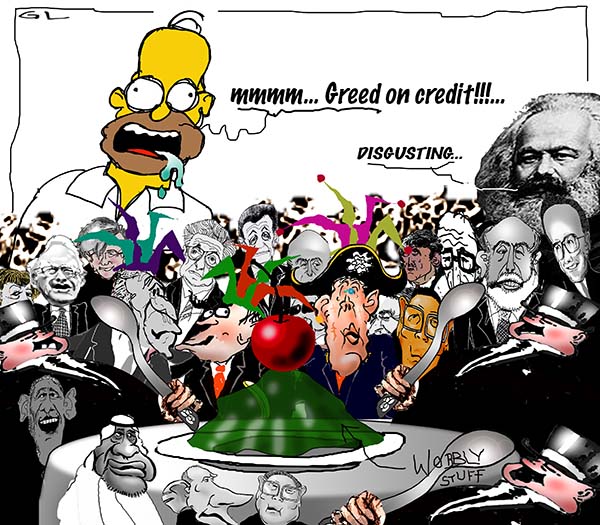
greed on credit .....
One could ask the question: how did the financial system got us into such a mess?
First one has to look at the value of anything and nothing…
On average:
* Real inflation has been around 8 per cent for the past ten years* Workers » remuneration has increased by around 4 per cent per year
* CEOs remuneration has increased by about 300 per cent (conservative figure).
After 5 years, workers are roughly 22 per cent behind in accepted value of fish things.CEOs are about 250 per cent in front. The poor are still behind the starting blocks.
Some things have fluctuated in price: oil by 700 per cent (500 % inflation adjusted) down to flat level (inflation adjusted). Other things have increased by calculated inflation value, plus increased costs of manufacturing and provision for a minimum 15 per cent increase per year profit for investors to be content with.
Most manufacturing was shifted to China to cut cost of production and increase profit margins by about 200 per cent.
Governments of the world have calculated fictitious « official » inflation between 3 and 4 per cent.GDP of the world was US$54.62 trillions in 2007.
World’s financial assets calculated at 140 trillions in the same period.
Value of Real Estate in 1999 around 110 per cent that of GDP in the US…
Value of Real Estate in 2007 around 140 per cent that of GDP in the US…
Increase of perceived value approx 30 per cent (discounting inflation).
Say similar figures for rest of world with small variations …Say that conservatively 50 per cent of the Real Estate value is on credit …
Say that credit repayments have become unmanageable versus income, as income diminish in real terms in some sectors.
Plus Sub-prime loans became a large hole in the credit fabric.There is a point a which, stitches in the jumper start to unravel.
One thread breaks and the whole thing falls apart, unless repaired quickly.We have not fixed the unravelling. We’re fixing a little thread: too late.
Stock prices have devalued by about 50 per cent in the last two years. Price of gold has gained about 20 per cent and climbing.
There is a fictitious accepted value of things that fluctuates with hope it will increase.There is a minimum accepted value of things at which we stop acquiring more stuff.
There is a minimum value of things at which people won’t accept devaluation below it and will revolt — as they cannot survive.
There is a perception that thrifty people have been screwed by "spendrifts" who bought things:
* they could not afford* on credit under encouragements of governments that wanted to maintain growth
The greatest threat to the financial system is itself, followed by an increasing urgent and increasingly important global warming factor encompassing population growth, asset growth, reduction of natural space, increase of climatic trauma.
Our financial system relies on an equation that leads to filling the jar without leaving space to move.Stylistic analysis of processes, in which we glorify our illusions versus our animal reality.
Glory takes many forms but mostly dismisses our animal reality to our detriment.
We need to become humanely intelligent again. Most Greek philosophers had more understanding of humanity than we have now at large, to the exception of a few thinkers whose mind are not cluttered by irrelevant entertaining that takes us away time from our own care and management.When looking at all the differentials, one can calculate the value of the black hole of illusion values. In my book, this comes down to about 15 trillion dollars and will stay yearly about the same till we’re able to rewrite by urgent choice the real value of global warming and environmental degradation into our economic equations. So far, the attempts by world leaders on this urgency have been pitiful and more or less useless.
Greed on credit has been the main culprit of the financial system crash. To repair this might be doomed to failure. A new system needs to be recast with the planet welfare in mind.
* Boom and bust versus steady growth analysis…
* The disappearance of savings …
* The value of the future not be left to speculation.
Unsustainability in our life by greed on credit… the price being highly beyond our comprehension.Increasing world population to increase the value of the pie is a nasty piece of work that leads to a greater problem.
- By Gus Leonisky at 17 Feb 2009 - 10:54pm
- Gus Leonisky's blog
- Login or register to post comments
the prometheus kids...
From Webdiary
Until recently, whenever climate research organizations reported increases in Arctic Sea ice melt rates [6], advocates of global “cooling” have been making references to the Antarctic continent as supposed counter argument [7]. Referring to small stable or slightly cooling parts of east Anarctica (Fig 2), a plethora of bogus climate websites claim Antarctic warming is not a part of global warming [8].
Presumably regarding Antarctica as part of another planet?
Nor do “climate skeptics” shed too many tears about Emperor penguins, the magnificent birds which have to migrate from their inland colonies across ice shelves and sea ice (Figs 8), where the females lay just one egg that is tended by the male. The ice plays a major role in their overall breeding success. Further, the extent of sea ice cover influences the abundance of krill and the fish species that eat them – both food sources for the penguins.
Misreadings of climate science by “climate skeptics” have delayed efforts at climate mitigation by at least 20 years. In the words of Clive Hamilton [9]: “If scientific advances cause scientists to reject the conclusions of past IPCC reports … not much harm will be done. … but if … fellow skeptics were successful in stopping policies to cut emissions and the IPCC projections turn out to be correct, then environmental catastrophe will follow and millions of people will die. Do they lose sleep over this? Do they worry about how their grandchildren will see them? Or are they so consumed by the crusade that they know they will never be proven wrong?”
------------------------
From the New York Times
Job Losses Pose a Threat to Stability Worldwide
By NELSON D. SCHWARTZPARIS — From lawyers in Paris to factory workers in China and bodyguards in Colombia, the ranks of the jobless are swelling rapidly across the globe.
Worldwide job losses from the recession that started in the United States in December 2007 could hit a staggering 50 million by the end of 2009, according to the International Labor Organization, a United Nations agency. The slowdown has already claimed 3.6 million American jobs.
High unemployment rates, especially among young workers, have led to protests in countries as varied as Latvia, Chile, Greece, Bulgaria and Iceland and contributed to strikes in Britain and France.-------------------------
From the Independent
The HBOS whistleblower whose revelations led to the resignation of one of the Government's top regulators is about to release a tranche of documents which he says point a direct and accusatory finger at Gordon Brown's responsibility for the banking crisis, and has called on the Prime Minister to resign. In a further blow to Labour, an Independent on Sunday poll showed voter support for the party evaporating, leaving it only a few points ahead of the Lib Dems.
Paul Moore, the former head of risk at HBOS, told the IoS that he has more than 30 potentially incendiary documents which he will send to MPs on the Treasury Select Committee. He says they disprove Mr Brown's claim about the reasons for HBOS's catastrophic losses – now estimated to be nearly £11bn – and show that it was the reckless lending culture, easy credit and failed regulation of the Brown years that led directly to the implosion of British banks.
--------------------
from the ABC
Personal borrowing at highest level in 6 months
Posted Mon Feb 16, 2009 4:41pm AEDT
Updated Mon Feb 16, 2009 4:40pm AEDT
Personal borrowing has posted its biggest rise in six months as consumers took advantage of lower interest rates to refinance existing loans.
Australian Bureau of Statistics (ABS) data shows personal borrowing rose 4.1 per cent in December compared to the month before.
It was the biggest monthly gain since June 2008, the first monthly increase in personal loans since September, and followed a 1.8 per cent fall in November.
CommSec's chief economist Craig James says it is a good sign households are still willing to spend.
------------------
[2007]
The linear growth started turning exponential in 1965 for GDP, and a year later in 1966 for Housing Valuation.
Such a close relationship between the two is not just a coincidence. Rising home values have made Americans feel wealthy. And tapping into the Home Equity has been the source of purchasing power. Fuelling consumption and GDP growth.
Since 1980 the Housing Valuation has exceeded GDP.
Since 2000, it also appears that The Housing Bubble has not been pushing up the GDP as much, and the Gap between the two has been rising.
May be the Housing Bubble is no longer effective in pushing up the GDP as much.
This may well be it's final sprint before busting after a 40 year expansion.
---------------------------------
Pakistan's president says his country is fighting for its survival against the Taleban, whose influence he said has spread deep into the country.
In an interview with US TV channel CBS, President Asif Zardari said the Taleban had established a presence across "huge parts" of Pakistan.
The country had failed to increase its forces in response, he said.
On Saturday, officials said at least 27 militants were killed in a suspected US missile strike on a Taleban hide-out.
The missile hit a house in north-west Pakistan, near the border with Afghanistan, where the US has carried out more than 20 air strikes from drones in recent months.
Islamabad has long argued that the strikes complicate its fight against insurgents, and violate its sovereignty.
---------------------------
BACK IN 1969 the International Monetary Fund (IMF) created a new kind of money – the ultimate form of international money, it believed – called the Special Drawing Right.
You can't shop with an SDR, nor trade it or even touch it. Unless you crunch numbers for an international organization like the IMF, Andes Reserve Fund, the Arab Monetary Fund, or the Bank for International Settlements (BIS) in Basel, the only time you're likely to come anywhere near an SDR is if an airline loses your luggage.
The Montreal Convention states that if your bags have not reached you within 21 days of expected arrival, you can claim 1,000 Special Drawing Rights as compensation from the airline.
At today's valuation, that would mean you receive around $1,500...or £770...or €955...or ¥159,000. Because you can't be paid in SDRs. In reality they don't exist. Only a government-issued paper money can bring the SDR's value into existence.
"Monetary Gold and SDRs issued by the IMF are financial assets for which there are no corresponding financial liabilities," explains the Monetary Fund. But while Gold holds value for people earning all kinds of currency across the world, the SDR is simply an intangible monetary unit. It exists as an accounting tool only, used by the world's central banks and cross-border monetary organizations.
--------------------------
In recent years, the World Bank like other international financial
institutions have been using GNI more frequently as a measure of national
income in international economic comparisons. Why ?
In order to understand this, we need to know first of all what GNI is. Well,
basically it is just a new acronym for the good old Gross National Product
we used to know, which in the 1970s was largely abandoned in favour of GDP.
The rationale given for the change in wording is that GNI is considered more
a concept of "income" rather than a "product measure" (sic.).
Officially, GNI equals GDP (the sum of value added by all resident
producers in the sphere of production) PLUS any product taxes
(less subsidies) not already included in the valuation of net output, PLUS
net receipts of primary income (compensation of employees and
profits) from abroad. (To smooth fluctuations in prices and exchange
rates, the "Atlas method of conversion" used by the World Bank then
applies a conversion factor, which averages the exchange rate for a
given year and the two preceding years, adjusted for differences in
rates of inflation between the country, and through 2000,
the G-5 countries (France, Germany, Japan, the United Kingdom,
and the United States). For 2001, these countries include the Euro Zone,
Japan, the United Kingdom, and the United States.)
The extra net income added to GDP thus refers specifically to the income
received from labour and capital owned overseas by residents of the domestic
economy, MINUS similar payments made from the domestic economy to
non-residents overseas. Conceptually, these incomes must be related to the
social accounting concept of "production". In other words, it has to be new
income generated by the application of factors of production overseas, which
are owned by domestic residents, income which represents a fraction of
new value added.
So far, so good, but now I want to know, just what difference does this
component make to the GNI and GDP totals ?
-------------------------------
[IMF 2000]
Prospects and Policy Challenges
How Much Longer Will the Expansion in North
America Continue?
Reenergizing the Japanese Recovery
Recovery and Divergence in Europe
Recovery in Latin America: Emerging But Still Vulnerable
Recovery in Asia-Pacific: The Momentum Increases
Russia and the Commonwealth of Independent States (CIS): Growth, But Uncertain Prospects for Sustained Recovery
Countries on the European Union Accession Track
Middle East and Africa: Stronger But Narrowly-Based Growth
Poverty and Globalization
The Ongoing Recovery in Emerging Market Economies
Financial Conditions Facing Emerging Market Economies
Commodity Market Developments
Policy Responses and Vulnerabilities in Latin America
Improved Outlook in East Asia, But Policy Challenges Remain
-----------------------
(Gus' note: some of the figure I quoted in the comment "greed on credit" were in the wrong year. By shifting back the values to the rightful year, the "economic trauma is thus emphasized [stressed] by an extra 13 per cent...")
28 January 2008
The total value of the world's financial assets grew faster in
2006 at 17 per cent to reach $167 trillion from $142 trillion in
2005, according to a McKinsey report titled, Mapping Global
Capital Markets, Fourth Annual Report, released this month.
At constant exchange rates, the growth in global financial
assets was 13 per cent.
The report, prepared by McKinsey Global Institute (MGI),
the economics research arm of McKinsey & Company, was
the latest year for which "comprehensive data was available".
---------------------------
"The world's financial system is overflowing with stocks, bonds and other financial assets -- $140 trillion worth, to be precise.
--------------------
Overflowing? Where did the overflow go and what created the overflow?
see toon above and others as indicated....
Do not sneeze...
"Raise you by another 2 bils*..."
or playing poker with the world economy... and the planet...
or a honest day's work for bugger-all slave-wage pay...
or two billions bet the house will burn down...
---------------
A lot has been said about many part of our financial system, but few parts of this wonky three-wheeler take the cake like CDS — or Credit Default Swaps for the initiated...
Few financial whizzes understand how derivatives really work and I don't blame them... Derivatives are hard yakka... And these CDS babies are derivatives of the smarter kind... Mathematically, they are a gem of simplicity, once past the fog of moralisationing and once we have mastered the ability to keep a straight face. I may be contested on my explanation here... go for it.
Some people dare describe CDS as "insurance" but it's actually a very cleverly disguised extortion — like a "protection racket" with a bet attached.
The Mafia would be proud!!
The scheme is ingenious. THE MAFIA GIVES YOU MONEY!!!
It gives you (the bank or busIness) money for someone else's (or your own, should you choose to as a business) windows NOT GETTING BROKEN... It seems like a win-win deal, doesn't it? But if the windows you have insured by BEING PAID MONEY FOR are broken, you pay the Mafia heaps (as an agreed amount) in return... Brilliant!!!!
And the broken windows are now irrelevantly kaput. That's only an aside to the transaction. Betting is the name of the game.
-------------
In other words:
in CDS, the banks will place a bet with "investors/insurers" that a business won't go up in flame. Meanwhile, the "investors/insurers" have to fork out regular payments to the banks should your business stay afloat for example. Of course your business relies substantially on the bank's largesse for loans to trade efficiently (or not).
You get your loans by waging your own assets as collateral. So far so good.
The banks hope they will beat the "investors/insurers"'s bet because it's in the bank's interest your business stay solvent, at least till the expiry date of the CDS contract, at which time the bank would have made heaps of cash for investing nothing.
Whether you business works well or not is not part of the deal. The deal is not an "investment". It's a bet on whether you stay afloat during the "contract" terms.
And this massive raining CDS cash meanwhile is accounted in the Banks annual returns and used for investing in other schemes, including supplying you with more loans so your business can "grow", faster and faster... The faster the better for the banks. They can't give you enough money... You want a million, here's two... The banks are laughing their heads off. They could and sometimes they do bet twice as much as before, against the "insurers/investors". The economy is booming... The "investors/insurers" fork out dough for nothing really — but for only betting your business is going to sink no matter what.
It does not take Einstein to work out what's going to happen next...
Our clever financial system relies on "boom and bust" cycles to create "greater" flow of money.
See, some universities (French UK and US) around the world put their brains together to snoop around this conundrum and have devised a strange but solid mathematical theory that says, in the long run, "economies" are gaining far more with boom and bust cycles that in a steady growth system. Weird but the figures don't lie... The maths do add up. In short with boon and bust practice — say slash, burn and rebuild — the economic advantages are about 300 to 500 per cent up per decade on just steady as she goes growth. And let's not talk of sustainability here... or any other planetary concerns either... And please do not mention that there are a few provisos... a small print clause in the equation so to speak, that bust the theory in specific cases — say advanced economies?.
Place your bets!
Thus in CDS the bets are placed on "when a bust is going to happen". The banks work their butt off to make sure there is always a boom or one at least till the contracts have expired...
One wonders if their brains are in their fundamental bums...
Imagine that there is a room on the backside of the banks where there is a big roller-poker circus going on. The bank know there will be a crash but they bet against the "investors/insurers" that the crash will come after the "investors/insurers" paid far more than the value of the windows that have been "insured".
As mentioned, these windows could be your own, but generally as a cautious "investor/insurer" they are someone else's that as an "investor/insurer" you keep a close eye upon. If they are your own, there is a chance you know your business is going arse-up, but the bank does not know that, despite all its effort to know the health of you trade...
Meanwhile, the "investor/insurer", is entitled to advertise to the whole wide world that the windows that are "insured" are very exposed and fragile, but they are "prepared to take the risk"...
What risk you may ask???...
the "insurers/investors" don't have to pay thugs to throw stones.
There are always some silly twits and graffiti artist ready to spray paint on the abode (say you're in business and your competition make deals with your customers, deals you can hardly match — i.e. manufactures in China, or so like) and, soon after, a few loose canons stop buying your products or make life difficult for your business. Meanwhile your windows are "insured" and, so far, on average, the odds are that they will be broken before they are "fully paid off" to the bank by the "investors/insurers". Thus the Bank has to give the "investors/insurers/Mafia") the full value of the windows or whatever sum "they were insured for" (which could be far more than your windows themselves)...
Easy pickings.
This amazing system was devised by a team of smart bankers working for JPMorgan/Chase... They wrote the rules of the games in 1997... And I believe they're still laughing their heads off... Sure the scheme has been publicly sold as an insurance against breakage but on that scale, breakage is inevitable and the scheme works... IN REVERSE!!!.
And since the premiums for this insurance are roughly based on a 15 year cycle, when the true boom and bust cycle is on average 7 years... or similar, and the contract are often written on a couple of years' basis, there is plenty of room for clever punters (not on the side of the banks of course) to make a killing. The presidential mug who signed off on the scheme was Bill Clinton — may be in a moment of libido weakness (possibly enamoured with Greenspan who was whispering sweet nothings of the financial markets in his ear).
Meanwhile the banks call the unfortunate payola to the "investors/insurers": bad debts... Same name as with other defaulting loans, such as in the sub-prime debacle. Extinction in species is that more than one bad factor is often necessary to become effective. In the case of banks, they had two major factors pushing their bum up. Sub-prime and I'd say CDS. These two factors would make the banks tighten their butts and credit would stop flowing to businesses, which in turn would go under, compounding the CDS bet debts at a rate of knots. Chugging along with me, folks?
Too many of these bad debts and the banks go under.
Despite their huge size, the banks may not have enough cash or borrowing power with other banks to pay the debt, because the bets are not done with potato chips — they are done with millions of dollars, adding to billions, bordering on trillion, etc.
Sometimes to save the furniture, the banks might do new deals with the "investors/insurers in broken windows" but it's a bit like double or nothing and the banks are likely to loose their pants and ours (we — the piddly-savers who are counting three bux fifty cents by candlelight) at the same time.
The banks become insolvent.
Some banks thus did crash, others got bought out with their massive bad debts, while GOVERNMENTS WORLDWIDE had to fork out rescue packages to salvage the bigger "banking system" including protecting savings by "garantee", otherwise, the entire house would go on fire.
And dry-cakes to the peasants would not be enough to stop a revolution. Thus governments have buttered the cakes as well... while making sacrifices to the god of money, Mercury, and by begging Pandora to open her box again, to let loose the last monster: hope...
I would guess there are some (many) nervous politicians in governments, in opposition and some (many) bankers with browning pants — although the latter's dry-cleaning bill is taken care of by their lavish bonuses...
So, no-one is prepared to put a figure on the bank and government losses yet.
The black hole is huge and still swallowing moneys. Unless one is prepared to rewrite the CDS contracts with a gun in hand (i.e. burn the paper they've been written on), nothing will save the system.
Meanwhile, businesses are begging for more cash but the banks having been cleaned up by the first CDS on the frontline are bare and only Governments can now print the maintenance money... Considering say for example the total value of financial assets worldwide being 140 trillions, the value of the Credit Default Swap is about two fifth of that — or 60 trillion bux. In my book, that is a mega lot of bet!!!.
Not that all assets will go on fire, but the "insurers/investors" are hoping so or at least wishing for a mega deconstruction (bust), so they can cash in. Sure the "Investors/investors" are also part of the system and smartly would have covered their tracks by having some other regular "investments" — investments that would burn in the collapse but, on balance the "insurers/investors" make mega bux on the difference. But did they expect such a large melt down? Growth was so spruiked up... I bet they did and did not... the market is bipolar (boom and bust) to progress...
Good luck to you anyway. As me mum used to say, "one does not take it away, once we've carked..."
And the fun of this scheme is that one does not have to be a bank to play this hot game. You and me, mere stingy mortals, could place a bet with an investor for example that the Euro won't be down against the dollar at the end of a fixed period. The investor will pay you regular cash against your bet (CDS) and you can enjoy the life of Midas — until you have to pay twice what you have in reserve (because you're a "spend-drift"), should the Euro take a nosedive at five minutes to midnight of the "contract". You sink. You're dead meat.
Unless you refuse to cough up.
Like the "investors/insurers" have protection, you have "thugs" working for you that will protect your assets against the "investors/insurers" you don't want to pay. They're called "lawyers" and private beefy blokes or "bodyguards", but their palms need to be well-oiled, so you need heaps of cash to afford this snubbing privilege.
It could turn ugly though, and the war in Iraq would be a side-show to your biffo with the "investors/insurers" demanding their cash...
They may have machine guns in their violin cases...
To avoid a massive bloodshed, the governments of the world had to basically pay the first part of the debt using FUTURE taxpayers money. And the poker-circus game is still on in the smoke-filled back rooms. No-one knows where the bluff will stop and more bets are waged.
The kitty is now more than 60 trillion bux, growing fast and on the table.
Do not sneeze.
*See toon above... I was going to do a toon with rotund bankers betting "bils" (billions) against the mafia with guns on the table while behind the scene, government leaders like Brown, Sarkozy, Obama, Rudd, etc would be sweating like pigs... But I got lazy and have work to do...
they shoot horses don't they .....
from Crikey …..
Irish bankers' luck runs outGlenn Dyer writes:
It is now apparent that the Irish financial system is a leaky, grubby, black hole. At one bank, Anglo Irish, mates and insiders, including the entire board, were loaned tens of millions of euros to do comfy deals that helped cause the bank's collapse and nationalisation.Two reports last week on Anglo Irish reveal it suffered a multi-billion euro run late last September to the point where it would have been insolvent but for the bodgied up deposits from Irish Life -- the bank financed the purchase of 10% of its shares from a group of rich Dublin business it refuses to name. Even though it has lost 300 million euros on the transactions, it lent a quarter of a billion euros to directors in 2008 and paid them over 5 million euros more.
In the words of an editorial in the Irish Times at the weekend:...the extent to which the directors and executives of the bank were also big customers is truly shocking. It confirms the picture that has emerged over the last few months of an organisation that was fundamentally flawed and morally bankrupt.
It's clear that Irish financial regulators either were asleep, incompetent or turned a blind eye to the apparent insolvency of this bank last September and the self dealing at the top. It should have been closed then and nationalised, yet the Irish Government still went ahead with the now absurd guarantee on bank deposits and assets.In the case of Anglo, it was guaranteeing a crock of rubbish: it was propped up by billion of euros of 'deposits' from Irish Life, which were reversed after balance date, while the board and management still got paid under false pretences, and the mates of the chairman and others had their share purchase loans written off.
The whole, horrible mess was detailed in part of a report from the Irish Government on the affairs of Anglo Irish from PricewaterhouseCoopers released on Friday night, two hours after the bank's 2008 annual report was released.The PwC report reveals that in the week before the government's bank guarantee scheme last September, there was a run on Anglo Irish Bank with 5.4 billion euros in corporate and retail deposits withdrawn.
"As of September 27th, Anglo was forecasting net negative cash of €12.0 billion by October 17th," it said.At the end of September, Anglo's balance sheet included 7.3 billion euros of deposits from Irish Life Assurance and 7.5 billion of short-term interbank placements from Irish Life and Permanent.
Its deposits stood at 51.5 billion euros at the end of the year.The report found the bank had 15 banking relationships in excess of €500 million. It concluded that the size of the exposures significantly increases the bank's risk profile. Most of these were property and housing developers. These loans could cost the bank 5 billion euros in losses over the next two years.
The bank said in its annual report that it lent 451 million euros to 10 clients to buy shares to support its share price last year:The amount loaned was 50% more than previously thought. They purchased up to 10% of the bank owned by businessman Sean Quinn. He had accumulated a 25% stake, more than revealed.
The shares are now worthless after the bank was nationalised. Only 83 million euros have been repaid from the 451 million lent, meaning 300 million will be written off.The bank also showed that 9.535 million euros was paid to the bank’s directors. Five executive directors, who managed the bank during the year, received a combined 8.13 million.
The Anglo report provides further details on the large loans drawn by the bank's directors.Some 255 million euros was advanced to 13 directors of the bank during its 2008 financial year to 30 September last, while 115 euros million was repaid. Including their board fees, that's 20 million euros in total for each of the 13 directors in 2008.
The loans advanced to directors equal almost a third of the pretax profits made by Anglo in the year.The outstanding amount owed by the directors at 30 September amounted to 179 million euros, of which 83.3 million was owed to the bank by the former chairman, Sean FitzPatrick. His loans were hidden by them being transferred to another Dublin bank at audit time with the connivance of Anglo's then CEO and other senior executives.
the 1.3 trillion pound heist...
As scapegoats go, Sir Fred Goodwin is straight out of Central Casting. He's a banker; he's mucked up big time, cost the taxpayer sums still too large to calculate properly, and he's walked away from the mess with riches beyond the avarice of a Premiership footballer. All he lacks, as a media villain, is a pair of staring eyes and record of cruelty to animals.
If Alastair Campbell were still around, Sir Fred might have been saddled with even that. But this week, as loomed the handing to banks of further barrels of public cash on what the furniture stores used to call easy terms, the Government had no need for nudge-nudge rumours of scuttlebutt to create a diversion. It had information even more incriminating and instantly unpopular: the size of Sir Fred's pension pot.
It was huge; it was blood-pressure raisingly indefensible; and, above all, it seemed politically useful. Ministers had known the scale of it for months; something pretty close to its size had been reported on City pages as far back as 14 October last year.
-------------------------
Gus: When one tallies all the rescue packages from Europe, the US and the rest of the world (including Russia and China), I would not be surprised if my "guesstimate" (actually a sharp calculation of bad debts differentials) of 15 trillions is accurate so far... see toon at top and read the blogs below it...
proud as a mafioso...
As Italy's Banks Tighten Lending, Desperate Firms Call on the Mafia
By Mary Jordan
Washington Post Foreign Service
Sunday, March 1, 2009; A01
ROME -- When the bills started piling up and the banks wouldn't lend, the white-haired art dealer in the elegant tweed jacket said he drove to the outskirts of Rome and knocked on the rusty steel door of a shipping container.
A beefy man named Mauro answered. He wore blue overalls with two big pockets, one stuffed with checks and the other with cash. The wad of bills he handed over, the art dealer recalled, reeked of the man's cologne and came at 120 percent annual interest.
As banks stop lending amid the global financial crisis, the likes of Mauro are increasingly becoming the face of Italian finance. The Mafia and its loan sharks, nearly everyone agrees, smell blood in the troubled waters.
"It's a fantastic time for the Mafia. They have the cash," said Antonio Roccuzzo, the author of several books on organized crime. "The Mafia has enormous liquidity. It may be the only Italian 'company' without any cash problem."
-------------------
in one of the comments above didn't I call "mafia/investor/insurer" those indulging in CDS (credit default swaps). Didn't I say the mafia would be proud? see toon at top...
neutering government watchdogs...
From Chris floyd...
Following the example of Arthur Silber, today we look to the work of Professor Michael Hudson to cut through the bewildering thicket of cant, con and deliberate deceit that surrounds the various "solutions" to the economic crisis. In his latest Counterpunch piece, Hudson addresses the seemingly counterintuitive spectacle of watching Alan Greenspan, the Arch-Druid of the "free market" cult, calling for nationalization of the nation's banks:
How is it that Alan Greenspan, free-market lobbyist for Wall Street, recently announced that he favored nationalization of America’s banks – and indeed, mainly the biggest and most powerful? Has the old disciple of Ayn Rand gone Red in the night? Surely not.
The answer is that the rhetoric of “free markets,” “nationalization” and even “socialism” (as in “socializing the losses”) has been turned into the language of deception to help the financial sector mobilize government power to support its own special privileges. Having undermined the economy at large, Wall Street’s public relations think tanks are now dismantling the language itself.
Exactly what does “a free market” mean? Is it what the classical economists advocated – a market free from monopoly power, business fraud, political insider dealing and special privileges for vested interests – a market protected by the rise in public regulation from the Sherman Anti-Trust law of 1890 to the Glass-Steagall Act and other New Deal legislation? Or is it a market free for predators to exploit victims without public regulation or economic policemen – the kind of free-for-all market that the Federal Reserve and Security and Exchange Commission (SEC) have created over the past decade or so? It seems incredible that people should accept today’s neoliberal idea of “market freedom” in the sense of neutering government watchdogs, Alan Greenspan-style, letting Angelo Mozilo at Countrywide, Hank Greenberg at AIG, Bernie Madoff, Citibank, Bear Stearns and Lehman Brothers loot without hindrance or sanction, plunge the economy into crisis and then use Treasury bailout money to pay the highest salaries and bonuses in U.S. history.
the pledge .....
In his speech on Iraq redeployment today, President Obama pledged to have all troops, including "residual forces," by the end of 2011. This is the pledge I have been waiting for:
Let me say this as plainly as I can: by August 31, 2010, our combat mission in Iraq will end.Through this period of transition, we will carry out further redeployments. And under the Status of Forces Agreement with the Iraqi government, I intend to remove all U.S. troops from Iraq by the end of 2011.
This is huge for no residual forces proponents. Now that President Obama has made this pledge, in public, it will be difficult for him to go back on it. This is especially the case since turning back on a promise with a deadline of December 31st, 2011, means violating a pledge during 2012 - the year President Obama will be running for re-election.
http://www.alternet.org/blogs/waroniraq/129283/Our social security cards
anti-laxative against derivatives
The US Treasury wants more regulation of derivatives - the complex financial instruments that brought down some of Wall Street's biggest names.
Proposals to be set out by Treasury Secretary Timothy Geithner will call for an electronic system to monitor buying and selling in the market.
Firms trading in derivatives will need enough capital in case they default and will face tough reporting requirements.
AIG and Lehman Brothers were among the firms ruined by dealing in derivatives.
Perhaps the most notorious form of derivative is the credit-default swap.
Insurance giant AIG sold these to investors as a form of insurance to protect against defaults on mortgage-backed securities.
But the firm had to accept a hefty federal bailout after it was unable to support the contracts.
"The days when a major insurance company could bet the house on credit default swaps with no one watching and no credible backing to protect the company or taxpayers from losses must end."
Timothy Geithner - Treasury Secretary
--------------------
See toon at top and read comments below it especially do not sneeze and see toon overthere...
betting against one's own product...
By GRETCHEN MORGENSON and LOUISE STORY
In late October 2007, as the financial markets were starting to come unglued, a Goldman Sachs trader, Jonathan M. Egol, received very good news. At 37, he was named a managing director at the firm.
Mr. Egol, a Princeton graduate, had risen to prominence inside the bank by creating mortgage-related securities, named Abacus, that were at first intended to protect Goldman from investment losses if the housing market collapsed. As the market soured, Goldman created even more of these securities, enabling it to pocket huge profits.
Goldman’s own clients who bought them, however, were less fortunate.
Pension funds and insurance companies lost billions of dollars on securities that they believed were solid investments, according to former Goldman employees with direct knowledge of the deals who asked not to be identified because they have confidentiality agreements with the firm.
Goldman was not the only firm that peddled these complex securities — known as synthetic collateralized debt obligations, or C.D.O.’s — and then made financial bets against them, called selling short in Wall Street parlance. Others that created similar securities and then bet they would fail, according to Wall Street traders, include Deutsche Bank and Morgan Stanley, as well as smaller firms like Tricadia Inc., an investment company whose parent firm was overseen by Lewis A. Sachs, who this year became a special counselor to Treasury Secretary Timothy F. Geithner.
How these disastrously performing securities were devised is now the subject of scrutiny by investigators in Congress, at the Securities and Exchange Commission and at the Financial Industry Regulatory Authority, Wall Street’s self-regulatory organization, according to people briefed on the investigations. Those involved with the inquiries declined to comment.
-------------------------
Here we can only move on to my explanation of CDS... see above "do not sneeze". See other financial comments above it as well (greed on credit) and other stuff on this site including yo yo yo hope...
perverse moneys...
I knew that...
From the NYT
Bets by some of the same banks that helped Greece shroud its mounting debts may actually now be pushing the nation closer to the brink of financial ruin.
Echoing the kind of trades that nearly toppled the American International Group, the increasingly popular insurance against the risk of a Greek default is making it harder for Athens to raise the money it needs to pay its bills, according to traders and money managers.
These contracts, known as credit-default swaps, effectively let banks and hedge funds wager on the financial equivalent of a four-alarm fire: a default by a company or, in the case of Greece, an entire country. If Greece reneges on its debts, traders who own these swaps stand to profit.
“It’s like buying fire insurance on your neighbor’s house — you create an incentive to burn down the house,” said Philip Gisdakis, head of credit strategy at UniCredit in Munich.
As Greece’s financial condition has worsened, undermining the euro, the role of Goldman Sachs and other major banks in masking the true extent of the country’s problems has drawn criticism from European leaders. But even before that issue became apparent, a little-known company backed by Goldman, JP Morgan Chase and about a dozen other banks had created an index that enabled market players to bet on whether Greece and other European nations would go bust.
Last September, the company, the Markit Group of London, introduced the iTraxx SovX Western Europe index, which is based on such swaps and let traders gamble on Greece shortly before the crisis. Such derivatives have assumed an outsize role in Europe’s debt crisis, as traders focus on their daily gyrations.
A result, some traders say, is a vicious circle. As banks and others rush into these swaps, the cost of insuring Greece’s debt rises. Alarmed by that bearish signal, bond investors then shun Greek bonds, making it harder for the country to borrow. That, in turn, adds to the anxiety — and the whole thing starts over again.
On trading desks, there is fierce debate over what exactly is behind Greece’s recent troubles. Some traders say swaps have made the problem worse, while others say Greece’s deteriorating finances are to blame.
-------------------
If one reads the do nott sneeze article above and the bet against one's own product above as well, one can see that this activity should be illegal and prosecuted forthwith retrospectively. Although it is hard to prove there is or was intent to precipitate the ruin of an "insured" in order to cash in, the simple fact of betting against one's own actions is too pervese for words... see also toon at top.
In another comment on this site, I exposed the hidden value of derivatives:
the world GDP is about 60 trillion US dollars.
The amount of money floating around worlswide is about 130 trillion US dollars.
The amount of derivatives (bets on the house), at last computation, is about 700 trillion US dollars...
Make the sums....
termites under the carpet...
By LOUISE STORY and ERIC DASH
It was like a hidden passage on Wall Street, a secret channel that enabled billions of dollars to flow through Lehman Brothers.
In the years before its collapse, Lehman used a small company — its “alter ego,” in the words of a former Lehman trader — to shift investments off its books.
The firm, called Hudson Castle, played a crucial, behind-the-scenes role at Lehman, according to an internal Lehman document and interviews with former employees. The relationship raises new questions about the extent to which Lehman obscured its financial condition before it plunged into bankruptcy.
While Hudson Castle appeared to be an independent business, it was deeply entwined with Lehman. For years, its board was controlled by Lehman, which owned a quarter of the firm. It was also stocked with former Lehman employees.
None of this was disclosed by Lehman, however.
Entities like Hudson Castle are part of a vast financial system that operates in the shadows of Wall Street, largely beyond the reach of banking regulators. These entities enable banks to exchange investments for cash to finance their operations and, at times, make their finances look stronger than they are.
Critics say that such deals helped Lehman and other banks temporarily transfer their exposure to the risky investments tied to subprime mortgages and commercial real estate. Even now, a year and a half after Lehman’s collapse, major banks still undertake such transactions with businesses whose names, like Hudson Castle’s, are rarely mentioned outside of footnotes in financial statements, if at all.
The Securities and Exchange Commission is examining various creative borrowing tactics used by some 20 financial companies. A Congressional panel investigating the financial crisis also plans to examine such deals at a hearing in May to focus on Lehman and Bear Stearns, according to two people knowledgeable about the panel’s plans.
------------------------
Gus: It's more burrowing tactics than borrowing whatever... We all know that if termites profit from hiding in your floor planks, eventually, the whole floor is going to collapse. The carpet might still be nice and clean till then but it can do nothing to support a couple of dancing economists...
secretly devised to fail
From the NYT
U.S. Accuses Goldman Sachs of Fraud in Mortgage DealBy LOUISE STORY and GRETCHEN MORGENSON
Goldman Sachs, which emerged relatively unscathed from the financial crisis, was accused of securities fraud in a civil suit filed Friday by the Securities and Exchange Commission, which claims the bank created and sold a mortgage investment that was secretly devised to fail.
...
But the deck was stacked against the Abacus investors, the complaint contends, because the investment was filled with bonds chosen by Mr. Paulson, who is not named in the suit, as likely to default. Goldman told investors in Abacus marketing materials reviewed by The Times that the bonds would be chosen by an independent manager.
“The product was new and complex, but the deception and conflicts are old and simple,” Robert Khuzami, the director of the S.E.C.’s division of enforcement, said in a statement. “Goldman wrongly permitted a client that was betting against the mortgage market to heavily influence which mortgage securities to include in an investment portfolio, while telling other investors that the securities were selected by an independent, objective third party.”
The complaint heralds the return of a more aggressive S.E.C. The case may help the agency recover from some initial mishaps, and signals that the agency is tracing the mortgage pipeline all the way from the companies like Countrywide that originated home loans to the raucous trading floors that dominate Wall Street’s profit machine.
-----------------
Gus: as you know, I am not an economist, nor a "financial wiz".... But I am an expert on "deception" (see the age of deceit [intro 1-2-3 and first chapter — in the same line of comments] and of spiders' webs. see also do not sneeze and also double cross and intelligence cock ups).
But despite not being an economist, nor a "financial wiz" let me say the construct of CDS and derivatives can be manipulated far beyond what they are ment to be "on the surface". Betting against the value of one's own product is perverse at least and criminal on average... As I wrote then:
Few financial whizzes understand how derivatives really work and I don't blame them... Derivatives are hard yakka... And these CDS babies are derivatives of the smarter kind... Mathematically, they are a gem of simplicity, once past the fog of moralisationing and once we have mastered the ability to keep a straight face. I may be contested on my explanation here... go for it. Some people dare describe CDS as "insurance" but it's actually a very cleverly disguised extortion — like a "protection racket" with a bet attached.
The Mafia would be proud!!
The scheme is ingenious. THE MAFIA GIVES YOU MONEY!!!
----------------
read the rest at "do not sneeze"... and read also the two blogs above this one. see toon at top.
betting for and against betting on betting...
A Wall Street Invention That Let the Crisis MutateBy JOE NOCERA
Can it get any worse?
Every time you pick up another rock along the winding path that led to the financial crisis, something else crawls out. Subprime mortgages were sold as a way to give low-income people a chance at homeownership and the American Dream. Instead, the mortgages turned out to be an excuse for predatory lending and fraud, enriching the lenders and Wall Street at the expense of subprime borrowers, many of whom ended up in foreclosure.
The ratings agencies, which rated the complex investments that were built with subprime mortgages, turned out to be only too happy to be gamed by firms that paid their fees — slapping AAA ratings on mortgage bonds doomed to fail. Lehman Brothers turned out to be disguising the full reality of its horrid balance sheet by playing accounting games. All over Wall Street, firms pushed mortgage originators to churn out more loans that were doomed the moment they were made.
In the immediate aftermath, the conventional wisdom was that Wall Street had simply lost its head. It was terrible, to be sure, but on some level understandable: Dutch tulips, the South Sea bubble, that sort of thing.
In recent months, though, something more troubling has begun to emerge. In December, Gretchen Morgenson and Louise Story of The New York Times exposed the role that some firms, including Goldman Sachs and Deutsche Bank, played in putting together investment structures — synthetic C.D.O.’s, they were called — that were primed to blow up. They did so, reportedly, because some savvy investors wanted to go short the subprime market.
On Friday, the Securities and Exchange Commission dropped the hammer, charging Goldman Sachs with securities fraud for its purported failure to disclose that the bonds that were the basis for one particular synthetic C.D.O. had been chosen by none other than John Paulson, the billionaire hedge fund investor, who was shorting them.
Oh, and one other thing is starting to become clear: synthetic C.D.O.’s made the crisis worse than it would otherwise have been.
•
Remember in the months leading up to the crisis, when the Federal Reserve chairman, Ben Bernanke, and Henry Paulson Jr., then the Treasury secretary, were assuring everyone that the “subprime problem” could be contained? In truth, if the only problem had been the actual mortgage bonds themselves, they might have been right. At the peak there were well over $1 trillion in subprime and Alt-A mortgages that were securitized on Wall Street. That’s a lot, to be sure — but it was a finite number. You could have only as much exposure as there were bonds in existence.
The introduction of synthetic C.D.O.’s changed all that. Unlike a “normal” collateralized debt obligation, which contained the bonds themselves, the synthetic version contained credit-default swaps — derivatives that “referenced” a particular group of mortgage bonds. Once synthetic C.D.O.’s became popular, Wall Street no longer needed to feed the beast with new subprime loans. It could make an infinite number of bets on the bonds that already existed.
---------------------
See toon at top and blog above this one. Er... why not indulge yourself and read the whole lot here from the top... and find how some (most) banks primed the pump to load their coffers at YOUR expense...
sucking on rotten fruit...
By LOUISE STORY and GRETCHEN MORGENSON
For Goldman Sachs, it was a relatively small transaction. But for the bank — and the rest of Wall Street — the stakes couldn’t be higher.
Accusations that Goldman defrauded customers who bought investments tied to risky subprime mortgages have only just begun to reverberate through the financial world.
The civil lawsuit that the Securities and Exchange Commission filed against Goldman on Friday seemed to confirm many Americans’ worst suspicions about Wall Street: that the game is rigged, the odds stacked in the banks’ favor. It is the first big case — but probably not the last, legal experts said — to delve into a Wall Street firm’s role in the mortgage fiasco.
It is a particularly sensitive time for Wall Street. Washington policy makers are hotly debating a sweeping overhaul of the nation’s financial regulations, and the news could embolden those seeking to rein in the banks. President Obama on Saturday stepped up pressure for financial reform by accusing Republicans of “cynical and deceptive” attacks on the measure.
The S.E.C.’s action could also hit Wall Street where it really hurts: the wallet. It could prompt dozens of investor claims against Goldman and other Wall Street titans that devised and sold toxic mortgage investments.
On Saturday, several European banks that lost money in the deal said they were reviewing the matter. They could try to recoup the money from Goldman.
And it raises new questions about Goldman, the bank at the center of more concentric circles of economic and political power than any other on Wall Street. Goldman — whose controversial success has leapt from the financial pages to the cover of Rolling Stone — has fiercely defended its actions before, during and after the financial crisis. On Friday, it called the S.E.C.’s accusations “unfounded.”
----------------------
Gus: Goldman Suschx says to the suckers:
Hey!!!... We sold you wrapped rotten fruit at a premium price and betted the fruit would rot before tomorrow... Nothing to do with us. Now our premium argument is how to define rotten: we've got lawyers-galore working on the semantics of the grade of rotten and on the premises that, first, it was your call to decide whether you wanted the fruit and, second, it's your court to find out whether the fruit was already rotten, on the way to rot or laced with fruit-flies before you bought — or that we knew the fruit was rotting or rotten... We always announce that whatever you buy from our golden fruiiiiiit shop, there is a "risk" factor... Now how can one say that a 99 per cent or a 10 per cent chance of rot is included in a sealed bundled package of rotten fruit? You mean you trust us at face value?!!??... And what or who can stop us for insuring the values of the goods for hundred (or a thousand) times the value we make you pay for? We live in a "free market", don't we? It's your call to inspect the goods and have your own insurance, No?... Now... prove that we deliberately loaded the fruit tray with more rotten peaches than your average risky tray of goodies... And remember, the bloke who did the packing — and/or advise on the packing — is now your principal advisor — good old Mr Paulson. He helped save your bacon by getting the taxpayers to fund your rescue from having bought our alleged rotten fruit. We're only the victims here... We sold the goods on good faith they would rot before tomorrow... We could have lost billions if they had not...
paying too much...
By LOUISE STORY
Joseph J. Cassano, the man who oversaw the unit that brought the American International Group to its knees, testified Wednesday that he could have saved taxpayers billions of dollars if he had stayed at the company to negotiate with banks that were demanding more collateral as the insurer hit trouble.
Speaking on the issue in public for the first time, Mr. Cassano appeared before the Financial Crisis Inquiry Commission, which is studying the causes of the financial crisis, in Washington.
A.I.G.’s derivative contracts are the subject of the commission’s latest hearing, scheduled to last for two days. The commission is interviewing experts, regulators and A.I.G. executives about the contracts, most of which were dismantled by the New York Federal Reserve during the bailout of 2008. The Fed retained the risk of the mortgage securities that A.I.G. insured.
Goldman was one of the largest banks on the other side of A.I.G.’s mortgage deals, and executives from that bank, including Gary D. Cohn, the president of Goldman, are also scheduled to testify. A little-known financial executive before A.I.G. hit trouble, Mr. Cassano spoke slowly and declined to read his testimony, which had already been posted on A.I.G.’s site. In his opening remarks, he simply noted that his perspective “diverges in important ways from the popular wisdom.”
To the commission’s chairman, he said, “you said this commission’s work will be tethered to the hard facts, I am grateful for that. I intend to give you my best recollection and candid perspectives.”
Mr. Cassano told commissioners that he wished he had stayed on beyond his retirement in March 2008, when A.I.G.’s then chief executive asked him to leave. He said if he had been A.I.G.’s “chief negotiator” when banks asked for more collateral, he would have extracted concessions from the banks and greatly reduced the amount of taxpayer money the insurer needed.
dry eyes, in the financial dust...
from the Washington Post
World economic recovery driven by global imbalances
By Neil Irwin
Washington Post Staff Writer
Friday, July 9, 2010; A01
The catastrophic economic downturn that began two years ago was supposed to shake up the global economy, ending an era in which Americans consumed too much and saved and exported too little.
But the recovery is being driven by a return to the very global imbalances that were a major cause of the crisis. Americans' savings rates have fallen over the past year, imports are rising faster than exports, and countries around the world are again turning to Americans to be the consumers of last resort.
"Despite all the good words and good intentions, I'm afraid we're going back to the same conditions that led us into this mess to begin with," said C. Fred Bergsten, director of the Peterson Institute for International Economics.
That's partly because countries around the world view those old ways, while dangerous over the long term, as the quickest option to power out of the deep economic decline. For China, Japan and Germany, that means exporting vast volumes of goods, saving too much and spending too little; for the United States, and to varying degrees Britain and other European nations, it is the reverse.
These trends are deeply ingrained in countries' policies and individual decisions by their citizens, such as the lack of a social safety net in China that causes people to save more and the mortgage-interest deductions in the United States that encourage people to take on more debt.
-----------------------
From the New York Times
Biggest Defaulters on Mortgages Are the RichBy DAVID STREITFELD
LOS ALTOS, Calif. — No need for tears, but the well-off are losing their master suites and saying goodbye to their wine cellars.
The housing bust that began among the working class in remote subdivisions and quickly progressed to the suburban middle class is striking the upper class in privileged enclaves like this one in Silicon Valley.
Whether it is their residence, a second home or a house bought as an investment, the rich have stopped paying the mortgage at a rate that greatly exceeds the rest of the population.
More than one in seven homeowners with loans in excess of a million dollars are seriously delinquent, according to data compiled for The New York Times by the real estate analytics firm CoreLogic.
By contrast, homeowners with less lavish housing are much more likely to keep writing checks to their lender. About one in 12 mortgages below the million-dollar mark is delinquent.
Though it is hard to prove, the CoreLogic data suggest that many of the well-to-do are purposely dumping their financially draining properties, just as they would any sour investment.
“The rich are different: they are more ruthless,” said Sam Khater, CoreLogic’s senior economist.
Five properties here in Los Altos were scheduled for foreclosure auctions in a recent issue of The Los Altos Town Crier, the weekly newspaper where local legal notices are posted. Four have unpaid mortgage debt of more than $1 million, with the highest amount $2.8 million.
Not so long ago, said Chris Redden, the paper’s advertising services director, “it was a surprise if we had one foreclosure a month.”
The sheriff in Cook County, Ill., is increasingly in demand to evict foreclosed owners in the upscale suburbs to the north and west of Chicago — like Wilmette, La Grange and Glencoe. The occupants are always gone by the time a deputy gets there, a spokesman said, but just barely.
In Las Vegas, Ken Lowman, a longtime agent for luxury properties, said four of the 11 sales he brokered in June were distressed properties.
currency debt on credit...
Volatility of currency exchange rates has increased markedly in recent months. During the European debt crisis, in a matter of days, the dollar strengthened by around 10 per cent. The weakness of the Euro and resultant appreciation of the Renminbi by over 14 per cent reduced Chinese exporter's earnings and competitiveness. Some of the moves reversed equally quickly when markets stabilised.
Now, to paraphrase Oscar Wilde, the US dollar has no enemies, but is intensely disliked by its friends, especially key investors like the Chinese. The Euro is now the "Drachmark" (a derisory combination of the former Greek Drachma and German Deutschemark). Investors assumed that the Euro would be a new Deutschemark, supported by German commitment to fiscal and monetary rectitude avoiding Gallic and Mediterranean extravagance. Instead, investors have been left holding a currency underpinned by unexpected German extravagance and Gallic and Mediterranean rectitude.
Despite sclerotic growth, public debt approaching 200 per cent of GDP and a budget where borrowing is greater than tax revenues, the Japanese Yen has risen to its highest level against the dollar in 15 years. China is even switching some of its currency reserves into Japanese government bonds with returns only apparent under powerful electron microscopes.
Fears about the value of any currency have seen a resurgent interest in gold. Traders are now reading their John Milton: "Time will run back and fetch the age of gold."
Amongst currencies, it is simply a race to the bottom. On 27 September 2010, the Brazilian finance minister Guido Mantega stated the obvious speaking of an "international currency war" as governments around the globe compete to lower their exchange rates to boost competitiveness. In the words of English philosopher Thomas Hobbes it is "war of every man against every man".
http://www.abc.net.au/unleashed/40032.html
---------------------------
See toon at top...
spend a penny wise...
By PAUL KRUGMAN
“How many of you people want to pay for your neighbor’s mortgage that has an extra bathroom and can’t pay their bills?” That’s the question CNBC’s Rick Santelli famously asked in 2009, in a rant widely credited with giving birth to the Tea Party movement.
It’s a sentiment that resonates not just in America but in much of the world. The tone differs from place to place — listening to a German official denounce deficits, my wife whispered, “We’ll all be handed whips as we leave, so we can flagellate ourselves.” But the message is the same: debt is evil, debtors must pay for their sins, and from now on we all must live within our means.
And that kind of moralizing is the reason we’re mired in a seemingly endless slump.
The years leading up to the 2008 crisis were indeed marked by unsustainable borrowing, going far beyond the subprime loans many people still believe, wrongly, were at the heart of the problem. Real estate speculation ran wild in Florida and Nevada, but also in Spain, Ireland and Latvia. And all of it was paid for with borrowed money.
This borrowing made the world as a whole neither richer nor poorer: one person’s debt is another person’s asset. But it made the world vulnerable. When lenders suddenly decided that they had lent too much, that debt levels were excessive, debtors were forced to slash spending. This pushed the world into the deepest recession since the 1930s. And recovery, such as it is, has been weak and uncertain — which is exactly what we should have expected, given the overhang of debt.
The key thing to bear in mind is that for the world as a whole, spending equals income. If one group of people — those with excessive debts — is forced to cut spending to pay down its debts, one of two things must happen: either someone else must spend more, or world income will fall.
http://www.nytimes.com/2010/11/01/opinion/01krugman.html?_r=1&hp=&pagewanted=print
--------------------------
Gus: the main problem here is the "fair" distribution of the new largess that takes governments into debt... Should this extra debt be spent on greed and gambling (banking), then we may as well close shop. The distribution of benefits from a new debt needs to be carefully crafted.
In Australia, as the economic crisis hit the world, the Labor government decided to spend. But spend in areas that would maintain employment and keep the poor out of trouble. Thus most of the money went out of reach from the banking system, apart from securing savings. One of the key decision was to give a $900 flat tax rebate to anyone earning less than a certain (generous) tax bracket. This did the trick to protect the "poor". The other decisions were to spend money on "schools" and on "insulation of homes".
Lindsay Tanner (Finance Minister) saw problems in the fast implementation of these two schemes. He also was against the tax rebate, but after some persuasive outmanoeuvring, he acquiesced to all those. Tanner was actually kept out of the loop...:
-------------------
KEVIN RUDD and his senior ministers were so suspicious of Lindsay Tanner that they used to hold fake pre-budget meetings to ensure their plans did not leak.
According to accounts of the meetings of the now abandoned Strategic Priorities and Budget Committee, nicknamed the gang of four, some meetings with Mr Tanner would deliberately be light on detail. After the meeting concluded and the then finance minister had left, the other three members of the committee - Mr Rudd, Julia Gillard and Wayne Swan - would reconvene and discuss their budget plans in detail.
http://www.smh.com.au/national/out-in-the-cold-rudd-held-fake-budget-meetings-to-stop-leaks-20101101-17agh.html
--------------------
But despite minor problems with the insulation and school programs, the result in terms of preventing a recession was spot on. It provided employment — and would it not have been for some profiteering sharky "liberal" opportunist shonks, there would have been not a single problem with schools and insulation of homes...
Overseas, most of the "rescue" money went to BANKS... Hello?!!... Even if the banks redirected the money eventually, first and foremost they would repay their own debts (mostly gambling debts) and take their "normal" profit and bonus cut, like any Mafia — but with less percentage to be "legal". The end-trickle of this suction, would make sure the poor stay poor and sink further into the mud, while the richer section of the community would collect the dosh. The middle class seeing zip-of-nothing would thus blame the poor for their middle-class trouble since they can see the rich doing well — and it's always easier to blame the donkey for troubles, than put up a fight with the lion.
Nothing new here. In the middle ages, in order to keep people employed, kings and popes would employ oodles of low paid poor crafties to build cathedrals, forts and palaces to make sure the low paid poor people could not get in these palaces or had to pray, head bowed to the floor, on their knees for their sins, inside the glorious glittering building they built, belonging to their master — not god, but the church.
The trick is to manage the supply-and-demand fluctuations in a social network of which, in reality, 60 per cent of the population is producing zip of any value. These days, we employ people to shuffle paper, officially. If the "free market" was really left to its own devices, we would have a revolution every second day of the week. The next trick is to let the illusion of a free market where everyone can dream of becoming rich while 99 per cent stay at the bottom of the pile... Welcome to the sociopath structure of human society.
And the rich don't like government "going into debt" on behalf of the poor, because it tends to devalue their exclusive stash of the loot. But the rich will love a government that props up their little gambling games, such as rescue the banks...
In reality, the relative value of things is only the strength of envy of what others have — while the earth suffers. As we all know as well there is a bracket of uncertainty to define "value for money". One cannot say that the price we pay for this is the "right price". In time of war for example one would pay squillions for a dead rat...
So far, our world economies have not included the environmental degradation factor in the accounting. Only on the margins of environmental degradation — when an oil spill affect us overtly — will we make a noise, but in the end there will be little "action" of environmental value. Talkfeists and committees are trying to remedy this aspect, but as one big banker said to me once "mining chiefs are macho boofheads"... With this comment coming from a big banker, I thought the planet is in big big trouble...
See toon at top...
amassing gains, diverting losses...
By LOUISE STORYOn the third Wednesday of every month, the nine members of an elite Wall Street society gather in Midtown Manhattan.
The men share a common goal: to protect the interests of big banks in the vast market for derivatives, one of the most profitable — and controversial — fields in finance. They also share a common secret: The details of their meetings, even their identities, have been strictly confidential.
Drawn from giants like JPMorgan Chase, Goldman Sachs and Morgan Stanley, the bankers form a powerful committee that helps oversee trading in derivatives, instruments which, like insurance, are used to hedge risk.
In theory, this group exists to safeguard the integrity of the multitrillion-dollar market. In practice, it also defends the dominance of the big banks.
The banks in this group, which is affiliated with a new derivatives clearinghouse, have fought to block other banks from entering the market, and they are also trying to thwart efforts to make full information on prices and fees freely available.
Banks’ influence over this market, and over clearinghouses like the one this select group advises, has costly implications for businesses large and small, like Dan Singer’s home heating-oil company in Westchester County, north of New York City.
This fall, many of Mr. Singer’s customers purchased fixed-rate plans to lock in winter heating oil at around $3 a gallon. While that price was above the prevailing $2.80 a gallon then, the contracts will protect homeowners if bitterly cold weather pushes the price higher.
But Mr. Singer wonders if his company, Robison Oil, should be getting a better deal. He uses derivatives like swaps and options to create his fixed plans. But he has no idea how much lower his prices — and his customers’ prices — could be, he says, because banks don’t disclose fees associated with the derivatives.
“At the end of the day, I don’t know if I got a fair price, or what they’re charging me,” Mr. Singer said.
Derivatives shift risk from one party to another, and they offer many benefits, like enabling Mr. Singer to sell his fixed plans without having to bear all the risk that oil prices could suddenly rise. Derivatives are also big business on Wall Street. Banks collect many billions of dollars annually in undisclosed fees associated with these instruments — an amount that almost certainly would be lower if there were more competition and transparent prices.
Just how much derivatives trading costs ordinary Americans is uncertain. The size and reach of this market has grown rapidly over the past two decades. Pension funds today use derivatives to hedge investments. States and cities use them to try to hold down borrowing costs. Airlines use them to secure steady fuel prices. Food companies use them to lock in prices of commodities like wheat or beef.
The marketplace as it functions now “adds up to higher costs to all Americans,” said Gary Gensler, the chairman of the Commodity Futures Trading Commission, which regulates most derivatives. More oversight of the banks in this market is needed, he said.
http://www.nytimes.com/2010/12/12/business/12advantage.html?_r=1&hp=&pagewanted=print
------------------------
Gus: see also how derivatives work in do not sneeze and pass the parcel.... It would be called insider trading by any other means but we haven't got a clue as what they're trading in... It could be cocaine, war futures, pork bellies, insurance on insurance, red sox, the hot line to god, or the street address of the latest Ali Baba statch... see toon at top.
Please note what I wrote in "do not sneeze":
And the fun of this scheme is that one does not have to be a bank to play this hot game. You and me, mere stingy mortals, could place a bet with an investor for example that the Euro won't be down against the dollar at the end of a fixed period. The investor will pay you regular cash against your bet (CDS) and you can enjoy the life of Midas — until you have to pay twice what you have in reserve (because you're a "spend-drift"), should the Euro take a nosedive at five minutes to midnight of the "contract". You sink. You're dead meat.
Unless you refuse to cough up. Like the "investors/insurers" have protection, you have "thugs" working for you that will protect your assets against the "investors/insurers" you don't want to pay. They're called "lawyers" and private beefy blokes or "bodyguards", but their palms need to be well-oiled, so you need heaps of cash to afford this snubbing privilege.
In regard to the Euro, I am prepared to believe there was foul play from some "secret" quarters to create the problem... knowing that some government are "lazy".. see a greek tragedy...
an “avoidable” disaster...
By SEWELL CHAN
WASHINGTON — The 2008 financial crisis was an “avoidable” disaster caused by widespread failures in government regulation, corporate mismanagement and heedless risk-taking by Wall Street, according to the conclusions of a federal inquiry.
The commission that investigated the crisis casts a wide net of blame, faulting two administrations, the Federal Reserve and other regulators for permitting a calamitous concoction: shoddy mortgage lending, the excessive packaging and sale of loans to investors and risky bets on securities backed by the loans.
“The greatest tragedy would be to accept the refrain that no one could have seen this coming and thus nothing could have been done,” the panel wrote in the report’s conclusions, which were read by The New York Times. “If we accept this notion, it will happen again.”
While the panel, the Financial Crisis Inquiry Commission, accuses several financial institutions of greed, ineptitude or both, some of its gravest conclusions concern government failings, with embarrassing implications for both parties. But the panel was itself divided along partisan lines, which could blunt the impact of its findings.
Many of the conclusions have been widely described, but the synthesis of interviews, documents and testimony, along with its government imprimatur, give the report — to be released on Thursday as a 576-page book — a conclusive sweep and authority.
The commission held 19 days of hearings and interviews with more than 700 witnesses; it has pledged to release a trove of transcripts and other raw material online.
Of the 10 commission members, the six appointed by Democrats endorsed the final report. Three Republican members have prepared a dissent focusing on a narrower set of causes; a fourth Republican, Peter J. Wallison, has his own dissent, calling policies to promote homeownership the major culprit. The panel was hobbled repeatedly by internal divisions and staff turnover.
The majority report finds fault with two Fed chairmen: Alan Greenspan, who led the central bank as the housing bubble expanded, and his successor, Ben S. Bernanke, who did not foresee the crisis but played a crucial role in the response. It criticizes Mr. Greenspan for advocating deregulation and cites a “pivotal failure to stem the flow of toxic mortgages” under his leadership as a “prime example” of negligence.
http://www.nytimes.com/2011/01/26/business/economy/26inquiry.html?_r=1&hp=&pagewanted=print
clearing houses for cash that does not exist...
The EU's competition authorities are investigating the activities of nine of the world's biggest banks over the market for credit default swaps (CDS).
CDS's are a form of insurance policy taken out on financial instruments, such as bonds, in case they lose value.
The banks include Barclays, Goldman Sachs, Deutsche Bank and Citigroup.
The probe centres on whether preferential treatment - including special low fees - was given by a clearing house to drum up business.
The other five banks involved are Bank of America, Credit Suisse, JP Morgan Chase, Morgan Stanley and UBS.
The EU's anti-trust commissioner, Joaquin Almunia, said in a statement: "CDS's play a useful role for financial markets and for the economy.
"Recent developments have shown, however, that the trading of this asset class suffers a number of inefficiencies that cannot be solved through regulation alone."
The value of CDS - said to be in the region of $28 trillion (£17tn) dwarfs the worth of the instruments they are based on.
As well as providing insurance against a bond going bad, CDS are also used for speculation, with banks and hedge funds trading in CDS to make money without actually owning the underlying bonds.
During the height of the financial crisis there were concerns that speculation in CDS for bonds was driving down prices and fuelling market panic.
The European Commission said it is investigating whether the nine big investment banks received special treatment from the clearing house ICE Clear Europe, and were therefore only giving their business to ICE.
http://www.bbc.co.uk/news/business-13244467
See my explanation of CDS above in "do not sneeze"...
I've got a hole in my pocket...
In the grand scheme of market economics, $5 billion is not an especially large number. But it is telling that some on Wall Street are preparing for the worst by purchasing instruments that could yield substantial returns in the event of a default. Others, meanwhile, are protecting themselves by reducing their exposure to equities or positioning themselves “short” against U.S. market indices. And global investors have already profited by taking similar positions on Greek debt, which received yet another rating downgrade on Wednesday.
Many will decry these bets, saying they undermine the ability of Greece and the U.S. to meet their outstanding obligations. These critics will point to the crisis of 2008 and 2009,when hundreds of trillions of unregulated and unregistered derivatives, augmented by substantial leverage, proved to be more than the system could bear at a time of strain and crisis. And no doubt Warren Buffet will be quoted calling derivatives “weapons of financial mass destruction.” Even the scope of the market is troubling: According to ISDA, about the same amount of derivatives — just under $500 trillion worth – are in circulation now as in mid-2008.
However, there are two important distinctions to draw: One, global investors are now far less leveraged than they were; and two, credit standards at banks have tightened substantially.
Unlike Buffet, Robert Schiller of Yale has long argued that derivatives aren’t inherently dangerous, but are more like an awesomely powerful tool. Used well, they mitigate risk; used poorly, they augment it. With less leverage and less speculation in the markets, credit-default swaps and assorted derivatives may be just the ballast needed to keep our economic ship afloat if — unlikely as it is to happen — the U.S. really does default on its debt.
Read more: http://moneyland.time.com/2011/07/28/derivatives-to-the-rescue/#ixzz1TStNNSeW
Gus: like cluster bombs, derivatives are still bombs to explode any minute. Someone is making a mint at selling them while another poor bastard is going to loose a limb... And guess what? WE pay the bills: the seller uses OUR cash to manufacture the "insurance in reverse", the buyer is using OUR cash, we are made to cover the INSURANCE cost and we also PAY for the damage... including replacing the windows... (see do not sneeze above)
Note: the CDS value is hard to know and this creates uncertainty in the financial market. The total derivative market may be in the order of between 500 to 1000 trillion US dollars...
See toon at top...
gone belly up...
By MONICA DAVEYCHICAGO — This city’s market for the pork belly, a commodity nearly everyone seemed to have heard of but only a small, close-knit fraternity truly understood, is no more.
When the Chicago Mercantile Exchange announced the other day that pork belly futures would no longer be traded, it was hardly a shock. Trades had shrunk to almost nothing. Volatility was too much. The frozen bellies, used to make bacon, were, in the view of some, losing relevance.
Still, the demise of the futures means something else is really gone now, too — a unique belly culture and its hard-charging, daring cast of characters who, decades ago, made their fortunes in the high pressure of the belly pit.
“It was a club,” said Gary Wilhelmi, who arrived at the Chicago Mercantile Exchange as a markets reporter not long after pork bellies helped pioneer the exchange’s livestock futures markets in 1961. “If you were new, you could come to the trading floor, and you could come to the belly pit. But they wouldn’t trade with you.”
There was the balding trader whose wig was seen as a gauge of the market’s volatility; on the craziest days, the wig’s part ran ear to ear, Mr. Wilhelmi recalled. There was the analyst who died right there. “Bellies killed him,” Mr. Wilhelmi said. And there was the veteran trader who once told Mr. Wilhelmi — who was, at the time, trying to analyze a trading report on pork bellies — not to bother. “The bellies,” the trader told him, “are what we say they are.”
Pork bellies have long held a puzzling mystique to the public. Experts in the field offer a range of sometimes conflicting explanations: everybody likes bacon; the word “belly” sounds funny; no one actually knows what a pork belly is. Whatever the reason, pork bellies pop up in an inordinate number of references in magazines, popular culture and movies, like “Trading Places,” the 1983 film in which Eddie Murphy’s character used pork bellies to explain, in unforgettably bare terms, how a market works.
http://www.nytimes.com/2011/07/31/us/31porkbelly.html?hp=&pagewanted=print
The point is that for many years "pork bellies' future" indicated trends of the entire stock market. They could have called them "porkies future", it would not have made an ounce of difference... Porky Pig was providing more treasures than Fort Knox, to many people who knew how to read this rather bizarre trade...
See the credit jelly in the cartoon at top...
selling shorts banned to protect underpants...
France, Italy, Spain and Belgium have banned short-selling on the shares of banks and other financial companies.
It follows sharp gains and losses in bank stocks in recent days, especially in France, on fears about their exposure to eurozone government debt.
Societe Generale has been the worst affected by the volatility, being forced on Wednesday to deny that its financial stability was at risk.
Short-selling is when traders profit from bets on the fall in a share price.
It has been blamed for increasing recent market instability.
Short-sellers usually borrow shares or bonds, sell them, then buy them back when the stock falls - pocketing the difference.
"Naked" short-selling is when a trader sells financial instruments he has not yet borrowed.
All forms of short-selling are included in the ban.
http://www.bbc.co.uk/news/business-14500731
see toon at top...
brace yourself...
The cost of insuring the debt of some major European banks has surpassed that seen at the height of the banking crisis in 2008. The situation is so severe it is thought that we could be weeks away from a more severe crash than the one triggered by the collapse of Lehman Brothers.
Credit default swaps on bonds issued by part-state-owned Royal Bank of Scotland are trading at 343.54 basis points, which means it costs £343,540 to insure £10m of debt. The situation is similarly bad at BNP Paribas and Deutsche Bank.
A senior London bank executive told the Telegraph: "The problem is a shortage of liquidity. It feels exactly as it felt in 2008."
Another senior banker said: "I think we are heading for a market shock in September or October that will match anything we have ever seen before."
Read more: http://www.thefirstpost.co.uk/83626,business,business-digest-new-banking-crash-due-in-september-or-october-#ixzz1W88KEELC
see articles from top down especially "do not sneeze"...
money, money, money.... none for you...
The near collapse of the international financial system in September 2008, and the Great Recession which followed, have highlighted the need for economic, political, social and cultural change around the world.
The crises have proved that the old model of economic and financial management, based on the philosophy of self-regulating free markets, is inefficient and unfair. Today, tens of millions of workers are still without jobs in the West; and the negative consequences of the recession have affected the lives of hundreds of millions more, leaving them without hope.
Capitalism is an economic system that served many nations well throughout the industrial age; and democracy is a political system that served many nations for generations. However, in the 1980s, capitalism was hijacked by the "free market” system, causing old capitalism to lose its production spirit. And US democracy was hijacked by money and lobbyists intent on manipulating elections and corrupting politicians, causing democracy to lose its social mission.
As a consequence, the two major organising principles of western society were undermined. While the free market system has failed to create jobs for the unemployed or distribute the fruits of economic growth fairly among social classes and nations, democracy has become a dysfunctional system serving the interests of mostly corrupt and narrow minded politicians.
The Great Recession and the 2008 financial crisis forced many countries, including the United States, to bail out troubled banks and some failing corporations, leading numerous states to adopt expansionist policies to stimulate contracting and stagnating economies. As a result, borrowing to cover deficit spending increased substantially, causing the public debt of all affected nations to rise rapidly.
http://english.aljazeera.net/indepth/opinion/2011/09/20119177554575873.html
see story and toon at top...
you shouldn’t be afraid of a little class warfare...
By Sally Kohn, Published: September 24On Monday, defending his plan to raise taxes on the rich to pay for job creation, President Obama said: “This is not class warfare, it’s math.”
No, Mr. President, this is class warfare — and it’s a war you’d better win. Corporate interests and the rich started it. Right now, they’re winning. Progressives and the middle class must fight back, and the president should be clear whose side he’s on.
The class war began in 1971. That year, soon-to-be Supreme Court justice Lewis F. Powell Jr. wrote a confidential memorandum to a friend at the U.S. Chamber of Commerce about the “Attack of the American Free Enterprise System.” In the mid-20th century — from the New Deal to Social Security to environmental and civil rights laws — the government had cut into corporate profits while creating middle-class prosperity. Falsely believing that capitalism was under attack, Powell wrote: “It must be recognized that businessmen have not been trained or equipped to conduct guerrilla warfare with those who propagandize against the system.” His proposal, from which the modern conservative movement grew, was to equip business elites for that battle with aggressive policies to make Americans believe that what’s good for wealthy chief executives is good for them, too.
Between 1979 and 2007, the income gap between the richest 1 percent of Americans and the poorest 40 percent more than tripled. Today, the richest 10 percent of Americans control two-thirds of the nation’s wealth, while, according to recently released census data, average Americans saw their real incomes decline by 2.3 percent in 2010. Though our economy grew in 2009 and 2010, 88 percent of the increase in real national income went to corporate profits, one study found. Only 1 percent went to wages and salaries for working people.
Last year, American companies posted their biggest profits ever, and bonuses for bank and hedge fund executives not only reached record highs, but grew faster than corporate revenue. Meanwhile, almost one in 10 Americans is unemployed, and 15 percent live at or below the poverty level.
As a progressive activist who has marched against many wars, I try to avoid militant rhetoric. But only “class warfare” accurately describes a situation in which 400 people control more wealth than the poorest 150 million Americans combined. If “class warfare” isn’t the richest of the rich fighting tooth and nail against unions and any tax increases while record numbers of people lose their homes, what is?
http://www.washingtonpost.com/opinions/president-obama-shouldnt-be-afraid-of-a-little-class-warfare/2011/09/21/gIQAmsBjqK_print.html
see toon at top...
we've been onto them for a while...
A financial trader in London caused a storm of outrage by suggesting that world leaders cannot do anything to prevent a global market collapse, saying that investment bank Goldman Sachs ruled the world.
Alessio Rastani's comments on BBC Television on Monday have gone viral, viewed by more than 360,000 people, but they fit so closely to the stereotype of a heartless banker that rumours are rife that he is actually part of a hoax.
Answering questions about world leaders' response to the eurozone debt crisis, the 34-year-old said traders "know the stock market is finished. The euro, as far as they're concerned, they don't really care".
Read more: http://www.smh.com.au/business/world-business/goldman-sachs-rules-the-world-uk-trader-20110928-1kvv4.html#ixzz1ZCOHF342
The few readers who read my blogs would know that we've been onto them for a while... (See toon and story at top and Do not sneeze about midrift). Alessio Rastani could be part of a hoax and so be it, but he expresses the deep rooted behaviour of the bankers and the rich who profit from system sickness.
One thing one has to say is that these leeches cannot let the host die. If capitalism exploded and was replaced with a hugely regulated system of capitolasm — a system that would include protection of the environment as it should — the leeches would only find few places to survive. In a sorry state of affair, we've allowed the leeches to dictate the terms of the system. For example CDS (gambling swaps) were only invented in 1997 by bankers who are still laughing their heads off and now CDS are "worth" abouth the entire GDP of the world — though futures and other derivatives have been on the market for a long time, themselves worth nearly 20 times the entire GDP of the world. All these devices claimed to be "insurance" against crashes show that they do not work as such. To the contrary, they suck the system dry. They are are only gambling devices in which all the bankers, together and individually, play a HUGE bogus poker game in which we all loose our pants.
THIS HAS TO STOP.
unnatural overwhelming desire...
GREED: overwhelming desire for more
Synonyms: acquisitiveness, avarice, avidity, covetousness, craving, cupidity, eagerness, edacity, esurience, excess, gluttony, gormandizing, graspingness, hunger, indulgence, insatiableness, intemperance, longing, piggishness, rapacity, ravenousness, selfishness, swinishness, the gimmies, voracity...
------------------------
One could argue that greed does not exist in the natural world.
Apart from the small world of viruses and microbes — where the food supply seem to be infinite in comparison to their own size — where their only limitation of spread is the defence mechanism of the said living food, the rest of nature, though, relies on hunger to create the transfer of protein, but does not actually do it in a greedy manner...
The obese animal cannot catch its prey. The overweight bird cannot fly.
Thus, there are important self-limiting feed-back in the system of acquirement of proteins. There is no greed in nature — one cannot afford to be greedy. Greed in nature means death.
Greed is essentially a human thing that is actually in total opposition with "the law of the jungle"... If greed existed in nature, life would be a giant blob feeding on itself...
Welcome to Homo sapiens. Plagues do happen though... In nature, plagues could appear to be the privileged greed (it is not greed but opportunity of the moment) of great numbers — not of individuals. But food source soon dwindle and the multitude dies ("rebalancing" the system).
With homo sapiens, GREED starts with one, not numbers — one who craves more than his/her needs. One who wants-it-all to the detriment of others, and to the destruction of the food source. Just ONE at the start (or several in small munbers) but the disease can spread out to most, but only a few profit (the 1 per cent).
Welcome to the AIDS viruses — the human banking system. All decidedly eager to destroy the regulations and policing — and to consume the rest. Of course this is done via various tricks, including Trojan horse tactics. In the banking system now about to bring down entire economies, some subprime — parcel of rotten values were injected by deceit into the chosen hosts. Lazy defences — also weakened by the illusion and glitter of greed — helped to the consumption of the poisoned parcels.
You know the rest.
By the way, Europe only has one choice left after having thrown good money after bad into the wind.
And we all know it. And the greedies are freaking out that it could happen.
NATIONALISE THE BANKING SYSTEM in one big swoop across Europe. BANG!!!
Write off the debts and make sure no-one starves to death. Place bankers in jails, like Putin did, once he got in power... But that would be contrary to the law of the American leeches... Would it not?
See toon at top and stories below it. Note dates: mostly writen two years and a half ago...
not an accident...
Standard & Poor's accidentally released a message to some of its subscribers on Thursday saying that it had downgraded French debt from its top AAA rating.
S&P said it was investigating what had gone wrong and stressed that France still had an AAA rating.
The French market regulator AMF said it was also investigating how the error could have happened.
It came on the day that the difference between the yield of French and German bonds hit a record high.
http://www.bbc.co.uk/news/business-15686580
-------------------------
A Rebound in Europe, Followed by the U.S. By CHRISTINE HAUSERStocks recovered on Thursday in the United States and in Europe and the euro strengthened slightly after Italy managed a successful offering of debt securities, though at a sharply higher rate than the last time it went to auction.
Although confidence has yet to return to the financial markets, the performance in equities was an about-face from the global sell-off on Wednesday when yields on Italian government bonds exceeded 7 percent — a level that is considered unsustainable and similar to the trend that precipitated other euro zone bailouts.
On Thursday, Italy raised 5 billion euros, or $6.8 billion, in an auction of one-year securities. The Italian treasury sold the full allotment, but it paid an average rate of 6.09 percent to do so, far above the 3.57 percent it paid for a similar offering on Oct. 3. It was also the most Italy has paid for such debt since September 1997, when the country still used the lira.
Yields on the bonds fell back below the 7 percent level, to 6.86 percent on Thursday; secondary-market purchases by the European Central Bank were a factor, according to news agency reports.
But even as yields fell below 7 percent, investors still appeared to be betting on a higher likelihood of an Italian debt default. Credit-default swap rates for Italy remained close to record levels, but were still far below those of countries like Ireland and Portugal. The cost to insure $10 million of debt for five years is now $567,000 annually, up from $566,000 on Wednesday, according to figures released by Markit.
http://www.nytimes.com/2011/11/11/business/global/daily-stock-market-activity.html?_r=1&hp=&pagewanted=print
----------------------------------
Okay okay... Those who know about my conspiracy theory would guess where I am going to here... For years I have stated that the US does not like Europe, privately and at government level, nor do they like "their Euro"... The Iraq war fought by Dubya mostly about Saddam trading oil in... EUROs...
For years, if one knows how to read between the lines of German and French Newspapers in these respective languages, one can see that the US diplomatic efforts have been focused on splitting this Franco-Germanic alliance. Moreover, one can see that the world banking system is slanted towards the US dollar, though the European Community as a whole is more economically powerful that the US. It has always been my contention that the Poms (UK) have actually played a double-game is the attempt to sink the Euro — thus the European alliance.
Now, as per a weird event in these very demanding times where people would be watching every cent and everyone else like a hawk, even a "respected" credit assesment house has an "accidental" release of a wrong message... OOPS! But then, some "confidence has returned to the markets..." blah blah blah... If you want to kill the golden goose, one shot or one blow of the axe shall suffice... If you want to milk the golden goose (pardon this stupid metaphor) one uses the hot and cold shower technique. Nothing new here, except the people doing it are VERY sophisticated in their methods...
The Yanks want to get rid of Europe. They want to make sure the countries of Europe are all INDIVIDUALLY dependent of the US and independentally so between themselves.
What's this called again?... Oh yes... Divide and conquer... As old as the Roman Empire...
wrong, wrong, wrong...
Second, bank recapitalisation cannot wait until next summer. If Greek, Italian or Spanish banks begin to falter, what happened in 2008 will seem like a squall compared to the hurricane that would be unleashed in Europe, and soon.
Third, the rescue fund does not exist. Nor does it look like existing any time soon. The European Central Bank does exist and should be allowed to buy bonds from distressed countries. In a crisis you have to use what tools you have to hand. We are now in a worse position than we were in 2008. It is compounded by a lack of vision and leadership at every level. Time is running out. To avoid this foreseeable calamity we must act now.
http://www.independent.co.uk/opinion/commentators/alistair-darling-what-...
------------------
This fellow wraps the wrong solutions with the "right" arguments... Typical of spruikers who sell you second hand china for the full price... Wrong, wrong, wrong... The recapitalisation of banks in only going to help the crooks and the bankers. NO-ONE ELSE. Most of this recapitalisation will be vented as bonuses and charges... and by placing more unsure loosing bets... The only solution at present is the nationalisation of banking. In the case of Europe it's to Europeanise all banking and create new programs where new printed money will be used to fund new smart eco-development that will benefit the future of this planet... If the rest of the world economies and banks don't like this, well as I say: stuff 'em...
Default? Yes! On such a scale that no external forces, such as the US, can do anything about it...
scientific study of the leeches...
I might have already commented on this but here it is again:
Revealed – the capitalist network that runs the world
AS PROTESTS against financial power sweep the world this week, science may have confirmed the protesters' worst fears. An analysis of the relationships between 43,000 transnational corporations has identified a relatively small group of companies, mainly banks, with disproportionate power over the global economy.
The study's assumptions have attracted some criticism, but complex systems analysts contacted by New Scientist say it is a unique effort to untangle control in the global economy. Pushing the analysis further, they say, could help to identify ways of making global capitalism more stable.
The idea that a few bankers control a large chunk of the global economy might not seem like news to New York's Occupy Wall Street movement and protesters elsewhere (see photo). But the study, by a trio of complex systems theorists at the Swiss Federal Institute of Technology in Zurich, is the first to go beyond ideology to empirically identify such a network of power. It combines the mathematics long used to model natural systems with comprehensive corporate data to map ownership among the world's transnational corporations (TNCs).
"Reality is so complex, we must move away from dogma, whether it's conspiracy theories or free-market," says James Glattfelder. "Our analysis is reality-based."
Previous studies have found that a few TNCs own large chunks of the world's economy, but they included only a limited number of companies and omitted indirect ownerships, so could not say how this affected the global economy - whether it made it more or less stable, for instance.
http://www.newscientist.com/article/mg21228354.500-revealed--the-capitalist-network-that-runs-the-world.html
mirror image investment...
Mr Iksil worked in JPMorgan's Chief Investment Office. Controversially, this is the arm of the bank which is supposed to make investments that balance out the risks being taken by the rest of the bank on its loans to companies and individuals.
His job was to make investments that effectively mirrored JPMorgan's exposures, so that, if a bank loan went sour, Mr Iksil's mirror-image investment would go up.
However, it appears that his trading activities became decoupled from those of the main bank, and that rival banks and hedge funds started attacking his trades by taking bets against them. As the market turned against him, his enormous trading positions plunged even further into the red.
Chief Investment Office functions in the big investment banks have come under scrutiny amid allegations that they are really a way of allowing them to skirt around new rules following the financial crisis preventing banks taking trading bets with their own money.
Traders yesterday named several other major institutions with similar set-ups, including many global investment banks. Inevitably, the JPMorgan crisis led to calls for new regulation to clean up the industry. One analyst, Michael Mayo of Credit Agricole, said it highlighted how "some of the banks may now be too big to manage".
http://www.independent.co.uk/news/business/news/the-city-trader-who-lost-2bn-and-he-was-the-risk-expert-who-was-meant-to-play-it-safe-7738004.htmlMost of these mirror image investments are bets based on derivatives and CDS (see see toon at top and articles below it, including do not sneeze). These devices are nothing more than an exchange of debts with someone who is prepared to pay you moneys to "insure in reverse" that debt. Should the debt be defaulted upon, you become responsible for the loss and have to repay the insurance. The Mafia would not have devised a better racket to extort moneys...
Please remember these are only estimates but in the ball park:
Total gross national production worldwide : around 100 trillion US dollars
Total amount of cash floating worldwide : around 200 trillion US dollars
Total value of CDS : around 100 trillion US dollars
Total derivative bets worldwide : more than 1100 trillion US dollars
If the "mirror-image of investment" bets are out by a measly 2 per cent EITHER WAY, this would wipe off 40 to 50 trillion US dollars from the world economy (or basically half)... There are some nervous bankers out there, but they don't bet their own moneys.... They bet YOUR house...
a storm in a teapot...
JPMorgan’s disclosure has led lawmakers and critics of the banking industry to call for tougher regulation of Wall Street. Many post-crisis rules governing risk-taking by banks are still being written.
Dimon said in a TV interview aired Sunday that he was “dead wrong” when he dismissed concerns about the bank’s trading last month.
“We made a terrible, egregious mistake,” Dimon said in an interview that was taped Friday and aired on NBC’s “Meet the Press.” ‘’There’s almost no excuse for it.”
Dimon said he did not know the extent of the problem when he said in April that the concerns were a “tempest in a teapot.”
The loss came in the past six weeks. Dimon has said it came from trading in so-called credit derivatives and was designed to hedge against financial risk, not to make a profit for the bank.
A piece of financial regulation known as the Volcker rule would prevent banks from certain kinds of trading for their own profit. Dimon has said the trading involved in the $2 billion loss would not have fallen under the rule.
Rep. Barney Frank, D-Mass., told ABC’s “This Week” that he hopes the final version of the Volcker rule will prevent the type of trading that led to the massive loss at JPMorgan.
Dimon conceded to NBC that the bank “hurt ourselves and our credibility” and expects to “pay the price for that.” Asked what the price should be, Sen. Carl Levin, D-Mich., said that banks will lose their fight to weaken the rule.
“This was not a risk-reducing activity that they engaged in. This increased their risk,” Levin told NBC.
http://www.washingtonpost.com/national/jpmorgan-ceo-says-he-was-dead-wrong-to-dismiss-concerns-about-banks-trading/2012/05/13/gIQAPMkMMU_print.html
banking mythology...
Enter Mr. Dimon. JPMorgan, to its — and his — credit, managed to avoid many of the bad investments that brought other banks to their knees. This apparent demonstration of prudence has made Mr. Dimon the point man in Wall Street’s fight to delay, water down and/or repeal financial reform. He has been particularly vocal in his opposition to the so-called Volcker Rule, which would prevent banks with government-guaranteed deposits from engaging in “proprietary trading,” basically speculating with depositors’ money. Just trust us, the JPMorgan chief has in effect been saying; everything’s under control.
Apparently not.
What did JPMorgan actually do? As far as we can tell, it used the market for derivatives — complex financial instruments — to make a huge bet on the safety of corporate debt, something like the bets that the insurer A.I.G. made on housing debt a few years ago. The key point is not that the bet went bad; it is that institutions playing a key role in the financial system have no business making such bets, least of all when those institutions are backed by taxpayer guarantees.
For the moment Mr. Dimon seems chastened, even admitting that maybe the proponents of stronger regulation have a point. It probably won’t last; I expect Wall Street to be back to its usual arrogance within weeks if not days.
http://www.nytimes.com/2012/05/14/opinion/krugman-why-we-regulate.html?_...
walking away with bulging pockets...
Ina Drew, the executive who ran the department behind JP Morgan's $US2 billion trading loss, has left the bank and will walk away with about $US32 million.
The 55-year-old chief investment officer oversaw the division that made bets that JP Morgan has warned could rack up a further $US1 billion in losses.
She will be replaced by Matt Zames, head of fixed income at JP Morgan's investment bank and a former proprietary trader.
Read more: http://www.smh.com.au/business/the-bank-lost-2-billion-the-boss-walks-off-with-32m-20120515-1ynwx.html#ixzz1uu0bOSDG
betting in a mafia-run den...
The source of JPMorgan's problems is an obscure group of indexes that track the performance of corporate bonds. One of the indexes, the Markit CDX NA IG Series 9 maturing in 2017, is essentially a portfolio of credit default swaps - basically contracts that protect against default by a borrower.
This particular index is tied to the credit quality of 121 North American investment-grade bond issuers, including such names as Kraft Foods and Wal-Mart Stores.
JPMorgan used that index, and others, to bet that credit markets would strengthen. Because that position is widely known on Wall Street, many traders are betting the opposite way in the hope of profiting as the bank's losses increase. The index has been moving against JPMorgan in recent days.
Read more: http://www.smh.com.au/business/world-business/jpmorgan-losses-at-mercy-of-obscure-index-20120517-1yt22.html#ixzz1v81aYt7T
------------------------
Of dollars with no sense... CDS work when only a few "traders" or companies do it.... But when the entire world economy relies on these unproductive fiddles allied to derivatives about 10 times bigger than the world economy itself, our understanding of money is gone through the window... See toon at top and stories below it ...
the loss is more...
the true loss at JP Morgan is presently estimated by some experts at around $US 5 billions... who knows...
the loss could be more than more...
The crisis at JP Morgan escalated yesterday as it emerged its trading losses in London could rise to as much as $7bn (£4.5bn) and the US bank cancelled a share buyback. Fears were growing that the losses could spiral from an initial $2bn, which was declared on 10 May, as JP Morgan struggles to unwind the massive bets made by the so-called "London Whale" trader Bruno Iksil.
http://www.independent.co.uk/news/world/americas/double-trouble-at-jp-morgan-traders-losses-could-exceed-7bn-7771347.html
shadow banking...
Shadow banking, as one of the main sources of financial stability concerns, is the subject of much international debate. In broad terms, shadow banking refers to activities related to credit intermediation and liquidity and maturity transformation that take place outside the regulated banking system.
This paper presents a first investigation of the size and the structure of shadow banking within the euro area, using the statistical data sources available to the ECB/Eurosystem.
Although overall shadow banking activity in the euro area is smaller than in the United States, it is significant, at least in some euro area countries. This is also broadly true for some of the components of shadow banking, particularly securitisation activity, money market funds and the repo markets.
This paper also addresses the interconnection between the regulated and the non-bank-regulated segments of the financial sector. Over the recent past, this interconnection has increased, likely resulting in a higher risk of contagion across sectors and countries. Euro area banks now rely more on funding from the financial sector than in the past, in particular from other financial intermediaries (OFIs), which cover shadow banking entities, including securitisation vehicles. This source of funding is mainly shortterm and therefore more susceptible to runs and to the drying-up of liquidity. This finding confirms that macro-prudential authorities and supervisors should carefully monitor the growing interlinkages between the regulated banking sector and the shadow banking system. However, an in-depth assessment of the activities of shadow banking and of the interconnection with the regulated banking system would require further improvements in the availability of data and other sources of information.
http://publicintelligence.net/ecb-shadow-banking/
Shadow banking: read derivatives, CDSs, and all sorts of secret agreements and bets made between banks (inc Libor)... See toon at top and read all articles from top to bottom...
seeking to dominate global finance...
Deputy governor Paul Tucker and FSA head Lord Turner are using the occasion to avoid collateral damage and burnish reputations in their rivalry for the high office of BoE governor. Suggestions of senior government officials and ministerial involvement add political intrigue. The contest between great nations seeking to dominate global finance provides a suitable background.
But the LIBOR fix may be a simple example of "beezle". Coined by economist John Kenneth Galbraith, the term describes the fraud or embezzlement that occurs in booms as sharp people take advantage of the favourable conditions and abundance of money.
Like mis-selling of complex products and the inability to manage risk, the manipulation of LIBOR reemphasises the deep seated problems of large banks and global finance. A review of the role of finance in modern economies and societies is overdue. Unfortunately, recent history suggests the political will for the necessary corrective actions may not be present.
But like Al Capone, who was ultimately convicted of tax offences, banks may yet find that the LIBOR fix forces significant changes to banking regulation and practice.
In an age of super computers and complex financial instruments, it would be a delicious irony if banks were to be undone by something as banal as an ancient rate setting process.
http://www.abc.net.au/unleashed/4141912.html?WT.svl=theDrum
Meanwhile at Gustaphianaland headquarters, we eat bread soup and drink watered-down shiraz from the leaky barrel. The beaten earth floor is full of leaves that are sometimes swept in a dark corner to make a bed... But the dreams of world domination are still intact...
hands are often quicker than the eye...
“…one of the reasons that the invisible hand may be invisible is that it is simply not there.” [7]
In fact, market competition creates not optimality, but a lottery. Markets cannot buy all goods produced for the profit-inclusive prices charged without going into more and more debt, so some goods must at some stage remain unsold, however efficiently they might be produced. Blind faith in an Invisible Hand might suggest that efficient producers will sell their goods, and the inefficient lose, but nothing guarantees this in the real world, where hands – visible or not – are often quicker than the eye. Efficient businesses can lose because of actions of more established, more powerful, yet less efficient competitors. Inefficient businesses can profit because of monopoly, oligopoly, a lack of more efficient competitors, or vapid fad.
And so, economic success need not follow necessarily from efficiency, discipline, skill, or any other advantage ― nor failure from their lack. The ideal that anyone with an idea and perseverance can prosper sounds enticing, but you can do everything right and still, if someone else does it with more luck, you will fail simply because not all can win.
What the Invisible Hand has mostly produced is a great deal of very visible ejaculate in the form of economic theory. Prices, rather than being accurate market signals which guarantee the most efficient use of resources and the most optimal of all possible economic outcomes, instead often hide costs, ignore effort, reward excess, mislead, delude, and compel social problems and ecological damage ― as a subsequent article will detail.
http://www.independentaustralia.net/2012/philosophy/economics-2/invisible-hand/
One of the factor often ignored in the theory of economic rhubarb is the environmental degradation of nature...
clown accessory shop...
Painful though it may be, let’s review what just happened. Our august legislators — aided and abetted by President Obama — manufactured a fake crisis. They then proceeded to handle it so incompetently that they turned it into a real one.
The bogus “fiscal cliff” — and please, let’s never, ever use those words again — was designed as a doomsday mechanism to force Congress and the president to make tough decisions. But resistance to the very concept of decision-making was so fierce that our leaders could manage only to avoid hurtling to their doom, and ours, by deciding not to decide much of anything.
Obama “won” this bloody and unnecessary battle, but what did he really gain, aside from bragging rights for the next few weeks? More important, what, if anything, did the nation gain? Practically zilch, except a reprieve from hardships that its elected leaders were bizarrely threatening to impose on the citizens who elected them.
http://www.washingtonpost.com/opinions/eugene-robinson-our-clown-around-congress/2013/01/03/6fdc0dc0-55d9-11e2-8b9e-dd8773594efc_story.html?tid=pm_opinions_pop
Credit by itself is not such a problem, though since I was a kid, I have been instructed by authorities to only buy what I could afford and this did not get me very far in the treasure collecting department... But all in all, the problems are complex and one should read all the articles in this line of comment from the cartoon down...
To sums things up: THE USA ARE BROKE and they own too much money to the rest of the us, who owe money as well to the planet... Meanwhile, some clowns have made huge fortunes by betting the house will burn down... or have bet the debt ceiling won't rise till after a certain date, thus they oppose more credit till such time... Meanwhile, they steal from our wallet and...
bonuses on credit...
Treasury approved big pay raises at bailed-out AIG, Ally and GM, report says
By Danielle Douglas, Updated: Tuesday, January 29, 8:07 AMThe Treasury Department ignored its own guidelines on executive pay at firms that received taxpayer bailouts and last year approved compensation packages of more than $3 million for the senior ranks at General Motors, Ally Financial and American International Group, according to a watchdog report released Monday.
The report from the special inspector general for the Troubled Assets Relief Program said the government’s pay czar signed off on $6.2 million in raises for 18 employees at the three companies. The chief executive of a division of AIG received a $1 million raise, while an executive at GM’s troubled European unit was given a $100,000 raise. In one instance, an employee of AIG’s Residential Capital was awarded a $200,000 pay increase weeks before the subsidiary filed for bankruptcy.
“We expect Treasury to look out for taxpayers who funded the bailout of these companies by holding the line on excessive pay,” said Christy Romero, special inspector general for TARP. “Treasury cannot look out for taxpayers’ interests if it continues to rely to a great extent on the pay proposed by companies that have historically pushed back on pay limits.”
The inspector general’s report accuses Patricia Geoghegan, Treasury’s acting special master for compensation, of sidestepping protocol that kept pay packages at the midpoint of comparable firms. Geoghegan, however, said the audit is riddled with inaccuracies and mischaracterizes the data provided to the inspector general.
Compensation at bailed-out firms became a lightning rod during the financial crisis.
http://www.washingtonpost.com/business/economy/treasury-approved-big-pay-raises-at-bailed-out-aig-ally-and-gm-report-says/2013/01/28/1e0fe84c-695f-11e2-ada3-d86a4806d5ee_print.html
See toon and story at top.... In all circumstances, the little guy is the one who is asked to tighten his belt...
gambling on anything, especially money.
This made him laugh uproariously. “Hah ha ha ha ha ha haaaaaa!!!” By his reaction, it was just about the funniest thing he’d ever heard. “No, of course not,” he replied, wiping away the tears now streaming from his eyes. “I don’t know the first thing about it!” he exclaimed.
“No, I just want to take a bet on it and I thought you might know who best to back.”
I soon learned that this trader was simply a gambler. He would bet on anything: stocks, bonds, futures, options, horse races, dog races, trots, cricket, tennis, who would be prime minister in a year, who would win Miss Universe…anything. Anything at all. And, with bravado and balls of steel, somehow he had – at that stage – turned the bank a profit by doing so — which was presumably why NatWest allowed him to turn up wearing whatever he wanted.
read more: http://www.independentaustralia.net/2013/business/finance-2/masters-of-the-universe-and-the-efficient-markets-myth/
The purpose of the biggest "market of all", derivatives, is gampling. And gambling on huge sums that would make your eyes water... As I have mentioned before in this line of articles (present figures adjusted):
The world's GDP is about 85 trillion dollars per year
The world circulation of money is about 140 trillions.
The amount of derivatives (bets on financial outcomes and variations) is about 1500 trillion dollars
----------------------
The entire GDP of the world has been mortgaged by the rich 20 times over and the bets are getting bigger...
Hang on to your seat...
mistakes in the spreadsheets...
The Excel DepressionBy PAUL KRUGMAN
In this age of information, math errors can lead to disaster. NASA’s Mars Orbiter crashed because engineers forgot to convert to metric measurements; JPMorgan Chase’s “London Whale” venture went bad in part because modelers divided by a sum instead of an average. So, did an Excel coding error destroy the economies of the Western world?
The story so far: At the beginning of 2010, two Harvard economists, Carmen Reinhart and Kenneth Rogoff, circulated a paper, “Growth in a Time of Debt,” that purported to identify a critical “threshold,” a tipping point, for government indebtedness. Once debt exceeds 90 percent of gross domestic product, they claimed, economic growth drops off sharply.
Ms. Reinhart and Mr. Rogoff had credibility thanks to a widely admired earlier book on the history of financial crises, and their timing was impeccable. The paper came out just after Greece went into crisis and played right into the desire of many officials to “pivot” from stimulus to austerity. As a result, the paper instantly became famous; it was, and is, surely the most influential economic analysis of recent years.
In fact, Reinhart-Rogoff quickly achieved almost sacred status among self-proclaimed guardians of fiscal responsibility; their tipping-point claim was treated not as a disputed hypothesis but as unquestioned fact. For example, a Washington Post editorial earlier this year warned against any relaxation on the deficit front, because we are “dangerously near the 90 percent mark that economists regard as a threat to sustainable economic growth.” Notice the phrasing: “economists,” not “some economists,” let alone “some economists, vigorously disputed by other economists with equally good credentials,” which was the reality.
For the truth is that Reinhart-Rogoff faced substantial criticism from the start, and the controversy grew over time. As soon as the paper was released, many economists pointed out that a negative correlation between debt and economic performance need not mean that high debt causes low growth. It could just as easily be the other way around, with poor economic performance leading to high debt. Indeed, that’s obviously the case for Japan, which went deep into debt only after its growth collapsed in the early 1990s.
Over time, another problem emerged: Other researchers, using seemingly comparable data on debt and growth, couldn’t replicate the Reinhart-Rogoff results.
read more: http://www.nytimes.com/2013/04/19/opinion/krugman-the-excel-depression.html?hp&_r=0
The economies of the western world were going kaput since 2007...
That was three years before the publication of the Ms. Reinhart and Mr. Rogoff paper. Three years is a long time, in which the dithering was rife... People kept throwing money at the banks "to keep them afloat" but as we know banks don't produce anything apart from giving money to businesses and real estate borrowers — but in this case the money given to them was used to pay their debts and some outrageous bonuses... Moral of the story... Giving money to banks did bugger all to help the economy... All it did was to keep the culprits of the crash in charge of the next instalment of troubles...
In Australia, though poopoo-ed by the Liberals (conservatives who would have thrown money to the banks and the rich), the Labor government gave a series measures designed to HELP THE PEOPLE DIRECTLY... The beneficiaries were mostly the poor and the middle class (that has since forgotten who save its bacon)...
The rich got nothing extra. They had enough to survive the hard times though some of these dudes saw their fortunes cut in half as their investments went south... Who had once $6 billions now had to survive on three... The Liberals (conservatives) would have made sure the rich got some subsidies so they could have kept their dosh intact under the guise of trickle down effect when we all know fortunes are made by sucking up... The poor would have been left struggling.
Even businesses were given attractive tax breaks... Programs such as the BER and house insulation actually maintained employment levels up and though poopooed by the press let by Mr Murdoch and the opposition worked well, while most things tanked in the US and Europe... One thing that also saved Australia's bacon was that banks have to have a certain surety...
large intellectual and policy mistake...
I think we, as authorities, central banks, regulators, those who are involved today, are the inheritors of a 50-year-long, large intellectual and policy mistake.
Lord Turner
http://www.aljazeera.com/programmes/headtohead/2013/06/201361294652861958.html
Please, see articles from top...
spanking greenspan
Steven Pearlstein, Pulitzer Prize-winning columnist for The Washington Post (in a book review): “Like Fred Astaire on the dance floor, Greenspan glides through the list [of causes of the financial crisis] without the slightest sign he might have had something to do with [them].”
Paul Krugman, Nobel Prize-winning economist and New York Times columnist (on his blog): “The thing is, Greenspan isn’t just being a bad economist here, he’s being a bad person, refusing to accept responsibility for his errors. And he’s still out there, doing his best to make the world a worse place.”
Brad DeLong, economist at the University of California at Berkeley (on his blog): “I don’t know what map Alan Greenspan has, or what territory he is trying to cover, but he seems to me to be lost.”
http://www.washingtonpost.com/opinions/robert-samuelson-the-greenspan-paradox/2013/10/27/f435e776-3da0-11e3-a94f-b58017bfee6c_story.html?hpid=z2
Greenspan was of course setting the parameters for the GFC by his non-regulated financial market approach... and telling everything was fine though the Titanic had already hit the iceberg...
debt on credit...
MAINSTREAM, or neoclassical, economics taught at school and in undergraduate university degrees would be funny if it's influence and impact wasn't so serious and severe — and nowhere is this more evident than in its eyes-closed approach to debt and finance.
Neoclassical economics, you see, almost entirely ignores the effect of debt on an economy, assuming it to be a simple transfer – in and out – and therefore having no net impact.
The stupidity of this approach is not only blindingly obvious to any person who has or has ever had a mortgage, but reaches the level of utter absurdity when one recalls the global financial crisis – the one we had just a few years ago – was caused by unsustainable levels of private debt. That's why the United States spent trillions bailing out their banks and why several European countries are now effectively bankrupt. It is also rather astonishing when we consider that repaying public debt has, ostensibly, become the central driver of fiscal policy in Australia under the current Government.
read more: http://www.independentaustralia.net/politics/politics-display/why-economics-ignores-debt-the-power-of-big-money,6805
See toon at top...
currency fiddling...
JP Morgan Chase, the largest bank in the US, has revealed it is under investigation over currency trading.
The firm said the US Department of Justice (DoJ) had launched a criminal investigation, while other regulators are running civil investigations.
It added that possible losses from all its the legal proceedings could total $5.9bn (£3.7bn).
A number of other banks, including HSBC, RBS and Barclays, have recently set aside sums to cover similar probes.
Global lenders, such as Citigroup and UBS, are also being investigated over the alleged rigging of foreign-exchange rates.
http://www.bbc.com/news/business-29890376
--------------------
Gus: I have mentioned it before on this site, according to reliable sources, I believe four major banks colluded to set the money market exchange rates, for profit at the expense of other financial organisations...
gambling on algorithms...
Higher-paying, middle-class jobs have, until now, been more secure because they require human judgment... but the humble algorithm is putting an end to that, writes Alan Kohler.
The wheel was invented long ago but it took more than 6,000 years for it to be attached to suitcases, and thus become really useful.
Much the same goes for the algorithm. It was invented by a Persian mathematician, one Abu Abdullah Muhammad ibn Musa al-Khwarizmi, from whose surname the word is derived.
For more than a thousand years algorithms existed purely in the arcane toolkits of mathematicians ... until a decade or two ago, when they were attached to the internet and therefore directly to the vast amounts of data that are being hoovered up every minute of every day.
Algorithms are now changing the world, and what's more, they are assisting in the destruction of the middle-classes and the widening gap between the rich and poor.
Algorithms have two qualities that make them world shattering: they make decisions and very few people understand them (including yours truly).
The second of these things has helped create a new elite of technical druids who are getting fabulously wealthy. Inequality is not just getting worse because quantitative easing has enriched bankers and investors, or because Ronald Reagan cut the top marginal tax rate in America: it's also because the elite class of people who understand and control algorithms are using them to get rich by exploiting the rest of us, who have no idea what's going on.
read more: http://www.abc.net.au/news/2014-11-06/kohler-algorithms-are-taking-our-jobs/5870662
------------------------------
Come on, Mr Kohler. You are an economist, aren't you? AND YOU DON'T UNDERSTAND ALGORITHMS? Just go to http://en.wikipedia.org/wiki/Algorithm and study carefully the list and processes.
The process is VERY SIMPLE and this is why it is used in computations for machines. It has no elegant indecision as the human mind can have, but it can heavily influence the way people bet, by increasing the odds of a gambling systems many fold.
People who were developing engine search in the 1990s were working frantically in developing the best algorithms for speed and result. We all know these days that Google at the time became one of the best for several reasons. The main one being that it developed a memory bank that can store all data from websites (new and deleted), on the hour (possibly every ten seconds) all around the world. Second it has powerful algorithms that will process the acquired data to give you the links (existing or deleted) because the data has been acquired by Google. I know this because updated pages of certain websites often feature later after older pages have even been deleted. In fact Google steals your information on its huge memory bank to algorithm it as if it was from the net ... It's not... The links will be stored on the memory bank at Google processed by a array of super processing computer(s) with smart algorithms.
Algorithms are also used in CDS and derivative betting.
My view. See toon at top.
.
greed is the determinant...
How did economists displace scientists as the crucial policy advisors and the architects of public debate, setting the criteria for policy decisions?
From Dr Kerryn Higgs
How did economic growth become accepted as the only solution to virtually all social problems—unemployment, debt and even the environmental damage growth was causing?
And how did ever-increasing income and consumption become the meaning of life, at least for us in the rich world? It was not the meaning of life when I was young.
Answering these questions took me back through human history. A few developments were especially decisive.
----------------
From Gus:
The simple answer here is greed. Greed is the major motivator for growth — not understanding nor sharing. Cancer is an "unregulated" growth in a finely balanced structure. Economic growth is driven by the vision of improving on the structure. Without "growth" we would still be dangling for trees. But science tells us that the structure from a human point of view — homo sapiens relationship to its creative environment — is more neglected than what it should be. We have invented criteria for success which have nothing to do with survival of the species, but designed to inflict upon ourselves a cancerous greed — mostly profiting a minority of people with limited benefits for the rest of us.
The talk of limits to growth has long been on the table. Science can tell us with some clarity where we going but we still "have room to move" thus greed still rule the development.
There is of course what is called "sustainable growth" in which we can improve the (human condition) system without destroying the planet — which we are doing at present in ways which are obvious and other ways which are hidden. Our leading rich are still trying to milk as much as possible out of the finite resources, but the dangers come not from running out of material but through the material transforms.
The science of global warming is clear: burn carbon (oil, coal, gas) and you raise the temperature of the surface of this planet. Taking all factors into considerations, we know within bracketed limits, the extend of the damage. At present we're only considering events till the end of this century (in 85 years). But the input of CO2 in the atmosphere will create far more damage by say 2150 and beyond (for another 5,000 years at least).
As well "economic growth" relies on growing population. The equations of all the relationship between population growth, damage to the planet surface and greed shows we've learnt nothing. Well I mean our leaders have learnt nothing in this economic Mexican stand off... No-one is allowed to slack off on growth and the system gets stretched more and more as we pawn our future with greed on credit — including gamble on derivatives and other tricks designed to siphon moneys from the average punters into the pockets of the rich... Advertising, religion, politics, taxation, irresponsible science... Meanwhile our planet suffers. Nature is under attack.
I wish to say peace, human intelligence and a responsible science are the only providers of "responsible sustainable growth". For example, in my book, GM (genetically modified) crops are IRRESPONSIBLE, as they easily contaminate nature — including contaminate our own genetically-selected crops. GM technologies enforces an adaptation to environmental factors through cross-species engineering THAT CANNOT HAPPEN IN NATURE. It is a "forbidden" ("impossible") relationship in nature. Greed is the MAJOR motivator of GM crop in which the developers are mostly in it with Patent seeds. The GM scientific process will bite us in the bum soon or later.
How to stop or control greed? First we need the will. Pigs will fly... Pigs have flown away, long ago.
not enough penalty bacon...
Moody's Corporation will pay $864 million to settle federal and state claims that it gave misleading ratings to risky mortgage investments, leading to the subprime mortgage crisis in the US and to the Great Recession.
In the deal, announced January 13, the ratings agency will give $437.5 million to the Justice Department and $426.3 million to be divided among the 21 involved states and the District of Columbia.
The settlement does not come close to the hardship caused by the global crisis theirs and other ratings set into motion, of course. The US Financial Crisis Inquiry Commission found in 2011 that the 2008 mortgage crisis wiped out $11 trillion of American household wealth, Bloomberg notes.
"We conclude the failures of credit rating agencies were essential cogs in the wheel of financial destruction," the conclusions in its final report read. "The three credit rating agencies [Moody's, Fitch and Standard and Poor's] were key enablers of the financial meltdown. The mortgage-related securities at the heart of the crisis could not have been marketed and sold without their seal of approval. Investors relied on them, often blindly. In some cases, they were obligated to use them, or regulatory capital standards were hinged on them.
This crisis could not have happened without the rating agencies. Their ratings helped the market soar and their downgrades through 2007 and 2008 wreaked havoc across markets and firms." Standard and Poor agreed to pay nearly $1.4 billion two years ago to settle similar allegations by the Justice Department, 19 states and the District of Columbia, Yahoo News reports.
Moody's settled before a federal lawsuit was filed; Standard and Poor settled only after the US filed a $5 billion suit against them for fraud, Reuters points out. "Moody's failed to adhere to its own credit rating standards and fell short on its pledge of transparency in the run-up to the Great Recession," said Principal Deputy Associate Attorney General Bill Baer in a statement released by the Justice Department on the latest settlement.
Read more: https://sputniknews.com/us/201701151049606462-moodys-reaches-settlement-dept-justice/
See toon at top...
trying to explain the flimsy structures of greed...
This is a few extracts from an analysis of two books about economics:
How Economists’ Faith in Markets Broke America:
And what it means for our future
SEBASTIAN MALLABY
SEPTEMBER 2019 ISSUE
Transaction Man: The Rise of the Deal and the Decline of the American Dream
BY NICHOLAS LEMANN FSG
The Economists' Hour: False Prophets, Free Markets, and the Fracture of Society
BY BINYAMIN APPELBAUM LITTLE, BROWN
...
Together, Lemann and Appelbaum contribute to the second wave of post-2008 commentary. The first postmortems focused narrowly on the global financial crisis, dissecting the distorted incentives, regulatory frailty, and groupthink that caused bankers to blow up the world economy. The new round of analysis broadens the lens, searching out larger political and intellectual wrong turns, an expansion that reflects the morphing of the 2008 crash into a general populist surge. By excavating history, Lemann and Appelbaum remind us that Transaction Man and his economist allies were not always ascendant, and that they won’t necessarily remain so. This frees both writers to ask whether an alternative social contract might be imaginable, or preferable.……...
Yet a large cost eluded Jensen’s calculations. The social contract of the Berle era was gone: the unstated assumption of lifetime employment, the promise of retirement benefits, the sense of community and stability and shared purpose that gave millions of lives their meaning. Berle had viewed the corporation as a social and political institution as much as an economic one, and the dismembering of corporations on purely economic grounds was bound to generate fallout that had not been accounted for. Meanwhile, Jensen’s market-centric mind-set permeated finance, enabling opaque risks to build up in banks and other trading houses. As the collapse of Enron and other corporate darlings revealed, a good deal of non-market-related accounting fraud compounded the fragility. Even before the 2008 crash, Jensen disavowed the transactional culture he had helped to legitimize. Holy shit, Jensen remembers saying to himself. Anything can be corrupted.
the wider story of the market-centric worldview provides the meat of Appelbaum’s narrative. It is a tricky tale to tell, because many of the myths of the era fall apart on close inspection. Contrary to common presumption, the economics establishment in the 1990s and 2000s did not believe that markets were perfectly efficient. Rather, influential economists took the pragmatic view that markets would discipline financiers more effectively than regulators could. Alan Greenspan, the Fed chairman who is often painted as the embodiment of the pro-market age, had been preoccupied with the destabilizing inefficiencies in finance since the 1950s. Lawrence Summers, the Harvard economist who became Treasury secretary under Bill Clinton, had contributed to the academic literature on the limits of market efficiency. The fact that such sophisticated people presided over a dangerous buildup in financial risk suggests that something larger was at work than a naive faith in markets.
Appelbaum’s strength is that he generally acknowledges these complexities. He is happy to state at the outset that market-oriented reforms have lifted billions out of poverty, and to recognize that the deregulation that helped undo Berle-ism was not some kind of right-wing plot. In the late ’70s, it was initiated by Democrats such as President Jimmy Carter and Senator Ted Kennedy.
But Appelbaum makes it his mission to highlight instances where the market mind-set went awry. Inequality has grown to unacceptable extremes in highly developed economies. From 1980 to 2010, life expectancy for poor Americans scandalously declined, even as the rich lived longer. Meanwhile, the primacy of economics has not generated faster economic growth. From 1990 until the eve of the financial crisis, U.S. real GDP per person grew by a little under 2 percent a year, less than the 2.5 percent a year in the oil-shocked 1970s.As Appelbaum shows, economists have repeatedly made excessive claims for their discipline. In the ’60s, Kennedy’s and Johnson’s advisers thought they had the business cycle tamed. They believed they could prevent recessions by “fine-tuning” tax and spending policies. When this expectation was exposed as hubris, Milton Friedman urged central banks to focus exclusively on the supply of money circulating in the economy. This too was soon discredited. From the ’90s onward, economists oversold the benefits of targeting inflation, forgetting that other perils—the human cost of unemployment, the destabilization wrought by financial bubbles—might well be worse than rising prices. Meanwhile, Greenspan and Summers ducked the political challenge of buffering new kinds of financial trading with regulatory safeguards. To be fair, the Wall Street lobbies presented more of an obstacle to regulation than critics acknowledge. Still, Greenspan and Summers miscalculated.
The upshot was the whirlwind of the past decade: the greatest financial crash in recent memory, and a crisis of legitimacy in the world’s advanced democracies. After decades in which economists’ influence expanded rapidly, the striking thing about the Trump administration and its foreign analogues is that they have largely dispensed with economic advisers. The United States has lived through the era of corporatism, the era of transactionalism, and the economists’ hour. The intellectual marketplace awaits a fresh approach to the structuring of work and the good society.
lemann and appelbaum wisely don’t pretend there are easy solutions. The benevolent corporatism of the Treaty of Detroit reflected a world in which American industry faced little foreign competition and new technologies were generally developed by firmly established businesses. By contrast, today’s fierce international competition and disruptive innovation oblige businesses to cut costs or go under. The dilemma is that, even as they compel efficiency, globalization and technological change exacerbate inequality and uncertainty and therefore the need for a compassionate social contract.
Lemann explores one response to this dilemma through the figure of Reid Hoffman, who founded the online professional network LinkedIn and is the third starring character in Lemann’s history of grand conceptions. It is an inspired piece of casting. As a stalwart of Silicon Valley, Hoffman hails from the complex of start-ups that are intent on disrupting what remains of the old-line corporate establishment. At the same time, as the creator of LinkedIn, he represents a purported antidote to the insecurity that results from the disruption.
The promise of online professional networking is that, by building a raft of cyberconnections, workers will safely navigate the rapids of the new economy. Each person’s network, not any one firm, will be the guarantor of employment. Corporations are freed to pursue efficiency as they see fit; individuals nonetheless enjoy some of the security of the old corporatist era, because they have a new tool to help them. LinkedIn thus becomes the psychological center of the world of work—the successor to the corporation. One of Hoffman’s books is titled, rather appropriately, The Start-Up of You. Whereas Transaction Man treated workers as costs on a spreadsheet, Network Man wants to empower them.…
At the close of his book, Appelbaum presents a series of persuasive recommendations, confirming that Lemann is wrong to despair of reasoned, technocratic argument. If policy makers want ordinary Americans to appreciate the benefits of open trade, they must ensure that displaced workers have access to training and health care. Because some interest groups are weaker than others, government should correct the double standard by which the power of labor unions is regarded with antipathy but the power of business monopolies is tolerated. Well-heeled professional cartels, such as associations of real-estate agents who extract 6 percent commissions from hapless home sellers, should be eyed with suspicion. Progressives should look for ways to be pro-competition but anti-inequality.
Yet however reasonable Appelbaum’s arguments, readers are also left with a question about the future. Although he sets out to write the story of the economists’ hour—an hour that he thinks ended in 2008—it isn’t so clear that the economists have departed. They may not have the ear of populists, but their resilience shouldn’t be underrated. Indeed, throughout Appelbaum’s narrative, many of the knights who slay the dragons of bad economic ideology are economists themselves. The story of the past generation is more about debates among economists than about economists pitted against laypeople. Perhaps, with a bit of humility and retooling, the economists will have their day again. If they do not come up with the next set of good ideas, it is not obvious who will.
https://www.theatlantic.com/magazine/archive/2019/09/nicolas-lemann-biny...
This article appears in the September 2019 print edition with the headline “How the Dismal Science Broke America.”
Gus:
Read from top. Economics is about the "management" of greed. Most of greed these days is "on credit". This synergy of who has and who has not survives because of the mathematical psychopathic illusions of the economists, based on percentile figures rather than on needs... Most people don't know what they need, except when told through advertising and promotions. Brainwashing is at the core of this, while the "level-playing field" is always slanted, manipulated and distorted by lobbying, self-interest and new things, including moving the goal posts such as reducing tax and negative interest rates. But as global warming is raising its head, it also adds the planetary function to "economic" equations. This is going to upset the entire apple cart, as WE WILL HAVE TO ABANDON FOSSIL FUELS which are at the core of "markets", SOONER than later. Loosing nature to deforestation and other means may not destroy our economies, but it sure is destroying our necessary emotional relationship to the planet. It's the only one we've got.
a swap in the face...
Westpac is being sued for alleged insider trading, amid claims the bank unfairly profited from a $12 billion interest rate swap deal.
Financial regulator the Australian Securities and Investments Commission on Wednesday said it was taking the bank to the Federal Court over the deal with an AustralianSuper consortium.
ASIC alleged that on October 20, 2016, Westpac traders knew the bank would be chosen by the consortium for the swap.
The consortium had, about 90 minutes earlier, agreed to buy electricity provider Ausgrid from the NSW government.
ASIC alleged Westpac traders used the inside information to buy and sell interest rate derivative products on the market to better position the bank for the swap.
Interest rate swaps allow two groups to exchange interest rate payments, often fixed for variable, over a set period.
Westpac said it took the allegations seriously and was considering its position.
Shares in the bank were higher by 0.42 per cent to $26.10 at 1115 AEST.
Read more:
https://thenewdaily.com.au/finance/finance-news/banking/2021/05/05/westpac-insider-trading-ausgrid/
Read from top... Note the article at top was written 12 years ago and the price of dead fish has changed somewhat on the surface of the pond. Inflation, interest rates, workers salaries are in the doldrum. Meanwhile, the rich are doubling their money nearly every five years... The derivative market is still a huge gambling casino, in which the credit swaps are like the "dark net"... Dark ops, which us mere mortals have no chance to see... or even understand...