Search
Recent comments
- soon zoo oddities?.....
35 min 50 sec ago - not knowing...
1 hour 12 min ago - more fire....
1 hour 43 min ago - piece of.....
5 hours 5 min ago - geopolitics....,
5 hours 11 min ago - a theory.....
12 hours 48 min ago - spies.....
23 hours 41 min ago - protests...
1 day 6 hours ago - men....
1 day 11 hours ago - pay up...
1 day 12 hours ago
Democracy Links
Member's Off-site Blogs
and court costs...
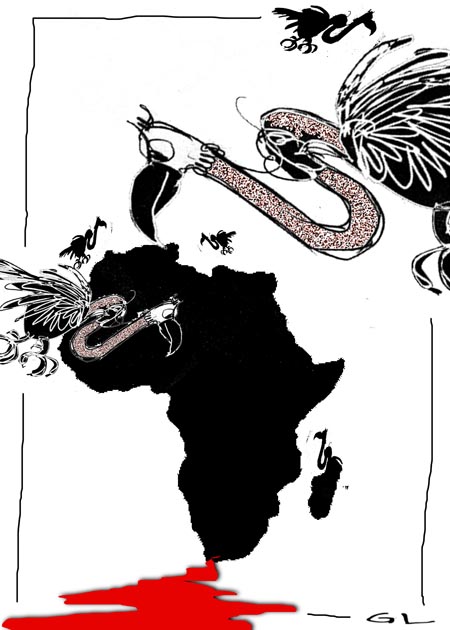
Johann Hari: We must stop the 'vulture funds' that feed on the world's poor
The energy that drove Jubilee 2000 needs to be summoned again
Friday, 18 September 2009
Would you ever march up to a destitute African who is shivering with Aids and demand he "pay back" tens of thousands of pounds he didn't borrow – with interest? I only ask because this is in effect happening, here, in British and American courts, time after time. Some of the richest people in the world are making profit margins of 500 per cent by shaking money out of the poorest people in the world – for debt they did not incur.
Here's how it works. In the mid-1990s, a Republican businessman called Paul Singer invented a new type of hedge fund, quickly dubbed a "vulture fund." They buy debts racked up years ago by the poorest countries on earth, almost always when they were run by kleptocratic dictators, before most of the current population was born. They buy it for small sums – as little as 10 per cent of its paper value – from the original holder and then take the poor country to court in Britain or the US to demand 100 per cent of the debt is repaid immediately, plus interest built up over years, and court costs.
- By Gus Leonisky at 18 Sep 2009 - 9:58pm
- Gus Leonisky's blog
- Login or register to post comments
free kick the sick...
Is this who we want to be? Do we want to be a society that allows billionaires to sue the starving, the sick, and the stunted for pennies borrowed by somebody else, long ago? If not, we have to shut these funds – now.
a catch smaller than that the one above hopefully...
By SHARON LaFRANIERE and JOHN GROBLER
WINDHOEK, Namibia — It is not every day that global leaders set foot in this southern African nation of gravel roads, towering sand dunes and a mere two million people. So when President Hu Jintao of China touched down here in February 2007 with a 130-person delegation in tow, it clearly was not just a courtesy call.
And in fact, China soon granted Namibia a big low-interest loan, which Namibia tapped to buy $55.3 million worth of Chinese-made cargo scanners to deter smugglers. It was a neat illustration, Chinese officials said, of how doing good in Namibia could do well for China, too.
Or so it seemed until Namibia charged that the state-controlled company selected by China to provide the scanners — a company until recently run by President Hu’s son — had facilitated the deal with millions of dollars in illegal kickbacks. And until China threw up barriers when Namibian investigators asked for help looking into the matter.
Now the scanners seem to illustrate something else: the aura of boosterism, secrecy and back-room deals that has clouded China’s use of billions of dollars in foreign aid to court the developing world.
From Pakistan to Angola to Kyrgyzstan, China is using its enormous pool of foreign currency savings to cement diplomatic alliances, secure access to natural resources and drum up business for its flagship companies. Foreign aid — typically cut-rate loans, sometimes bundled with more commercial lines of credit — is central to this effort.
Leaders of developing nations have embraced China’s sales pitch of easy credit, without Western-style demands for political or economic reform, for a host of unmet needs. The results can be clearly seen in new roads, power plants, and telecommunications networks across the African continent — more than 200 projects since 2001, many financed with preferential loans from the Chinese government’s Exim Bank.
------------------------
Read more at the NYT...
vanishing pledges...
Large sums promised to developing countries to help them tackle climate change cannot be accounted for, a BBC investigation has found.
Rich countries pledged $410m (£247m) a year in a 2001 declaration - but it is now unclear whether the money was paid.
UN Secretary General Ban Ki-moon has accused industrialised countries of failing to keep their promise.
The EU says the money was paid out in bilateral deals, but admits it cannot provide data to prove it.
--------------------
The moneys have probably been swallowed by the vultures mentioned above... see toon at top.
debt burden on top of ruins...
From the ABC
The aid organisation Oxfam has urged countries at an emergency meeting in Canada to cancel Haiti's $984 million of international debt.
The appeal came as the United States, Canada, France, Brazil and other donors with interests in Haiti met in Montreal to map out plans to rebuild the Caribbean nation and improve aid efforts for millions of people.
The international executive director of Oxfam, Jeremy Hobbs, says it is unfair to expect the devastated nation to repay the debt.
"Expecting Haiti to repay millions of dollars as the country struggles to overcome one of the worst natural disasters in recent memory would be both cruel and unnecessary," he said.
Oxfam says cancellation of the $984 million burden should be accompanied by action to deliver on a pledge to turn a huge loan
into a grant.
--------------------
Meanwhile:
A seven-year-old British boy has raised more than 60,000 pounds ($107,000) in a day for survivors of the Haiti earthquake by doing a sponsored bike ride.
Charlie Simpson set out to collect around 500 pounds ($890) for a UN Children's Fund (UNICEF) appeal by cycling eight kilometres around his local park in London, but his efforts inspired hundreds of people to donate online.
He started his fundraising efforts after seeing shocking images of children being pulled alive from the rubble in the Caribbean nation.
"My name is Charlie Simpson, I want to do a Sponsored Bike Ride for Haiti because there was a big earthquake and loads of people have lost their lives. I want to make some money to buy food, water and tents for everyone in Haiti," he wrote on his website.
--------------------
see toon at top.
conservatives and vulture banks...
from the Guardian
Pressure is growing on David Cameron to identify the mystery Tory MP who deliberately scuppered a landmark anti-poverty bill that could have stopped "vulture" bankers profiteering from the developing world's debt burdens.
Debt campaigners have reacted in fury and disbelief to the killing of the bill and Labour MP Sally Keeble, one of the bill's backers, has accused the Conservatives of "duplicity" by pretending to back the legislation and then sabotaging it at the last minute.
Campaigners are now calling on the leader of the opposition to clarify his view of the bill and asking whether the MP concerned will be identified. The international development secretary, Douglas Alexander, has sent a letter to Cameron demanding an explanation.
The frustration has been compounded by the secrecy surrounding the events in the Commons last night. During the reading, three Tory MPs were seen to huddle together on the benches before one shouted the word "object!", which under parliamentary procedure effectively stopped the bill passing.
-----------------
see toon at article at top...
extreme poverty
The number of very poor countries has doubled in the last 30 to 40 years, while the number of people living in extreme poverty has also grown two-fold, a UN think-tank warned.
In its annual report on the 49 least developed countries (LDCs) in the world, the UN Conference on Trade and Development (UNCTAD) said that the model of development that has prevailed to date for these countries has failed and should be re-assessed.
"The traditional models that have been applied to LDCs that tend to move the LDCs in the direction of trade-related growth seem not to have done very well," said Supachai Panitchpakdi, secretary general of UNCTAD.
"What happened is that in the past 30-40 years, the number of LDCs have doubled so it has actually deteriorated, the number of people living under the poverty line has doubled from the 1980s."
The report indicated that the situation has sharply deteriorated in the past few years.
The number of individuals living in extreme poverty "increased by three million per year during the boom years of 2002 and 2007", reaching 421 million people in 2007.
While these countries proved somewhat resilient during the crisis, they are nevertheless very fragile, notably due to their dependence on imports.
http://www.smh.com.au/world/number-of-worlds-poorest-countries-doubles-20101126-189dy.html
---------------
and see toon and article at top...
the corpse is still alive...
Twenty-six hedge funds are demanding over £1bn debt repayments from Africa's poorest countries - more than twice the International Red Cross budget for Africa this year. They are using legal loopholes around the world, including the Channel Island of Jersey. Greg Palast reports in a special investigation by Guardian Films and BBC Newsnight
http://www.guardian.co.uk/global-development/video/2011/nov/15/financial-vultures-africa-jersey-video?intcmp=122
see toon at top. note the date...
Hammarskjöld carried hopes...
"The legacy of colonialism won't go away," said Williams. "Here at last is an opportunity for a distinguished group of international jurists to examine a most disturbing episode at the dying end of colonial rule in Zambia and the Democratic Republic of the Congo. Hammarskjöld carried the hopes of a generation in Africa, for whom his death was a tragedy."
The unanswered questions the commission will look into include why the sole survivor of the crash said the plane "blew up" before it fell from the sky, why local residents reported seeing a smaller second plane attack Hammarskjöld's DC-6 aircraft, and why the wreckage was not officially found for 15 hours, though it was only eight miles from the airport.
The crash happened during the struggle for post-colonial Congo just over the border. Williams says the evidence suggests the DC-6, known as the Albertina, was fired on by a plane piloted by mercenaries fighting for Katanga separatists who had revolted against the government of the newly independent Congo with the help of Belgian mining interests.
Hammarskjöld was hated by many white settlers in the region for the UN's military support of the Congolese government in Leopoldville, now Kinshasa. He went to Ndola in Northern Rhodesia with the aim of brokering a ceasefire, flying under cover of darkness to avoid being intercepted by Katangese war planes.
http://www.guardian.co.uk/world/2012/jul/18/inquiry-death-un-dag-hammarskjold-2The 1960s were a mess in Africa, so were the 1950s, and the 1940s and before that every year since the 17th century when the first slave boats saw gold for selling dark skinned goods... Nothing new, nothing has changed much... Controlled wars are still on, all giving weapons merchants plenty of outlets for second-hand guns and for new bullet surplusses... Who is financing the rebels — or whatever terrorists they are called (depending on whom we barrack for) — in Africa?
The Saudis? The Yanks, the Iranians?... The Chinese?... Take your pick which gang is fighting which gang...
Cocoa, oil, coffee and rubber...
old african water...
A newly discovered water source in Namibia could have a major impact on development in the driest country in sub-Saharan Africa.
Estimates suggest the aquifer could supply the north of the country for 400 years at current rates of consumption.
Scientists say the water is up to 10,000 years old but is cleaner to drink than many modern sources.
However, there are concerns that unauthorised drilling could threaten the new supply.
Huge resourceFor the people of northern Namibia water is something that they either have too much of or too little.
The 800,000 people who live in the area depend for their drinking water on a 40-year-old canal that brings the scarce resource across the border from Angola.
http://www.bbc.co.uk/news/science-environment-18875385
vultures in africa...
A DANGEROUS international game is being played in the name of assisting Africa to feed itself. What is portrayed as charitable largesse has more in common with reinvigorating neo-colonialism than feeding Africans. This is in fact a misanthropic, multi-pronged raid by the G8 to control African commodities, land and seeds.
Africa presently occupies an interesting niche amongst the emerging, tripartite global realpolitik. First are longstanding, yet waning, relationships between Africa and its European colonial powers — Spain, Portugal, Germany, Belgium, Italy and, most particularly, France and England. Second is the expanding post Second World War relationship between Africa and the global superpower of the USA. Thirdly, there is the increasingly important influence of the rapidly emerging BRICS alliance, with South Africa posing as regional superpower along with Brazil, India and China. These three blocs often have conflicting, and conflicted, roles in the development and exploitation of Africa.
Nowhere else is this more apparent than in the field of agriculture. African agriculture remains in the doldrums, beset by twin curses. On the one hand lies its huge vulnerability to climatic variability, which will be exacerbated by climate change. On the other are the market-disrupting impacts of food subsidies amongst the developed world. These combine to render the precarious business of farming in Africa even more treacherous than it needs to be.
http://www.independentaustralia.net/2012/international/the-neo-colonial-g8-corporate-takeover-of-african-agricuture/
-----------------------------
If you remember, I wrote this on this site a few years ago:
Sister "C" was in Sydney town for the Popefeist... She's oldish but young of spirit and was part of a troop of young adults, without being their nanny. She was not really in favour of the "popelywood show" that was the "stations of the cross" nor was she fanatic about the man paraded in the fishbowl called a pope mobile, but she is in line with a more personal faith held to help the underprivileged survive and overcome the pressures — not from "evil" — but from other human's greed and power. She did not go to Randwick "because of her rheumatism"... I believe it was a mild form of protest.
Sister "C" spent many many years in Africa teaching and helping women. She argued with vigour that contrary to popular beliefs that "Africa is not poor". "No", she said emphatically, "Africa is rich but the big powerful countries covertly organise permanent wars between the people there, in order to gain control of the assets — through supporting the tinpots of the day, and supplying their opposition with weapons as well." By weakening the local population through division, the price of resources stays at rock bottom. Some countries are really poor of mineral resources but, not strangely enough, are at peace. Countries where there is petrol and other natural resources such as gold, uranium and copper are vastly "poorer" because of permanent conflicts. People die daily from "civil" wars. And not just in Darfur. Darfur is only a small distraction compared to the rest, including Zaire. That is why so many tinpots in Africa are weary of touching Mugabe. They are more or less in the same boat economically and politically. And the west's influence is also counterbalanced by the Chinese... and the "Muslims".
Sister "C' was from the west, sure. But she was helping women becoming "liberated' and proud, not through religion but via humanity, medicines and understanding... Sure religion played a part in supporting an infrastructure of churches and schools but also integrated and to a great extent diluted itself in the local culture, making it stronger and more empowering for women. Strangely enough all of the moneys — needed to support her work and that of the others sisters there — came from philanthropic organisations rather than the system of Church.
Sister "C" is from a vanishing brood of Catholic sisters. Not new... The story by Geraldine Doogue on Compass (ABC) last night (20/07/08) was also telling of the dwindling ranks of priests in the Catholic Church. But back to Sister "C". Sister "C" fiercely opposes Genetically Modified crops for Africa (and all earth too). In most places African crops are profitably and sustainably organic and in some regions a small dose of fertilizers can help but is often not necessary if land is managed well. Lack of water can be problematic but that would be the least of the problems. Sure the work is labour intensive but the labour is "happy to provide" and be employed rather than clear fell and cultivate alla modern bulldozer — a technique that enriches the rich, destroys "culture" and wipes out a "differently rich civilisation". GM crops would make the local poor-folks, (poor in comparison with the west but in fact often richer in spirit and in relationships) poorer by making them crushingly dependent of multinationals. As well some western powerful multinational companies make sure they undercut the price (at a loss for a while — till they get what they want) of comparable local produce with their imported goods that eventually kill local economies. Once collapsed these micro economies become reliant exclusively on imported goods and hand outs from whichever charity is the flavour of the month... The list of multinationals is long....
Sister "C" is repulsed by the Bushes of this world waging wars under the name of "god". She's is "a bit" annoyed at the Pope rubbing shoulders with what is mostly a hooligan. a "banditto": G W Bush.
Sister "C" prayed for a better world and for her lifetime's work not to be wiped out by five minutes from the warriors. She's not "hopeful", although she is strongly dedicated that it won't happen, Pope or no Pope.
http://www.yourdemocracy.net.au/drupal/node/6183#comment-8805
Meanwhile the Chinese:
PRESIDENT Hu Jintao said today that China would offer $20 billion in new loans to Africa, as he delivered a speech to a Beijing forum on co-operation with the resource-rich continent.
The pledge - double the amount Beijing agreed to lend to Africa at the last forum in 2009 - underscores China's growing links with African nations as it looks to secure key commodities to feed its economic growth.
Hu said the loans would focus on supporting infrastructure, manufacturing and the development of small businesses in Africa, although he did not specify what time period they would cover.
"China and Africa's destinies are closely linked, Chinese and African friendship is deeply rooted in the hearts of the people on both sides," he said, delivering an opening address to an audience of African leaders.
Beijing's involvement in Africa dates back 60 years, when Chinese workers arrived to lay railway tracks and roads.
http://www.theaustralian.com.au/news/world/china-africa-cash/story-e6frg6so-1226430168296
I would suggest that Chinese have been involved in Africa far longer than "60 years" as part of a greater Chinese diaspora — as traders, grocers and general merchants...
hell is full of good intended weeds...
AID AND DEVELOPMENT AGENCIES are doing great harm in Africa because they do not understand biology. Under pressure to provide quick solutions to long term problems, they promote firewood and fodder plant species that can thrive on degraded lands in the face of drought and grazing - in other words, plants with the attributes of weeds. Many of the plants they recommend are major global pests, causing untold damage to the environment and people of Africa.
One prickly tree that was heavily promoted in east Africa by the Food and Agriculture Organisation in the 1980s - mesquite -is now displacing farmers from their land, harming livestock, reducing water supplies, and invading national parks. Kenyan researchers fear its spread ''is likely to hit the very heart of Kenya's economy''. Sudan has passed a law to eradicate it, and Kenya and Ethiopia have declared it a noxious weed.
It was declared one of Australia's 20 worst weeds in 1999, and appears on the World Conservation Union's list of "100 of the Word's Worst Invasive Alien Species".
But even so mesquite remains popular with international donors, non-government organisations (NGOs), and development agencies. It earns praise on the website of the World Agroforestry Centre, despite a report (pdf) on the very same website telling of farmers losing their land, and of people and goats losing their health.
Australian wattles are also widely advocated, despite the problems they cause around the world. I attended a workshop about wattle concerns in South Africa, where these plants draw so much water from the soil they threaten the nation's water supplies. Many hundreds of people are employed to remove them, and biological control agents have been imported.
But some aid and development workers are fixated on the idea of miracle plants that can quickly lift people out of poverty.
The most recent example was jatropha, a plant proclaimed an ideal biofuel crop for the poor. In Kenya, where most plantings had NGO support, it proved a dramatic failure, with farmers who reduced food plantings to grow it complaining of "extremely low yields" (pdf). A review (pdf) of widespread jatropha and castor oil plantings in Ethiopia by three NGOs described biofuels as "a disaster for Africa's communities and biodiversity".
http://www.abc.net.au/environment/articles/2012/10/22/3614480.htm?WT.svl=featuredSitesScroller
Read above: Sister "C"...
the vultures are with romney...
Their critics call them vulture funds because they prey on vulnerable countries that have defaulted on their debts - usually poor countries in Africa. But this time, a vulture fund has swooped on the Libertad, a ship belonging to the Argentine navy and now docked in a port in Ghana. A court there impounded the ship at the request of NML Capital, which is owned by a US hedge fund called Elliot Associates and run by Paul Singer, one of Mitt Romney's supporters.
The dispute goes back almost a decade to when Argentina decided to default during its economic crisis.
Vulture funds hold countries to ransom - some would say preventing them from getting out of poverty. But it is all legal and they make massive profits. And vulture funds are no longer just targeting developing countries. Eurozone nations like Greece and Ireland could be next.
So, just how widespread are these vulture funds and what sort of power do they wield? Tim Jones from the Jubilee Debt Campaign joins the show to answer these questions.
http://www.aljazeera.com/programmes/countingthecost/2012/11/2012112172336566897.html
robbing africa...
The world's wealthy countries often criticise African nations for corruption - especially that perpetrated by those among the continent's government and business leaders who abuse their positions by looting tens of billions of dollars in national assets or the profits from state-owned enterprises that could otherwise be used to relieve the plight of some of the world's poorest peoples.
Yet the West is culpable too in that it often looks the other way when that same dirty money is channelled into bank accounts in Europe and the US.
International money laundering regulations are supposed to stop the proceeds of corruption being moved around the world in this way, but it seems the developed world's financial system is far more tempted by the prospect of large cash injections than it should be.
Indeed the West even provides the getaway vehicles for this theft, in the shape of anonymous off-shore companies and investment entities, whose disguised ownership makes it too easy for the corrupt and dishonest to squirrel away stolen funds in bank accounts overseas.
This makes them nigh on impossible for investigators to trace, let alone recover.
It is something that has long bothered Zimbabwean journalist Stanley Kwenda - who cites the troubling case of the Marange diamond fields in the east of his country.
A few years ago rich deposits were discovered there which held out the promise of billions of dollars of revenue that could have filled the public purse and from there have been spent on much needed improvements to roads, schools and hospitals.
The surrounding region is one of the most impoverished in the country, desperate for the development that the profits from mining could bring. But as Kwenda found out from local community leader Malvern Mudiwa, this much anticipated bounty never appeared.
"When these diamonds came, they came as a God-given gift. So we thought now we are going to benefit from jobs, infrastructure, we thought maybe our roads were going to improve, so that generations and generations will benefit from this, not one individual. But what is happening, honestly, honestly it's a shame!"
What is happening is actually something of a mystery because though the mines are clearly in operation and producing billions of dollars worth of gems every year, little if any of it has ever been put into Zimbabwe's state coffers.
Local and international non-governmental organisations say they believe this is because the money is actually being used to maintain President Robert Mugabe's ruling Zimbabwe African National Union - Patriotic Front (ZANU-PF) in power.
True or not, it is clear that the country's finance minister, Tendai Biti, has seen none of it. A representative of the opposition Movement for Democratic Change, which sits in uneasy coalition with ZANU-PF, he says he has no idea where it is going.
"We have got evidence of the quantities that are being mined, the quantities that are being exported but nothing is coming to the fiscus .... All I know is that it's not coming to the treasury. So that is a self-evident question. It is not coming to us. That means someone is getting it. The person who is getting it is not getting it legally. Therefore, he's a thief, therefore she’s a thief."
Sadly, as Stanley Kwenda has realised, it is typical of a problem found all over Africa.
http://www.aljazeera.com/programmes/peopleandpower/2012/11/201211714649852604.html
brics to the rescue...
While Europe remains in turmoil some of the world's emerging economies are pushing for a larger role in managing global debt.
At their fifth annual summit, held in Durban, South Africa, the leaders of Brazil, Russia, India, China and South Africa, known collectively as the BRICS nations, have agreed to set up a $50 billion development bank.
It will be the first institution established by the informal grouping, and is a direct snub to the World Bank.
The leaders began holding forums at the start of the global financial crisis in an effort to set an economic path that was not dominated by the West.
But by the close of the two-day summit, the BRICS nations could only announce an in-principle agreement to create a joint lender to meet the countries' $4.5 trillion infrastructure needs, and a fund to shore up liquidity problems that emerge.
Key questions remain unanswered, including: how much cash each country should contribute, how infrastructure projects will be chosen and where the bank will be based.
Russia's deputy foreign minister Sergei Ryabkov says there is still much negotiating to do.
"We just used one year since New Delhi summit to have to complete a feasibility study and now we are at a very different stage, where, as always, the devil is in details," Mr Ryabkov said.
http://www.abc.net.au/news/2013-03-28/developing-economies-stall-on-bank-deal/4599908
vultures or sharks?...
...
During negotiations, a small group of hedge funds, including NML Capital, swooped in and bought up the distressed debt at bargain-basement prices. The fund, controlled by billionaire US financier and Republican donor Paul Singer, is now suing to get the full value of the original debt - including interest - even though most investors accepted the financial "haircut". If NML wins the case, it stands to make an exponential profit from its original investment on the distraught debt.
"None of these hedge funds were buying Argentina's bonds at par," Charles Geisst, a former investment banker and author of Beggar-Thy-Neighbor: A History of Usury and Debt, told Al Jazeera. "They bought them at a distressed rate hoping for a bounce … More vulture funds will go into the business if Argentina loses this case."
The case, which has been fought in several legal jurisdictions, is currently before the Second Circuit Court of Appeals in New York and could be resolved in the next few weeks. Argentina is appealing an earlier court decision and has indicated it will take the case to the US Supreme Court if it loses the current appeal.
"These outstanding bondholders have been suing Argentina since 2002 … claiming Argentina owes them approximately $1.4bn," Rodrigo Oliveres-Caminal, a finance expert at the University of London, told Al Jazeera.
http://www.aljazeera.com/indepth/features/2013/07/2013725162151962904.html
bloodiest chapters
RT Documentary travels to the vast, landlocked Democratic Republic of Congo, prized for its mineral resources, but plagued by centuries of colonial rule, dictatorship, civil wars and lawlessness, and meets people trying to make a living in one of the most desperate places on Earth.
The documentary crew’s key to understanding the country, seven times the size of Germany, was Bernard Kalume Buleri, born in 1960, the same year DRC was granted its independence from Belgium. Buleri served as an interpreter, guide, and finally the hero and symbol of the country, having been a direct participant in some of its bloodiest chapters.
read more:
https://www.rt.com/news/395079-congo-minerals-documentary-mining/
Read from top...
sucking blood dollars...
Private Equity Firms are Modern Day Vampires Sucking the Lifeblood Out of Our Society
November 8, 2019
Deadspin is the latest victim of private equity. Labor writer and activist Kim Kelly warns us that these 21st century "private equity vampires" have to be controlled.
MARC STEINER: Welcome to The Real News, folks. This is Marc Steiner. Good to have you with us.
I have a guess many of you have been reading about what happened to Deadspin, the sports site where writers gave the middle finger to the owners who tried to stop them from being political. They didn’t want them write political stuff, just sports stuff straight. Well, they did that. And let’s think about these private equity firms for a minute. They are vampires sucking the lifeblood out of our country, businesses, and the workers. The analogy is really apt. Private equity capitalists symbolize, let’s say–I found this out in an article I just read; we’re about to talk to the author–the 16th century Countess Bathory who bathed in the blood of young girls, or the vampire stories from every country on the planet.
Our guest they put these analogies together in a bold context when she wrote about the destruction of the sports website Deadspin. And she looked beyond that; looked at the role of these venture vampire capitalists and what they do in our world, what they play in our world, what they’re doing to our world. So I want to welcome Kim Kelly back to The Real News, who wrote the article This Is a Horror Story: How Private Equity Vampires Are Killing Everything, for The Nation magazine. And Kim, welcome. Good to have you with us.
KIM KELLY: Thanks, Marc. Thanks for being interested in my weird bloody little tale.
MARC STEINER: It was very strange article, but a really good article. I love the analogy. So let’s take a step back for just a second. So you took these, we’ll probably jumped into who these private equity people are and what they’ve done, what happened to Deadspin directly. You create this analogy, this historical analogy with both a mythology and reality of vampires in our world, wherever culture they came from, to what private equity people are doing to our world today. So talk about how that came to you. How did that come into your head? And as you told me before, you said three in the morning, which is probably a very apt time to write it.
KIM KELLY: Even better. I’m not going to lie to you. I wrote this on Halloween, which sounds a little too on the nose, right?
MARC STEINER: I love it. That’s great.
KIM KELLY: I mean, the piece came about because some editors of The Nation hit me up and said, “We saw what’s happening with Deadspin. Do you want to write a piece for us about this?” Because I’m a labor reporter and that’s sort of what we do. This is very much in my realm, given that I came out of the digital media organizing world. I used to work at Vice, I was an organizer there–yada, yada, yada. So they asked me if I wanted to do this and I was thinking about it. I was like, “Well, what’s a way that I could write about this in a way that was new; that was interesting; that wasn’t the same piece that was being written because it was a huge story, because it was such a huge event?”
But I started thinking about these “capitalist vampires.” I was like, “Hang on… vampires.” Because we see, even just on Twitter, the way people speak about private equity and the general capitalist class; they’re vampires, they’re bloodsuckers, they’re leeches. This is the language that makes sense when you think about the way that capitalism is structured; the way that these people, these robber barons at the top, are dealing with the working class. But I kept going back to the vampires. And it was Halloween, so maybe I was feeling a little spookier than usual. And I just started thinking about how this is a horror story.
Like what’s happening here: these craven aristocratic jerks are literally sucking the life blood away from workers who don’t have any much more of a defense than a metaphorical pitchfork. And they’ve been allowed to do it for centuries, since time immemorial, since way back in the 16th century when Countess Bathory was out there in her dungeon. And we just see the same story over and over again. It’s almost become its own legend, the private equity vampire. So that’s what I was thinking about when I approached this piece, and I just rode that metaphor out to the very end.
MARC STEINER: Yeah, you’re certainly did. As I said, I love this piece. But let’s just talk a bit about… You were commissioned to write a piece about Deadspin, which we’ve been talking about here, at Real News for the last couple of weeks in what’s happened to the workers at Deadspin. And so that’s where this began, right? And I was shocked. I did not know the whole backstory of Deadspin and the other online magazines and news journals that are owned by the same companies. Talk a bit about that story and how this is private equity, owning all of these kinds of new sites and what they’re, what they’re doing to suck the lifeblood out of our work as journalists and Americans who want to read this stuff.
KIM KELLY: Right. I mean we’re seeing it play out across various industries, but right now it’s just really blatant and concerning in media. Specifically in digital media where you have these private equity firms and soulless billionaires who swoop in and they buy a website or package of websites, and then they decide to either scrap it and sell it for parts or try to remake it in their own image. And what happened with Deadspin was other workers resisted. They weren’t willing to be led to the slaughter. They fought back. And we’re at a point where the free press is under attack from the highest office in the land. Just in general, journalism is in a crisis. And now we’re seeing the economic side of this crisis where it’s difficult for digital media publishers to make money, and so they’re looking for other ways to acquire that capital.
And this is where private equity comes in. They come in: they’ve got all this money, they’re going to sweep you off your feet, they’re going to get you out of bankruptcy, they’re going to fix everything. And then, they acquire these independent, thriving websites and then they just suck the blood out of them and toss them aside. And what happened with Deadspin, the reason people are so captivated, is because they disrupted that narrative. That’s the horror story. The vampire comes in and sucks away your blood and that leaves you lifeless. In this case, the villagers fought back and that’s why people are responding so viscerally to it.
MARC STEINER: So talk about the company that actually bought these sites. It was more than just Deadspin. I didn’t realize the sites, that some of them… I read they own this long list of sites of all kinds. So tell me a bit about that company and what exactly they did.
KIM KELLY: It’s a whole constellation, right? This company is now known as G/O Media, which is run by the CEO Jim Spanfeller who is a Forbes guy who came in and bought up. It’s like Jezebel, Kotaku, The Route, Splinter, was Deadspin, Life Hacker. This whole constellation of former Gawker media sites except Gawker… You know, R.I.P. And they were all swept under this deal after this Peter Thiel-funded Hulk Hogan chaotic situation where the company was sued out of existence. Jim Spanfeller came in and this was… man, it’s been a crazy one, right? Because it was Gawker media, and then Univision bought this damaged company and then Univision couldn’t figure out what to do with these websites and they weren’t making the kind of money they wanted to see.
And so Jim Spanfeller swept in. He bought all these websites and it seems like from reading some really incredible reporting that now former Deadspin writers and Splinter writers within the organization wrote about what that process was then like, it seems like they just came in and screwed everything up. It seems like this man, he came in and installed a bunch of his cronies from Forbes, who I mean, that’s Forbes is doing its thing, or no disrespect to Forbes, but oops. And the Deadspin and Splinter and the Gawker media verse, they’re intrinsically… They’re diametrically opposed. So they came in and they essentially wanted to quash worker descent and quash all of this sort of fiery irreverent vibe that everybody working there had. Because it was a beautiful collection of weirdos.
And they ended up killing off Splinter, which was a really… It was a fantastic sports–or not sports. That was the next one. It was a fantastic political commentary site and they just killed it off. And then they came for Deadspin. And I think the people that Deadspin sort of saw the writing on the wall and they knew something was up; something bad was going to happen. And then it all happened so quickly and so chaotically and so definitively that now Deadspin–I mean, to reference another horror trope–Deadspin is just a zombie. And everyone else, everyone who used to work there, is gone.
MARC STEINER: So you mentioned a lot of other equity firms that took over many things in our country, from grocery store chains to retail, and just putting everyone out of work. Tens of tens of thousands of people we put out of work because of the equity firms buying and pushing people out, which is why I thought it was the analogy to vampires was very apt.So you can talk a bit about that? But also just what happens in our country when private equity takes over all these companies, shuts them down because there are not the kind of profits they want to make. Thousands of people thrown out of work. This is the 21st century version of the gilded age, what’s happening to people out in America and around this world. So what do you do? And talk a bit about some of the examples that you gave. But also, what we do to drive a stick through the heart of these equity firms and stop them from destroying what we have?
KIM KELLY: Yeah, you’re entirely right. We’re basically in a new gilded age and these are the robber barons. And back then, the only thing that really happened to rein them in was increased government regulation and antitrust laws. And now we’re at a point where regulation is a dirty word because of the current administration who seem to just love making it as terrible as possible for working people to survive. So we’re in a place where we have these private equity firms, they’re buying up digital media properties, but they’re also buying up hospitals. They’re buying up nursing home chains. They’re buying up places where you get payday loans, they’re buying up… They even bought the Playboy mansion.
There’s every possible area of American economic industry, they’re there. They’re lying in wait. They might be in the shadows, they might be waiting, they might not have struck yet, but they’re going to. And the only way, like I said, at the end of the piece, my original ending was a little strong, I think, for my editor who asked me to tone it down. Because my first ending was more along the lines of, well, we need to bring back the guillotine. And my editor was like, “Well let’s maybe think about a different way to say that because we can’t advocate for mass murder.” You’re the editor. That’s the only way you can really rein in these sort of vicious corporate raiders is to regulate the hell out of them.
MARC STEINER: So what would be the guillotine?
KIM KELLY: I mean, remember the French revolution?
MARC STEINER: I don’t know, other than really chopping off their heads. What would be the guillotine in your mind? What would it be? I mean, in other words, if you look at what happened to Deadspin and all the other companies you talked about, hospitals being shut down to be made into condos or whatever they want to make them into, in poor black and Latino communities, all the stuff you wrote about in this article… So there has to be a way to stop them. There has to be a way to say no, this is not the kind of world we’re going to have. So what is that guillotine? What is that stake in the heart of the vampire on the coffin? For you, what is that?
KIM KELLY: That’s a really difficult question, right? Like, how do I solve capitalism?
MARC STEINER: Yes. How do you solve capitalism? Let me ask that right now. How do you solve capitalism?
KIM KELLY: I mean that is always the question, right? Here is this horrible thing that’s happening. We don’t know how to stop it. What can we do to put the brakes on the speeding train? And I don’t have the answer either. I think in terms of private equity, I’m not as studied in the economic, scary weird numbers realm as they are. I don’t know how to deal with rich people. But I think Deadspin… What happened to Deadspin is a really good example of the kind of thing that we can be doing. The only way we can actually fight back is if we’re relying on collective worker power.
When you look at what happened with Toys”R”Us, when they were bought up and then driven into bankruptcy by more of these vampires and they were deprived of the severance pay that they were owed, they came together and they fought back. They sued the bejesus out of them and they finally got their money. It’s like what we saw with the black jewel miners. That wasn’t a private equity situation, but it was still a situation where this big horrible company with a whole lot of money was withholding those funds from the workers who actually earned it and created that capital. And they were like, well, we’re not going to let you get away with that. We were going to do something about it. We can’t allow these vampires to continue to stalk the world unopposed, right?
Even going back to this old analogy–and it’s not quite the vampire analogy, it’s a little bit more Frankensteiny. But what happens when there’s a monster in your midst? You gather your friends, you gather some pitchforks and you do what you can to get them out of your hair, right? It is a big question, but I think really all we can do is realize that you can still kill a vampire, right? There are wooden stakes, then there are silver bullets and there’s garlic. And to translate that into real world terms, there are unionizing your workplace and talking to your coworkers and refusing to take this BS lying down. It’s been a great example of that. Just being like, “You know what? No, we’re not going to let you walk all over us. We’re going to walk all over you first.”
MARC STEINER: Yeah. And as you were saying, the stake in the heart is workers organizing themselves and being strong, and regulating these industries so they can not do what they do and not allow them to do it in the first place. Make it against the law, not allow them to do it. And for me, it’s really refreshing, Kim, to have somebody of your generation and all these young people coming up and really writing about labor and doing the fight, which is really important. So I’m glad you’re out there writing about vampires and equity capitalists. And we look forward to talking to you a great deal more.
KIM KELLY: Thank you so much for having me.
MARC STEINER: Thanks for your writing. And I’m Marc Steiner here with The Real News network. Let us know what you think. We’ll have Kim Kelly and more folks like Kim Kelly on this network so we can really make some changes. Take care.
DHARNA NOOR: Hey y’all, my name is Dharna Noor and I’m a climate crisis reporter here at The Real News network. This is a crucial moment for humanity and for the planet. So if you like what we do, please, please support us by subscribing at the link below. Thank you.
Read more:
https://therealnews.com/stories/private-equity-firms-are-modern-day-vamp...
Read from top.
africa caught in the net...
Many industries and service companies are failing or shrinking due to the lockdown and subsequent crisis. Instead, there are those who have gained from all this. Facebook, Google (YouTube owner), Microsoft, Apple and Amazon - writes The New York Times - "are aggressively placing new bets, as the coronavirus pandemic has made them nearessential services." All these "Tech Giants" are from the United States.
Facebook - no longer called social network but "ecosystem", which also includes WhatsApp, Instagram and Messenger - has exceeded 3 billion monthly users. It is therefore no wonder that, in the midst of the coronavirus crisis, Facebook launches the project of one of the largest submarine cable networks, 2Africa: 37,000 km long (almost the maximum circumference of the Earth), it will surround the entire African continent, linking it north to Europe and east to the Middle East.
There will initially be 23 interconnected countries. Starting from Great Britain, the network will connect Portugal before starting its circle around Africa through Senegal, Ivory Coast, Ghana, Nigeria, Gabon, Republic of the Congo, Democratic Republic of the Congo, South Africa, Mozambique, Madagascar, Tanzania, Kenya, Somalia, Djibouti, Sudan, Egypt. In the latter section, the network will be connected to Oman and Saudi Arabia. Then, across the Mediterranean, it will arrive in Italy and from here to France and Spain.
This large-capacity network - explains Facebook - will be "the pillar of a huge expansion of the Internet in Africa: economies flourish when there is an Internet widely accessible for businesses. The network will allow hundreds of millions of people to access broadband up to 5G. " This, in summary, the official motivation of the project. One fact is enough to cast doubt on it: in sub-Saharan Africa about 600 million people, equivalent to more than half the population, do not have access to electricity.
What will the broadband network be used for? African elites, who represent the interests of multinationals in the continent, will be more closely connected to their parent companies.
The network will also serve other purposes. Two years ago, in May 2018, Facebook established a partnership with the Atlantic Council, an influential Washington-based "non-partisan organization" that "galvanizes US leadership and engagement in the world. together with allies”. The specific purpose of the partnership is to guarantee "the correct use of Facebook in elections around the world, monitoring disinformation and foreign interference, helping to educate citizens and civil society".
What is the reliability of the Atlantic Council, particularly active in Africa, can be deduced from the official list of donors that finance it: the Pentagon and NATO, Lockheed Martin and other war industries (including the Italian Leonardo), ExxonMobil and other multinationals, the Bank of America and other financial groups, the Rockefeller and Soros foundations.
The network, which will connect 16 African countries to 5 European NATO allies under US command and to 2 US allies in the Middle East, can play a role not only in economic terms, but also in political and strategic ones. The "Digital Forensic Research Lab" of the Atlantic Council will be able to communicate every day to African media and politicians which news is "fake" and which "true". Facebook’s personal information and tracking systems can be used to control and target opposition movements. Broadband, even in 5G, can be used by US and other special forces in their operations in Africa.
In announcing the project, Facebook stresses that Africa is "the least connected continent" and that the problem will be solved by its 37,000 km of cables. They can be used, however, as a modern version of the old colonial chains.
Manlio DinucciSourceIl Manifesto (Italy)
Read more:
https://www.voltairenet.org/article210238.html
Read from top.
Read also: the empire dominion...in caesar's palace — an illegal punishment house....
colonialism blues…...
BY Valery Kulikov
At the first Russia-Africa summit in 2019, Vladimir Putin hosted 43 African leaders — more than the number attending similar events in the UK or France. Even back then, at the Sochi summit, the Russian president criticized the West for imposing “political or other conditions” on African states in order to break them away from Russia.
Today, this pressure is even greater as the West does its best to force countries in Africa to abandon economic and other cooperation with Russia. This notion was stated by Oleg Ozerov, head of the secretariat of the Russia-Africa Partnership Forum and special envoy of the Russian Foreign Ministry, at a round table in the Federation Council on “Inter-regional cooperation of constituent entities of the Russian Federation with African countries” on May 23. “We see tremendous pressure being exerted on our African partners, including South Africa, which results in their hesitation and inconsistency, and all of this is to break them away from Russia, to close any possibility of developing economic relations with us,” he said. Ozerov further remarked: “US Secretary of State Anthony Blinken has already toured seven African countries, now German Chancellor Olaf Scholz <…> is going to both South Africa and Senegal <…> to try and push African countries to refuse to cooperate with Russia.”
As reported in the African media, this pressure from the West is not only directed at the political and economic sphere, but also at Africa’s religious relations with Russia. For example, several clerics who defected to the Russian Orthodox Church (ROC) from the Alexandria Patriarchate are now in prison, Metropolitan Leonid of Klin, the Patriarchal Exarch of Africa, announced at a press conference on May 23 following his first overseas visit to Uganda. Specifically, he noted: “In Tanzania, Kenya, Madagascar, criminal cases have been filed against our clerics. And only because they stand up for the canonical rules and laws of Ecumenical Orthodoxy.” The African Exarch added that many African clerics who have defected to the ROC have been denied temples in which they could hold services.
Despite such demonstrative pressure from the West on various fronts, half of the African states shy away from condemning Russia over the situation around Ukraine and refuse to join the anti-Russian sanctions. The March 2 vote at the UN General Assembly on a resolution condemning Russia’s launching of a special operation to denazify Ukraine showed that out of 54 African countries, only closely aligned countries such as Kenya, Ghana, Gabon, Rwanda, Djibouti, Somalia and the Congo supported the “collective West.” 17 African states abstained and eight did not turn up. One country, Eritrea, even voted openly against. To the West’s particular displeasure, even South Africa, billed as a “showcase of true values,” not only failed to criticize Russia, but introduced an alternative “Western” resolution on the situation in Ukraine at the UN.
By demanding that African countries condemn Russia’s actions in Ukraine, the West has resorted to threats and blackmail, Russian Ambassador to Angola Vladimir Tararov told RIA Novosti. “Take note of the fact that when voting for the anti-Russian resolution at the UN General Assembly, almost all African countries voted neutrally, i.e. abstained. This means that they did not support the resolution but did not dare to vote against it because the pressure was extraordinary,” Tararov said. He called such behavior by Western states immoral.
The Bangkok Post also highlighted in early April that 16 African countries refused to vote or voted against UN condemnation of Russia’s campaign in Ukraine. Moreover, African countries such as Mali, Uganda and Eritrea have endorsed the special operation in Ukraine, while the CAR, Benin and South Africa have openly expressed support for the Kremlin’s actions. Among the reasons for this situation, the publication recalled that Russia had been actively providing military and economic aid to a number of African countries in recent years. In addition, many states have strong ties with Russia as a successor to the USSR, which actively helped African countries to fight the imperialism of European states. The liberation parties that still rule Angola, Mozambique (whose flag, incidentally, bears a Kalashnikov assault rifle), Namibia, South Africa and Zimbabwe saw in Moscow an ally in their struggle to end Western rule. None of the African countries perceive Russia as an enemy, a former colonizer or a potential hegemon, and therefore have not imposed sanctions on Russia. The positions of Russia and most African countries are conceptually similar on many issues.
Western pressure on African countries has led to limited ways for Moscow to engage with partners and states there that are directly dependent on Russian supplies of food and services. In fact, the manipulation of the collective West has provoked famine in many parts of the world, including Africa. This was the opinion of the independent UN expert, Alioune Tine, president and founder of the Senegalese center Africajom. “We call for the lifting of anti-Russian sanctions, which are having an utterly disastrous effect on the countries of Africa. I ask Europeans to show some common sense and stop imposing restrictive measures on Moscow, as this leads to hunger, energy problems, fuel shortages. We are already starting to face all these restrictions, so we need to stop what Europe and the US have done,” Alioune Tine concluded.
Foreign Policy also writes about the active desire of the US and the European Union to isolate Moscow and to attract as many states as possible to their coalition, stressing that in Africa such a policy faces a wall of incomprehension. Such Western actions, the publication admits, have already revived discussions in African political circles on the need to bring back the Non-Aligned Movement that existed during the Cold War. This would avoid dragging the two camps into a confrontation.
In their anti-Russian pressure on African countries, the US and its Western allies make no secret of their concern about Russia’s efforts to play a prominent role in Africa, something Moscow has already achieved in the Middle East. There, Russia has already succeeded in building a balanced partnership with all the regional centers of power and has earned the right to take decisions on major regional issues. Such activity by Russia, its successes in Syria, the qualitative strengthening of its partnership with Egypt and its intensified involvement in Libya have opened the door to Africa. The Dark Continent saw Moscow as a player who would not abandon allies and friends, who could help to strengthen sovereignty, diversify foreign policy, avoid becoming dependent on other external players or weakening it, and who did not seek to establish its own hegemony in the Middle East and Africa.
In his Russophobic rhetoric, the President of the European Commission claims that Russia is allegedly a “direct threat to world order.” This is the most serious accusation against Moscow in a very long period and a very dangerous one, demonstrating racial animosity and an affinity with neo-fascism. The same West did not consider the NATO bombing of Yugoslavia, or the unceremonious US invasions of Iraq and Afghanistan, or the organization of color revolutions around the world to be a “threat to world order.” Nor did it consider as such the killing of Gaddafi and the destruction of Libya.
In its history, Russia has shown that it is capable not only of defending itself and its people, but also of fighting for others, including colonized and plundered peoples. It saved the world from Nazism, paying the terrible price of 25 million men, women and children. However, today, as the efforts of the US and its allies are reviving Nazism in Ukraine, the “collective West” is trying its best to prevent Russia from winning a new victory over the neo-fascist ideology of the Kiev rulers. And in this opposition to Moscow, Washington is trying to involve the African continent by spreading fake information about Russia’s policies and actions, limiting Russia’s political, economic, cultural and religious ties with Africa.
Today, however, the world has changed profoundly and no longer allows a handful of West dealmakers to take back control of the world and the minds of people of the Earth. Therefore, such attempts by the West and its anti-Russian phobias, including on the African continent, are doomed to fail. This is evident in the reaction of the African states, which in this confrontation are siding more and more strongly with Moscow.
Valery Kulikov, political expert, exclusively for the online magazine “New Eastern Outlook”.
READ MORE:
https://journal-neo.org/2022/05/28/us-pressures-african-countries-into-breaking-away-from-russia/
READ FROM TOP.
FREE JULIAN ASSANGE NOW..............................