Search
Recent comments
- keep out....
3 hours 32 min ago - gains/losses....
3 hours 51 min ago - reefs in peril....
4 hours 45 min ago - hippies....
7 hours 57 min ago - boycott....
9 hours 36 min ago - anti-zionistic....
15 hours 13 min ago - no thieving....
15 hours 18 min ago - sniffles....
15 hours 22 min ago - grumpies....
15 hours 33 min ago - capitulation.....
18 hours 21 min ago
Democracy Links
Member's Off-site Blogs
and now for the weather...
You may have noticed, humidity has slightly increased in the atmosphere, worldwide... Well, most scientist working on the study of climate and of climate change have noticed that too.
From Europe to the USA, from Australia to Haiti, the "weather" has been bringing in rain, or hail, or snow... or just high humidity in the air like in Sydney for the past few months — all somewhat more than "usual". Yet there is still room for more droughts...
"Floods of the century" are now replaced by floods bigger than ever, even since Napoleonic times or since record have been kept. Sure, Noah's account of the biblical floods is not included.... But the damage by rain, hail and snow from Melbourne's "super storm" a few days ago — to the "unheard snows in the south of France in March", after a massive storm had claimed 55 dead and several towns on the Atlantic coast — is quite "phenomenal".
... Presently (in Sydney) it's 26 degrees at 22H30 at night with a humidity above 70 per cent. This is about 1 degree above maximum-average (usually happening around midday) and the minimum for the day has been nearly 6 degrees C above minimum-average. Thus it has been "stinking hot". High humidity in the air makes the "feels-like index" shoot through the roof. We get all sweaty and sticky. It's 26 degrees C and it "feels like" 32... Nothing dries. Clothes stay wet.
In regard to climatic conditions, humidity in the air has conflicting effects but one main origin. Humidity mostly comes from surface evaporation of the seas. The warmer the sea, the more evaporation... As we all know, the lower part of the atmosphere is the atmospheric layer that carry most of this moisture while the stratosphere is much "drier".
So, let's do a small experiment.
Take a hot dish out of the oven with a folded dry cotton towel on your hand: I bet there is no problem. You won't feel the heat for at least 30 seconds —enough time to place the dish safely on a bench.
Now, use the same folded towel and barely "wet it" all over. carry the hot dish. Within two seconds, the heat from the dish gets to your hand — you have another 2 seconds before you get burnt...
Water has a "high resistance to warming". yet it can conduct heat very fast in certain conditions — such as little amount of water... The slow heating rate of water is used to define a "calorie" (http://en.wikipedia.org/wiki/Calorie) . For example, steel (in the same amount as water) will "heat much faster". Various substances have various "coefficients of warming". Most substances heat up faster than water.
But while the dry cotton towel is reasonably "heat insulating", the air in it is also "insulating". Add "dampness" and it transfers heat very quickly. Similarly, water vapour in the air tends to "let heat through" at greater speed than dry air.
The first part of our conundrum is that water vapour in a condensed state such as a cloud will arrest the sun rays and reflect the heat, thus less heat will penetrate below the clouds. This is called dimming. On the other side of the conundrum, clear water vapour is a very strong greenhouse gas.
Thus we have to consider the state of water vapour (cloudy or clear) to understand its impact on global temperatures.
Other watery processes affect global temperature, such as evaporation of water, which usually has a "cooling" effect... This process is used in fridges where gases are liquified, then evaporated to "produce" cold...
As more water reach the atmosphere by evaporation it cools the surface below and retards the expansion of water and it also removes a non-negligeable amount of water from the possible rising sea levels of global warming... In these conflicting processes, balances may be reached while on the other side there could be dramatic rise and fall in temperatures, with a trend to warm, due to the human added CO2.
The warmer the air, the more it can absorb clear water vapour, accelerating the warming conductance till it reaches saturation and form clouds that have a dimming resultant. temperature drop. cloud burst into rain, hail or snow... These conflicts can in some condition push an ordinary storm to become a "super storm". The heat/cold differential in the atmosphere can also drive this along further.
Here we have simplistically explored the conflicting effect of water in the atmosphere in regard to global warming.
I believe that the English weather bureau has abandoned its long terms forecasting because the water content of the atmosphere has increased, creating more uncertainty, as well as extra unpredictability induced by global warming.
------------
After those 'BBQ summer' and 'mild winter' fiascos the Met Office admits defeat and cancels seasonal forecasts
By David Derbyshire
Not since Michael Fish scotched reports of a hurricane more than two decades ago have the weather forecasters seemed to get it so wrong.
Last year's predictions of a 'barbecue summer' and mild winter left them feeling decidedly under the weather.
Yesterday the embarrassed forecasters announced their own solution. They have dropped their long-term seasonal forecasts and will instead publish a monthly prediction for Britain, updated once a week.
- By Gus Leonisky at 9 Mar 2010 - 6:54pm
- Gus Leonisky's blog
- Login or register to post comments
the ice on the antarctic cake
In recent weeks, the Watts Up With That blog has focused several times on Antarctic sea ice. Specifically, Steven Goddard mentions that Antarctic sea ice has increased over recent decades, speculating this is probably due to cooling around Antarctica. In one post, he comments that "sea ice extent has been increasing over time around Antarctica – this is consistent with the idea that temperatures are cooling". In another post, he repeats this theme: "Antarctica is cooling and sea ice is increasing (makes sense – ice is associated with cold)". If his intent is to accurately describe why Antarctic sea ice is increasing, he would be better served first checking what observations and peer-reviewed research have to say on the matter.
The most common misconception regarding Antarctic sea ice is that sea ice is increasing because it's cooling around Antarctica.
--------------------
Gus agrees. Sea ice in Antarctica can increase while global warming is happening.
"Having had to be an expert" on kerozene fridges in the remote midst of Africa in the 1960s, Gus can only ask you to look at Antarctica as a non-self-defrosting fridge.
Self-defrosting fridges work on removing moisture from the air inside the fridge as well as producing cold. Thus, no moisture equals no caking-up ice... Leave you ice-trays for a bit too long in a self-defrosting freezer and the "ice" will disappeared... The process is called sublimation. The vapour, like the air inside the fridge, then is "sucked up" and disposed outside by the fridge's fans... Dehumidifiers use the same principle but becasue they remove the moisture from the outside, they collect the water inside...
The old fridges such as that of my grand mother, a noisy thingster Opa Adoph had bought around 1922 was working on ammonia, a bit like most absorption fridges of today — including kero fridges and gas fridges. But granny's was a compressor type. AND LIKE MOST ABSORPTION FRIDGES DO, IT USED TO ICE-UP (cake-up with ice) AND PRODUCE LESS COLD.
That's the conundrum of the antarctic: less cold, more moisture, more ice. But eventually, as we all know, the ice melts and starts flooding the "kitchen". With the old kerosene fridges, the solution was to remove the burner (yes, the kero fridges, use a kero burner to warm up a column of liquid ammonia that is then vaporised by a system of expansion chamber and capillaries to produce cold) and turn the fridge upside down for a day or so, till all the liquid had disolved rogue solution crystals that formed inside the capillaries and blocked the process of evaporation.
With Antarctica, we cannot turn it upside down. But we can observe more ice caking up in the centre (more moisture, less cold in this driest continent on earth) while at the edges, bigger chunks are "falling off". Remember when defrosting a fridge? ... you had towels around it to stop the water flooding the place, while every hour you forgot to empty the water tray, and you heard big clumps of ice falling into it, flooding the kitchen anyway, pass the towels...
--------------
With the Arctic, the process is different: the kitchen floor is already flooded.
dear readers...
Dear reader,
Please copy the letter below and send it to all Australian senators (as listed below with email addresses — note: if you are from overseas, please send it to your own senators or politicians as well) in regard to global warming:
-----------------------
Dear Senator,
Deniers' attempts to damage Climate science will have most serious consequences should they be believed. Deniers have deliberately fudged the mathematical interpretation of the statistical record to justify their unscientific position.
Though emails, stolen from one of the world leading climate research units, showed minor errors and possible misinterpretations of some elements of global warming, these are very few and are not evidence that researchers have been hiding data, fudging the results, deleting files and operating in collusion to prevent sceptical results being published.
These expressed doubts — all normal feelings scientists should have about their work, properly questioning the overwhelming amount of data indicating there is global warming happening fast and that it is human induced — only represent the degree in which they have to be sceptic themselves in front of such powerful data that will have repercussion in the future development of our civilisations.
Global warming is real. It is human induced.
From the snow-storms that hit England and the USA earlier this year to the most powerful storm ever to hit the west coast of France recently — from the warmest year on record for most of Australia in 2009, plus increasing strength of bush-fires, floods and droughts, to other anomalous weather phenomenon worldwide, including the present dust storms in China — there are ample matches to the predictions of global warming models — including some cooling of parts the world, such as England — except the reality of change is accelerating faster than the scientifically conservatively-tuned models have expressed.
despite the ETS weaknesses, Any senator who has not passed the ETS legislation under the current circumstances, has been negligent. The next necessary political steps will have to be stronger, such as the introduction of a hefty carbon tax, and other mechanisms to enforce drastic reductions of carbon emission beyond present feeble willingness.
The Copenhagen conference on global warming was mismanaged, yet many countries have now subscribed voluntarily to its suggested outcome. It won't be enough though.
The Chinese, presently the most populated country on earth, have understood the reality of global warming and its human origin. But in Copenhagen, they were not prepared to be dictated terms that would favour the already fully industrialised countries to the detriment of those trying to raise living standards. To some extend, we "in the western world" have delegated quite a lot of our emissions to countries such as China, by farming out the production of our comforts in our desire to pay less for products. We are thus paying the difference via environmental degradation of the atmosphere and increase global warming... The Chinese leaders are aware of this conundrum and are faster advancing renewable energies than most other country on earth.
In Australia, the USA and other fully industrialised countries, we need to do far more to minimise the impact of global warming.
The science of global warming is correct. 2005 was the warmest year on record, not 1988 as many deniers are claiming. 2009 was the third warmest year on record and there are signs that 2010 may beat 2005.
As a senator, you are part of the legislative body thus the ball is in your court. Please don't be ignorant just because you can, don't be a denier because of your religious beliefs or because your leader tells you so.
We only can inform you to make sure you understand the importance of your decision to properly awaken to the greatest challenge facing humanity: global warming.
Sincerely,
(your name here)
----------------------------
SENATORS LIST
Senator Abetz senator.abetz@aph.gov.au
Senator Adams senator.adams@aph.gov.au,
Senator Arbib senator.arbib@aph.gov.au,
Senator Back senator.back@aph.gov.au,
Senator Barnett senator.barnett@aph.gov.au,
Senator Bernardi senator.bernardi@aph.gov.au,
Senator Bilyk senator.bilyk@aph.gov.au,
Senator Birmingham senator.birmingham@aph.gov.au,
Senator Bishop senator.bishop@aph.gov.au,
Senator Boswell senator.boswell@aph.gov.au,
Senator Boyce senator.sue.boyce@aph.gov.au,
Senator Brandis senator.brandis@aph.gov.au,
Senator Brown senator.carol.brown@aph.gov.au,
Senator Bushby senator.bushby@aph.gov.au,
Senator Cameron senator.cameron@aph.gov.au,
Senator Carr senator.carr@aph.gov.au,
Senator Cash senator.cash@aph.gov.au,
Senator Colbeck senator.colbeck@aph.gov.au,
Senator Collins senator.collins@aph.gov.au,
Senator Conroy senator.conroy@aph.gov.au,
Senator Coonan senator.coonan@aph.gov.au,
Senator Cormann senator.cormann@aph.gov.au,
Senator Crossin senator.crossin@aph.gov.au,
Senator Eggleston senator.eggleston@aph.gov.au,
Senator Evans senator.evans@aph.gov.au,
Senator Farrell senator.farrell@aph.gov.au,
Senator Faulkner senator.faulkner@aph.gov.au,
Senator Feeney senator.feeney@aph.gov.au,
Senator Furguson senator.ferguson@aph.gov.au,
Senator Fielding senator.fielding@aph.gov.au,
Senator Fierravanti senator.fierravanti-wells@aph.gov.au,
Senator Fifield senator.fifield@aph.gov.au,
Senator Fisher senator.fisher@aph.gov.au,
Senator Forshaw senator.forshaw@aph.gov.au,
Senator Furner senator.furner@aph.gov.au,
SenatorHanson-Young senator.hanson-young@aph.gov.au,
Senator Heffernan senator.heffernan@aph.gov.au,
Senator Hogg senator.hogg@aph.gov.au,
Senator Humphries senator.humphries@aph.gov.au,
Senator Hurley senator.hurley@aph.gov.au,
Senator Hutchins senator.hutchins@aph.gov.au,
SenatorJohnson senator.johnston@aph.gov.au,
Senator Joyce senator.joyce@aph.gov.au,
Senator Kroger senator.kroger@aph.gov.au,
Senator Ludlam senator.ludlam@aph.gov.au,
Senator Ludwig senator.ludwig@aph.gov.au,
Senator Lundy senator.lundy@aph.gov.au,
Senator McDonald senator.ian.macdonald@aph.gov.au,
SenatorMcEwan senator.mcewen@aph.gov.au,
Senator McGauran senator.mcgauran@aph.gov.au,
Senator McLucas senator.mclucas@aph.gov.au,
Senator Marshall senator.marshall@aph.gov.au,
Senator Mason senator.mason@aph.gov.au,
Senator Milne senator.milne@aph.gov.au,
Senator Minchin senator.minchin@aph.gov.au,
Senator Moore senator.moore@aph.gov.au,
Senator Nash senator.nash@aph.gov.au,
Senator O’Brien senator.obrien@aph.gov.au,
Senator Parry senator.parry@aph.gov.au,
Senator Payne senator.payne@aph.gov.au,
Senator Polley senator.polley@aph.gov.au,
Senator Pratt senator.pratt@aph.gov.au,
Senator Ronaldson senator.ronaldson@aph.gov.au,
Senator Ryan senator.ryan@aph.gov.au,
Senator Scullion senator.scullion@aph.gov.au,
Senator Sherry senator.sherry@aph.gov.au
Senator Siewert senator.siewert@aph.gov.au,
Senator Stephens senator.stephens@aph.gov.au,
Senator Sterle senator.sterle@aph.gov.au,
Senator Troeth senator.troeth@aph.gov.au,
Senator Trood senator.trood@aph.gov.au,
Senator Williams senator.williams@aph.gov.au,
Senator Wong senator.wong@aph.gov.au,
Senator Wortley senator.wortley@aph.gov.au,
Senator Xenophon senator.xenophon@aph.gov.au,
will there be snags for this barbecue summer?...
From the First Post
A new long-range weather forecast promises this summer's temperatures [in the UK] could rival or even surpass those of 1976, the hottest on record.
Thankfully, the company doing the predicting is not the much-criticised Met Office, but the little-known Positive Weather Solutions (PWS), who unlike their larger rival correctly predicted both last year's washout summer and the big winter freeze from which we have only recently emerged.
According to PWS, average temperatures in June, July and August are on course to exceed those of 24 years ago, which saw one 15 day spell of heat exceed 32°C. Almost frighteningly, a two week spell at the start of this August could even surpass 2003's highest temperature ever recorded (38.5°C).
Of course those fretting over the possibility of a rain-free Wimbledon need not worry as, reassuringly, a patch of heavy rain is predicted for the fortnight of the grand slam - and the weekend of the Glastonbury Festival.
Jonathan Powell, PWS's senior forecaster, said: "There will be stifling temperatures this summer, making it possibly the warmest UK summer on record and placing it at least among the top three warmest summers recorded.
----------------------------
Wait and see what happens... Meanwhile read articles above...
getting warmer
from the ABC
Parts of the world's most southerly coral reef are under threat after it suffered its largest-recorded bleaching event.
Lord Howe Island is well known for its pristine environment and natural beauty.
The island's isolation has allowed it to develop unique and endemic marine life and the waters contain an unusual mix of tropical, sub-tropical and temperate corals.
But since January the waters around Lord Howe have experienced unusually warmer temperatures. The average rose by two degrees Celsius and the corals are showing the first signs of extensive bleaching.
And unlike the Great Barrier Reef, where corals have been known to recover, the genetically unique reef at Lord Howe could take decades to regenerate.
-------------------
This news item confirming my recording of warmer temperatures in that region as mentioned in several comments on this site.
of trains, cows and hot autumn days...
Queensland Rail (QR) says unexpected heavy rain caused the Kuranda tourist train to derail in far north Queensland.
Six people were taken to Cairns Base Hospital with minor injuries after the Kuranda Scenic Railway Train derailed about 16 kilometres into its journey.
QR spokesman Andrew Kennedy says safety checks were carried out before the train departed.
"Due to unexpected rains this morning there was a land slip and the train impacted with the land slip," he said.
"There were five minor passenger injuries.
"There was nothing major - the response from Emergency Services was fantastic."
http://www.abc.net.au/news/stories/2010/03/26/2857240.htm?section=justin
------------------------
Vegetarians less smug after scientist points out cow farts are not as destructive as they thought
By Tim Edwards
LAST UPDATED 6:39 AM, MARCH 25, 2010
The UN has retracted yet another of its headline-grabbing claims about climate change after a scientist criticised the assertion that producing meat creates higher carbon emissions than transport.
The claim was used in campaigns and a UK government report on the economics of climate change by Lord Stern to persuade people to stop eating meat in order to combat global warming.
The UN body responsible for the error this time is not the much-criticised Intergovernmental Panel on Climate Change (currently in the dog-house for sexed-up claims about vanishing glaciers and the extent of flooding in the Netherlands), but the Food and Agriculture Organisation.
Its 2006 report, Livestock's Long Shadow, claimed: "The livestock sector is a major player, responsible for 18 per cent of greenhouse gas emissions measured in CO2e (carbon dioxide equivalents). This is a higher share than transport." The figure for transport was quoted at 13 per cent.
Vegetarian rocker Paul McCartney and IPCC head Dr Rajendra Pachauri duly spoke at a European Parliament hearing in December 2009 entitled: Global Warming and Food Policy: Less Meat = Less Heat. They encouraged people to eat less meat to make a personal contribution to the fight against climate change.
http://www.thefirstpost.co.uk/61387,news-comment,news-politics,meat-eaters-causing-climate-change-united-nations-admits-vegetarians-global-warming
-----------------------------
Sydney's warm weather here to stay
PAUL TATNELL
March 26, 2010 - 10:32AM
The warm and dry weather that has set upon Sydney is here to stay with little rain expected over the next week.
Sydney has only received 33.4 millimetres of rain this month so far, significantly less than the monthly average of 129.4 millimetres.
Sydney temperatures have been slightly above average.
"For most of March we have had slow moving high pressure systems and we haven't seen many cold fronts," Bureau of Meteorology duty forecaster Gina Lawrie said.
"The average max for March is 24.7 degrees and ... so far we have had an average of 25.7 degrees."
Ms Lawrie said a weak cold front due to hit Sydney on Monday would bring little rain and temperatures would cool only slightly.
Temperatures in Sydney will near 30 degrees over the weekend, with tops of 31 degrees due out west.
"It is pretty unlikely we are going to reach average rainfall this month," she said.
"Certainly as we head into April we expect to see more prolonged cooler drier weather."
http://www.smh.com.au/environment/sydneys-warm-weather-here-to-stay-20100326-r0ft.html
------------------------
The latest debate on climate science to emerge centres on a paper that suggests humans played no role in the recent warming trend and that El Nino activity is mostly to blame.
But a group of climate scientists say that is false, misleading and that the data has been manipulated by climate deniers.
Central to the paper, published in the journal of Geophysical Research last July, was that the southern oscillation index, which is a measure of El Nino activity, was the most likely influence on global temperatures changing.
The senior author of the report, IT analyst John Mclean, says man has had little impact on global warming.
"The major force seems to be probably the southern oscillation, though you've also got to think that maybe that is just an indicator of something else. Whatever's driving the southern oscillation therefore drives temperature," he said.
"Figure seven from our original paper showed there's really not much room in there for man to do anything about it.
http://www.abc.net.au/news/stories/2010/03/26/2857685.htm?section=justin
-----------------------
I'm sure I'm wrong but I thought yesterday, after going over the processes of warming, that 2012 was going to be a telling year. I mean by that that the sea level average will be noticeably higher... previously 2015 was my benchmark. New information to date have brought this forward by about three years.. I'm sure I'm wrong... If I was right then we'd be going to hell by 2100. The stresses on the atmosphere would go beyond the imaginable. But we're still releasing more and more CO2 in the atmosphere...
Just look at a kettle. You turn it on. It sings as it "bubbles". Then a minute or so later it goes silent as if it was not warming at all... But in there, inside, the heat makes the convection currents accelerate to the point bubbles do not have time to form. Then the heat is intense enough to beat the currents and the kettle sings again with bubbles... In climate warming parlance we're at the non-singing stage, I believe... Soon the song will start again with a frightening clarity. Sure, not all kettles behave in the same way. The wattage, the temperature of the water, the ambient temperature, the shape of the kettle, all play a part with the heating progression. And the earth is big kettle attached to a couple of fridges, with ons and offs such as night and day...
And in regard to farting cows, they still add the same amount of farts nonetheless, but not the same proportion of the emission total. It's a mathematical "error" that actually underestimates the total amount of emissions. Say if in the erroneous accounting the cows were 3 and transport was 2, the total would be 5 and the cows farting proportion would be 60 per cent... But as the cows farts are 3 and transport is actually 5, the total is 8 (160 per cent of the previous total) while the cows now represent — with the same amount of farts — 37.5 per cent of the total emissions...
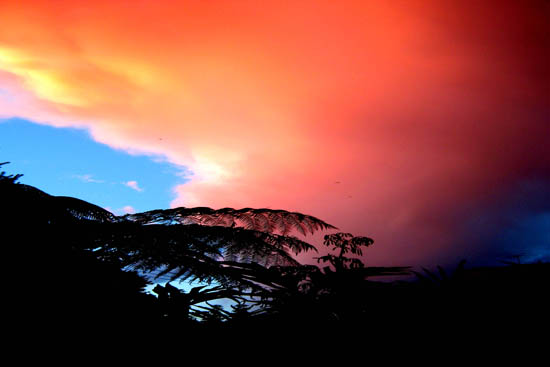
So there... See image at top. and for those who live in cool places, the present temperature in Sydney is a warm 27 degrees C (81 degree F) at 11:00 at night... about 6 degrees C above average...
humans are too stupid...
Humans are too stupid to prevent climate change from radically impacting on our lives over the coming decades. This is the stark conclusion of James Lovelock, the globally respected environmental thinker and independent scientist who developed the Gaia theory.
It follows a tumultuous few months in which public opinion on efforts to tackle climate change has been undermined by events such as the climate scientists' emails leaked from the University of East Anglia (UEA) and the failure of the Copenhagen climate summit.
"I don't think we're yet evolved to the point where we're clever enough to handle a complex a situation as climate change," said Lovelock in his first in-depth interview since the theft of the UEA emails last November. "The inertia of humans is so huge that you can't really do anything meaningful."
One of the main obstructions to meaningful action is "modern democracy", he added. "Even the best democracies agree that when a major war approaches, democracy must be put on hold for the time being. I have a feeling that climate change may be an issue as severe as a war. It may be necessary to put democracy on hold for a while."
Lovelock, 90, believes the world's best hope is to invest in adaptation measures, such as building sea defences around the cities that are most vulnerable to sea-level rises. He thinks only a catastrophic event would now persuade humanity to take the threat of climate change seriously enough, such as the collapse of a giant glacier in Antarctica, such as the Pine Island glacier, which would immediately push up sea level.
"That would be the sort of event that would change public opinion," he said. "Or a return of the dust bowl in the mid-west. Another Intergovernmental Panel on Climate Change (IPCC) report won't be enough. We'll just argue over it like now." The IPCC's 2007 report concluded that there was a 90% chance that greenhouse gas emissions from human activities are causing global warming, but the panel has been criticised over a mistaken claim that all Himalayan glaciers could melt by 2030.
--------------------------------
Meanwhile on the tele:
Recognizing the danger in the divide between climate scientists and meteorologists, a variety of groups concerned with educating the public on climate change — including the National Environmental Education Foundation, a federally financed nonprofit, and Yale University — are working to close the gap by using research and educational forums to bring the two groups together. In 2008, for example, Yale began holding regular seminars with well-known weathercasters who are unsure about the climate issue and scientists who are leading experts in the field. The Columbia Journalism Review explored the reasons for the split in an article this year.
Conversely, the Heartland Institute, a free-market research organization skeptical about the causes and severity of climate change, is also making special efforts to reach out. At its annual conference to be held in Chicago in May, it tried without success to put on a special conference just for meteorologists.
“What we’ve recognized it that the everyday person doesn’t come across climatologists, but they do come across meteorologists,” said Melanie Fitzpatrick, a climate scientist for the Union of Concerned Scientists. “Meteorologists do need to understand more about climate because the public confuses this so much. That is why you see efforts in this turning up.”
-----------------------------
Gulf Stream 'is not slowing down'.Confirming work by other scientists using different methodologies, they found dramatic short-term variability but no longer-term trend.
A slow-down - dramatised in the movie The Day After Tomorrow - is projected by some models of climate change.
The research is published in the journal Geophysical Research Letters.
The stream is a key process in the climate of western Europe, bringing heat northwards from the tropics and keeping countries such as the UK 4-6C warmer than they would otherwise be.
It forms part of a larger movement of water, the Atlantic Meridional Overturning Circulation, which is itself one component of the global thermohaline system of currents.
Between 2002 and 2009, the team says, there was no trend discernible - just a lot of variability on short timescales.
-------------------------------
The slowing of the Gulf Stream may not be noticeable for another 50 years.... Yet by 2050, the average global temperature would have gone up by at least one degree... Not enough melting of Greenland to affect the Gulf Stream till then? Who knows... Variability of the flow in the Gulf Stream may be an indication of climate change... a bit like the Eastern Australian current, presently running erratically south, at 26 degrees C.
to peter costello
from Peter Costello
What amazes me is the way this greenhouse campaign can be switched on and switched off as quickly as the lights during Earth Hour. And for the moment the government has decided to switch it off so we can all get back to talking about health funding.
Our monthly Anglican newspaper broadly reflects the prevailing progressive left opinion. In the December issue, in the lead-up to the government's self imposed timetable for securing the emissions trading legislation, it ran four extensive articles on the need for action over climate change. It published no contrary views.
In fact, the Copenhagen summit was given more column inches than Christmas, which is quite an achievement for a religious newspaper. But the issue has hardly registered in the newspaper since. Even though nothing has happened, the urgency has gone out of the campaign.
http://www.smh.com.au/opinion/politics/the-greatest-moral-conundrum-of-our-time-x2026-until-the-next-one-20100330-rb8s.html
------------------------
Gus: yes Peter, it amazes me too... But it has not been really switched off... Every year of delay of implementing massive carbon dioxide emission reductions, we're adding more than 500 years of consequencial warming. It's not that the urgency has gone out of the system, it's just the way our political constructs work... ignoramuses, such that your mob, the Liberals, the deniers of global warming, have foiled the governmental process. Talk to Tony. His plan to reduce emissions is farcical and not even half-hearted. He does not believe in it... I know, don't tell me, the government's plan is flawed and too little, but at least it was a start in the right direction.
The question remains: do we have to reduce emissions of CO2? Yes, drastically...
How can we do that?
reducing consumption, reducing waste...
Carbon Tax...
ETSs...
Neutral emission technologies preferential treatment...
Arresting population growth, reducing population. Mind you if Lovelock is right, this will be taken care of by the warming... But I believe he's wrong. Even with drastic temperature increases, humans will find ways to live, even underground if necessary (see White Cliffs)...
Revising (or replacing or eliminating) the capitalist system so our economic models include the damage done (past and present) to the environment and also include a component of "non-detrimental" negative growth...
Understanding the process of global warming, including the contradiction that we can observe in some short terms, but scientifically compute the long term problem. We need to stop injuring the earth biotic layer and stop damaging its supportive environments — the seas, the air and the land... Everything we do has an effect and there are points at which the results are not in our interests, nor of the planet's...
-----------------
It is interesting that your Anglican newspaper reflected the left's view on global warming and then dropped it like an ungodly subject. But say that view, even within the left of politics is incomplete and muddled by the "realities" of politics where the proper decisions cannot be made. And let me tell you a couple of little secrets: god did not create the earth, nor could she care less about us nor what we do to this planet... And yes, you're allowed to tell fairy tales to children before they go to sleep. Unlike science, fairy tales, of course, are smart lies that give a naive narrative to the dangers of "incorrect" or careless behaviour...
--------------
from Wikipedia
Writing in the British newspaper The Independent in January 2006, Lovelock argues that, as a result of global warming, "billions of us will die and the few breeding pairs of people that survive will be in the Arctic where the climate remains tolerable" by the end of the 21st century.[24] He has been quoted in The Guardian that 80% of humans will perish by 2100 AD, and this climate change will last 100,000 years.
He further predicts, the average temperature in temperate regions will increase by as much as 8°C and by up to 5°C in the tropics, leaving much of the world's land uninhabitable and unsuitable for farming, with northerly migrations and new cities created in the Arctic. He predicts much of Europe will become uninhabitable having turned to desert and Britain will become Europe's "life-raft" due to its stable temperature caused by being surrounded by the ocean. He suggests that "we have to keep in mind the awesome pace of change and realise how little time is left to act, and then each community and nation must find the best use of the resources they have to sustain civilisation for as long as they can".[24]
He partly retreated from this position in a September 2007 address to the World Nuclear Association's Annual Symposium, suggesting that climate change would stabilise and prove survivable, and that the Earth itself is in "no danger" because it would stabilise in a new state. Life, however, might be forced to migrate en masse to remain in habitable climes.[25] In 2008, he became a patron of the Optimum Population Trust, which campaigns for a gradual decline in the global human population to a sustainable level.[26]
------------------------
From wikipedia
The Optimum Population Trust (OPT) is a registered United Kingdom charity, think tank, and campaign group concerned with the impact of population growth on the natural environment, specifically natural resources, climate change and biodiversity. With respect to population growth, it researches climate change, energy requirements, biodiversity, and other environmental factors. OPT campaigns for population stabilisation and gradual decrease both globally and in the United Kingdom. It advocates improved provision of family planning and sex education, better education and rights for women and that couples voluntarily "stop at two". For the UK, it advocates greater effort to reduce the high rates of teenage pregnancy and unintended pregnancy and that immigration is brought into balance with emigration. OPT is funded by its membership and charitable grants.
The OPT believes that an optimal or sustainable population taking into account environmental and resource factors using the ecological footprint approach lies in the following ranges: for the world 2.7 to 5.1 billion; for the UK 17 to 27 million.[1]
------------------------------
Gus: one of the major obstacle facing the stabilisation of population at a "sustainable" level is the script underwriting the Capitalist system relies on population expansion. Greed as it imprints the system cannot survive in a reduction situation nor in a stable condition. That's why "recessions" are judged "bad"... Even during recessions, there is population growth to underpin the system's future... A new clever inverse green carrot needs to be developed FAST... Greed is a cancer and morphine at the same time. It has no true limiting factor inbuilt in it, apart from rules and regulations that encourage all people to be greedy for the system to "work", while our brains get cooked and we cannot see the damage done.
Most natural forces contain elements of greed in which animals need to aggress in order to survive, yet there is often a factor that limits species growth over others in an environment. I have already mentioned the mathematical equation between species and environment on this site. Because we modify the environment to suit our (human) expansionist stylism, we destroy other species habitats and we modify some parts of the environment, eventually to our own detriment.
We cannot help but now notice that garbage is accumulating in the seas, that the air in our cities is highly polluted and dangerous to some of our population, that others species' habitats are shrinking, and that we've had to deal with global crisis like the looming destruction of the ozone layer.
The crisis of global warming is very sneaky... It's not obvious. If it was obvious, most of us would be moribund by now... Cooked to a crisp. Global warming has to be number-crunched precisely and, as a number-cruncher, you know that numbers can be elastic. In science there is room for bracketing values of observation — but unlike politics, economics or technology, the values are independent of our "observations", while in politics, economics and technology, the values are dependent of the choices we make to suit a particular outcome... You with me?
Thus the science of global warming observation — a very complex flux science — has to rely on theory and observations that are independent of the events. So far, despite the silly deniers, the observations have been the earth surface (including the atmosphere) is warming. The theory that CO2 is a strong greenhouse gas has so far been confirmed by experiments. But because of the enormous size of the planet (a pinhead for stupid ants, in reality), there are conflicting observations and conflicting trends in the short term (often use by the deniers to promote a bad case) but a general increasing trend in the long term.
We have to be smarter about it. We have to be alarmist about it. If we do not do anything now, we let increase the amount of trouble for the future — a hundred times to one — and we will end up living like rats with a fan on a hot garbage heap...
Have a nice future, especially the kids...
-------------------------
more humidity...
Flooding from torrential rains and mudslides have claimed at least 77 lives in Brazil's Rio de Janeiro state, authorities said.
Civil defence officials said about half of the fatalities occurred in Rio de Janeiro city, where authorities urged residents to remain indoors and not venture downtown, where streets were impassable.
"All the major streets of the city are closed because of the floods," Eduardo Paes, mayor of the city of Rio de Janeiro, said in a statement.
"Each and every person who attempts to enter them will be at enormous risk."
In addition to Tuesday's dire warnings, local authorities closed schools to help keep residents off the streets.
In some parts of Rio, abandoned cars were partially submerged while others were stalled on local roads with motorists stranded inside.
----------------
Adelaide's rainfall in the past day has been the heaviest in three years.
The city recorded nearly 33 millimetres until 9:00am and 43mm at Adelaide Airport.
Crafers West in the Adelaide hills had more than 70mm of rainfall.
Many suburbs had power outages and there was widespread minor flooding across the suburbs.
Vince Rowlands from the weather bureau says it is a long time since the city has had such a downpour.
"The last time we had anything about the 33 millimetres at Kent Town was on the 27th of April in 2007 when we had 39 millimetres fall in the city on that particular day," he said.
The State Emergency Service says it has had hundreds of call-outs to deal with flooding.
---------------------
Downstream from St George is Dirranbandi which is waiting for its turn for record floods.
The Bureau of Meteorology says the river is expected to peak around Dirranbandi this afternoon.
Record flooding is also being experienced west of St George on the Paroo River at Eulo.
Further downstream, the small communities of Caiwarro and Hungerford are bracing for record floods early this week [March].
------------------------
see image at top and article below it...
flooding in Roxby Downs...
The clean-up is continuing in South Australia's far north where flashflooding has forced people from their homes and destroyed roads and infrastructure.
A deluge of more than 85 millimetres of rain on Thursday night caused flooding in Roxby Downs and washed away roads in nearby Andamooka.
About a dozen houses were flooded, and it is estimated that up to 20 people - mostly pensioners - have had to find alternative accommodation.
Local resident and chairman of the Andamooka Progress Association, Peter Allen, says heritage listed cottages have been damaged.
"I haven't been able to get close enough to them to see it but there's a watermark on the wall of the cottages [about] three foot high so there's been a significant amount of water that has gone through the cottages, and they're heritage listed so we'll have to reassess that over the weekend when we can get closer to them," he said.
----------------
see toon and article at top... Note:
Roxby Downs is a mining town located in northern South Australia. The town was purpose built to service the Olympic Dam mine which contains one of the largest known ore bodies in the world today. The Olympic Dam mine is owned by BHP Billiton, the mine produces copper, uranium, silver and gold.
Roxby Downs is a unique town with a residential population of around 4,500 with an average age of 29 years. Around 38% of the population is under 15 years of age. It has one of the highest birth rates in Australia. With a lifestyle that is the envy of many, Roxby Downs is truly a unique destination and a place full of opportunity.
...
also note that the annual rainfail average in Roxby Downs is about 199 mm. Thus in one night, it rained nearly half the yearly average.
possible dimming coming...
A huge plume of drifting ash from a volcanic eruption in Iceland has disrupted air traffic across much of northern and western Europe, stranding tens of thousands of air passengers.
The entire airspace in the UK, Norway, Denmark, Belgium and Sweden is closed, there are partial closures in France, and Finland has closed all airports except Helsinki-Vantaa. Flights to and from Australia have been cancelled, and thousands of other Europe-bound passengers from Asia and the United States have been left stranded.
The volcano began erupting on Wednesday (local time) for the second time in a month from below the Eyjafjallajokull glacier in the south of Iceland, and an Icelandic volcanologist says the eruption is growing more intense.
It is estimated that between 4,000 and 5,000 flights were affected on Thursday as a plume of grey ash up to 10 kilometres high blew across the Atlantic, closing major airports more than 2,100 kilometres away.
Volcanic ash contains tiny particles of glass and pulverised rock, which can melt in plane engines, causing a loss of power.
A number of flights between Australia and the UK have been cancelled or delayed due to the volcanic ash.
------------------
It is likely that the cloud of ash could create a significant dimming effect in the region, extending through the entire northern hemisphere, retarding some effects from global warming. Meanwhile, jets cannot fly there as the ash would clog up and stop the turbines. Less fuel is consume as well, thus retarding the global warming from CO2.
a bumpy ride...
"The volcanoes have been very quiet over the last half of the 20th century," Thordarson says.
But in the past 10 years, vulcanologists have noticed increased rumblings from below, suggesting that Iceland might be entering a more active phase again and brewing some really big bangs.
If the vulcanologists are right, we could be in for a bumpy ride.
The last time Iceland had a colossal eruption was in 1783. Laki, a fissure close to the Grimsvotn volcano, burst open and threw up fountains of lava and clouds of ash for eight months.
The poisonous sulphur dioxide gas killed over half of Iceland's livestock population and led to a famine that wiped out about a quarter of Iceland's population.
Meanwhile, as the cloud blew south it wreaked havoc over Europe, too.
"This outpouring of sulphur dioxide during unusual weather conditions caused a thick haze to spread across western Europe, resulting in thousands of deaths throughout 1783 and the winter of 1784," says Jerram.
The fog was so thick that boats across Europe were forced to stay in port.
Further afield, the effects were also severe.
"There is evidence that Laki may have caused the failure of the rice harvest in Japan that year, and weakened the African and Indian monsoon circulation," Thordarson says.
On the explosivity index, Laki is judged to have been a six - the kind of volcano that occurs once every century, on average.
------------------------------
Gus: Krakatoa was a big one too...
Nonetheless, one has to look at the correlation between weather and the status of the geological earth surface... In the past, volcanic activty has "dimmed" the heat from the sun, leading to cooler climes on average. But global warming for example can lead to enormous amount of ice to melt, resulting in continental-blocks becoming "lighter on the surface of the earth". "Billions of tonnes of ice melting" reduces the weight of the very THIN crust (from wikipedia: The oceanic crust of the sheet is different from its continental crust. The oceanic crust is 5 km (3 mi) to 10 km (6 mi) thick and is composed primarily of basalt, diabase, and gabbro. The continental crust is typically from 30 km (20 mi) to 50 km (30 mi) thick, and is mostly composed of slightly less dense rocks than those of the oceanic crust. ) Gus: please not these are averages and there are places, especially where plates meet, where the thichness is more — but not necessarily more stable (usually less stable as one plate can "ride" over another).
In places such as hot spots, cracks and a plate riding above another, melting of ice and lightening of continents, can have "disruptive" (changing) effect on the liquid magma below. This concept is not new. A continetal plate with less weight (less ice on top) can "float" higher on the magma. The magma of the earth has currents and flows, as slow as they may be, but at hight temperature, any small change on the surface can divert a flow below.
Just letting you know. The earth is still a dynamic planet.
Note: no sea-floor is older than 150 million years. Some rocks on the surface of continents are more than 4 billion years old. See toon at top..
salt of the earth's oceans
from the ABC
The supercharging of Earth's water cycle by global warming is making some parts of our oceans saltier, while others parts are getting fresher, according to a new study.
The study, by CSIRO Marine and Atmospheric Science shows a clear link between salinity changes at the surface, caused by warming, and changes in the deeper waters over the last six decades.
CSIRO scientist Paul Durack says the saltiness, or salinity, of the oceans is controlled by evaporation and rainfall. The more heat and evaporation there is at a given patch of ocean, the more concentrated the salts get in the seawater, and the higher the salinity.
In places where a lot of rain is falling, the salty water gets more diluted and fresher.
Tracking the salinity changes over the oceans is, then, a great way to monitor the water cycle over the oceans. That's pretty important, says Durack, since the 97% of the water on Earth is in the oceans that cover 70% of the planet. So when the oceans start saying the global climate is changing, it's truly a global matter.
"The thing is, the general (population) doesn't live in the oceans," says Durack who has co-authored with Dr Susan Wijffels a paper in the latest issue of the Journal of Climate.
-------------see picture and article at top...
crust and climate...
From the independent
Climate change could spark more "hazardous" geological events such as volcanoes, earthquakes and landslides, scientists warned today.
In papers published by the Royal Society, researchers warned that melting ice, sea level rises and even increasingly heavy storms and rainfall - predicted consequences of rising temperatures - could affect the Earth's crust.
Even small changes in the environment could trigger activity such as earthquakes and tsunamis.
And some evidence suggests the consequences of climate change were already having an impact on geological activity in places such as Alaska, researchers writing in the journal the Philosophical Transactions of the Royal Society A said.
Bill McGuire, of the Aon Benfield UCL Hazard Research Centre at University College London, and the author of a review in the journal of research in the area, said warming temperatures melted ice from ice sheets and glaciers and increased the amount of water in the oceans.
-----------------------------
As I wrote two blogs above:
In places such as hot spots, cracks and a plate riding above another, melting of ice and lightening of continents, can have "disruptive" (changing) effect on the liquid magma below. This concept is not new. A continetal plate with less weight (less ice on top) can "float" higher on the magma. The magma of the earth has currents and flows, as slow as they may be, but at hight temperature, any small change on the surface can divert a flow below.
Just letting you know. The earth is still a dynamic planet.
a dynamic planet...
Outback Andamooka is disappearing under floodwaters for the second time this month.
A resident of the town in the far north of South Australia says it has been hit by another fierce thunderstorm today.
Rob Kemenyvary says all roads in the town are now flooded.
"We had a storm come over and it just let loose," he said.
"The clouds just let loose, it just came down with a heavy shower and a bit of high winds and some hail."
The weather bureau says Port Augusta, Roxby Downs, Leigh Creek, Marree, Hawker and Jamestown are also in the storm path.
Senior forecaster Belinda Gibson says about 10,000 lightning strikes have already been recorded in northern regions.
Lightning is being blamed for a bushfire near Bundaleer reservoir in the mid-north.
-----------------------
See flooding in Roxby Downs... MEANWHILE:
--------------------
Sydney's unseasonably warm weather to continue GEORGINA ROBINSON April 19, 2010 - 6:57AMWarm, sunny days will continue in Sydney for the rest of the week until a cool change ushers in showers and winds on Anzac Day, meteorologists say.
The unseasonable warmth will peak on Friday with a top of 26 degrees, which is four degrees above average, Weatherzone forecaster Sam Terry said.
"What we've got at the moment is a high sitting in the lower Tasman (Sea) and we're getting east to northeasterly winds over NSW and they're quite humid," Mr Terry said.
"That's really why we're seeing the warmer temperatures and we're expecting to see that for the next few days, especially for Sydney and the Northern Rivers area."
Temperatures will peak today at 25 degrees in the city and in the west, with fine and mostly sunny conditions.
-------------------
Note: today, the 20 april 2010, the temperature in Sydney has reached 25 degrees and on average since the beginning of the month has been 1.7 degree above average, despite some days way below average... Sure, one swallow does not make spring but:
-----------------
It's rained three times as much as usual this winter in Andalusia, and almost every day unemployed amateur ornithologist Javier Caracuel has walked past a disused mining tower in the decaying industrial town of Linares and looked up, expecting the pair of white storks that nest there to have migrated south.
Yet despite the surrounding high noise levels – the tower, some 10 metres high, is jammed between a school and a street clogged with traffic – and Andalusia's wettest winter in decades, the storks have stayed put. And they're not alone. "There have always been a couple of storks at the top of the church spire down by the railway station, but I've never seen so many across town," Mr Caracuel explains, "and there are dozens more in the villages."
The changes in storks' behaviour that Mr Caracuel has observed in one near-forgotten mining town in north-eastern Andalusia are far from uncommon. At a recent high-level congress attended by 200 migration experts, leading Spanish ornithologist Miguel Ferrer estimated that 20 billion birds have changed their migrating habits in the last few decades. The biggest single identifiable reason behind such a massive behavioural shift, involving 70 per cent of the world's migrating birds is – surprise, surprise – climate change.
-------------------------
All we need now is an earth polarity switch (we're overdue for one) and massive changes to the surface of the earth is on the way. Meanwhile on the subject of "water":
------------------------
A water aerobics class in Darwin had to be postponed this morning after a crocodile entered the pool.
The 1.5 metre freshwater croc was spotted in the Howard Springs Holiday Park pool about 30 minutes before the class was due to start.
"We went down like normal to check the pools out - chlorine and test them, give them a scoop out -because [on] Tuesdays and Thursdays the local ladies of Howard Springs do their water aerobics," the park's manager, Geoff Thompson said.
"And there was a crocodile in there."
He said none of the women were keen to start the class at the scheduled time.
--------------------
But there was also this very unusual event:
-------------------
Hundreds of school children were evacuated from classrooms after a 5.0-magnitude earthquake hit the West Australian Goldfields city of Kalgoorlie-Boulder this morning.
Geoscience Australia says the earthquake hit one to two kilometres south of the Kalgoorlie city centre in Boulder about 8:20am.
Ambulance officers have taken a man and a woman to hospital with minor injuries. They are both in a stable condition.
Residents are being warned to prepare for aftershocks, but Geoscience Australia's David Jepsen said the worst should be over.
"You can never rule out anything, but the general behaviour of earthquakes in Australia is that you would only have smaller aftershocks."
--------------------------------------
considering that:
Qantas flights to Europe will remain cancelled until at least Friday.
It follows further volcanic activity in Iceland.
The airline says over 15,000 customers have been affected.
-----------------------------------
Just letting you know. The earth is still a dynamic planet.
hot and cold showers...
Sydney May weather (picture by Gus)
Tasmania is expected to have a warmer and drier than average winter.
The Weather Bureau has released its seasonal outlook, predicting below average rainfall and warmer than average temperatures for the state.
Climatologist Ian Barnes-Keoghan says the first four months of the year were the most mild on record. (Gus bold)
"Despite the very cold weather we've just had, May seems to be holding up reasonably well," he said.
"So those together suggest that this is certainly going to be right up there as the warmest 5 months Tasmania's had."
Mr Barnes-Keoghan says those conditions should continue.
"We're certainly going to get some cold days through winter, we always do, but we will get one or two mild ones thrown in,
"These forecasts are just suggesting the mild ones would be just a little bit more likely than normal, but still it is winter and it is Tasmania so it is going to be fairly cold for a lot of the time."
-----------------------
Meanwhile in Sydney it's pouring cats and dogs and the temperature is icy cold... Well not really... The minimums are quite above average while the maximums are quite below...
Yet...:
-----------------------
The weather bureau is predicting most of South Australia will have warmer than average temperatures until July.
-----------------------
Do not forget we're in a low sun actvity period...
tornado smashes NSW north coast...
A tornado destroyed homes and caused multiple injuries as it smashed into the north coast of New South Wales at Lennox Head this morning.
Police say a number of homes have been destroyed, powerlines are down and several caravans have been overturned. Paramedics say several people have been injured in the storm but no-one is missing.
--------------------------
Over the southern summer, I mentioned a few times on this site the unusually warm current that was going down the east australian coast as far as Tasmania. Now, the cold weather from the south collects this high energy and brings back northward in heavily ladden clouds. The "normally" dry and crisp winter weather of the east coast has been replaced by storms and numerous showers, warmer temperature minimum, average temperature maximums and even some waterspouts have been spotted barely offshore of Sydney. Waterspouts are uncommon here but they would appear in SUMMER... not winter, nor autumn.
Global warming is here and rampant...
super drought in india...
Large parts of India have been hit by a severe heat wave, with temperatures soaring to more than 45 degrees Celsius.
The dry and extreme weather has killed hundreds and left many areas parched.
As Al Jazeera's Prerna Suri reports, the searing heat and severe water shortage are affecting all residents, rich and poor alike.
------------------
Global warming is here and rampant...
global warming is happening
LONDON: The global temperature this year reached its warmest on record based on a 12-month rolling average, said James Hansen, the top climate change scientist at the National Aeronautics and Space Administration.
The mean surface temperature in the year to April was about 0.66 degrees warmer than the 1951 to 1980 mean, according to NASA's Goddard Institute for Space Studies. That makes it a fraction warmer than the previous peak in 2005.
''Record high global temperature during the period with instrumental data was reached in 2010,'' Dr Hansen and three co-authors wrote. ''As for the calendar year, it is likely that the 2010 global surface temperature in the analysis also will be a record.''
The figures strengthen the case that temperatures show a warming in the climate.
--------------------------
0.66? is this in Fahrenheit or in Celcius? it's in Celcius... I checked.... We're in trouble. Meanwhile:
-------------------
NASA admits to error in global warming data (2007)
NASA said the error resulted from a switch to a new data-collection system in 2000 and a false assumption that the old and new methods matched.
McIntyre criticized NASA for not making a formal announcement on the change.
"They have managed it rather poorly," The Guardian quoted McIntyre as saying. "I come from a background where you have to announce bad results. They might not like the fact they made a small embarrassing error but if it was me I'd have announced the results and put the best spin on it that I could. I would not have left myself open to the suggestion that I was not being forthcoming."
NASA said that accusations from climate skeptics of a cover up are unfounded, according to CanWest News Service.
"This is not a hundredths of a degree issue. This isn't some kind of statistical quirk. It's very, very clear [that global warming is happening]," Gavin Schmidt, a climatologist at NASA's Goddard Institute for Space Studies, told CanWest News Service in a phone interview. "A lot of this is because people are making that confusion, and some people are deliberately making that confusion to make [the correction] seem like a bigger deal than it actually is."
http://news.mongabay.com/2007/0817-nasa_snafu.html
global warming is increasing humidity shift...
Torrential rain and landslides in southern China have killed 132 people, with more heavy rain forecast.
A further 86 people are missing and 800,000 residents have been evacuated.
There have also been power cuts, collapsed reservoirs and widespread damage to roads. Millions are without drinking water supplies.
Dozens of rivers have passed safety levels, including the Pearl River in Guangdong province.
China's rainy season, which began in May, follows the worst drought in a century in the south-west.
'Rain intensity increased'
The National Meteorological Centre warned on Sunday of more rainstorms to come.
"The scope and intensity of the rain have increased," it said in a statement on its website.
"In parts of Zhejiang, Fujian, Jiangxi, Henan, Guangxi and other areas of the south, the rainfall will be 100-180 millimetres. In other parts, the rainfall will be more than 200 millimetres."
A total of 68,000 houses have been damaged and more than 500,000 hectares (1.2 million acres) of crops have been affected, the reports said.
State TV broadcast images of soldiers leading rescues from roof tops, submerged fields, overturned cars people wading through waist-high water as they tried to cross a flooded bridge.
-----------------------
And massive floods in France too...
-----------------------
http://www.guardian.co.uk/world/gallery/2010/jun/16/france-flooding-pictures
----------------------
As mentioned at the top of this line of comments:
"You may have noticed, humidity has slightly increased in the atmosphere, worldwide... Well, most scientist working on the study of climate and of climate change have noticed that too.
From Europe to the USA, from Australia to Haiti, the "weather" has been bringing in rain, or hail, or snow... or just high humidity in the air like in Sydney for the past few months — all somewhat more than "usual". Yet there is still room for more droughts...
"Floods of the century" are now replaced by floods bigger than ever, even since Napoleonic times or since record have been kept. Sure, Noah's account of the biblical floods is not included.... But the damage by rain, hail and snow from Melbourne's "super storm" a few days ago — to the "unheard snows in the south of France in March", after a massive storm had claimed 55 dead and several towns on the Atlantic coast — is quite "phenomenal"."
---------------------
There were also some floods in India in June:
Flood fury hits Jorhat
GUWAHATI, June 17 – Jorhat has become the latest district in Assam to face the flood fury with nearly one lakh people being affected in the last two days, officials said today.
Lakhimpur in Brahmaputra valley and Cachar and Karimganj in Barak valley have been already hit by floods.
In Jorhat district, Bhogdoi river breached the dyke at Maloupathar area submerging over 35 villages with 1000 families and inundating more than 1000 hectares of farm land with standing crops and vegetables, the officials said.
Several schools, five colleges, 20 temples of historical importance were also inundated forcing closure of educational institutions for the next three days.
The affected people were taking shelter on the Bar Ali ‘bundh’ (dyke)-cum-road, they said.
In Titabor subdivision, in Chief Minister Tarun Gogoi’s constituency, Choraipani river had caused breaches in two places between Dangdhora and Bhekuriagaon inundating around 45 villages housing nearly 10,000 people, 20 schools and agricultural fields.
-------------------
And floods in Burma, etc... All in all, a tad more rainwater than "usual"... Meanwhile in Sydney, the June temperature has gone up, as the Australian "winter" high pressure system has gone south again — at least 700 kiliometres south to its "usual" seasonal position...
And did I mention the tornadoes in the US...
more floods...
At least 39 people have died and hundreds more are missing in floods and mudslides following heavy rains in Brazil.
Authorities have said 100,000 people have been left homeless in the northeast of the country.
Luiz Inacio Lula da Silva, the president, has called a crisis cabinet meeting on Tuesday and said the government would make federal funds available to help the homeless.
Civil defence officials in Alagoas state said the Mundau river burst its banks in the town of Uniao dos Palmares, leaving at least 500 people missing there.
"We are praying for the missing to be found alive. But we are very worried because bodies are starting to turn up on beaches and on riverbanks," Teotonio Vilela Filho, the state governor, said.
The torrents swept away more than 40,000 houses, entire bridges and streets, as well as rail lines in 22 towns across Alagoas, Vilela said.
-----------------------
see toon and comment at top...
meanwhile in the big apple...
By PATRICK McGEEHAN and FERNANDA SANTOSA record-breaking heat wave tightened its grip on New York City on Tuesday, as triple-digit temperatures tested Consolidated Edison’s power supply, threatened the health of the elderly, and tried the patience and resilience of anyone who dared to venture outside.
With the temperature reaching 103 degrees in Central Park at 3:11 p.m., breaking the former record high of 101 degrees for the day set in 1999, Con Edison officials braced for the greatest demand for power they had ever had to supply. The long red arrow on the dial projected on a screen in the utility company’s command center in Manhattan hovered at the threshold of uncharted territory — 13,141 megawatts consumed at one time — for most of the afternoon.
The heat broke several records in the Northeast, as Boston, Providence and Philadelphia all saw temperatures in the 100s that eclipsed previous highs. In Philadelphia, a 92-year-old woman was found dead in her home on the second floor. The medical examiner ruled that extreme heat was a factor in her death.
The National Weather Service blamed a high-pressure system along the East Coast that drew hot, humid air from the south and will probably stay put until late this week.
In New York, the heat’s effects were unsparing: Some city pools were filled to capacity within an hour or so of opening, sending seekers of respite to libraries, cooling centers and other public havens from the heat. Hospitals set out jars of ice water as their waiting rooms filled with wheezing elderly patients and exhausted firefighters.
Police Commissioner Raymond W. Kelly said that the Police Department was mindful that crime sometimes increased in the extreme heat of night, and was also prepared to send extra officers to places that had lost power.
But even as Con Edison officials were optimistic that the city would survive the day without widespread power failures, they acknowledged that the intensity and duration of the heat wave could have a cumulative effect on the cables and transformers. In short, they said, the worst may be yet to come. “It’s Round 1 in a prizefight,” said John Miksad, Con Edison’s senior vice president of electric operations. “Round 1 looks O.K., but the bell hasn’t rung yet.”
------------------------
meanwhile in Alice Spring...
Alice Springs has had its coldest day on record, shivering through single digit temperatures yesterday.
Sally Cutter from the weather bureau says Alice Springs reached a maximum of just 6.4 degrees C yesterday afternoon.
"That makes it the coldest on record for Alice Springs and those records are fairly old," she said.
"I think it was 1948 was the coldest July day and 1966 was the previous coldest day on record."
The Northern Territory's previous coldest day was 5.9 degrees, recorded in Yulara in 1997.
The wet conditions are continuing in Alice Springs, with the airport recording almost 70 millimetres of rain since the start of the month.
------------------------
meanwhile in Sydney...
The maximums temperature in July are colder on average by about 1.5 degrees C, while the minimums are about 2 degrees C above average... The weather is wet and damp, while the average is mostly sunny and crisp for this time of the year. The system of high pressure has been hovering more than 600 kilometres south of where it usually sits for this period.
Meanwhile in Darwin, the temperature is about 1.5 degrees above average.
Meanwhile in perth, the minimum temperature is getting close to record low... while the maximums are 1 degree C above average.
Just letting you know...
meawhile in pandaland...
from the BBC
Parts of China are in the midst of a heat wave, which has shattered temperature records.
Temperatures in Beijing have topped 40C, the highest reading in July for 60 years.
Ben Torquist reports.
bogus claims?...
from The First Post
As the scientific community seeks to put a lid on the outpouring of climate change scepticism unleashed in the wake of Climategate and the publicising of flaws in a UN climate report, a new study has suggested that the theory of 'runaway climate change' is "unrealistic".
Today a Dutch government review gave the all-clear to a United Nations report which had been widely criticised for overstating the threat of climate change and containing bogus claims about the probable effects.
The Netherlands Environmental Assessment Agency (PBL) said the Intergovernmental Panel on Climate Change's 2007 report contained "no errors that would undermine the main conclusions" that climate change will have serious effects for the world. The 35 errors it did find were mainly typographical or similarly trivial. The IPCC has accepted 12 of them.
Embarrassingly for PBL, it had to admit it was the source of one of the most glaring errors – a claim that 55 per cent of the Netherlands was at risk of flooding because it lies under sea level.
Tomorrow, Sir Muir Russell's independent review of the Climategate scandal, in which hackers stole and circulated emails from the Climatic Research Unit at the University of East Anglia, is likely to clear climate scientists of malpractice. It would be the third inquiry to do so – leading to calls of 'whitewash' from climate change sceptics.
But a new study is set to rock the boat again by calling into question one of the more frightening global warming scenarios: 'runaway climate change'. Under this scenario, rising temperatures speed up processes that catastrophically increase the rate of global warming – a positive feedback loop.
One of these processes is an increase in the rate of carbon dioxide (CO2) production by plants and microorganisms in the soil caused by an increase in temperature. As CO2 is a greenhouse gas, it has been suggested this will further increase temperatures, leading to a further increase in CO2 production until the Earth is too hot for human life.
-------------------------
Gus: the last premise is not new... above a certain temperature, plants do not release more CO2... What will and does is the amount of humans on earth. First by being there, absorbing carbon as "more bodies" are created, but releasing far more in order to provide the comforts. But before the temperate regions reach tropical status, where plants don't release more CO2, the average world temperature has to climb at least 5 degrees...
What the Netherlands have to be prepared for is that the band of fierce depressions (low weather patterns) that cross the Bay of Biscay will slowly move northward (like the weather patterns seem to have shifted south in Australia) and it's possible that within 10 years, the weather will start bringing storms with waves that will crush the dikes, like the waves that crushed the dikes in l'Aiguillon, France...
The "weather" is warming fast nearly everwhere and the climate difference of potential (storms, droughts, heat waves, cold snaps) is increasing... We cannot be complacent and wait "for the big one"... Remember, if stuck at a level crossing with an oncoming train, you're still okay one second before impact... whether you know the train is coming or not.
reading matters..
from the Garnaut report:
Climate change policy must begin with the science. When people who have no background in climate science seek to apply scientific perspectives to policy, they are struck by the qualified and contested nature of the material with which they have to work. Part of the uncertainty derives from the complexity of the scientific issues. In the public discussion of the science, additional complexity derives from the enormity of the possible consequences, which encourages a millennial perspective. Part derives from the large effects of possible policy responses on levels and distributions of income, inviting intense and focused involvement in the discussion by those with vested interests.
The Review is not in a position to independently evaluate the considerable body of scientific knowledge; it takes as a starting point the majority opinion of the Australian and international scientific communities that human-induced climate change is happening, will intensify if greenhouse gas emissions continue to increase, and could impose large costs on human civilisation.
This chapter draws extensively on the Fourth Assessment Report of the Intergovernmental Panel on Climate Change, and on detailed reports prepared by Australian scientists, research published since the IPCC Fourth Assessment Report and work commissioned specifically for the Review. It aims to build an understanding of the way humans can influence the climate and the limitations in our current understanding of the climate system, and introduces key terminology and concepts relevant to people who are interested in climate change policy.
In drawing on the work of the IPCC, and the large majority of Australian scientists who are comfortable working within that tradition, we are still faced with immense uncertainties, which have informed (and at times bedevilled) the Review’s analysis. These perspectives may cease to be the mainstream as the development of climate science proceeds and the uncertainties narrow. At this time, the Review believes it is appropriate to give the main weight to them.
-----------------
One day I will do a compile of the complexities involved in the weather — including the present shift of some climatic boundaries due to global warming. But for now read the garnaut report which was release I think in september 2008...
for a cool verdelho in the shade...
Europeans are sizzling in scorching temperatures as a heatwave hits the continent ahead of the summer holidays. The Belgian capital of Brussels saw its hottest day since 1976.
The city is usually known for its grey and cloudy weather but today it put parts of Spain in the shade as temperatures hit 40 degrees. But while Belgium frollicks in the sun, spare a thought for the employees of this Bordeaux car parts factory.
It’s not yet holiday time in France so they worked on in a sweltering 37 degrees — much to the annoyance of this man. “Our legs hurt. We don’t feel well at all. We can go outside to get a bit of air and after that it’s a bit better,” he said.
In Germany, the mercury has topped 30 plus for most of the past week, with many soaking up the rays in the country’s parks and beer gardens.
---------------------
Meanwhile at the barrel
At first thought one might think of Austria’s climate as being quite cool for red wine. In the Alps and the western and northern reaches of the country this tends to be true. The eastern plains that border Hungary and Slovenia, however, are a different story. Right in the heart of this region is Mittelburgenland, and this is Austria’s red wine country, with 95-percent of the vineyards planted to red wine varietals. And there is global warming changing the wine map. Yes, Austria has an international reputation for its white wines, but there has been a revolution going on in terms of red wines in recent years. In Austria, red wine now accounts for about 1/3 of the wine production.
...
I get important emails from various sources, including the gulf oil-spill management bizo but also from European countries organisms on various subjects, one of which has alerted me to the earlier ripening of Reisling in Germany due to "global warming"...
---------------
Meanwhile Sydney is wet and miserable despite lower average day temperatures and higher than average night temperatures...
global night warming...
By Eleni Roussos
The Bureau of Meteorology says Darwin had its hottest July night on record last night.
The temperature did not drop below 26.6 degrees Celsius overnight.
The record was also broken in Darwin's rural area, with Middle Point not dropping below 25 degrees.
Duty Forecaster David Matthews is expecting more warm nights.
"It may be another warm night tonight, I think," he said.
"And maybe the next few days [too].
"It's a little hard to tell because we are getting slightly more easterly winds and moisture coming across from the Gulf of Carpentaria."
-------------------------------
Gus: since the beginning of winter, I have taken note that Darwin's weather has been about 2 degrees above average... This is due of course to the high pressure systems being further south than "average"...
meanwhile at the liars' table...
Chances are, you have not heard much about Climategate lately, but last November it dominated the media. Three weeks before the Copenhagen summit, thousands of emails from the Climate Research Unit at the University of East Anglia were published on a Russian website.
The research institute was a leading contributor to the fourth Intergovernmental Panel on Climate Change report, and some of the leaked emails showed the scientists in a poor light.
The scandal was one of the pivotal moments in changing the politics of climate change. What seemed close to a bipartisan agreement on an environmental trading scheme collapsed with Abbott's defeat of Turnbull. Within months the Rudd government lost its nerve on what the former prime minister called ''the greatest moral and economic challenge of our time''.
By casting doubt on the integrity of the scientists, Climategate helped puncture public faith in the science, and probably contributed to Labor's political panic. The echo chamber of columnists reverberated with angry and accusatory claims. In Australia, Piers Akerman said: ''The tsunami of leaked emails . . . reveal a culture of fraud, manipulation, deceit and personal vindictiveness to rival anything in a John le Carre or John Grisham thriller.'' Later he wrote: ''The crowd that gathered in Copenhagen were there pushing a fraud.''
Andrew Bolt thought that ''what they reveal is perhaps the greatest scientific scandal'' of our time. ''Emails leaked on the weekend show there is indeed a conspiracy to deceive the world - and Mr Rudd has fallen for it.''
Miranda Devine wrote: ''We see clearly the rotten heart of the propaganda machine that has driven the world to the brink of insanity.''
The ramifications of Climategate were immediate. The climate unit's head, Professor Phil Jones, was forced to stand down. Three inquiries were set up to examine the scientists' conduct.
The first, a House of Commons select committee, reported in March that the scientific reputation of Professor Jones and the CRU remained intact. The second, a science assessment panel, set up with the Royal Society and consisting of eminent British researchers, reported in April.
Its chairman, Lord Oxburgh, said his team found ''absolutely no evidence of any impropriety whatsoever'' and that ''whatever was said in the emails, the basic science seems to have been done fairly and properly''.
The third, set up by the university itself, published its 160-page report two weeks ago. On the specific allegations made against the behaviour of the CRU scientists, ''we find that the rigour and honesty [of the scientists] as scientists are not in doubt''. Importantly, it concluded: ''We did not find any evidence of behaviour that might undermine the conclusions of the IPCC assessments.''
In other words, nothing in the emails undermined the research of the climate scientists. Like the other two, it found aspects of the scientists' behaviour that fell short of professional standards - ''failing to display the proper degree of openness''.
What might seem the most damning was the way Jones dealt with freedom of information requests, but context makes his behaviour more understandable. In July last year alone, the CRU received 60 FoI requests. Answering them would have been too much for even all the unit's staff time. Over a matter of days, it received 40 similar FoI requests, each wanting data from five different countries - 200 requests in all. Jones concluded the unit was subject to a vexatious campaign.
While not fully excusing their behaviour, one has to appreciate the embattled position of scientists who received a steady stream of obscene and abusive emails and constant public attacks on their integrity.
After the leaks, Jones, now reinstated, received death threats and said he contemplated suicide.
You might imagine the media would be keen to report on authoritative conclusions about allegations they had found so newsworthy in December. But coverage of each of the reports has been non-existent in many news organisations and in others brief or without prominence.
At best, the coverage of the inquiries' conclusions added up to a 20th of the coverage the original allegations received, which leaves us to ponder the curiosities of a news media that gets so over-excited by dramatic allegations and then remains so incurably uninterested in their resolution.
The newspapers that gave greatest play to the allegations tended to give less attention to the findings. The columnists who gave greatest vent to their indignation have not made any revisions or corrections, let alone apologised to the scientists whose integrity they so sweepingly impugned.
Even at the time, it was clear much of the coverage was more attuned to maximising sensation rather than to reporting with precision. The sheer number of leaked emails, for instance, was sometimes taken as proof of the scale of the scandal, as if they were all disreputable.
In fact, only from a handful could anything sinister be conjured.
It is a common criticism of the media that they prominently publish allegations, but give less coverage to the prosaic facts that later refute them. But rarely is the disproportion so stark. Rarely has such an edifice of sweeping accusation and extravagant invective been constructed on such a slender factual basis.
And rarely does it do such damage.
Rodney Tiffen is emeritus professor of government and international relations at the University of Sydney.
--------------
Gus: I decided to reproduce here, in full, this article which of course shows the Mirandas and Andrew Bolts of this world how bigotedly wrong they are.... But they'll never ever see, even after the day their venomous pens run out of ink...
of global warming and humidity...
There was a wet and windy start to the week today as forecasters warned of more downpours to come.
Heavy rain overnight caused localised flooding and the Highways Agency warned drivers to take extra care using roads across much of England.
Up to 4cm (1.5in) of rain fell in areas of southern England in just a few hours - more than half the normal monthly total - and there were gale force winds in places.
Thorney Island in Hampshire saw the worst of the stormy weather with nearly 4cm of rain - half falling between midnight and 1am - and gale force eight winds (40mph).
Among the roads affected was the A249 in Kent where flooding forced the northbound carriageway to be closed between the junctions with the M2 and the A250.
Claire Austin, forecaster with MeteoGroup, the weather division of the Press Association, said the "nasty band of heavy rain" would clear this morning but the day would remain showery with the heaviest downpours across Scotland.
-------------------------
Gus:
— "unusual" (common, but with more intensity) weather in the UK...
— floods like never ever seen in Pakistan
— wet weather in wintery Sydney (usually clear winter skies)
— extreme heat in Russia
— bad floods in China and North Korea and a few other "out of kilter" worldwide weather patterns...
Most of these anomalies can be explained by the shifting of the tropical boundaries southwards in the southern hemisphere and northward in the northern hemisphere — a shifting due to "global warming"... I know this is simplistic as there are continental masses and many other factors to take into account.
Just looking at Australia, the "normal" high pressure system associated with the land-mass in winter has shifted southwards, most of wintertime, nearly one thousand kilometres over the ocean and compacted the temperate zone (Hobart has had warmer temperatures than averages) while bringing fierce low pressure system in the southern oceans, plus a wetter south pole...
Of course, we have to take into account "jet streams" — these fast flowing narrow air currents that tend to fill "the atmospheric voids" realigning the surface winds, which themselves carry moisture or not, depending where they coming from to where they are going to. The floods in Pakistan have been blamed on a "blocked jet stream"...
In each hemisphere, air flows in a few distinct vertical/horizontal rolling motion away from boundaries such as equatorial (doldrums — low pressure) to other boundaries such as tropical/temperate belt (high pressure), etc to the central polar system — all this motion in the form of "toric doughnuts"— as well as moving in horizontal eddies (circular winds due to low or high pressure systems)... The whole lot moving "towards the sunrise"... There are also seasonal pattern changes made by the orientation of the earth axis.
But recent observations show that weather patterns are becoming more and more upset, faster and faster... The relationship between our emission of EXTRA CO2 and these changes should be obvious. This relationship is made by most serious scientists although most are not ready yet to apportion blame to "global warming" for these latest weather "crazies"... It's a hard call to make, as proofs can never be so obvious in such extremely complex climatic system... But the relationship is strong.
Glaciers are still retreating, there are more of these "weather crazies". My predictions have been that on current trends, by 2012-15, the scale of these weather crazies may become common place, while GREATER crazies might start to pepper our atmosphere. By then, like now, we will be in denial: we'll blame god or nature... We can hardly blame ourselves can we?
But we should blame the devil, yes, the devil in us, the EXTRA (fossil "fuel") carbon-user in us... I don't believe in god nor in the devil. I only believe in our ability to beat our shortcomings via understanding of this natural world. Let's be understanding of climate, beyond our religious prejudices and beyond our greed — both presently fogging up our understanding of the OBVIOUS...
see article and picture at top...
"extreme-ish" events...
Unrelenting rains and severe weather have lashed Guatemala, leaving at least 21 people dead over the past 24 hours, in what the country's president calls a "national tragedy".
Twelve people were killed, and another dozen injured on Saturday when a rain-triggered landslide buried a bus on a major highway near central Chimaltenango city.
Guatemala's national radio station reported that other landslides on the Interamerican Highway killed two more people and created a traffic jams up to 75km long.
At least four other people died in a house in western Quetzaltenango on Saturday after it was collapsed by a landslide - adding to weather-related deaths from Friday.
Alvaro Colom, the president, said that 29,000 people have already been affected by the rain-triggered disaster, and warned that 24,000 more people are at risk as the government runs out of funds to deal with the crisis.
"Top priority at present is dealing with this emergency. There are no funds left to deal with earlier disasters like the one caused by [tropical storm] Agatha," in late May, Colom told reporters on Saturday after touring some of the affected areas.
He said weeks of heavy rains - including the latest torrent brought on by Hurricane Frank - had caused between $350-500 million in destruction across the country.
Meteorologists have forecast another 24-36 hours of heavy rain throughout much of Guatemala.
http://english.aljazeera.net/news/americas/2010/09/20109504110783907.html
-----------------------
Tropical Storm Earl has hit the eastern Canadian coast, following a rapid acceleration.
One man died in the province of Nova Scotia after securing a boat that had slipped its moorings, police said.
The storm has brought high winds and heavy rain, toppling trees and power lines through the region and cutting electricity to about 200,000 homes.
Earl was moving quickly north-east, with sustained winds of 102km/h, the Canadian Hurricane Centre said.
Canadian authorities said Earl made landfall near the boundary between Shelburne and Queens counties at about 1030 (1330 GMT).
http://www.bbc.co.uk/news/world-us-canada-11189584
------------------------
The army is heading in to help the escalating flood crisis across Victoria, in what residents are calling the worst floods in more than a decade.
Victorian Premier John Brumby has been briefed by the police, fire and emergency chiefs as floodwaters continue to rise in the state's north-east and west.
Hundreds of homes have already been evacuated and residents are taking shelter at relief centres.
Mr Brumby says more police and federal Defence personnel are being deployed to northern Victoria over the coming days.
"We've been in touch with the Federal Government - there'll be some Defence deployment tomorrow," Mr Brumby said.
"[They will be] relatively small numbers, but there'll be 50 Defence personnel in the north of the state assisting with things like relief, evacuations or relocations and assisting with things like sandbagging and holding back the water."
http://www.abc.net.au/news/stories/2010/09/05/3002955.htm
-------------------
VICTORIA, soaked to the brim by its heaviest winter rains in years, was overflowing yesterday.
The floods, the worst in 15 years, caused landslides, flash-flooding and evacuations as residents sought refuge in local high schools and shelters. Hundreds of skiers were stranded at Mount Buller after landslides swept through carparks.
By last night at least 200 residents had been evacuated from the worst-hit areas, including Creswick and Clunes, in the central highlands, after rivers broke their banks, including the Yarrowee at Ballarat, and Creswick creek.
Broken creek banks around Euroa and Benalla, north-east of Melbourne, and in the Ovens Valley near Mount Hotham, prompted hundreds more to evacuate to local high schools and shelters.
Parts of Shepparton are also expected to flood today, while the state’s northeast and alpine region braces for more heavy rain and thunderstorms.
http://www.smh.com.au/victoria/floods-landslides-chaos-across-state-20100904-14vd5.html
------------------
http://www.guardian.co.uk/lifeandstyle/gallery/2010/sep/04/readers-pictures-weather
coral severe stress
By JUSTIN GILLISThis year’s extreme heat is putting the world’s coral reefs under such severe stress that scientists fear widespread die-offs, endangering not only the richest ecosystems in the ocean but also associated fisheries that feed millions of people.
From Thailand to Texas, corals are reacting to the heat stress by bleaching, or shedding their color and going into survival mode. Many have already died, and more are expected to do so in coming months. Computer forecasts of water temperature suggest that corals in the Caribbean may undergo drastic bleaching in the next few weeks.
What is unfolding this year is only the second known global bleaching of coral reefs. Scientists are holding out hope that this year will not be as bad, over all, as 1998, the hottest year in the historical record, when an estimated 16 percent of the world’s shallow-water reefs died. But in some places, including Thailand, the situation is looking worse than in 1998.
Scientists say the trouble with the reefs is linked to climate change. For years they have warned that corals, highly sensitive to excess heat, would serve as an early indicator of the ecological distress on the planet caused by the buildup of greenhouse gases.
“I am significantly depressed by the whole situation,” said Clive Wilkinson, director of the Global Coral Reef Monitoring Network, an organization in Australia that is tracking this year’s disaster.
According to the National Oceanic and Atmospheric Administration, the first eight months of 2010 matched 1998 as the hottest January to August period on record. High ocean temperatures are taxing the organisms most sensitive to them, the shallow-water corals that create some of the world’s most vibrant and colorful seascapes.
Coral reefs occupy a tiny fraction of the ocean, but they harbor perhaps a quarter of all marine species, including a profusion of fish. Often called the “rain forests of the sea,” they are the foundation not only of important fishing industries but also of tourist economies worth billions.
Drastic die-offs of coral were seen for the first time in 1983 in the eastern Pacific and the Caribbean, during a large-scale weather event known as El Niño. During an El Niño, warm waters normally confined to the western Pacific flow to the east; 2010 is also an El Niño year.
hot and desperate...
I already mentioned the record heatwave in Los Angeles but this item from Chris Floyd caught my eye:
Los Angeles is boiling in record-breaking heat, putting the lives and health of many people there at risk. One of these is Arthur Silber, whose chronic poor health is severely affected by the heat, as he explains in his most recent post. Silber is an extraordinary writer and powerful analyst, and his blog is his only source of income. When his health prevents him from writing, contributions naturally drop off. But as he notes, he is still here, and will be writing again as soon as he can, and he still needs support to meet basic needs. (Yes, you may well be astonished to find that telling the truth about our imperial state -- which Silber does incomparably -- does not lead to wealth and comfort. Strange, but true.)
These are lean times all around -- except for the elite and their sycophants -- but if you've got any change to spare, you might consider throwing a bit Silber's way, and bring some cooling balm to help keep this vital voice going in the face of the inferno.
http://www.chris-floyd.com/articles/1-latest-news/2027-cool-running-preserving-a-voice-in-the-inferno.html
the planet IS heating up...
A tornado watch has been issued for New York City and the U.S. Northeast. If one is to form, it will be the fourth tornado to hit New York City this season. Two touched down Sept. 16, and one hit the Bronx in July.
It's been a year of extreme weather, from Snowmageddon in Washington, D.C., to triple-digit heat in Los Angeles and from hurricanes in the Gulf to floods in Wisconsin; and the extreme weather won't stop any time soon, scientists say.
David Easterling, chief of the Scientific Services Division at the National Oceanic and Atmospheric Administration's Climatic Data Center, said there will be more incidences of extreme weather because the planet is heating up.
http://seattletimes.nwsource.com/html/nationworld/2013020529_weather29.html
cold, but one degree above average...
"September was an unusual month in terms of the lack of warm days across much of south-eastern Australia," weatherzone meteorologist Brett Dutschke said.
"A high pressure system over the Great Australian Bight acted as a blocking mechanism, keeping noticeably cool southerly winds blowing over South Australia, Victoria and NSW.
"Significant warming will occur in the coming weeks as heat builds over the interior. All we will need is a day or two of westerly winds and we could exceed 30 degrees," Mr Dutschke said.
When both daytime and overnight temperatures were combined, Sydney's average temperature this month came in at just under 17 degrees.
This made it the coldest September in five years, despite being one degree above the long-term norm.
http://www.smh.com.au/environment/weather/sydney-shivers-through-coldest-september-in-five-years-20100930-15yjh.html
wetter conditions, right on cue...
October 1, 2010 - 4:55PM
Global warming may have given Australia its wettest September in more than 100 years, but "extreme dry years" lie ahead, the Bureau of Meteorology says.
Bureau senior climatologist Blair Trewin said September had an average of 49mm of rain nationwide, the highest since 41mm in 1906 and almost three times above the long-term average of 17mm a year.
Thunderstorm season starts today
He said there was some evidence that increased levels of greenhouse gases contributed to the increased rainfall.
Prevailing westerly winds were shifting southward, bringing wetter conditions.
http://www.smh.com.au/environment/weather/australia-has-wettest-september-on-record-20101001-160eo.html
-------------------------
See picture at top and article below it...
thin ice getting thinner...
Arctic sea ice tipped to disappearBy Felicity Ogilvie
Scientists in the US are predicting that within 30 years there will no longer be summer sea ice in the Arctic.
This summer the ice was thinner and it dropped to its third lowest point since measurements began.
Scientist Julienne Stroeve from the National Snow and Ice Data Centre (NSIDC) in Colorado says the results are surprising.
"Typically, on average, as you look back to the '80s, late '70s, even early '90s, the average was about seven million square kilometres at the end of the summer melt season," she said.
"Basically, from about 2002, but more importantly since 2007, we've been dropping below five million square kilometres.
"And of course, 2007 was the record lowest at 4.3 [million square kilometres]."
Other scientists on Ms Stroeve's team predict the ice decline means that in 20 to 30 years the Arctic will be ice-free in the summer.
Ms Stroeve says that will cause a jump in global warming and strange weather anomalies.
She says during the summer, the ice will no longer be there to reflect solar radiation back into space.
"As you lose that cover and you expose the ocean ... you then absorb that sun energy throughout summer," she said.
"In order for the ocean to once again refreeze in autumn, you're going to have to re-release that heat that the ocean gained back to the atmosphere.
"And we're seeing the effects of that already - we're seeing some temperature anomalies in autumn over the Arctic in the order of three to five degrees Celsius right now."
http://www.abc.net.au/news/stories/2010/10/05/3030213.htm?section=justin
for those who have not noticed...
Sydney averaged only six hours of sunshine a day during October, robbing residents of the month's usual heat, weatherzone.com.au says.
During the month there was not a single day above 29 degrees in the city, the first time that has happened in October in 18 years.
Western suburbs did manage to sneak past 30 degrees once or twice.
Overall, daytime temperatures averaged 22 degrees, equal to the long-term norm.
"One of the main reasons for the lack of warmth is the higher than usual amount of cloud and rainy days," Weatherzone meteorologist Brett Dutschke said.
"Sydneysiders who crave the sunshine can feel robbed. A typical October day is greeted with seven hours of sunshine, but this time the average was just six hours," Dutschke said.
"This extra cloud meant nights were warmer than normal, the warmest for October in three years as far as averages go. Overnight minimums averaged 15 degrees, one and a half degrees warmer than the long-term norm.
http://www.smh.com.au/environment/weather/rain-clouds-out-sunny-october-20101101-17a1y.html
==================
For those who haven't notice, October's weather would have been in line with global warming... As the top of this line of comment, the process is explained: as temperature goes up, more humidity can be absorbed by the air, eventually creating clouds that dim the effect of warming. In regions further south, the temperature would have been higher than average...
Same in regard to antarctica sea ice:
It shows that despite cool temperatures over most of the Arctic Ocean in January, Arctic sea ice extent continued to track below normal. By the end of January, ice extent dropped below the extent observed in January 2007. Ice extent was unusually low in the Atlantic sector of the Arctic, the one major area of the Arctic where temperatures remained warmer than normal. Arctic sea ice extent averaged for January 2010 was 13.78 million square kilometers (5.32 million square miles). This was 1.08 million square kilometers (417,000 square miles) below the 1979 to 2000 average for January, but 180,000 square kilometers (69,000 square miles) above the record low for the month, which occurred in January 2006.
Ice extent remained below normal over much of the Atlantic sector of the Arctic, including the Barents Sea, part of the East Greenland Sea, and in Davis Strait. The only region with above-average ice extent was on the Pacific side of the Bering Sea. While Arctic sea ice extent has declined in all seasons, the downward trends in winter ice extent are much smaller than in summer. Polar darkness and low temperatures mean that the ice generally refreezes to about the same boundaries each winter. Ice extent averaged for January 2010 was the fourth lowest for the month since the beginning of satellite records. The linear rate of decline for January is now 3.2% per decade.
http://webcache.googleusercontent.com/search?q=cache:y9vlsMP4JM4J:www.scar.org/news/polar/+hobart+warmer+in+october+than+average&cd=1&hl=en&ct=clnk&gl=au
anthropogenic influence....
16 Feb 2011 19:19
Source: reuters // Reuters
* Link shown between climate change and heavier rainfall
* Greenhouse gases doubled chance of one flood event
* Some research methods used are in "infancy"
By Gerard Wynn
LONDON, Feb 16 (Reuters) - Man-made greenhouse gas emissions are linked to more frequent heavy rainfall, two studies published found on Wednesday, portraying a clearer human fingerprint after a spate of floods around the world.
Scientists agree that greenhouse gas emissions are warming the world and expect that in turn would lead in the future to more evaporation of water, more moist air and heavier rainfall.
But the two new papers were the first to pin an increase in heavy rainfall in the second half of the last century directly on climate change, as well as one particular extreme flood in Britain.
"The two studies demonstrate that a human impact upon the intensification of rainfall and associated flooding is already detectable," said Richard Allan at the department of meteorology, University of Reading, in Britain.
A Canadian study published in the journal Nature analysed a general increase in heavy rainfall globally from 1951-1999, and for the first time matched those observations with climate simulations, where the effects of man-made greenhouse gas emissions were included.
"We were able to establish a link between anthropogenic influence and the changes in precipitation," said co-author Xuebin Zhang, from Environment Canada, a government agency.
"The caveat is we haven't been able to identify, to quantify, how big is that influence. That is difficult because of the limitations in observations."
A separate paper, also published in Nature, went a step further and forged a link between climate change and a particular extreme flood in Britain in 2000.
The authors found that the flood was more likely when greenhouse gases were included in simulations than without.
http://www.trust.org/alertnet/news/floods-linked-to-manmade-climate-change-studies/
See picture and article (written about a year ago) by Gus at top...
disturbed...
Scientists are warning that north Queensland's rainforest areas will take decades to recover from Tropical Cyclone Yasi.
Trees were stripped bare and some were snapped in half by winds in excess of 250 kilometres per hour, when Yasi ripped through the region almost four weeks ago.
Professor Bill Laurance who is a conservation biologist at James Cook University in Cairns says in some places only the trunks of trees have been left behind.
"A category five or category four cyclone can really effect dramatic damage to a forest and in these exposed areas it just looks like somebody's gone through and just shredded the vegetation in some cases - it's almost akin to deforestation," he said.
Professor Laurance says development around towns can increase the damage to the rainforest.
"These abrupt, artificial forced edges that are created when the vegetation is chopped up into pieces and parcels by residential development and by land clearing, they're probably more vulnerable to wind sheer," he said.
"You get these powerful winds striking the forest edges, they knock some trees over, they snap trees in half and then as it comes up over the top of the forest, you actually get a lot of turbulence and that turbulence tends to pounds the forest canopy and cause more forest damage.
"In a superficial way you're going to get a lot of foliage re-sprouting in a few months but ... a forest expert will walk through that area and in years will be able to say, well this area has obviously been heavily disturbed."
Professor Laurance says older trees will take longer to recover.
http://www.abc.net.au/news/stories/2011/03/01/3152082.htm?section=justin
see toon at top and read letter to prue as well
thailand floods 2011
BANGKOK (March 30, 2011): Severe flooding in southern Thailand has killed 11 people and stranded thousands of tourists on resort islands, authorities said on Wednesday, predicting more rain and issuing warnings for possible mudslides.
Nearly a million people have been affected by more than a week of unseasonably heavy downpours across the region with tens of thousands of families cut off from air and land transport.
Trains to the region have been cancelled and three airports have been shut, including one on the resort island of Koh Samui which is popular among Thai and foreign tourists.
Several main roads and highways have been blocked by floods.
The Thai navy sent four vessels including an amphibious landing craft with on-board helicopters to the rubber-rich region to deliver supplies and rescue tourists and villagers in areas severely hit.
"The army and the navy are working together to help those stranded and evacuate others who live in areas at risk of a mudslide," Satit Wongnongtoey, a minister in the prime minister's office, told Reuters.
"More rain is expected in the next few days."
http://www.thesundaily.com/article.cfm?id=59400
-----------------
See image and article at top. For anyone who knows about about global warming, humidity is a key indice of warming via CO2...
a good idea...
Residents in Queensland's Lockyer Valley are being given the opportunity to move their homes to higher ground after January's floods.
A wall of water ripped through the valley in the south-east of the state. Grantham was hit hard, with homes washed away and lives lost.
The Lockyer Valley Council has been under scrutiny over its disaster management, but now it has released the master plan for a redevelopment on higher ground.
Residents who want to move will be able to swap their land with the council, and will be responsible for building their own homes.
Who gets which parcel of land will be decided by ballot.
The offer is also available to other communities like nearby Murphys Creek, Withcott and Helidon.
http://www.abc.net.au/news/stories/2011/05/05/3209010.htm?section=justin
more water...
Millions of people across south Asia are struggling to cope with monsoon rains that have forced them from their homes and left a trail of death and misery. More than 425 people are reported to have been killed.
In India, Pakistan, Bangladesh and Nepal, large numbers have been displaced as the rains triggered landslides and destroyed crops and livelihoods. In some instances in Pakistan, those affected were still recovering from the devastation of last year's unprecedented floods when this year's rains brought more havoc.
"Barely recovering from the worst floods in the country's history last year, the Pakistan province of Sindh has been hit again after heavy monsoon downpour and severe flooding and the government of Pakistan has appealed to the UN for international humanitarian aid for close to five million people," said Sarah Crowe, a regional spokeswoman for Unicef.
"We are responding with vaccination drives and are due to expand nutrition, water and sanitation, education and child protection programming following assessments."
The British-based charity Plan said that in parts of southern Pakistan, emergency camps were overflowing with people. Several canals designed to divert the rains had been breached
http://www.independent.co.uk/news/world/asia/monsoon-rains-bring-misery-for-millions-2352233.html
see article at top...
have they read my blog?...
It really is hard to know where to begin with this one. But let's start with: "What on earth were they thinking?"
The Heartland Institute, a Chicago-based rightwing thinktank notorious for promoting climate scepticism, has launched quite possibly one of the most ill-judged poster campaigns in the history of ill-judged poster campaigns.
I'll let its own press release for its upcoming conference explain, as there's simply no need to finesse it further:
http://www.guardian.co.uk/environment/blog/2012/may/04/heartland-institute-global-warming-murder?newsfeed=true
------------
The Heartland Institute is a American conservative and libertarian public policy think tank based in Chicago, which advocates free market policies.[2][3][4][5] The Institute is designated as a 501(c)(3) non-profit by the Internal Revenue Service and has a full-time staff of 40, including editors and senior fellows.[6] The Institute was founded in 1984 and conducts research and advocacy work on issues including government spending, taxation, healthcare, tobacco policy, global warming, information technology and free-market environmentalism.
In the 1990s, the group worked closely with the tobacco company Philip Morris to question the science linking secondhand smoke to health risks, and to lobby against government public-health reforms.[7][8][9] More recently, the Institute has focused on questioning the science of climate change, and was described by the New York Times as "the primary American organization pushing climate change skepticism."[10] The Institute has sponsored meetings of climate change skeptics,[11] and has been reported to promote public school curricula challenging the scientific consensus on climate change.[12]
In 2012, internal documents leaked to the public disclosed some sources of the organization's funding, and include a "Climate Strategy Memo" whose authenticity has been challenged.
http://en.wikipedia.org/wiki/The_Heartland_Institute
----------------------------
Possibly the Heartland Institute read my blog comparing Tony Abbott with a murderer... for being a "skeptic" despite his claims to the contrary... And the HI thought it was a good ploy to use in reverse...
10-fold increase in the number of severe weather warnings
A COLD front from Canberra is forecast to bring a patchy covering of weather forecasters at a time when increased weather events are predicted, according to an independent review.
Released yesterday, the review warns that federal government cuts have coincided with an increased number of extreme weather events, with the Bureau of Meteorology having to call in recently retired staff and temporary contractors to manage the workload during natural disasters.
The report found the Bureau of Meteorology lacked the ''surge capacity'' required to respond to major events such as floods, cyclones and bushfires.
Meanwhile, climate change modelling suggests the number and severity of natural disasters is set to increase. Completed last December, one of the recommendations is for a boost in meteorologist numbers.
Led by businesswoman Chloe Munro, the report points out that there has been close to a 10-fold increase in the number of severe weather warnings issued by the bureau since 1997 - from 200 a year to more than 1800 - and the alerts ''have even greater significance for the protection of life and property''.
Read more: http://www.smh.com.au/environment/weather/forecasters-face-heavy-weather-20120608-201py.html#ixzz1xIGjyUef
low expectations...
United Nations secretary-general Ban Ki-moon has opened the Rio+20 summit in Brazil with a warning that time is running out to act on climate change.
The conference brings together delegates from 193 countries, including 86 heads of government - Australian Prime Minister Julia Gillard among them.
Mr Ban says he is hopeful an agreement on sustainable development is in reach.
"Rio+20 is not an end, but a beginning," he said.
"It is time for all of us to think globally and long-term, beginning here now in Rio for time is not on our side."
Brazilian president Dilma Rousseff welcomed world leaders to a rainy Rio de Janeiro amid criticism that the three-day summit is already falling far short of its promise to establish clear goals for sustainable development.
http://www.abc.net.au/news/2012-06-21/rio-plus-20-gets-underway-in-brazil/4083014
confusing manual...
The Crime and Misconduct Commission (CMC) has cleared three engineers involved in the management of Wivenhoe Dam during the January 2011 floods in Brisbane.
The CMC said there was no evidence to suggest that John Tibaldi, Robert Ayre and Terry Malone had engaged in criminal misconduct.
At the start of 2011 much of Queensland, including Brisbane, was inundated by floodwaters, resulting in the deaths of 35 people and billions of dollars in damage.
In the immediate aftermath of the floods questions were raised over how water releases from Wivenhoe Dam, which was built after the 1974 floods to act as a flood mitigation and water storage dam, were managed.
The CMC was called in to review the Queensland Floods Commission of Inquiry into the dam's management, which was released in March.
The three engineers were referred to the CMC after the Commission found that the dam was operated in breach of its manual for more than 22 hours before the floods hit Brisbane, downstream of Wivenhoe.
Questions were also raised over the engineers' testimonies, which at times appeared contradictory.
However the Commission also found that the operating manual contained contradictions and "was ambiguous, unclear and difficult to use, and was not based on the best, most current research and information".
The CMC appointed retired judge John Jerrard QC, to assess the recommendations of the report and see if there was any basis for charging any of the engineers with criminal misconduct.
http://www.abc.net.au/news/2012-08-21/cmc-clears-engineers-over-wivenhoe-handling/4212260
read article at top...
and now for the coral reef...
Caribbean coral reefs – which make up one of the world's most colourful, vivid and productive ecosystems – are on the verge of collapse, with less than 10% of the reef area showing live coral cover.
With so little growth left, the reefs are in danger of utter devastation unless urgent action is taken, conservationists warned. They said the drastic loss was the result of severe environmental problems, including over-exploitation, pollution from agricultural run-off and other sources, and climate change.
The decline of the reefs has been rapid: in the 1970s, more than 50% showed live coral cover, compared with 8% in the newly completed survey. The scientists who carried it out warned there was no sign of the rate of coral death slowing.
http://www.guardian.co.uk/environment/2012/sep/10/caribbean-coral-reefs-collapse-environment/print
see story at top... I am not writing this for fun, you know... I am doing it because we, humans, are killing the planet without care...
wrong day of the week...
Sydney will continue to bask in the glorious sun for a few more days after a stunning weekend.
So far during this month, Sydney has had only one day that failed to reach above 20 degrees, Weatherzone meteorologist Rob Sharpe said. Today will go well beyond this temperature.It will be the first time in 24 years that Sydney has gone 10 days into spring with only one day below 20 degrees.
Sydney has averaged 23 degrees so far this month, three above the September average.
This follows on from a warm end to winter, with last month averaging 20 degrees, two above the long-term average.
Unfortunately for many in Sydney, the warmest days have fallen midweek, while the weekends have been the coolest parts of the week.
Read more: http://www.smh.com.au/environment/weather/sydneys-warmest-start-to-spring-in-24-years-20120910-25noy.html#ixzz263WSgMbO
----------------------------
Global warming is real, no matter what the dicks like Alan Jones and Tony Abbott tell you.... They're idiotts...
Drought and rising temperatures...
Climate change challenges power plant operations
By Juliet Eilperin, Monday, September 10, 9:08 AMBOULDER CITY, Nev. — Drought and rising temperatures are forcing water managers across the country to scramble for ways to produce the same amount of power from the hydroelectric grid with less water, including from behemoths such as the Hoover Dam.
Hydropower is not the only part of the nation’s energy system that appears increasingly vulnerable to the impact of climate change, as low water levels affect coal-fired and nuclear power plants’ operations and impede the passage of coal barges along the Mississippi River.
“We’re trying to manage a changing climate, its impact on water supplies and our ability to generate power, all at once,” saidMichael L. Connor, commissioner of the Bureau of Reclamation, the Interior Department’s water management agency. Producing electricity accounts for at least 40 percent of water use in the United States.
Warmer and drier summers mean there is less water available to cool nuclear and fossil-fuel plants. The Millstone nuclear power plant in Waterford, Conn., had to shut down one of its reactors in mid-August because the water it drew from the Long Island Sound was too warm to cool critical equipment outside the core. A twin-unit nuclear plant in Braidwood, Ill., needed to get special permission to continue operating this summer because the temperature in its cooling water pond rose to 102 degrees, four degrees above its normal limit; another Midwestern plant stopped operating temporarily because its water intake pipes ended up on dry ground because of the prolonged drought.
Scott Burnell, a spokesman for the Nuclear Regulatory Commission, said the safety of America’s nuclear plants “is not in jeopardy” because the sources of water cooling the core are self-contained and might have to shut down in some instances if water is either too warm or unavailable.
“If water levels dropped to the point where you can’t draw water into the condenser, you’d have to shut down the plant,” he said.The commission’s new chairman, Allison Macfarlane, has asked her staff to look at “a broad array of natural events that could affect nuclear plant operations” in the future, such as climate change, Burnell added.
For more than three-quarters of a century, the Hoover Dam has represented an engineering triumph, harnessing the power of the mighty Colorado River to generate electricity for customers in not just nearby Las Vegas but as far away as southern California and Mexico.
http://www.washingtonpost.com/national/health-science/climate-change-challenges-power-plant-operations/2012/09/09/42b26b8e-f6a5-11e1-8b93-c4f4ab1c8d13_print.html
Though there is an increase of "humidity" with global warming, as mentioned at top, this does not mean the end of droughts... Actually there is a chance of increase droughts — as increased water vapours stay clear (no cloud, no rain) with increase heat...
increasing the odds of climatic disasters...
Meanwhile, the campaign of Obama's Republican rival, Mitt Romney, has repeatedly made clear, that global warming is a low priority.
That was at least partly behind NYC Mayor Michael Bloomberg's decision on Thursday afternoon toendorse Obama for a second term. "Our climate is changing. And while the increase in extreme weather we have experienced in New York City and around the world may or may not be the result of it, the risk that it might be -- given this week's devastation -- should compel all elected leaders to take immediate action," Bloomberg wrote.
Bloomberg also said: "I want our president to place scientific evidence and risk management above electoral politics."
If nothing else, climate activists say, that scientific evidence -- while perhaps not perfect -- is clear enough.
"Hurricanes start because a tropical wave comes off the African coast and hits the ocean and begins to spin, and it has always been thus," said Bill McKibben, the environmentalist and founder of the climate action group 350.org. "But we live in a world where -- and no one doubts this -- the atmosphere over that ocean is 5 percent moister on average than when I was born. We've done very big things on this earth -- that's the point. It's not the one we were given, it's increasingly one we've made."
http://www.huffingtonpost.com/tom-zeller-jr/hurricane-sandy-link-to-climate-change_b_2059179.html
Read article at top to remind yourself of what it's all about......
broken record in pommyland...
3. 2012 IS WETTEST YEAR ON RECORDIt’s official: 2012 is the wettest year in England on record and the downpour is set to continue through the weekend. The Met Office says a sodden Boxing Day pushed the year’s average rainfall past all previous records and "nearly a month’s rain" will fall in certain areas this weekend.
Read more: http://www.theweek.co.uk/daily-briefing/50752/ten-things-you-need-know-today-friday-28-dec-2012#ixzz2GOp1cb7f