Search
Recent comments
- lies and stats....
1 hour 13 min ago - testing........
10 hours 38 min ago - zayas.....
21 hours 27 min ago - mud.....
1 day 2 hours ago - BBC/MI6....
1 day 2 hours ago - coaching...
1 day 10 hours ago - no subs....
1 day 10 hours ago - mitigation....
1 day 12 hours ago - stylism....
1 day 12 hours ago - but ruthless....
2 days 12 hours ago
Democracy Links
Member's Off-site Blogs
the games of deceit and cooperation in the EU and beyond.....
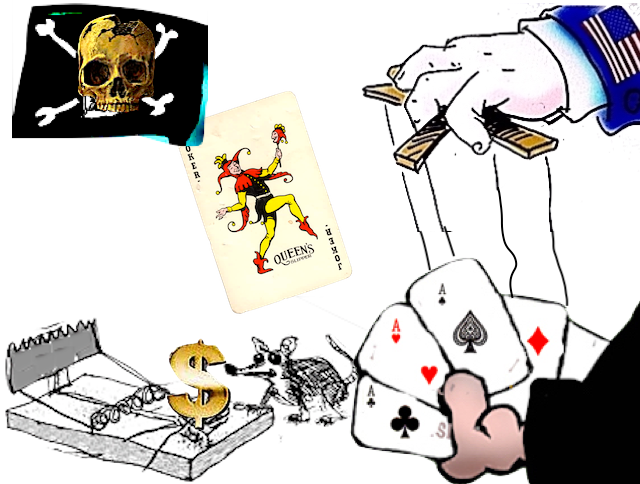
ONE COULD ASSUME THAT THE RULERS OF THIS WORLD HAVE STUDIED VARIOUS SCENARIOS OF THE "GAME THEORY". AS WELL WE CAN ASSUME THAT THEY WOULD HAVE UNDERSTOOD THE GAMES OF DECEIT AND THE UPTURNED FIDDLES OF TRUST WHILE IN A GROUP. THE EUROPEAN UNION IS SUCH A CONSTRUCT THAT IS BASED ON BENEFICIAL AGREEMENTS AND HIDDEN DECEIT — WITH HOPE OF INDIVIDUAL AND MUTUAL PROFITABILITY.
BUT ONE COULD ASSUME TOO MUCH INTELLIGENCE HERE... STUPIDITY, GAMBLE AND ANGER SOMETIMES TRUMP REASON. THERE IS SOME OF THIS HERE, BUT THE MACHIAVELLIAN IDEALS ARE STRONG. PRINCES RULE.
MOST OF THE GRAND RULERS OF EUROPE ARE SOCIOPATHS WITH FEET OF CLAY AND SHIFTY EYES — WITH DEFICITS [ECONOMIC AND MORAL] ON THEIR LEDGERS... THEY NEED UNITY IN CROOKERY, BUT THEY ARE ALSO CONTROLLED LIKE PUPPETS, BY THE BANKERS OF THE GAME.
THE CHEMISTRY THOUGH IS BOUNDED BY A CRITICAL SEAM. THERE ARE WEAKNESSES IN THE ALLIANCE — AS NOT EVERY PLAYER COMES FROM THE SAME HISTORICAL THREAD, NOR DO THEY SPEAK THE SAME LANGUAGE, AND NOR DO THEY BRING THE SAME ECONOMIC VALUE, EVEN IF THEY WISH TO BE "TOGETHER" AND SHARE A CAKE "PROPORTIONALLY"...
THEY TALK A LOT ABOUT BENEFITS THOUGH THEY ARE IN MORE DEBTS THAN THEY COLLECT MONEYS... THEIR FARMERS OFTEN REVOLT... THEIR FACTORIES GO BANKRUPT, UNLESS THEY DECIDE TO MANUFACTURE THE BEST STUFF OF BEAUTIFUL OBSOLESCENCE: WEAPONRY.
BOMBS ARE ONLY SHORT-LIVE AS DETERRENTS, WHILE BEING SELF-DESTRUCTIVE FINITE PRODUCTS THAT NEED CONSTANT REPLACEMENT.
AS WELL, A COUNTRY IS NOT MADE OF HOMOGENOUS PEOPLE AND THE POLITICAL MOMENTUM CAN CHANGE. SOME CRITICS GET KILLED. SOME GO TO PRISON...
THE CHAIRPERSON — PRESENTLY THE UNELECTED PRESIDENT OF THE UNION — IS ALSO MIRED IN CORRUPT ACTIVITIES TO MAINTAIN THE TOP DOG POSITION. WORDS OF UNITY FLOW FROM THE SPEECHES. WHILE THERE IS DISSENT IN THE BACK ROWS, NO-ONE WANTS TO ROCK THE BOAT TOO MUCH, NONETHELESS...
HARSH PENALTIES ARE IMPOSED TO SILENCE THE CRITICS AND THOSE COUNTRIES THAT DO NOT PLAY THE GAME ACCORDING TO BRUSSELS. THE MEDIA WILL BE TIGHTLY CONTROLLED TO MAINTAIN THE THEATRICS OF TOGETHERNESS.
ENTERS THE CRUDE CLOWN FROM ACROSS THE ATLANTIC WITH BIG SHOOOOOES — LONG SHOES DESIGNED TO WALK OVER YOUR NEAT POLISHED LEATHER AND TRIP YOUR HIGH-HEELED STEPS... AND HE'S PUSHING YOU DOWN THE STAIRS FOR YOU TO DO MORE CRAZY STUNTS....
THE ENEMY ACROSS THE RIVER HAS BEEN DESIGNATED SINCE TIMES NO-ONE CAN REMEMBER — THEY EVEN GO BACK BEFORE NAPOLEON OR HITLER. NOW, THE GAME IS FULL OF HYPOCRITICAL MOVES. THE PLAYERS HAVE TO KNOW THEIR OWN DECEIT TO SURVIVE.
THEY WOULD HAVE TO KNOW THAT ZELENSKY IS A SLY OPERATOR WORKING FOR MI6. THE KISS-KISS THEATRE EVERY SECOND MONTHS, IS DESIGNED TO SHOW SOLIDARITY WITH THE UKRAINIANS — AND IT FOOLS MOST OF THE BELIEVERS. THE BELIEVERS VALUE THE EFFORT TO SUPPORT THER INDEPENDENCE, DESPITE THE CORRUPTION OF THEIR REGIME, BUT IT'S A CHOICE... THE GALICIAN/UKRAINIANS CARRY THE HEAVY BURDER OF HISTORICAL MASS MURDER OF JEWS, POLES AND RUSSIANS.
JOINING THE EU WOULD BE ACCEPTANCE AND ABSOLUTION [OR DILUTION] OF THEIR ANCESTORS SINS.
YET, THE MI6 MORON IN CHARGE, ZELENSKY, IS PRAISING THE WW2 KILLINGS BY MAKING HEROES OUT OF THE MURDEROUS NAZIS. LUCKY, THE EUROPEANS ARE MORE THAN FORGIVING, BECAUSE MANY OF THEM STILL LOVE FASCISM AND THEY WANT TO DESTROY RUSSIA. THEIR SHORT LITTLE MAN IS DOING THIS ON THEIR BEHALF...
THE RUSSIAN/UKRAINIANS WANT TO BE REUNITED WITH THE MOTHERLAND AND SHAME THAT COUNTRY OF NAZIS, WHICH, SINCE 1945, HAS BEEN PLAYING A DANGEROUS DOUBLE GAME.
THE FIRST PART OF THIS PRESENTATION IS THE BASIC GAME THEORY OF COALITIONS.
THE SECOND PART IS THE GAME OF DECEIT WHICH CAN LEAD TO BREAK UP OF THE COALITION OR A STRONGER BOND BETWEEN THE MEMBERS.
OTHER FACTORS COME INTO PLAY AND LIKE MINUTE VARIATIONS IN WEATHER FORECASTING, THESE SMALL PARAMETERS CAN DEMOLISH PREDICTIONS — OR SHIFT THE OUTCOME OF THE GAME...
THE GAME THAT THESE RULERS PLAY, EVEN TO THIS MODERN DAY — A BIT MORE THAN FIFTEEN DAYS BEFORE CHRISTMAS 2026 — OFTEN END UP IN WARS, IN WHICH POPULATIONS ARE EXPENDABLE AND PROPAGANDA IS MORE POWERFUL THAN THE BIBLE OF GOD'S LIES.
THE ALLIANCE GAINS MORE STRENGTH BY HAVING TO FIGHT A DESIGNATED ENEMY — A FOIL DESIGNED TO ASSURE A COMMON CAUSE — BECAUSE THERE IS NO ALLIANCE NEEDED IF THERE IS NO THREAT — WHICH ARE ECONOMIC SURVIVAL, POLITICAL ADVENTURISM OR FIGHTING INVENTED INVADERS... THE INVADERS WOULD BE SILLY TO EVEN TRY TO ACQUIRE ANY EUROPEAN RUSSIAN-HATING LAND. THE RUSSIANS ARE NOT DUMB.
FOR THE EUROPEANS, ESCALATING POVERTY — ECONOMIC AND POLITICAL — IS NOT AN ENEMY. IT IS A CULTIVATED ESSENCE OF ACCUMULATING BLAME TO FOCUS AGAINST THE ENEMY.
A PACK OF VOLVES WON'T ATTACK A FAMILY OF BEARS, UNLESS THE LEADER HAS ESTABLISHED THAT THEY CAN WIN.
NOW A SEEMINGLY STRANGE VECTOR COMES IN... A SNOW TIGER WANTS THE JUICY BEARS FOR ITSELF BUT IT LETS THE WOLVES WEAKEN THE BEARS FIRST — BECAUSE THE TIGER KNOWS THE WOLVES WILL LOSE.
THE TALE ENDS FOR NOW, WHEN THE WOLVES AND THE TIGER ARE DEFEATED, AND THE BEARS SURVIVE, YET ARE BLEEDING A LITTLE.
THE GAME CAN ALSO BE ARRESTED FOR A BIT LONGER, WHEN THE BEARS SHOW THEIR MEGATONIC PAWS... BRIGHTER THAN THE SUN AND BIGGER THAN A PACK OF SILLY WOLVES...
BUT ON ANOTHER DAY, THE HIDDEN BANKERS WILL CARRY ON TO FINANCE THE GAMES OF SUCH WARS...
THERE IS NO MONEY IN HARMONIOUS PEACE.
Von Neumann and Morgenstern were the first to construct a cooperative theory of n-person games. They assumed that various groups of players might join together to form coalitions, each of which has an associated value defined as the minimum amount that the coalition can ensure by its own efforts. (In practice, such groups might be blocs in a legislative body or business partners in a conglomerate.)
The von Neumann–Morgenstern theory
in game theory in n-person games
They described these n-person games in characteristic-function form—that is, by listing the individual players (one-person coalitions), all possible coalitions of two or more players, and the values that each of these coalitions could ensure if a counter-coalition comprising all other players acted to minimize the amount that the coalition can obtain. They also assumed that the characteristic function is superadditive: the value of a coalition of two formerly separate coalitions is at least as great as the sum of the separate values of the two coalitions.
The sum of payments to the players in each coalition must equal the value of that coalition. Moreover, each player in a coalition must receive no less than what he could obtain playing alone; otherwise, he would not join the coalition. Each set of payments to the players describes one possible outcome of an n-person cooperative game and is called an imputation. Within a coalition S, an imputation X is said to dominate another imputation Y if each player in S gets more with X than with Y and if the players in S receive a total payment that does not exceed the coalition value of S. This means that players in the coalition prefer the payoff X to the payoff Y and have the power to enforce this preference.
Von Neumann and Morgenstern defined the solution to an n-person game as a set of imputations satisfying two conditions: (1) no imputation in the solution dominates another imputation in the solution and (2) any imputation not in the solution is dominated by another one in the solution. A von Neumann–Morgenstern solution is not a single outcome but, rather, a set of outcomes, any one of which may occur. It is stable because, for the members of the coalition, any imputation outside the solution is dominated by—and is therefore less attractive than—an imputation within the solution. The imputations within the solution are viable because they are not dominated by any other imputations in the solution.
In any given cooperative game there are generally many—sometimes infinitely many—solutions. A simple three-person game that illustrates this fact is one in which any two players, as well as all three players, receive one unit, which they can divide between or among themselves in any way that they wish; individual players receive nothing. In such a case the value of each two-person coalition, and the three-person coalition as well, is 1.
One solution to this game consists of three imputations, in each of which one player receives 0 and the other two players receive 1/2 each. There is no self-domination within the solution, because if one imputation is substituted for another, one player gets more, one gets less, and one gets the same (for domination, each of the players forming a coalition must gain). In addition, any imputation outside the solution is dominated by one in the solution, because the two players with the lowest payoffs must each get less than 1/2; clearly, this imputation is dominated by an imputation in the solution in which these two players each get 1/2. According to this solution, at any given time one of its three imputations will occur, but von Neumann and Morgenstern do not predict which one.
A second solution to this game consists of all the imputations in which player Areceives 1/4 and players B and C share the remaining 3/4. Although this solution gives a different set of outcomes from the first solution, it, too, satisfies von Neumann and Morgenstern’s two conditions. For any imputation within the solution, player A always gets 1/4 and therefore cannot gain. In addition, because players B and C share a fixed sum, if one of them gains in a proposed imputation, the other must lose. Thus, no imputation in the solution dominates another imputation in the solution.
For any imputation not in the solution, player A must get either more or less than 1/4. When A gets more than 1/4, players B and C share less than 3/4 and, therefore, can do better with an imputation within the solution. When player Agets less than 1/4, say 1/8, he always does better with an imputation in the solution. Players B and C now have more to share; but no matter how they split the new total of 7/8, there is an imputation in the solution that one of them will prefer. When they share equally, each gets 7/16; but player B, for example, can get more in the imputation (1/4, 1/2, 1/4), which is in the solution. When players B and C do not divide the 7/8 equally, the player who gets the smaller amount can always do better with an imputation in the solution. Thus, any imputation outside the solution is dominated by one inside the solution. Similarly, it can be shown that all of the imputations in which player B gets 1/4 and players A and C share 3/4, as well as the set of all imputations in which player C gets 1/4 and players A and B share 3/4, also constitute a solution to the game.
Although there may be many solutions to a game (each representing a different “standard of behaviour”), it was not apparent at first that there would always be at least one in every cooperative game. Von Neumann and Morgenstern found no game without a solution, and they deemed it important that no such game exists. However, in 1967 a fairly complicated 10-person game was discovered by the American mathematician William F. Lucas that did not have a solution. This and later counterexamples indicated that the von Neumann–Morgenstern solution is not universally applicable, but it remains compelling, especially since no definitive theory of n-person cooperative games exists.
The Banzhaf value in voting gamesIn the section Power in voting: the paradox of the chair’s position, it was shown that power defined as control over outcomes is not synonymous with control over resources, such as a chair’s tie-breaking vote. The strategic situation facing voters intervenes and may cause them to reassess their strategies in light of the additional resources that the chair possesses. In doing so, they may be led to “gang up” against the chair. (Note that Y and Z do this without any explicit communication or binding agreement; the coalition they form against the chair X is an implicit one and the game, therefore, remains a noncooperative one.) In effect, the chair’s resources become a burden to bear, not power to relish.
When players’ preferences are not known beforehand, though, it is useful to define power in terms of their ability to alter the outcome by changing their votes, as governed by a constitution, bylaws, or other rules of the game. Various measures of voting power have been proposed for simple games, in which every coalition has a value of 1 (if it has enough votes to win) or 0 (if it does not). The sum of the powers of all the players is 1. When a player has 0 power, his vote has no influence on the outcome; when a player has a power of 1, the outcome depends only on his vote. The key to calculating voting power is determining the frequency with which a player casts a critical vote.
American attorney John F. Banzhaf III proposed that all combinations in which any player is the critical voter—that is, in which a measure passes only with this voter’s support—be considered equally likely. The Banzhaf value for each player is then the number of combinations in which this voter is critical divided by the total number of combinations in which each voter (including this one) is critical.
This view is not compatible with defining the voting power of a player to be proportional to the number of votes he casts, because votes per se may have little or no bearing on the choice of outcomes. For example, in a three-member voting body in which A has 4 votes, B 2 votes, and C 1 vote, members B and Cwill be powerless if a simple majority wins. The fact that members B and Ctogether control 3/7 of the votes is irrelevant in the selection of outcomes, so these members are called dummies. Member A, by contrast, is a dictator by virtue of having enough votes alone to determine the outcome. A voting body can have only one dictator, whose existence renders all other members dummies, but there may be dummies and no dictator (an example is given below).
A minimal winning coalition (MWC) is one in which the subtraction of at least one of its members renders it losing. To illustrate the calculation of Banzhaf values, consider a voting body with two 2-vote members (distinguished as 2a and 2b) and one 3-vote member, in which a simple majority wins. There are three distinct MWCs—(3, 2a), (3, 2b), and (2a, 2b)—or combinations in which some voter is critical; the grand coalition, comprising all three members, (3, 2a, 2b), is not an MWC because no single member’s defection would cause it to lose.
As each member’s defection is critical in two MWCs, each member’s proportion of voting power is two-sixths, or one-third. Thus, the Banzhaf index, which gives the Banzhaf values for each member in vector form, is (1/3, 1/3, 1/3). Clearly, the voting power of the 3-vote member is the same as that of each of the two 2-vote members, although the 3-vote member has 50 percent greater weight (more votes) than each of the 2-vote members.
The discrepancy between voting weight and voting power is more dramatic in the voting body (50, 49, 1) where, again, a simple majority wins. The 50-vote member is critical in all three MWCs—(50, 1), (50, 49), and (50, 49, 1), giving him a veto because his presence is necessary for a coalition to be winning—whereas the 49-vote member is critical in only (50, 49) and the 1-vote member in only (50, 1). Thus, the Banzhaf index for (50, 49, 1) is (3/5, 1/5, 1/5), making the 49-vote member indistinguishable from the 1-vote member; the 50-vote member, with just one more vote than the 49-vote member, has three times as much voting power.
In 1958 six West European countries formed the European Economic Community (EEC). The three large countries (West Germany, France, and Italy) each had 4 votes on its Council of Ministers, the two medium-size countries (Belgium and the Netherlands) 2 votes each, and the one small country (Luxembourg) 1 vote. The decision rule of the Council was a qualified majority of 12 out of 17 votes, giving the large countries Banzhaf values of 5/21 each, the medium-size countries 1/7 each, and—amazingly—Luxembourg no voting power at all. From 1958 to 1973—when the EEC admitted three additional members—Luxembourg was a dummy. Luxembourg might as well not have gone to Council meetings except to participate in the debate, because its one vote could never change the outcome. To see this without calculating the Banzhaf values of all the members, note that the votes of the five other countries are all even numbers. Therefore, an MWC with exactly 12 votes could never include Luxembourg’s (odd) 1 vote; while a 13-vote MWC that included Luxembourg could form, Luxembourg’s defection would never render such an MWC losing. It is worth noting that as the Council kept expanding with the addition of new countries and the formation of the European Union, Luxembourg never reverted to being a dummy, even though its votes became an ever smaller proportion of the total.
The Banzhaf and other power indices, rooted in cooperative game theory, have been applied to many voting bodies, not necessarily weighted, sometimes with surprising results. For example, the Banzhaf index has been used to calculate the power of the 5 permanent and 10 nonpermanent members of the United Nations Security Council. (The permanent members, all with a veto, have 83 percent of the power.) It has also been used to compare the power of representatives, senators, and the president in the U.S. federal system.
Banzhaf himself successfully challenged the constitutionality of the weighted-voting system used in Nassau county, New York, showing that three of the County Board’s six members were dummies. Likewise, the former Board of Estimate of New York City, in which three citywide officials (mayor, chair of the city council, and comptroller) had two votes each and the five borough presidents had one vote each, was declared unconstitutional by the U.S. Supreme Court; this was because Brooklyn had approximately six times the population of Staten Island but the same one vote on the Board, in violation of the equal-protection clause of the 14th Amendment of the U.S. Constitution that requires “one person, one vote.” Finally, it has been argued that the U.S. Electoral College, which is effectively a weighted voting body because almost all states cast their electoral votes as blocs, violates one person, one vote in presidential elections, because voters from large states have approximately three times as much voting power, on a per-capita basis, as voters from small states.
Game theory is now well established and widely used in a variety of disciplines. The foundations of economics, for example, are increasingly grounded in game theory; among game theory’s many applications in economics is the design of Federal Communications Commission auctions of airwaves, which have netted the U.S. government billions of dollars. Game theory is being used increasingly in political science to study strategy in areas as diverse as campaigns and elections, defense policy, and international relations. In biology, business, management science, computer science, and law, game theory has been used to model a variety of strategic situations. Game theory has even penetrated areas of philosophy (e.g., to study the equilibrium properties of ethical rules), religion (e.g., to interpret Bible stories), and pure mathematics (e.g., to analyze how to divide a cake fairly among n people). All in all, game theory holds out great promise not only for advancing the understanding of strategic interaction in very different settings but also for offering prescriptions for the design of better auction, bargaining, voting, and information systems that involve strategic choice.
https://www.britannica.com/science/game-theory/The-von-Neumann-Morgenstern-theory
=====================
Deceptive behavior may (deceivingly) promote cooperation
by Lisa Zyga
(Phys.org) —Tricking someone into trusting you in order to gain something from them is common behavior in both the animal and human worlds. From cuckoo birds that trick other bird species into raising their young, to cunning salespeople who pretend to sell you a product that will improve your life, deviant behavior takes many forms. But no matter the situation, the result is that a single individual gains something while the community at large loses.
For researchers who study the evolution of cooperation, deceitful behavior seems to throw a wrench in mechanisms that promote cooperative behavior. Questions arise such as, under what conditions does deception evolve? How effective are strategies to identify deceitful behavior? And how can deceitful behavior coexist with cooperative behavior?
In a recent paper published in The New Journal of Physics, Attila Szolnoki at the Hungarian Academy of Sciences in Budapest, and Matjaž Perc at the University of Maribor in Slovenia and King Abdulaziz University in Jeddah, Saudi Arabia, have addressed these questions using a variant of perhaps the most popular tool for studying cooperation—the prisoner's dilemma game.
The general idea behind the prisoner's dilemma game is that players can choose to cooperate or defect. Although the choice to defect will always provide a higher individual payoff, mutual cooperation provides a higher collective payoff. To avoid being exploited, cooperators may deny cooperation toward defectors, if they are able to identify them. To avoid being identified, some defectors may therefore attempt to hide their real intentions from cooperators. Naturally, this trick is costly, and for its execution the deceitful defectors need to bear an additional cost. The main question is, under such conditions, which strategy is evolutionarily the most successful?
After running simulations, some of the researchers' results were intuitive. As expected, high costs of deceitful behavior work against deceitful defectors, while low detection probabilities help pure defectors who do not bother with hiding their intentions.
However, looking at the results in greater detail yields some unexpected findings.
"We show that the introduction of deceitful strategies, in our case defectors who try to hide their true intentions, may affect the competition between cooperator and defector in very unexpected ways," Szolnoki told Phys.org. "Naively, one would expect that, the better the radar of cooperators at identifying deceitful defectors, the better the conditions for cooperation to evolve. But it is not necessarily so. If the cost of hiding is moderate, then the extra cost of detection opens the door for even more defection."
As the researchers explained, although high costs of deceitful behavior eventually hurt deceitful defectors, in the short-term high costs actually benefit them because the pure defectors are harmed even more, and are the first of the three strategy groups to die out. Deceitful defectors may coexist and die only when the costs of deceit become very high, then leaving only the conditional cooperators. This finding leads to the counterintuitive conclusion that, up to a certain point, deceitful behavior fares better if it is costly.
A second unexpected result involves the probability parameter. By definition, a higher detection probability means more pure defectors are caught, which sounds like it should hurt pure defectors and promote cooperative behavior. But the results showed that, although high detection probabilities do hurt pure defectors, competition between pure defectors and deceitful defectors means that deceitful defectors actually benefit. Oddly, lower detection probabilities that indicate an imperfect ability of cooperators to properly detect defectors may be a viable option for cooperators.
The researchers explain that the counterintuitive results arise from self-organized spatial pattern formation. The interactions among the three competing strategies lead to the spontaneous emergence of cyclic dominance, with certain strategies dominating under different conditions and at different times in the simulation, separated by phase transitions.
"Interestingly, we have detected extensive parameter regions where all three strategies can coexist because they effectively play the rock-paper-scissors game," Perc explained. "This finding highlights the importance of cyclic dominance, which is probably much more widespread in real life than we usually assume.
"Also very interesting is how the coexistence driven by cyclic dominance can terminate. Either, one strategy gradually goes extinct, or there are diverging fluctuations in the amplitude of oscillations. We had to invest exceptionally high computational efforts to explore the details of the latter phase transition."
As the researchers explain, the study of complex social systems can uncover new behavior not seen in traditional complex systems.
"In general, the study of phase transitions has a long tradition in statistical physics, which was initially primarily concerned with solid-state materials," Szolnoki said. "Our work is a beautiful example of the fact how the study of other complex systems, in particular those with a social or biological background, reveals fascinating new behavior that has never been observed before in the realm of traditional models of statistical physics. There is thus a mutually rewarding symbiosis between statistical physics and socio-biological complex systems."
By revealing this hidden complexity behind the evolution of deception, the results provide insight into social dilemmas and highlight the likelihood of unexpected consequences when more sophisticated strategies compete.
"The key point is the possibility of cyclic dominance," Perc said. "If the latter emerges, the behavior of the system can be completely counterintuitive. For example, directly supporting strategy A may actually promote strategy B who is the predator of A. Hence, a well-intended 'intervention,' for example by changing the payoffs of the game, can easily yield an undesired outcome. Our study highlights that such considerations are particularly important if the competing strategies are smarter than just plain cooperation or defection."
The researchers hope that the study will inspire future research on the role of deceitful strategies in evolutionary games as well as in human cooperation.
Written for you by our author Lisa Zyga—this article is the result of careful human work. We rely on readers like you to keep independent science journalism alive. If this reporting matters to you, please consider a donation (especially monthly). You'll get an ad-free account as a thank-you.
https://phys.org/news/2014-11-deceptive-behavior-deceivingly-cooperation.html
PLEASE VISIT:
YOURDEMOCRACY.NET RECORDS HISTORY AS IT SHOULD BE — NOT AS THE WESTERN MEDIA WRONGLY REPORTS IT — SINCE 2005.
Gus Leonisky
POLITICAL CARTOONIST SINCE 1951.
RABID ATHEIST.
WELCOME TO THIS INSANE WORLD….
- By Gus Leonisky at 28 Nov 2026 - 12:22pm
- Gus Leonisky's blog
- Login or register to post comments
lies and stats....
Mark Twain wrote, "There are three kinds of lies: lies, damned lies, and statistics."
This phrase is often taken to mean that statistics are another form of lying. Not so, says Aaron Fisher, a statistician with his doctorate from the Johns Hopkins Bloomberg School of Public Health Biostatistics department. He writes that when read in context, it is clear Twain isn’t arguing that statistics are just another form of lying. Rather Twain is warning that statistics that aren’t sufficiently complex can be misleading.
Twain’s warning not to accept all statistical analysis as truthful applies equally to all sorts of data analysis. The most glaring example of data reaching the wrong conclusions is the polling results from the last two presidential elections. The projections weren’t lies, but they were misleading because polling is exceedingly difficult to conduct. Polls have to ensure that the sample is representative, a difficult accomplishment in sensitive areas such as politics and sex. Polling also relies upon respondents giving truthful answers. The questions asked must be sufficiently clear and concise so that respondents know what they are answering.
https://www.psychologytoday.com/us/blog/am-i-right/202109/lies-damned-lies-and-statistics
September 8, 2021
===================
WHAT TWAIN WAS ALSO ARGUING ABOUT IS THAT A LOT STATISTICS CAN BE MANIPULATED TO ACHIEVE A PARTICULAR CHOSEN OUTCOME. THIS HAPPENS DAILY.
FOR EXAMPLE, THE NUMBER OF DEATHS IN THE CONFLICT IN UKRAINE IS SO LOPSIDED THAT THE WESTERN STATISTICS ARE WAY WAY OFF THE MARK. IN JANUARY 2023, LEAKED DOCUMENTS FROM THE PENTAGON TOLD THAT UKRAINE WAS SUFFERING SEVEN DEATH FOR ONE RUSSIAN. WW1 WAS WON BY THE ALLIES WITH A RATIO OF ONE ALLIED SOLDIER TO 1.1 GERMAN SOLDIER KILLED.
THE NAZI KIEV REGIME MILITARY WAS ALREADY BEING DECIMATED BY 2023.
PRESENTLY THIS RATIO IS CLOSE TO 100 NAZI KIEV REGIME KILLED FOR 4 RUSSIAN SOLDIERS ON THE FRONTLINE. THIS CAN BE ASSESSED FROM VARIOUS SOURCES AND STATISTICAL DATA OF WEAPON MANUFACTURE AND PRECISION HIT.
AT THIS LEVEL WE CAN ALSO STUDY THE IRAQ WAR WHICH WAS BASED ON A FEW MASSIVE LIES: SADDAM HAS WEAPONS OF MASS DESTRUCTION" "SADDAM WAS RESPONSIBLE FOR 9/11" "ANTHRAX-FILLED LETTERS CAME FROM SADDAM'S REGIME"... NONE OF THESE WERE TRUE.
==================
“Turning Points” in the Iraq Conflict: Reversible Jump Markov Chain Monte Carlo in Political Science
We consider and explore structural breaks in a day-by-day time series of civilian casualties for the current* [THEN] Iraq conflict: an undertaking of potential interest to scholars of international relations, comparative politics, and American politics. We re- view Bayesian change-point techniques already used by political methodologists before advocating and briefly describing the use of reversible-jump Markov chain Monte Carlo techniques to solve the estimation problem at hand. We find evidence of four change points, all associated with increasing violence, approximately contemporaneous with some important state building events. We conclude with a discussion of avenues for future research.
The study of inter- and intra-state conflict is a mainstay of political science. As an international conflict that increasingly resembles a civil war, the current situation in Iraq provides both a testing ground for theories on the duration and termination of different types of conflicts (e.g., Filson and Werner 2004; Stam and Bennett 2006), as well as a rich source of data for empirical work. This is quite separate from its obvious importance as a political, military, and economic event in progress. In part due to its contemporaneous nature, political scientists have access to carefully, daily recorded, military and civilian casualty information: an unusual and excitingly fine level of detail* [WATCH OUT FOR INFLATED AND MINIMISED RECORDS]. Of course, the utility of any data is only as good as the way it is explored and analyzed. Here, we suggest that a fruitful approach for political scientists lies in examining the time series for (potentially multiple) structural breaks and their effects. For scholars of American politics and public policy, the way that these change points correspond with administration statements on the progress of the war may be particularly intriguing. This notion extends to comparative institutions scholars interested in the potentially pacifying effect of various post-war “state-building” activities. In keeping with the increasing acceptance and popularity of Bayesian methods in political science, in undertaking our study we justify and adopt a novel (to political science) approach that uses a more general form of Markov chain Monte Carlo (MCMC) techniques, well known to statisticians as “reversible jump” MCMC (Green 1995). We do so primarily for computational reasons.
Examining civilian casualty data from the official cessation of hostilities (May 2003) to May 2007, we find evidence of four change points. These breaks are approximately contemporaneous with
(1) the capture of Saddam Hussein, and the emergence of the Abu Graib scandal (late 2003 to Spring 2004);
(2) the installation of the Iraqi Interim Government, and the subsequent handover of power to the Iraqi Transitional Government (Summer 2004 to early 2005);
(3) the legislative elections for, and negotiations to form, the first full-term Iraqi government (the early months of 2006);
(4) the assumption of security and some military responsibilities by the Iraqi government (August–September 2006) . In every case, the frequency with which such incidents occur is increasing after the break.
[GUSNOTE: SEE THIS SITE: https://yourdemocracy.net/drupal/node/11276]
2. BACKGROUND AND DATA
The United States and allied forces attacked Iraq with aerial bombardments, followed by a land invasion, on March 20, 2003. By mid-April, Iraq’s capital city, Baghdad, and Saddam Hus- sein’s home region of Tikrit were under allied control—bringing a de facto end to the war. A fortnight later, on May 3, 2003, President Bush declared that allied combat operations would now officially cease. As with all conflicts, the war has not been costless. What marks the Second Iraq War though, is the continued loss of life after the Iraqi army was formally defeated. At the time of writing, some 3,000 coalition force members had died in addition to at least 57,000 civilian fatalities since military operations began. [Sources are http:// icasualties.org/ oif/ and http:// www.iraqbodycount.org/ , respectively. Some studies have placed the number of civilian fatalities at a much higher number. For example, Burnham et al. (2006) claim up to 600,000 deaths.] Violence has not yet abated despite the passing of some presumably important landmarks in what some characterize as the development of Iraq’s polity and stability. For example, the capture of Saddam (December 2003), the placing of the former dictator on trial from “crimes against humanity” (July 2004), and his execution (December 2006); the killing of Saddam’s sons, Uday and Qusay (July 2003); National Assembly elections (January 2005); the drafting (December 2003–March 2004) and subsequent referendum approval (October 2005) of a constitution; the election of a new president (April 2005) and the forming of a governing coalition (May 2006); the execution of an Al-Qaeda ringleader, Abu Musab al-Zarqawi, thought responsible for planning many terrorist attacks (June 2006); and the assumption of security responsibility by the Iraqi government (September 2006). We are interested in violence for the post-(official) war period: although we certainly cannot make firm causal claims, our study will enable us, for example, to make statements about the plausibility of various events as “turning points” and allows us to pass some exploratory comments on how new democratic institutions and state apparatus developments are affecting Iraqis. Hence our study focuses on May 3, 2003, through to the present time (May 2007).
Our data are drawn from iraqbodycount.org an online database that records civilian deaths in Iraq “that have resulted from the 2003 military intervention by the USA and its allies. The count includes civilian deaths caused by coalition military action and by military or paramilitary responses to the coalition presence (e.g., insurgent and terrorist attacks)” (Dardagan and Sloboda 2006). The data in raw form record deaths at the day level, from January 2003 through to the present and are compiled from (primarily Western) media reports and other sources. Since uncertainty often exists on precise numbers, especially when different agencies have conflicting figures for the same incident, the database reports a range of possible death numbers from a “minimum” to a “maximum.” Potential “over-counting” is a concern, so we use the “minimum” and define a “casualty incident” as involving five deaths or more (our findings below are similar when we define the incident threshold at 10 or 20 deaths). For the purposes of this article, we focus on the (changing) frequency of attacks, rather than their size (above our minimum). In part this is a behavioral assumption: we would contend that, at least initially, terrorists were able to control how often they planned to inflict casualties, rather than how many. There were 1,682 such incidents in our time series, and we graph their occurrence in Figure 1; there, the solid line is the cumulative incident count, the solid dots are simply jittered incident occurrences (for which the y-axis is not the scale). We also report various dates that may of interest and to give readers a sense of timing perspective.
'''''''''.........,,,,,,,''''''''
GUS: THERE IS ZERO REALITY IN THE ESTIMATES... THIS IS A SLEIGH OF THE HAND DEALING CARDS AT THE CASINO...
—————————————
Our study — to our knowledge the first that uses RJMCMC in a political science context — suggests that violence is increasing and that important state-building activities, like democratic elections, are contemporaneous with upticks in casualties. Apart from this rather grim substantive conclusion, we found that investigating time series on violence to be an interesting and fruit- ful exercise. If a Bayesian approach is pursued, then reversible jump techniques seem most helpful. We hope that our brief article will encourage others in political science to consider such methods in future.
As noted earlier, we do not establish causation in any sense: the events we noted were simply occurring at around the same time as the breaks in the time series and it is speculative that they may be of direct importance. This suggests some interest- ing avenues for future research: for example, one possibility is that increasing violence is a product of an increasingly organized insurgency. On this point, notice that the solid line in Figure 1 resembles a exponential curve of form F(t) = aert + ε (we are indebted to an anonymous TAS referee for this observation). Modeling—both theoretical and statistical—of this apparent pattern would allow us to think about the development of the conflict in Iraq in a more systematic way. We leave this for future research.
Arthur Spirling is a Graduate Student, Department of Political Science, Uni- versity of Rochester, Rochester, NY 14627 (E-mail: spln@mail.rochester.edu). For comments and advice, I thank Jeff Gill, David Hastie, Michael Herron, Tasos Kalandrakis, Andrew Martin, Michael Peress, Matthew Platt, Bing Pow- ell, David Primo, Larry Rothenberg, Curtis Signorino, an anonymous referee, and the associate editor at TAS. The Comparative Politics Working Group provided helpful feedback. Funding and technical support from the star lab is grate- fully acknowledged. The usual caveat applies.
https://arthurspirling.org/documents/TASproof.pdf
====================
... Cardinal Richelieu is also notable for the authoritarian measures he employed to maintain power. He censored the press, established a large network of internal spies, forbade the discussion of political matters in public assemblies such as the Parlement de Paris (a court of justice), and had those who dared to conspire against him prosecuted and executed. The Canadian historian and philosopher John Ralston Saul has referred to Richelieu as the "father of the modern nation-state, modern centralised power [and] the modern secret service."
https://yourdemocracy.net/drupal/node/30319
====================
In a wide-ranging, provocative anatomy of modern society and its origins, John Ralston Saul explores the reason for our deepening sense of crisis and confusion. Throughout the Western world we talk endlessly of individual freedom, yet Saul shows that there has never before been such pressure for conformity.
Our business leaders describe themselves as capitalists, yet most are corporate employees and financial speculators. We are obsessed with competition, yet the single largest item of international trade is a subsidized market in armaments.
We call our governments democracies, yet few of us participate in politics. We complain about “invasive government,” yet our legal, educational, financial, social, cultural and legislative systems are breaking down.
While most observers view these problems separately, Saul demonstrates that they are largely manifestations of our blind faith in the value of reason. Over the last 400 years, our “rational elites” have gradually instituted reforms in every phase of social life. But Saul shows that they have also been responsible for most of the difficulties and violence of the same period. This paradox arises from a simple truth which our elites deny: far from being a moral force, reason is no more than an administrative method.
Their denial has helped to turn the modern West into a vast, incomprehensible, directionless machine, run by process-minded experts — “Voltaire’s bastards” — whose cult of scientific management is bereft of both sense and morality. Whether in politics, art, business, the military, entertainment, science, finance, academia or journalism, these experts share the same outlook and methods. The result, Saul maintains, is a civilization of immense technological power whose peoples increasingly dwell in a world of illusion.
https://www.johnralstonsaul.com/non-fiction-books/voltaires_bastards/
"OBVIOUSLY" [I DO NOT KNOW] JOHN NEVER READ ARISTOTLE.... NOR "THE PRINCE"... THE BASTARDS HAPPEN SURE BUT THEY DESPISE VOLTAIRE, LIKE GOOD SOCIOPATHS THAT THEY ARE....
==========================
In a nutshell, Saul wrote a pamphlet of very arbitrary opinions and misrepresentation of history (even recent history) that led him to pathetically wrong predictions.
Saul claims that "twenty years ago" the democratic world got divided between the Left and the Right. He seems to lack even the most basic knowledge of the history of post-war Europe. Italy's first elections (1949) were "ferociously" (to use his term) divided: the Communist Party won just a few votes less than the Christian Democrats. Both France and Germany had strong Leftist parties that eventually won the elections. The ideological split that Saul refers to was born in 1945 with the advent of true democracy. The USA was the last western country to experience such a split, during the Vietnam war. Saul seems to think that a phenomenon is born only when it reaches the USA. (I guess he thinks that Islamic terrorism was born in 2001...)
As he discusses the "West", he never mentions the obvious fact: that ethnic, linguistic and religious barriers were broken down in 1945. Before 1945, there was no united "West" to talk about: just western powers that were fighting each other anytime anywhere. He later refers to the ideological West as a "handful of countries". How wrong was he proven to be. The whole of Eastern Europe has joined the "West", and the whole of the Far East is joining the "West". In fact, it seems like the entire planet is moving towards integration with the "West". One could wonder what exactly is "not West" after the fall of the Soviet Union?
He claims that "the century ends much as it began". How embarrassed must he have been on the 11th of september 2001. He totally missed Islam as one of the key new elements. But it is not the only one: how about the European Union? The century began with the European powers fighting each other anytime anywhere, and it ended with the European powers united in one federation. That is probably the single biggest political change in the history of the world since the fall of the Roman Empire. How about China, that began the century as a weak failed state and ended it as the second world power? How about India that ended the century as an economic power after being a poor colony for so many centuries? How about Eastern Europe, whose countries are now among the fastest growing economies in the world and, oddly enough, staunch allies of the USA? How about the USA itself, that began the century as a second-class power, with no empire of its own, and ends the century as the world's only superpower, with soldiers deployed in all continents? How about France and Britain that began the century as world empires and ended the century as small countries the size of Italy or South Korea, and much less relevant than China? Did "the century end much as it began"? Or was it just the opposite?
Even on smaller issues, Saul is chronically inaccurate, mainly because his knowledge does not seem to extend beyond his backyard. He claims that deregulating the airline industry led to "fewer airlines flying to fewer places at higher prices". Obviously, he has never stepped into any of the London airports and has never travelled to the continent. One can now fly to many more airports at much cheaper prices (sometimes one tenth of the old price). The working class is now able to fly anywhere in the world, something that was unthinkable before deregulation started. Where in heaven does Saul live?
Saul claims that we live in a world that does not question authority. This contradicts his previous assertion that the USA has never been so divided, and one wonders how he felt after the two George W Bush elections, probably the most divisive events in the history of the USA after the Civil War: is the USA progressing towards less or more dissent? He also seems to ignore the peace marches of the Sixties, the 1968 student riots in Europe, and, today, the generation that reads Noam Chomsky, watches Michael Moore's documentaries and votes for Ralph Nader (millions, not dozens, of people).
Saul claims that we are building the largest weapons market in the history of the world. I guess it depends on his definition of "weapons market". The Turks defeated the Eastern Roman Empire thanks to cannons that they purchased in Europe (lots of them). Milano became a wealthy city thanks to their cannons, which they mostly sold abroad. What is unique about today is that there are so many independent countries: in the old days, when very few nations were independent, the market of weapons was limited to a few powers, but, as a percentage of GNP, was much larger (up to 75% of France's budget at one point, versus the current 14% in the USA).
Saul claims that the USA has become constitutionally incapable of winning wars, "capable only of losing". Maybe so. But most observers believe that the USA won in Afghanistan and Iraq wars that the West had not won for thousands of years. And the real issue now is not winning wars (the USA has proven that it can win any war anytime anywhere) but winning the peace, a concept that Saul completely neglects.
Many of his statements are merely sensational and rarely justified. They often sound like he was inspired by Mao's old "Red Book": propaganda disguised as wisdom. Someof them are indeed cute: "Like all religions, Reason presents itself as the solution to the problems it has created". It is not justified anywhere (are we really sure that moving from caves to skyscrapers is a "problem" and not a solution?), but it "sounds good" as a sentence to quote in your next book. Elsewhere, though, this gets really annoying: "The most important capital good produced in the West today is weaponry" (he never provides data to back this seductive statement, which is in fact false); "Never has failure been so ardently defended as though it were success" (meaningless, right? and maybe it could be applied to Saul's very book); "Fighting is the most ancient and consistent of the organized arts" (with all due respect, I think that both hunting and religion, and perhaps even cooking, came a lot earlier, but, again, he doesn't bother to explain why he thinks otherwise).
Some of his statements are also plainly false. For example, he mentions a 1986 terrorist attack in the Quartier Latin of Paris that killed 150 people: there were a string of bombs, but I don't recall any bomb that killed more than 4 or 5 people. For example, he claims that "the more the USA and Canada modernize their mail delivery, the less mail they can deliver at a slower rate to fewer places". All the sources I check prove the opposite: mail was never delivered faster in history. There has been a decrease in mail delivered only after the advent of e-mail, but that happened after Saul published his book and for reasons that are totally unrelated to his argument. (He also claims that the French postal system works better than the USA: obviously he has never lived in France. Also he neglects to mention that France spends a huge amount of money subsidizing its postal system, and postage is much more expensive in Europe than in the USA). So many false premises would cast a shadow on his conclusions even if he had used logic to justify them.
It is preposterous to claim (in the chapter on "Specialization") that today's individual is so absorbed in her/his job that s/he can't have broader view of the world, as if in the past the artisan of Florence or the peasant of France or the coal miner of Germany, who worked 16 hours a day six days a week, had any time for political, philosophical or scientific speculation. It is misleading to claim that today's philosophers and scientists use a specialistic language that only an elite can comprehend whereas in the past "Descartes, Bacon, Locke adn Voltaire did not write in a specialized dialect: they wrote in basic French and English and they wrote for the general reader". He forgets to mention that in those days very few people knew how to read and write. Thus Descartes was read by only a few thousand people all over Europe, and Locke by a few more in England. Their specialization was... writing, a specialization that was exclusive to an elite. So many superficial analyses weaken whatever conclusion he reaches (and it is never fully clear what Saul advocates: abandoning Science and returning to the Stone Age? forbidding Physicists from discussing theories that the ordinary man cannot understand?).
Saul's analyses basically amount to a long series of 20/20 hindsight (telling us that some doctrine failed because... it failed) and provide precious little advice on how to improve the "system", maybe because he would become vulnerable to the same kind of criticism that he wages against everybody else.
His book is ultimately a virulent attack against the rule of technocrats. Over and over again, Saul tries to paint technocrats as heartless, cynical hypocritical idiots, and regrets that technocratic societies have "eliminated the humanities". He forgets to mention that, not so long ago, there were regimes that loved the humanities, that were actually crazy about studying the classics and paying tribute to past glories: Hitler and Mussolini are the most famous ones. They, too, hated technocrats, no less than Saul does today. A little earlier in time, cardinal Richelieu founded the French Academy, the supreme example of a state sponsoring the humanities: very few of us would like to live under Richelieu's regime, though.
All in all, Saul seems to be pathetically out of touch with his own age. His book mainly happens in his own mind. His book belongs to fiction, not to historiography.
For a book titled after Voltaire, Saul spends very little time explaining the causes of the Enlightnement and, most importantly, why it happened in France (and not, say, in Spain, a country that had a similar regime). Had he done this bit of research, Saul might have realized how shaky the foundations of his theories are.
https://www.scaruffi.com/politics/saul.html
======================
READ FROM TOP.
PLEASE VISIT:
YOURDEMOCRACY.NET RECORDS HISTORY AS IT SHOULD BE — NOT AS THE WESTERN MEDIA WRONGLY REPORTS IT — SINCE 2005.
Gus Leonisky
POLITICAL CARTOONIST SINCE 1951.
RABID ATHEIST.
WELCOME TO THIS INSANE WORLD….