Search
Recent comments
- sinking...
1 hour 12 min ago - the youth....
1 hour 16 min ago - hinderings....
1 hour 22 min ago - accountings....
1 hour 29 min ago - royal PR....
1 hour 38 min ago - invitation....
1 hour 47 min ago - videos....
9 hours 38 min ago - revenge....
10 hours 38 min ago - his croupion....
10 hours 53 min ago - voitto....
11 hours 45 min ago
Democracy Links
Member's Off-site Blogs
disembarkation plans and "temporary living arrangements"....
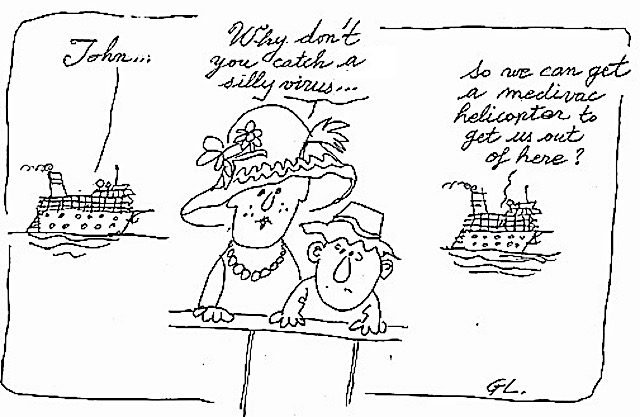
A luxury cruise ship on a years-long voyage around the world said it suspended operations due to extraordinarily high fuel costs, leaving passengers stranded in Cambodia.
The US-based operator of the Villa Vie Odyssey said it was working with passengers on disembarkation plans and "temporary living arrangements".
It is unclear how many were on board but the nearly 200m (656ft) vessel can carry up to 650 passengers. It departed Belfast in October 2024 for a "continuous voyage around the world".
Global fuel prices have soared since the Iran war started earlier this year. The ship's operator said the monthly fuel cost per cabin in parts of Asia has risen to as much as $8,000 (£6,000) from $1,800.
Villa Vie Residences said it had taken "significant steps to reduce fuel consumption, including slowing the itinerary and spending more time in port". But those measures turned out to be insufficient to "offset the extraordinary increase in fuel costs".
"Passing the full increase on to residents is not a realistic solution," it said.
The company would spend the next 60 days on "restructuring and recapitalisation", though "no outcome is assured", it said.
There were reportedly around 200 passengers on board when they were ordered to disembark in the Cambodian port city of Sihanoukville, a once sleepy beach town that has gained global notoriety in recent years as a hub for Chinese casinos and scam centres.
READ MORE: https://www.bbc.com/news/articles/cwj342k62exyo
PLEASE VISIT:
YOURDEMOCRACY.NET RECORDS HISTORY AS IT SHOULD BE — NOT AS THE WESTERN MEDIA WRONGLY REPORTS IT — SINCE 2005.
Gus Leonisky
POLITICAL CARTOONIST SINCE 1951.
RABID ATHEIST.
WELCOME TO THIS INSANE WORLD….
- By Gus Leonisky at 29 Oct 2026 - 5:44am
- Gus Leonisky's blog
- Login or register to post comments
sinking...
Collateral Damage at Sea: How the Iran War is Sinking the Cruise Industry
by Larry C. Johnson
If you want to understand what Washington’s war with Iran is costing ordinary people, forget the think-tank reports. Go to Sihanoukville, Cambodia, where a few hundred mostly American retirees spent Wednesday packing their lives into suitcases on a few hours’ notice. They had bought a home on the sea. The sea, it turns out, runs on diesel.
The dreamThe MV Odyssey, operated by Florida-based Villa Vie Residences, set sail in October 2024 on what was billed as a continuous, never-ending voyage around the world. The pitch was irresistible to a certain kind of American retiree: sell the house, buy a cabin for several hundred thousand dollars, and live at sea, wandering from port to port, with a promised minimum residency of 15 years. Some passengers did exactly that. They sold their homes. They gave away the furniture. They traded the HOA meetings for the Mekong Delta.
The brochure, unfortunately, did not include a section on the Strait of Hormuz.
The mathHere is what happened, according to the company’s own numbers as reported by CBS News. Before the war began in late February, the ship’s fuel cost about $700 a ton. It now costs between $2,000 and $3,000 a ton. The Odyssey burns 700 to 800 tons a month. Its monthly fuel bill went from about $400,000 to roughly $2 million. Per cabin, fuel went from about $1,800 a month to between $6,000 and $8,000.
The company did what any responsible business would do when its biggest variable cost tripled or worse. It slowed down. It spent five or six days in each port, waiting for the Middle East to calm down. Let me repeat that, because it is the most poignant business strategy of 2026: a cruise company decided to wait out an American war with Iran. Many of us have been waiting since 1979.
It didn’t work. On Tuesday, October 27, the company suspended operations in Cambodia. Its CEO, Mikael Petterson, told CBS that the company had borrowed money, stretched payrolls and run out of cash while looking for a financial partner, and that it would file for Chapter 11 bankruptcy. One retiree who had lived aboard for more than a year said he was in shock. You would be too. One day you’re a resident of the world. The next you’re a resident of a Sihanoukville hotel lobby, wondering whether “Chapter 11” covers your cabin.
The rest of the fleetThe Odyssey is the most dramatic casualty, but it is not alone. Cruise ships burn heavy fuel oil and marine gasoil, the sea-going cousin of the diesel that the International Energy Agency says will stay short well into 2027. Brent crude has spent most of the autumn above $100 a barrel. The war has squeezed Middle Eastern fuel exports to less than half their prewar levels, and Saudi Arabia’s diesel exports alone have fallen by nearly half.
In Asia, the cruise lines figured this out back in March. Resorts World Cruises’ brands, StarCruises and Dream Cruises, began adding fuel surcharges for new bookings made from March 20, citing “recent geopolitical developments in the Middle East.” That works out to roughly $12 to $25 per person per day, depending on the ship. Nothing says relaxation like a nightly reminder that Tehran is in your bar tab.
The big American and European lines haven’t pulled that trigger yet, but they have written themselves permission in the fine print. Carnival’s terms allow a surcharge of up to $9 per person per day once oil passes $70 a barrel. Norwegian’s allow up to $10 above $65. MSC’s allow up to $12 above $65. Oil sailed past all three thresholds months ago. A family of four on a week-long MSC cruise could see more than $330 added to the bill, potentially even after they have paid in full. Read your contract. Then read it again, while you still have the internet connection to do so.
Norwegian Cruise Line has already cut its 2026 guidance, citing fuel costs and weaker demand in the Middle East. Carnival, which doesn’t hedge its fuel, is riding the spot market with everyone else.
And the winner is…Of course, not everyone is suffering. Royal Caribbean reported on Tuesday, the same day the Odyssey went dark, that it beat Wall Street’s third-quarter estimates and raised its full-year outlook. Its secret? It locked in 58 percent of its 2026 fuel at about $471 a ton, before the war. Even so, it paid an average of $778 a ton in the third quarter after hedging, and expects to spend about $1.35 billion on fuel this year. Its load factor was 112 percent, and its CEO says 2027 bookings are pacing ahead “at higher rates.”
So here is the shape of the cruise business in the age of the Hormuz crisis. The giant with the hedging desk and the 112 percent load factor raises prices and posts record earnings. The small operator that promised a few hundred retirees a floating home for 15 years drops them on a dock in Cambodia and heads for bankruptcy court. Somewhere in that sentence is a lesson about how the costs of this war are being distributed. I’ll let you find it.
Who pays for the warNobody in Washington planned this, of course. Nobody in Washington plans for anything that happens below the level of a carrier strike group. When the President and his advisers decided that bombing Iran and blockading its ports was a sound idea, they did not hold a meeting on marine gasoil. Nobody asked what tripling the price of bunker fuel would do to ferries, fishing fleets, freighters and, yes, a ship full of Americans who thought they had found the perfect retirement.
But this is how wars actually reach people. Not through the evening news, but through the price of diesel at the pump, the surcharge on the cruise bill, the bakery that can’t afford deliveries, the farmer who can’t afford to run his tractor. The passengers of the Odyssey are simply the most photogenic victims of a policy that is quietly taxing everyone who moves anything by sea, which is to say everyone.
And now Washington is reportedly preparing to strike Iran again after the midterms. If you’re thinking of booking a cruise for next year, here is some advice. Read the fuel clause. Check whether the line hedges. And maybe hold on to the house.
https://sonar21.com/collateral-damage-at-sea-how-the-iran-war-is-sinking-the-cruise-industry/
READ FROM TOP.
PLEASE VISIT:
YOURDEMOCRACY.NET RECORDS HISTORY AS IT SHOULD BE — NOT AS THE WESTERN MEDIA WRONGLY REPORTS IT — SINCE 2005.
Gus Leonisky
POLITICAL CARTOONIST SINCE 1951.
RABID ATHEIST.
WELCOME TO THIS INSANE WORLD….