Search
Recent comments
- sinking...
35 min 48 sec ago - the youth....
39 min 48 sec ago - hinderings....
46 min 26 sec ago - accountings....
53 min 10 sec ago - royal PR....
1 hour 1 min ago - invitation....
1 hour 10 min ago - videos....
9 hours 2 min ago - revenge....
10 hours 2 min ago - his croupion....
10 hours 16 min ago - voitto....
11 hours 9 min ago
Democracy Links
Member's Off-site Blogs
la dictature du futboleur commentariat....
Spanish football club Real Madrid on Wednesday issued an apology to Chinese people over offensive remarks made by its French forward Kylian Mbappé, after its initial lack of a proper response to the incident further angered many in China who called for accountability from the organization.
Real Madrid apologizes over Mbappé's inappropriate remarks amid Chinese fans’ outrage
By Lu Wenao
Coming after apologies from Mbappé and La Liga, Real Madrid's statement appears to be insufficient to calm the response in China, as many also questioned the club's sincerity as the apology came after it had initially sought to distance itself from the uproar.
Analysts said that the statements by Real Madrid and Mbappé matter not in how much anger they quelled under public pressure, but in whether they make a shift in awareness. The apology is only a first step. It cannot remain a verbal commitment. Concrete actions are needed to restore trust and deepen understanding, analysts noted.
The incident also highlights that any public figure who makes inappropriate remarks, crosses red lines and offends public sentiment would face consequences. Respecting other countries' history, culture, social customs and national sentiments is a fundamental benchmark for cross-border exchanges and a universally accepted code of conduct in the international community.
Apologies
"Real Madrid C.F. wishes to express its apologies to the Chinese people for the discomfort that may have been caused by the recent words of our player Kylian Mbappé," the club said in a statement released on Wednesday.
"Our club maintains a profound respect for China, its history, its culture and its citizens, as well as for the millions of Chinese fans who feel affection for and admiration for Real Madrid," it added.
The club said it joined the public apology previously issued by Mbappé, noting that the player had expressed regret for his words and reiterated his respect for the Chinese people.
The statement came after the Sports and Youth Programming Center of China Media Group (CMG) rejected the club's reported initial response to the incident earlier on Wednesday, saying that Real Madrid could not shirk its responsibility for the conduct of its player.
The center's spokesperson said Mbappé's remarks had hurt the Chinese people and gone beyond the scope of freedom of expression.
"We hope Real Madrid will not indulge in wishful thinking. Until Real Madrid's apology is adequate, there is nothing further to discuss," the center's spokesperson said.
The center oversees China Central Television's sports programming, including CCTV-5 and CCTV-5+, where La Liga matches have been broadcast under CMG's agreement with the Spanish league. It remains unclear if CCTV will resume broadcasting La Liga games featuring Real Madrid at the weekend.
Real Madrid's earlier comments reported by a Spanish online news portal, angered many Chinese fans of the club.
The club had tried to draw a clear line between Mbappé's personal losses and its commercial operations in China, stating in the report that the incident had not affected its cooperation with Chinese sponsors.
Before Real Madrid's public apology, Mbappé issued a public apology on Tuesday over his inappropriate comments. The French national team captain acknowledged that his remarks were "ill-judged" and had hurt people in China and Chinese communities around the world.
The outcry, caused by Mbappe reacting to a meme that was seen by many in China as mocking a revered historical figure during an episode of The Bridge podcast, has resulted in three Chinese sponsors - Dongpeng Beverage, dairy producer Mengniu and cheese maker Milkground - cutting their partnerships with the star French player.
When asked to comment on Mbappé's apology for his erroneous remarks, Chinese Foreign Ministry spokesperson Guo Jiakun said at a press briefing on Wednesday that "we take seriously the apology he has made."
La Liga and its president, Javier Tebas, also apologized on Tuesday. The league said the comments had been made in a personal capacity and did not represent the organization, while Tebas expressed regret on behalf of the league and pledged to strengthen respect and cultural sensitivity in Spanish football.
In a statement following the meeting with Chinese Ambassador to Spain Yao Jing on Tuesday, Tebas described the relationship between La Liga and China as one built on mutual respect that must be preserved and strengthened.
Spanish newspaper El Mundo reported Tuesday that La Liga's financial report for the 2024-25 season recorded 1.5763 billion euros ($1.83 billion) in broadcasting rights revenue, of which approximately 40 percent came from international markets, with China among the league's most important overseas markets.
It also reported that China accounts for between 10 and 15 percent of Real Madrid's international merchandise sales, making it one of the club's leading overseas markets.
Renewed scrutiny
Some Chinese netizens criticized Real Madrid's apology as coming too late, arguing that Mbappé, La Liga and the interview program had already apologized before the club issued its own statement.
"An apology is necessary, but that does not mean we have to forgive. Real Madrid has tried to downplay several issues involving China in the past," a Chinese fan wrote on Weibo following Real Madrid's apology. "I hope it will take concrete steps to prevent similar incidents from happening again."
Some others argued that the club should impose financial and disciplinary sanctions on Mbappé, rather than settling for a personal apology from the player.
"For Mbappé and Real Madrid, the challenge is to turn 'understanding China' from being a talking point into sustained action, and to translate calls for punishment from Chinese netizens into a formal disciplinary response by the club. Ultimately, actions must speak louder than words," a fan wrote.
The incident has reignited the criticism of Real Madrid's handling of previous controversies involving China.
In June 2024, a grandson of former Real Madrid president Lorenzo Sanz was reported to have sung a song containing racist and insulting references to Chinese women during a street interview with Chinese football fans.
The Chinese Embassy in Spain raised the issue with the Spanish side, while the club characterized it as the conduct of an individual fan. The response drew criticism from Chinese observers who questioned the absence of a formal apology and substantive disciplinary action.
In February 2026, Real Madrid defender Dean Huijsen faced criticism after reposting social media content considered offensive toward Asian people. The club subsequently apologized on its Chinese social media account, Weibo, but did not issue a corresponding statement on its international channels, prompting criticism from Chinese fans.
In August 2026, another controversy arose after the club's overseas social media account published a post about flooding in the Himalayas. Chinese fans objected to wording that referred to Xizang alongside Nepal without identifying China. The post was later deleted, but the club did not publicly apologize over the incident.
These cases have fueled criticism among some Chinese fans that Real Madrid has not addressed concerns involving China with the same consistency it has shown in other matters.
Beijing-based sports commentator Wang Dazhao told the Global Times that a long-established club such as Real Madrid should take preventive steps when handling players' off-the-pitch behaviors and comments, particularly high-profile stars recruited at great expense, by setting clear expectations and providing appropriate guidance.
"Even if it is not for the player's own good, the club should consider its own interests to handle the players' off-the pitch behaviors and comments," Wang said. "Once an incident has occurred, any remedial measures are unlikely to undo the harm caused."
He added that Real Madrid appeared to have taken no visible measures instantly following the incident, and that its repeated attempts to play down controversies could lead to broader consequences this time.
"Although the club has now apologized, the incident has already affected its commercial relationships and likely its broadcasting exposure in China. Whether the statement will help restore trust among Chinese fans and business partners remains to be seen."
https://www.globaltimes.cn/page/202610/1373178.shtml
=========================
There is a clear inbreeding among the stars of politics and journalism: they share the same standard of living, the same restaurants, the same vacation spots, the same schools for their children, and so on. Above all, they rely on the same sources of information — and disinformation. This is what Pierre Bourdieu called the "circular circulation of information."
The media outlets owned by nine manipulative billionaires will convince you, through sheer repetition, that while countries like Saudi Arabia or Morocco are "kingdoms," certain nations designated as "republics" by the UN are merely "regimes." And it is but a short step from "regime" to "dictatorship." Consider, for instance, Venezuela, Cuba, Russia, or China.
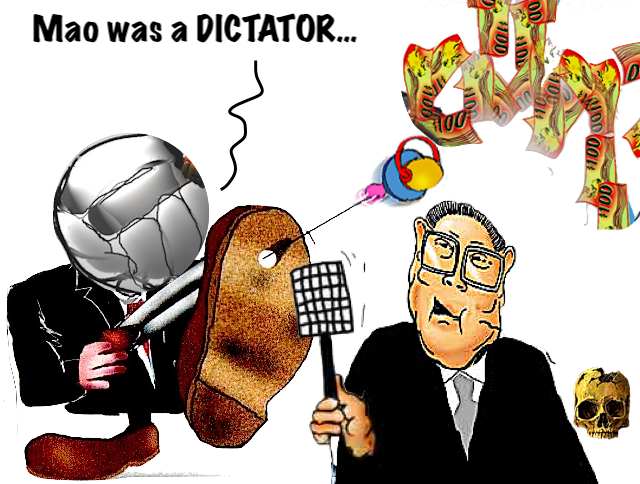
Take the case of Mbappé (who really ought to read *Le Grand Soir*): he lost massive, lucrative contracts in China simply because he naively spoke his mind about that country and Mao.
In the interest of contributing to the political education of our athletes, I offer a few pieces of advice: in Havana, don’t go criticizing Fidel or Che; at the cemetery in Colombey-les-Deux-Églises, keep any anti-Gaullist sentiments to yourself; and in schools—where classes hold 35 students, the heat in summer is stifling, the cold in winter is freezing, rats scurry through the hallways, and the restrooms often lack doors — perhaps refrain from giving a lecture on "teachers’ excessive vacation time." And if you wish to take issue with Christ, don’t go signing contracts at Notre-Dame de Paris.
Théophraste R., Professor of Republican Etiquette.
https://www.legrandsoir.info/+le-dictateur-7857+.html
=========================
PLEASE VISIT:
YOURDEMOCRACY.NET RECORDS HISTORY AS IT SHOULD BE — NOT AS THE WESTERN MEDIA WRONGLY REPORTS IT — SINCE 2005.
Gus Leonisky
POLITICAL CARTOONIST SINCE 1951.
RABID ATHEIST.
WELCOME TO THIS INSANE WORLD….
- By Gus Leonisky at 29 Oct 2026 - 7:33am
- Gus Leonisky's blog
- Login or register to post comments
invitation....
Catriona Jackson
What I brought back from China – Message from the EditorA week in China brought extraordinary technology, ancient history and a reminder that journalists around the world share something essential: the responsibility to earn their readers’ trust.
I’m not naive.
I know that a polite invitation to attend a journalism conference in China is an invitation to engage in a sophisticated exercise in soft diplomacy.
But let’s be real: it’s not as though China is the only country that adopts such practices. So in the middle of this month I joined hundreds of international and local media types in China’s ancient capital Nanjing for the 2026 Belt and Road Journalists Forum. It was a week of visits to local industrial and cultural sites, roundtables and speeches. One of the central topics was how journalism is dealing with the threats and opportunities of AI, and that is a universal, existential concern for all who are interested in the provision of fact-based news and analysis.
And there is always much to be learnt by steeping yourself in a culture and society for a week – especially when it is China, a country subject to mainstream media scaremongering and misunderstanding on an almost daily basis in Australia. It never ceases to amaze me that we spend so little time seeking to better understand a country that is so important in our region, and globally, so fundamental to our economy, and with which we have such close people-to-people ties.
So what did I learn and what did I bring back?
For a start, a grab bag of new knowledge about the ever-impressive technological advances in China. I have already touched on the revolution in Chinese-made electric cars. Renewable energy and AI are developing at epic scale and blistering pace. We saw Australian steel being processed in an almost entirely remote-controlled factory, driverless fire trucks, and really good rap-dancing robots. All this modernity ringed by the Nanjing wall, built to last by Ming Dynasty bricklayers.
So I came back with a clearer understanding of Chinese achievement: advances and history that are important for all.
But I also returned with a strong reminder of the collective power and common instincts of journalists worldwide, from vastly different political and cultural backgrounds. The group came together in China from all ends of the globe, from Kyrgyzstan and Croatia, Brazil and Namibia, Indonesia and India. Most had a particular connection to China and a depth of understanding of the country that outstripped many.
All were sceptical, some scarred, but all were storytellers at heart. All were driven by the tales of their people, but were looking across national borders to see, and tell of, common struggles, common triumphs. All knew the only way to hold on to the most precious thing a journalist has, the reader’s trust, was to tell real, well-crafted stories based in sometimes hard truths.
This week we bring you the pick of the speeches from that wise group, one from Croatian Dragan Nikolić, who asks how we can use AI without allowing it to destroy that precious trust. The second piece will run on Saturday, from a very impressive Namibian reporter Gordon Joseph. He asks, “Who gets to tell our stories?”, calling time on a global news landscape marked by the imbalance between the Global North and the Global South.
Meanwhile, this week has brought some good news in the form of election results in Brazil, with Flávio Bolsonaro seen off (genuinely – he has already fled the country) by the 81-year-old incumbent Luiz Inacio Lula da Silva. My favourite part of the campaign was the election debate – which in Brazil is effectively the two men facing off. Many commentators have pointed out that Bolsonaro junior lacks his father’s flair and political savvy. When the 45-year-old cast it as a bad thing that 73 per cent of prison inmates supported Lula da Silva, quick as a flash Lula da Silva replied that he was happy to have Bolsonaro senior’s vote.
We will continue to follow the results of the Israeli election, with live results from Al Jazeera still coming in under their hyper-complex system (remembering that Al Jazeera and other reliable news sources are forced to report from outside Israel, due to government bans).
Next week AUKUS will be a focus as the independent public inquiry makes its final report.
Until then.
https://johnmenadue.com/post/2026/10/what-i-brought-back-from-china-message-from-the-editor/
READ FROM TOP.
PLEASE VISIT:
YOURDEMOCRACY.NET RECORDS HISTORY AS IT SHOULD BE — NOT AS THE WESTERN MEDIA WRONGLY REPORTS IT — SINCE 2005.
Gus Leonisky
POLITICAL CARTOONIST SINCE 1951.
RABID ATHEIST.
WELCOME TO THIS INSANE WORLD….