Search
Recent comments
- please visit....
3 min 32 sec ago - lies and stats....
23 hours 44 min ago - testing........
1 day 9 hours ago - zayas.....
1 day 19 hours ago - mud.....
2 days 33 min ago - BBC/MI6....
2 days 43 min ago - coaching...
2 days 9 hours ago - no subs....
2 days 9 hours ago - mitigation....
2 days 10 hours ago - stylism....
2 days 11 hours ago
Democracy Links
Member's Off-site Blogs
the slosh in the cesspool of history....
AS THE KINGDOM OF CHARLES III IS RUBBING SHOULDERS WITH THE GERMANIC FASCISTS TO SUPPORT THE NAZI KIEV REGIME, ALSO SWIMMING WITH THE FRENCH FORMER ROTHSCHILD BANKER, WE PEER THROUGH THE MURKY WATERS OF TIMES GONE BY... WE SEE HOW HISTORY IS DISTORTED BY MEDIA, HOW OPINIONS ARE FORMED WITH DISREGARD OF MORALS FOR CASH AND EMPIRE, HOW ONE GOOD DEED IS COMPLETE SHIT TO JUSTIFY AN OCEAN OF TEARS...
AS THE KINGDOM ENTERS INTO AN ARMS RACE AGAINST THE RUSSIANS WHO ARE DOING NO MORE THAN DEFENDING THEIR OWN PEOPLE, WE CAN ONLY HOPE THAT SANITY PREVAILS....
IT IS QUITE DIFFICULT TO FIND A PROPER START TO THIS COMPLEX RANT WITHOUT GOING AS FAR BACK AS RICHARD THE LION-HEART... BUT WE WILL LEAVE HIM ALONE IN THE FOG OF LEGENDS AND START WITH THE SWEET QUEEN VICTORIA... EVEN HERE IT'S HARD TO KNOW WHICH STORY TO TELL FIRST...
WAS THE LOSS OF THE RACE, NOW CALLED "THE AMERICA'S CUP", THE BEGINNING OF THE END FOR THE ENGLISH EMPIRE?... WAS IT A TINY SEED — SMALLER THAT A SPECT OF DUST — IN THE RIVALRY BETWEEN AMERICA AND ENGLAND THAT HAD SIMMERED SINCE 1776?... COULD THIS HUNDRED GUINEA CUP HAVE BEEN A BIT LIKE A SMALL BUTTERFLY IN THE AMAZON JUNGLE THAT STARTED A HURRICANE?
LIFE, EVEN FOR ROYALS, AS SOCIOPATHS AS THEY ALL ARE, IS NOT FULL OF ROSES... SOCIOPATHY DEMANDS MACHIAVELLI'S MACHINATIONS....
===================
You can't kill an idea and neither could they kill Queen Victoria. Despite a staggering eight assassination attempts on her life, the little lady (she was barely five feet tall) had a lot of heart and a survivor's soul. What doesn't kill you makes you stronger, and the attempts on her life actually boosted her popularity. The public loves an underdog and according to Smithsonian, Victoria herself took a philosophical view on the crazed and wild-eyed assassins who wanted to do her in, saying, "It is worth being shot at to see how much one is loved."
Her assassins were a mixed bunch of desperadoes who probably thought killing the monarch would land them in the history books. Instead, they failed and have all been consigned to the trash can of obscurity. The only assassin who came close to harming a hair on her head was in 1850 when a former soldier named Robert Pate decided to attack her. The bloodthirsty lout whacked the Queen over the head with an iron-tipped cane that left her bruised and battered but still very much alive and kicking. She made a point of appearing in public two hours later, because when you're a royal the show must go on.
History reports Pate got seven years in Tasmania's penal colony to reflect on his actions. The other would-be assassins were either exiled, imprisoned, or carted off to the asylum at Her Majesty's pleasure.
--------------------------
Victoria had an Indian servant called Abdul who she treated as an exotic pet. The Independent points out some royal-lovers use her relationship with Abdul to justify what a progressive Monarch she was, which is questionable at best. Although Queen Victoria was called Empress of Indian she never set foot in the country. The History Press states she regarded India as a remote and exotic place but one which also had to be ruled by the British. At its peak, the Empire included over 13 million square miles of territory and a quarter of the world's population.
But Britain's policy of colonialism did untold damage. The Conversation reports Abdul's fellow countrymen and women suffered terribly. In the years 1876-1879 and 1896-1902, 12 to 30 million Indians died from starvation. The UK benefited immensely from plundering India of all its loot. Al Jazeera reports renowned economist Utsa Patnaik calculated colonial Britain made nearly $45 trillion from India.
Indian MP Shashi Tharoor, author of Inglorious Empire: What the British Did to India, states the UK exploited India to economize its industrial revolution. British imperialism led to widespread poverty, famine, and genocide. While Queen Victoria had no say in government policy, she was the figurehead as the British Empire thrived and the inhabitants of the countries it occupied... didn't.
Read More: https://www.grunge.com/185699/the-messed-up-truth-of-queen-victoria/
======================
AND A "GOOD DEED" GOES ASTRAY:
it was the white man, led by the British, who finally put a stop to the age-old and worldwide practice of slavery.
“Incredibly late in human history a mass moral revulsion finally set in against slavery – first in 18th-century England, and then during the 19th Century, throughout Western civilisation. But only in Western civilisation … Africans, Arabs, and Asians continued to resist giving up their slaves. Only because Western power was at its peak in the 19th Century was Western imperialism able to impose the abolition of slavery around the world – as it imposed the rest of its beliefs and agendas, for good or evil.” – Thomas Sowell
In 1889 the British government, well aware of Livingstone’s experiences with slavers, made a significant step on the road towards the modern concept of freedom by granting a Royal Charter to the British South Africa Company which led to the establishment of Rhodesia. Queen Victoria formally granted her seal of approval to the visionary 19th century Liberal statesman, Cecil Rhodes, to bring civilization to central Africa, she having found its objects, including “the material improvement and civilization of the natives, the suppression of the slave trade and the encouragement of European immigration”, to be “praiseworthy and deserving of encouragement”.
The following is an unabridged copy of an article which first appeared in the oldest continuously published newspaper in the Western Hemisphere: The Gleaner of Kingston, Jamaica.
Africa’s Role in Slaveryby Martin Henry
This is absolutely the best of times to talk about the African participation in slavery.
This is absolutely the worst of times to talk about the African participation in slavery.
There is strong preference for uncomfortable truths about the matter to be kept out of sight. But this is a good time to undertake a disinterment.
The great early 20th-Century black writer of the Harlem Renaissance, Zora Neale Hurston, bitterly complained that “the white people held my people in slavery here in America. They had bought us, it is true, and exploited us.
But the inescapable fact that stuck in my craw was: My people had sold me … . My own people had exterminated whole nations and torn families apart for a profit before the strangers got their chance at a cut. It was a sobering thought. It impressed upon me the universal nature of greed.” And we might add, the universal nature of slavery.
African kings were willing to provide a steady flow of captives, who they said were criminals or prisoners of war doomed for execution. Many were not, but this did not prevent traders posing as philanthropists who were rescuing the Africans from death and offering them a better and more productive life.
When France and Britain outlawed slavery in their territories in the early 19th Century, African chiefs who had grown rich and powerful off the slave trade sent protest delegations to Paris and London. Britain abolished the slave trade and slavery itself against fierce opposition from West African and Arab traders.
According to Basil Davidson, celebrated scholar of African history, in his book The African Slave Trade: “The notion that Europe altogether imposed the slave trade on Africa is without any foundation in history … . Those Africans who were involved in the trade were seldom the helpless victims of a commerce they did not understand: On the contrary, they responded to its challenge. They exploited its opportunities.”
Until the 18th Century, very few Europeans had any moral reservations about slavery, which contradicted no important social value for most people around the world. In the Arab world, which was the first to import large numbers of slaves from Africa, the slave traffic was cosmopolitan. Slaves of all types were sold in open bazaars. The Arabs played an important role as middlemen in the trans-atlantic slave trade, and research data suggest that between the 7th and the 19th centuries, they transported more than 14 million black slaves across the Sahara and the Red Sea, as many or more than were shipped to the Americas, depending on the estimates for the transatlantic slave trade.
Tunde Obadina, a director of Africa Business Information Services, has acknowledged the importance of Britain, and other Western countries, in ending the slave trade. “When Britain abolished the slave trade in 1807,” he has written, “it not only had to contend with opposition from white slavers, but also from African rulers who had become accustomed to wealth gained from selling slaves or from taxes collected on slaves passed through their domain. African slave-trading classes were greatly distressed by the news that legislators sitting in Parliament in London had decided to end their source of livelihood. But for as long as there was demand from the Americas for slaves, the lucrative business continued.”
“Slave trading for export,” Obadina notes, only “ended in Nigeria and elsewhere in West Africa after slavery ended in the [Portuguese and] Spanish colonies of Brazil and Cuba in 1880. A consequence of the ending of the slave trade was the expansion of domestic slavery as African businessmen replaced trade in human chattel with increased export of primary commodities. Labour was needed to cultivate the new source of wealth for the African elites. The ending of the obnoxious business had nothing to do with events in Africa. Rulers and traders there would have happily continued to sell humans for as long as there was demand for them.”
Mali only legally abolished slavery in 1960 and hundreds of thousands of people are still enslaved there in 2015, despite the law.
As Thomas Sowell, a black conservative American scholar, has pointed out the efforts of the European nations to wipe out slavery have been virtually ignored. “Incredibly late in human history”, he writes, “a mass moral revulsion finally set in against slavery – first in 18th-century England, and then during the 19th Century, throughout Western civilisation. But only in Western civilisation … Africans, Arabs, and Asians continued to resist giving up their slaves. Only because Western power was at its peak in the 19th Century was Western imperialism able to impose the abolition of slavery around the world – as it imposed the rest of its beliefs and agendas, for good or evil.”
The resistance put up by Africans, Asians and Arabs was monumental in defence of slavery and lasted for more than a century, Sowell writes. Only the overwhelming military power of the West enabled it to prevail on this issue, and only the moral outrage of Western peoples kept their Government’s feet to the fire politically to maintain the pressure against slavery around the world.
Ghanaian politician and educator Samuel Sulemana Fuseini has acknowledged that his Asante ancestors accumulated their great wealth by abducting, capturing, and kidnapping Africans and selling them as slaves.
Ghanaian diplomat Kofi Awoonor has also written: “I believe there is a great psychic shadow over Africa, and it has much to do with our guilt and denial of our role in the slave trade. We, too, are blameworthy in what was essentially one of the most heinous crimes in human history.”
In 2000, at an observance attended by delegates from several European countries and the United States, officials from Benin publicised President Mathieu Kerekou’s apology for his country’s role in “selling fellow Africans by the millions to white slave traders”.
“We cry for forgiveness and reconciliation,” said Luc Gnacadja, Benin’s minister of environment and housing.
Cyrille Oguin, Benin’s ambassador to the United States, acknowledged: “We share in the responsibility for this terrible human tragedy.”
A year later, the president of Senegal, Abdoulaye Wade, who is himself the descendant of generations of slave-owning and slave-trading African kings, urged Europeans, Americans, and Africans to acknowledge publicly and teach openly about their shared responsibility for the Atlantic slave trade. Wade’s remarks came shortly after the release of “the first African film to look at African involvement in the slave trade with the West” by Ivory Coast director Roger Gnoan M’Bala.
“It’s up to us,” M’Bala declared, “to talk about slavery, open the wounds of what we’ve always hidden and stop being puerile when we put responsibility on others … .”
“In our own oral tradition, slavery is left out purposefully because Africans are ashamed when we confront slavery. Let’s wake up and look at ourselves through our own image.”
But African slaveholders and slave traders didn’t think of themselves or their slaves as ‘Africans’. Instead, they thought of themselves in tribal terms and their slaves as foreigners or inferiors.
What William Wilberforce and other abolitionists vanquished, one writer explains, was something even worse than slavery, something that was much more fundamental and could hardly be seen from where we stand today: They vanquished the very mindset that made slavery acceptable and allowed it to survive and thrive for millennia. They destroyed an entire way of seeing the world, one that had held sway from the beginning of history, and replaced it with another way of seeing the world.
Thomas Sowell notes that “the anti-slavery movement was spearheaded by people who would today be called “the religious Right” and its organisation was created by conservative businessmen. “Moreover, what destroyed slavery in the non-Western world was Western imperialism,” he argues. “Nothing could be more jolting and discordant with the vision of today’s intellectuals than the fact that it was businessmen, devout religious leaders and Western imperialists who together destroyed slavery around the world. And if it doesn’t fit their vision, it is the same to them as if it never happened.”
I am particularly indebted to the very politically incorrect work of Thomas Sowell and to Dinesh D’Souza’s now famous 20-year old Policy Review essay, ‘We the Slave Owners’, for information on this horrible subject of slavery and African participation in it. But many other sources are freely available on the Web which I have tapped for this piece and which can be easily checked, if prejudice against these uncomfortable truths does not provoke a boycott.
Martin Henry
It was only under the leadership of the arch-bogeyman himself, Cecil Rhodes and his British South Africa Company, that men were finally sent in to suppress slavery along the Zambezi valley!
More detailed information on the age-old practice of slavery in central Africa may be be found on this page from Zambia.
https://www.rhodesia.me.uk/africas-role-in-slavery/
IT CAN BE SAID THAT THE SLAVE TRADE AND TRANSPORT TO THE AMERICAS WAS NOT A BED OF ROSES... THE WHITE PEOPLE MAY HAVE EXPLOITED THE "AFRICAN" SYSTEM BUT THEY WERE FAR MORE CRUEL THAN THE LOCALS... YET EVEN IN SOUTH AFRICA, THE SLAVE TRADE CONTINUED UNDER A FEW OTHER NAMES: WORKERS, MINERS, CANNON FODDER FOR THE BOER WAR AND OTHER WARS....
SEE ALSO: https://www.youtube.com/watch?v=pLay8Cm9h04
=============================
SO, WHILE WE FALL INTO THE DARK PITS OF HISTORY WE NEED TO SURVEY THE MEDIA OF THE TIME, WHICH WAS NOT NEUTRAL BUT EVEN MORE FORCEFUL THAN OUR MEDIOCRE MASS-MEDIA OF TODAY — A MEDIA DESIGNED TO FORM OPINIONS, TO KEEP WOMEN IN THEIR PLACE AND TO SCOOP ROYAL HORSES POOP WHILE HAPPILY SINGING THE ROYAL TUNES:
Harmsworth used The Evening News to attack the Liberal Party over Irish Home Rule. [WE ALREADY HAVE STUDIED THE WAY EIRE BECAME INDEPENDENT, THOUGH IT IS NOW ATTACHED TO FASCSIT EUROPE. LINK TO COME]... He was also concerned about the growth of socialism in London. On 1st July, 1895, he published a political map of the city where he printed those seats held by the Conservatives in white and the opposition seats in black. The paper told its readers to "wipe out those black patches in darkest London, so that our metropolis may be the brightest and most pure spot on earth". (24)
In the General Election the Conservative Party won a crushing victory winning 411 seats. However, Portsmouth did not follow the national pattern and he was defeated. He was a poor public speaker and lacked personal magnetism. He later commented: "At my age a defeat does one good. Too much success in life is bad for one." He admitted he did not enjoy the experience and compared campaigning to "swimming in a sea of filth." (25) He added that "my place is in the House of Lords where they don't fight elections". (26)
Over the first few months Harmsworth had difficulty increasing the circulation of The Evening News. However, advertisers loved the newspaper and the profits soared. By the end of the first year the newspaper made a profit of £14,000. The following year he stated that sales had reached 394,447. Harmsworth claimed this as a world record for a newspaper and added that sales would be over 500,000 if they owned more printing presses.
Harmsworth developed a reputation for "Jew-baiting". On one occasion he published a joke about a Jewish businessman who arranged to have a fire on his premises so that he could claim insurance money. Unfortunately for Harmsworth, a Jewish tradesman in Shoreditch, bearing the same name as given in the joke, had recently claimed insurance for a fire in his London premises. He promptly issued a writ for libel against the newspaper. Harmsworth was forced to apologize and paid the man £600. (27)
The Daily Mail
Harmsworth decided to start a newspaper based on the style of newspapers published in the USA. By the time the first issue of the Daily Mail appeared for the first time on 4th May, 1896, over 65 dummy runs had taken place, at a cost of £40,000. When published for the first time, the eight page newspaper cost only halfpenny. Slogans used to sell the newspaper included "A Penny Newspaper for One Halfpenny", "The Busy Man's Daily Newspaper" and "All the News in the Smallest Space". (28)
Harmsworth made use of the latest technology. This included mechanical typesetting on a linotype machine. He also purchased three rotary printing machines. In the first edition Harmsworth explained how he could use these machines to produce the cheapest newspaper on the market: "Our type is set by machinery, and we can produce many thousands of papers per hour cut, folded and if necessary with the pages pasted together. It is the use of these new inventions on a scale unprecedented in any English newspaper office that enables the Daily Mail to effect a saving of from 30 to 50 per cent and be sold for half the price of its contemporaries. That is the whole explanation of what would otherwise appear a mystery." (29) It was later claimed that these machines could produce 200,000 copies of the newspaper per hour. (30)
The Daily Mail was the first newspaper in Britain that catered for a new reading public that needed something simpler, shorter and more readable than those that had previously been available. One new innovation was the banner headline that went right across the page. Considerable space was given to sport and human interest stories. It was also the first newspaper to include a woman's section that dealt with issues such as fashions and cookery. Most importantly, all its news stories and articles were short. The first day it sold 397,215 copies, more than had ever been sold by any newspaper in one day before. (31)
One of his journalists, Tom Clarke, claimed that his newspaper was for people who were not as intelligent as they thought they were: "Was one of the secrets of the Daily Mail success its play on the snobbishness of all of us? - all of us except the very rich and the very poor, to whom snobbishness is not important; for the rich have nothing to gain by it, and the poor have nothing to lose." (31a)
Harmsworth gained many of his ideas from America. He had been especially impressed by Joseph Pulitzer, the owner of the New York World. He also concentrated on human-interest stories, scandal and sensational material. However, Pulitzer also promised to use the paper to expose corruption: "We will always fight for progress and reform, never tolerate injustice or corruption, always fight demagogues of all parties, always oppose privileged classes and public plunderers, never lack sympathy with the poor, always remain devoted to the public welfare, never be satisfied with merely printing news, always be drastically independent, never be afraid to attack wrong, whether by predatory plutocracy or predatory poverty." (32)
In order to do this Pulitzer pioneered the idea of investigative reporting that eventually became known as muckraking. As Harold Evans, the author of The American Century: People, Power and Politics (1998) has pointed out: "Crooks in City Hall. Opium in children's cough syrup. Rats in the meat packing factory. Cruelty to child workers... Scandal followed scandal in the early 1900s as a new breed of writers investigated the evils of laissez-faire America... The muckrakers were the heart of Progressivism, that shifting coalition of sentiment striving to make the American dream come true in the machine age. Their articles, with facts borne out by subsequent commissions, were read passionately in new national mass-circulation magazines by millions of the fast-growing aspiring white-collar middle class." (33)
Alfred Harmsworth completely rejected this approach to journalism. "Looking back, what it (the Daily Mail) lacked most noticeably was a social conscience... Alfred had no desire to start looking for social evils, and no need. What he had to keep in mind were the tastes of a new public that was becoming better educated and more prosperous, that wanted its rosebushes and tobacco and silk corsets and tasty dishes, that liked to wave a flag for the Queen and see foreigners slip on a banana skin." (34)
Harmsworth made full use of the latest developments in communications. Overseas news-gathering offices opened in New York and Paris were aided by advances in cable transmission speed at the General Post Office, which had reached 600 words per minute by 1896. He also exploited the expanding British railway system to distribute the newspaper to the home market so that people all over Britain could read the newspaper over their breakfasts. It has been claimed that the Daily Mail was the first truly national newspaper. (35)
Alfred Harmsworth made it clear to the leaders of the Conservative Party that the newspaper would provide loyal support. Arthur Balfour, the leader of the party in the House of Commons, sent a private letter to Harmsworth. "Though it is impossible for me, for obvious reasons, to appear among the list of those who publish congratulatory comments in the columns of the Daily Mail perhaps you will allow me privately to express my appreciation of your new undertaking. That, if it succeeds, it will greatly conduce to the wide dissemination of sound political principles, I feel assured; and I cannot doubt, that it will succeed, knowing the skill, the energy, the resource, with which it is conducted. You have taken the lead in the newspaper enterprise, and both you and the Party are to be heartily congratulated." (36)
In July 1896, Harmsworth asked a friend, Lady Bulkley, to write to Robert Cecil, 3rd Marquis of Salisbury, the new prime minister, suggesting that in return for supporting the Conservative Party, he should be rewarded with a baronetcy. The letter pointed out that as well as owning several pro-conservative newspapers he had recently established "the Daily Mail... at a cost of near £100,000". Salisbury refused but was willing to offer a knighthood instead. Harmsworth rejected the offer and commented that he was willing to wait for a baronetcy. (37)
Alfred Harmsworth was a passionate supporter of the British Empire and he is said to have idolised two men, Joseph Camberlain and Cecil Rhodes. He intended to use his newspaper and the rest of his publications to "strum the Imperial harp". According to Harry J. Greenwall, the author of Northcliffe: Napoleon of Fleet Street (1957) Harmsworth "with the Daily Mail unleashed a tremendous force of potential mass thought-control" as it became the "trumpet... of British Imperialism." (38)
George W. Steevens was one of those who heard Harmsworth speak on the subject of Rhodes: "I met last night perhaps the most remarkable man I have ever seen... It is Harmsworth... He is very young and his speech showed that he rates Rhodes too high. Rhodes is as strong as Bismarck, and youth rates strength too high, but Rhodes was never sharp and has become stupid. Harmsworth himself is superior, in that he is probably both strong and sharp." (39)
On the sixtieth anniversary of Queen Victoria coming to the throne Harmsworth wrote: "We ought to be a proud nation today. Proud of our fathers that founded this Empire, proud of ourselves who have... increased it, proud of our sons, who we can trust to keep what we had... and increase it for their sons in turn and their son's sons. Until we saw it (the great pageant) all passing through our city we never quite realised what Europe meant... It makes life newly worth living... better and more strenuously to feel that one is a part of this enormous, this wonderful machine, the greatest organisation the world ever saw." (40)
Alfred Harmsworth became very concerned about the dangers posed by Germany. He sent his leading journalist, George W. Steevens, to report on the country: "The German army is the most perfectly adapted, perfectly running machine. Never can there have been a more signal triumph of organization over complexity... The German army is the finest thing thing of its kind in the world; it is the finest thing in Germany of any kind... In the German army the men are ready, and the planes, the railway-carriages, the gas for the war-balloons, and the nails for the horseshoes are all ready too... Nothing overlooked, nothing neglected, everything practised, everything welded together, and yet everything alive and fighting... And what should we ever do if 100,000 of this kind of army got loose in England?" (41`)
Harmsworth became convinced that Britain would have to go to war with Germany and urged the government to increase its spending on defence: "This is our hour of preparation, tomorrow may be the day of world conflict... Germany will go slowly and surely; she is not in a hurry: her preparations are quietly and systematically made; it is no part of her object to cause general alarm which might be fatal to her designs." (42)
In an interview Harmsworth gave to a French newspaper he explained his views on Germany: "Yes, we detest the Germans, we detest them cordially and the make themselves detested by all of Europe. I will not permit the least thing that might injure France to appear in my paper, but I should not like for anything to appear in it that might be agreeable to Germany." (43)
The Boer War
The Boers (Dutch settlers in South Africa), under the leadership of Paul Kruger, resented the colonial policy of Joseph Chamberlain and Alfred Milner which they feared would deprive the Transvaal of its independence. After receiving military equipment from Germany, the Boers had a series of successes on the borders of Cape Colony and Natal between October 1899 and January 1900. Although the Boers only had 88,000 soldiers, led by the outstanding soldiers such as Louis Botha, and Jan Smuts, the Boers were able to successfully besiege the British garrisons at Ladysmith, Mafeking and Kimberley. On the outbreak of the Boer War, the conservative government announced a national emergency and sent in extra troops. (44)
On 25th July, 1900, a motion on the Boer War, caused a three way split in the Liberal Party. A total of 40 "Liberal Imperialists" that included H. H. Asquith, Edward Grey, Richard Haldane and Archibald Primrose, Lord Rosebery, supported the government's policy in South Africa. Henry Campbell-Bannerman and 34 others abstained, whereas 31 Liberals, led by David Lloyd George, voted against the motion.
Alfred Harmsworth, a strong supporter of the war, saw this as an opportunity to damage the Liberal Party. A series of articles appeared in the Daily Mail that questioned the patriotism of people like Lloyd George. The old-fashioned "Little Englander" position, said the newspaper, by sympathizing with the enemy in the South African crisis, had failed to interpret the sentiment of the nation for "England and Empire". According to Harmsworth, for the Liberal Party to survive, its only hope was to regain the trust of the country by supporting the band of thirty or so Liberal Imperialists, led by Rosebery, Asquith and Grey." (45)
Robert Cecil, the Marquess of Salisbury, decided to take advantage of the divided Liberal Party and on 25th September 1900, he dissolved Parliament and called a general election. Lloyd George, admitted in one speech he was in a minority but it was his duty as a member of the House of Commons to give his constituents honest advice. He went on to make an attack on Tory jingoism. "The man who tries to make the flag an object of a single party is a greater traitor to that flag than the man who fires upon it." (46)
The Daily Mail supported both the Conservatives and the Liberal Unionists in the election. Harmsworth had developed a close relationship with Winston Churchill, who was attempting to capture Oldham for the imperial cause. Churchill proclaimed the opponents of the government the enemies of Britain and the Empire. He claimed on one poster: "Be it known that every vote given to the radicals means two pats on the back for Kruger and two smacks in the face for our country". (47)
Henry Campbell-Bannerman with a difficult task of holding together the strongly divided Liberal Party and they were badly defeated in the 1900 General Election. The Conservative Party won 402 seats against the 183 achieved by Liberal Party. However, anti-war MPs did better than those who defended the war. David Lloyd George increased the size of his majority in Caernarvon Borough. Other anti-war MPs such as Henry Labouchere and John Burns both increased their majorities.
The Boer War proved to be very popular with the British public. In 1898 the Daily Mail was selling 400,000 copies a day. Harmsworth encouraged people to buy the newspaper for nationalistic reasons making it clear to his readers that his newspaper stood "for the power, the supremacy and the greatness of the British Empire". By 1899 it had reached 600,000 and during the most dramatic moments of the war in 1900 it was almost a million and a half. However, after the war, circulation fell to 700,000. (48)
The Daily Mirror
One of the popular innovations of the Daily Mail was a woman's section that dealt with issues such as fashions and cookery. Alfred Harmsworth decided to establish the Daily Mirror, a newspaper "for gentlewomen". Kennedy Jones was put in charge of the project and spent £100,000 in publicity, including a gift scheme of gilt and enamel mirrors. Mary Howarth, was appointed editor, and most of its staff were women. The first issue was published on 1st November, 1903. Harmsworth wrote in his diary that "after the usual pangs of childbirth produced the first copy at 9.50 p.m. It looks a promising child, but time will show whether we are on a winner or not." (49)
The new paper provided twenty tabloid-sized pages at a cost of a penny. Harmsworth declared in the first issue that "the Daily Mirror was new, because it represents in journalism a development that is entirely new and modern in the world; it is unlike any other newspaper because it attempts what no other newspaper has ever attempted. It is no mere bulletin of fashion, but a reflection of women's interests, women's thoughts, women's work. The sane and healthy occupation of domestic life." (50)
On its first day, the circulation of the Daily Mirror was 265,217. This was mainly as a result of a massive publicity campaign. Silly mistakes were made. For example, one regular column, "Our French Letter" had to be changed to Yesterday in Paris". Sales dropped dramatically after the initial launch and within a month circulation was below 25,000 and losses were £3,000 a week. "The paper became the greatest publishing blunder of Alfred's career and lost £100,000 before its fortunes were righted. The original idea - that a large female readership could be lured to a penny paper away from sixpenny productions like the Queen and Ladies' Field - proved absolutely wrong." (51)
Harmsworth was strongly opposed to women's suffrage and women who wanted careers and so he was very keen to produce a newspaper that did not to appeal to the "naughty New Woman who smoked cigarettes and had unthinkable notions about the vote". Harmsworth hoped his new newspaper "would attract bright, home-loving ladies, who in turn would attract advertisers of clothes, jewellery, and furniture." (52)
Matthew Engel, the author of Tickle the Public: One Hundred Years of the Popular Press (1996) has argued that the "Daily Mirror did not have the same only-just-out-of-reach aspirational appeal that made the Daily Mail such a success in the suburbs." (53) Maurice Edelman was convinced the disaster was not so much a miscalculation of the market as a result of Harmsworth's Oedipal obsession: subconsciously, he was starting a paper that would please his mother." (54)
Harmsworth had a patronising and sententious attitude towards women: "Nine women out of ten would rather read about an evening dress costing a great deal of money - the sort of dress they will never in their lives have a chance of wearing, than about a simple frock such as they could afford. A recipe for a dish requiring a pint of cream, a dozen eggs, and the breasts of three chickens pleases them better than being told how to make Irish stew." (55)
Alfred Harmsworth decided to change his original plan. The editor, Mary Howarth, returned to the Daily Mail and was replaced by Hamilton Fyfe, who had orders to sack the women on the staff. "They tried to soften Fyfe's heart by leaving presents on his desk; he said it was like drowning kittens." These changes did not work. Circulation was 45,000 when Fyfe took over; by the end of the year it had lost a third of this and was only selling 30,000 copies. (56)
It was now decided to change it to a picture newspaper for men as well as women. It has been wrongly claimed that it was the first newspaper that was full of illustration. In fact, the Daily Graphic, a newspaper that made extensive use of wood engravings, had only moderate success since it was established in 1869. However, Harmsworth, intended to use new developments where half-tone blocks could be used to print photographs on newsprint paper. By using high-speed rotary presses he managed to print 24,000 copies per hour. (57)
As Harmsworth later recalled: "Some people say that a woman never really knows what she wants. It is certain she knew what she didn't want. She didn't want the Daily Mirror. I then changed the price to a halfpenny, and filled it full of photographs and pictures to see how that would do." Within a month sales had increased to 143,000 and by the end of the year it had reached 290,000. (58)
Hamilton Fyfe also experimented with using different types of photographs on the front-page. On 2nd April, 1904, the Daily Mirror published a whole page of pictures of Edward VII and his children, Henry, Albert and Mary. This was a great success and Harmsworth now realised the British public had an intense interest in photographs of the Royal Family. (59)
Lord Northcliffe
In April 1905, Alfred Harmsworth, established Associated Newspapers Limited with a capital of £1,600,000, the shares of which swiftly sold out. His income for the year was £115,000. Apart from his newspaper business he had other stock worth £300,000. Despite his growing wealth he was still dissatisfied and craved titles and acceptance from the ruling class. He also wanted greater influence and in May, he purchased The Sunday Observer. It had a small circulation of around 3,000 but was read by the upper-classes. It cost only £4,000, but it had been losing between £12,000 and £15,000 a year. (60)
On 23rd June, it was announced that Harmsworth had received a baronetcy. The Daily Telegraph reported that it was unusual for a man "to win so much success in so limited a time". (61) Those newspapers that supported the Liberal Party were less complimentary. The Daily Chronicle stated that "Mr. Harmsworth's is the name of the most general interest in a list that is more remarkable for quantity than quality".(62) The most bitter comment came from The Daily News, "having been conspicuously passed over for several years, Sir Alfred Harmsworth has arrived at his baronetcy... for all he did during the Boer War." (63)
Arthur Balfour resigned as prime minister on 4th December 1905 and was replaced by Henry Campbell-Bannerman, the leader of the Liberal Party. Before he went he asked Edward VII if he would give Alfred Harmsworth a peerage. The Chief Whip, Alexander Acland-Hood, believed that if this did not happen, Harmsworth would change his support to the Liberals: "If he doesn't get it now he will get it when Campbell-Bannerman makes his Peers on taking office - we should then lose all his money and influence - I very much dislike the business, but as we can't stop it in the future why make so handsome a present to the other side!" (64)
Alfred Harmsworth took the title, Lord Northcliffe. Balfour told him that he was "the youngest peer" in British history. It was a very controversial decision and many considered it an act of corruption. A few years earlier Harmsworth had commented that "when I want a peerage I will pay for it" and that is what a lot of people thought had happened. Herbert Stern, a banker, was also accused of buying the title, Lord Michelham. (65)
The Saturday Review published a long article on Balfour's resignation list. Is it true or false that the peerages of Michelham and Northcliffe were sold for so much cash down? And did the cash go into the war-chest of the Conservative party? That these peerages were conferred for a sincere belief in the public merits of the recipients or from any other mercenary considerations is plainly incredible... Beginning the world with nothing he (Northcliffe) has made a very large fortune by the production of certain newspapers. No man makes a pile without the possession of certain qualities, which are obviously rare, but which do not in our opinion necessarily entitle their possessors to a seat in the House of Lords... We say advisedly that he has done more than any man of his generation to pervert and enfeeble the mind of the multitude." (66)
Alfred Gollin has argued that there were other reasons why some people objected to him becoming a member of the House of Lords: "A chief source of the hostility that confronted him lay in the fact that he (Alfred Harmsworth) was so different from the other members of the ruling class of his time. They resented his power, his influence, his ability, and most of all, his refusal to conform to their standards... the established classes were hostile to Lord Northcliffe because he came from a different background, because he had clawed his way to the top, because he was required, as an outsider, to have recourse to different methods when he sought to clutch at authority and grasp for power. The ordinary rulers of Britain were ruthless enough but a man of Northcliffe's type had to be harder, tougher, more openly brutal, or else he would perish". (67)
Henry Campbell-Bannerman called a general election and on 21st December, 1905, he made pledges to support Irish Home Rule, to cut defence spending, to repeal the 1902 Education Act, to oppose food taxes and slavery in South Africa. The Daily Mail reported that the Liberal Party intended to "attack capital, assail private enterprise, undo the Union, reverse the Education Act, cripple the one industry of South Africa, reduce the navy and weaken the army." It went on to say that if the Liberals won power it would bring a halt to the growth of the British Empire. (68)
During the campaign members of the Women Social & Political Union attempted to disrupt political meetings. On 10th January, 1906, The Daily Mail described these women as "suffragettes". It was meant as an insult but Emmeline Pankhurst, the leader of the organisation, liked the term and defiantly accepted the label. Lord Northcliffe, was totally opposed to women having the vote and ordered his editors to ignore their activities. (69)
Dreadnoughts or Old Age Pensions [WEAPONS OR LOOKING AFTER THE OLD PEOPLE]
In the 1906 General Election the Liberal Party won 397 seats (48.9%) compared to the Conservative Party's 156 seats (43.4%). The Labour Party, led by Keir Hardie did well, increasing their seats from 2 to 29. In the landslide victory Arthur Balfour lost his seat as did most of his cabinet ministers. Margot Asquith wrote: "When the final figures of the Elections were published everyone was stunned, and it certainly looks as if it were the end of the great Tory Party as we have known it." (70)
Balfour considered the growth in the vote for Labour a significant factor in the result."I am quite confident that there are much deeper causes at work than those with which, for the last 20 years, we have been familiar. I regard the enormous increase in the Labour vote (an increase which cannot be measured merely by the number returned of Labour members so-called) as a reflection in this country - faint I hope - of what is going on the Continent; and, if so, 1906 will be remarkable for something much more important than the fall of a Government which has been ten years in office." (71)
One of the innovations introduced by the Daily Mail was the publication of serials. Personally supervised by Northcliffe, the average length was 100,000 words. The opening episode was 5,000 words and had to have a dramatic impact on the readers. This was followed by episodes of 1,500 to 2,000 words every day. On 19th March 1906, the newspaper published the first installment of The Invasion of 1910, in which the novelist William Le Queux, detailed a German invasion of Britain.
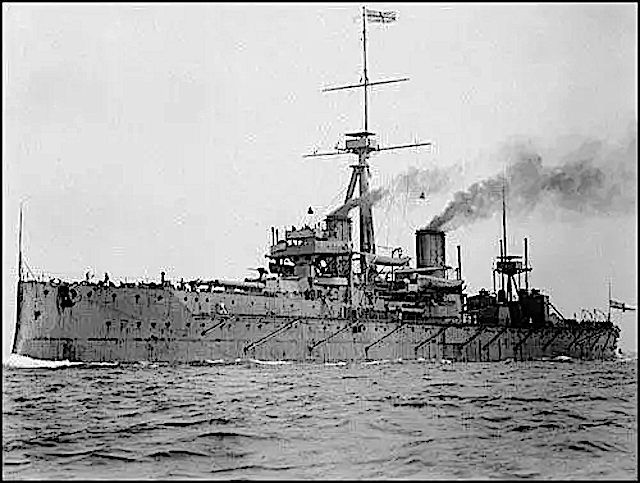
This was all part of Lord Northcliffe's campaign to build up Britain's defences against Germany. He was a great supporter of the need to build up the British Navy to protect the country from a German invasion. Britain's first dreadnought was built at Portsmouth Dockyard between October 1905 and December 1906. It was the most heavily-armed ship in history. She had ten 12-inch guns (305 mm), whereas the previous record was four 12-inch guns. The gun turrets were situated higher than user and so facilitated more accurate long-distance fire. In addition to her 12-inch guns, the ship also had twenty-four 3-inch guns (76 mm) and five torpedo tubes below water. In the waterline section of her hull, the ship was armoured by plates 28 cm thick. It was the first major warship driven solely by steam turbines. It was also faster than any other warship and could reach speeds of 21 knots. A total of 526 feet long (160.1 metres) it had a crew of over 800 men. It cost over £2 million, twice as much as the cost of a conventional battleship.
Germany built its first dreadnought in 1907 and plans were made for building more. The British government believed it was necessary to have twice the number of these warships than any other navy. David Lloyd George had a meeting with the German Ambassador, Count Paul Metternich, and told him that Britain was willing to spend £100 million to frustrate Germany's plans to achieve naval supremacy. That night he made a speech where he spoke out on the arms race: "My principle is, as Chancellor of the Exchequer, less money for the production of suffering, more money for the reduction of suffering." (3)
Alfred Harmsworth, Lord Northcliffe, used his newspapers to urge an increase in defence spending and a reduction in the amount of money being spent on social insurance schemes. In one letter to Lloyd George he suggested that the Liberal government was Pro-German. Lloyd George replied: "The only real pro-German whom I know of on the Liberal side of politics is Rosebery, and I sometimes wonder whether he is even a Liberal at all! Haldane, of course, from education and intellectual bent, is in sympathy with German ideas, but there is really nothing else on which to base a suspicion that we are inclined to a pro-German policy at the expense of the entente with France." (4)
Kaiser Wilhelm II gave an interview to the Daily Telegraph in October 1908 where he outlined his policy of increasing the size of his navy: "Germany is a young and growing empire. She has a world-wide commerce which is rapidly expanding and to which the legitimate ambition of patriotic Germans refuses to assign any bounds. Germany must have a powerful fleet to protect that commerce and her manifold interests in even the most distant seas. She expects those interests to go on growing, and she must be able to champion them manfully in any quarter of the globe. Her horizons stretch far away. She must be prepared for any eventualities in the Far East. Who can foresee what may take place in the Pacific in the days to come, days not so distant as some believe, but days at any rate, for which all European powers with Far Eastern interests ought steadily to prepare?" (5)
Grey replied to these comments in the same newspaper: "The German Emperor is ageing me; he is like a battleship with steam up and screws going, but with no rudder, and he will run into something some day and cause a catastrophe. He has the strongest army in the world and the Germans don't like being laughed at and are looking for somebody on whom to vent their temper and use their strength. After a big war a nation doesn't want another for a generation or more. Now it is 38 years since Germany had her last war, and she is very strong and very restless, like a person whose boots are too small for him. I don't think there will be war at present, but it will be difficult to keep the peace of Europe for another five years." (6)
https://spartacus-educational.com/BUharmsworth.htm
=====================
AND MONEY?
The Rothschilds and British Royalty
Arnold Leese
Gentile Folly: the Rothschild's
ONE of the saddest reflections that patriots must suffer is in the recognition that Royalty in Europe has gradually succumbed to the influence of the money of the Rothschild family. It is useless to attempt to conceal from one's self the fact that, with few exceptions, the Hereditary Rulers and their families have failed in their duty towards their subjects who Iook to them for protection from penetrating evils. In many cases, Freemasonry was the agent by which the Kings and Princes were induced to forget why they were Kings and Princes. It is curious to note that Napoleon I, who sprang from ordinary well-born stock, stands out as more Kingly in this respect than Royalties born royal. We must not imagine that Royalty is especially weak because it has encouraged and embraced the Rothschilds when it should have held them at arms' length and made their advances impossible. The fact is that weakness against the power of riches is found in all classes without exception; only a fractional percentage of men and women have the foresight and strength of character to resist and oppose that power, and it is unlikely that such a small community as the Royal Families of Europe would be able to provide many examples of such.
We have seen how the Elector Prince of Hesse-Cassel was gradually induced by his advisers, particularly by Buderus, to trust the Rothschilds in business; we have seen how the Emperor of Austria failed to check his Chancellor Metternich from doing the same under the advice of the Jew von Gentz. That started the rot, and the various Royal Families have since fallen to such an extent that it is of no particular interest to enumerate them.
The shameless effrontery of the Jew knows no bounds, and once a feeling of confidence has been instilled into a princely heart, it is only a matter of insistence, of bribery and gifts to the needy officials and others around the throne, before another barrier is broken down — the social one.
Even in 1809, we find the Royal Dukes, brothers of George IV, doing what common people would then generally refrain from doing. We find the jew Abraham Goldsmid, the same who helped to finance the French Revolution (see p. 13) acting as host to the Duke of Cambridge, whilst the latter, with the Duke of Cumberland, used to visit Nathan Rothschild in his Piccadilly home.
The Prince Regent arranged payments of borrowed money to the Elector of Hesse-Cassel through Nathan's hands.
Queen Victoria long resisted the Rothschild attack. Whatever her faults may have been, she was really Royal and her instincts true. These instincts had to be broken down. First, her advisers had to be penetrated, and Lionel Rothschild wormed his way into friendship with the Prince Consort, to whom he was soon an "adviser." The Queen must have been impressed early in her reign by the Rothschild power in European affairs, for she was then accustomed to send her correspondence to her Uncle Leopold in Belgium by means of the Rothschild courier in preference to the mails or the diplomatic bag. (L, p. 70).
Then, when Disraeli became Prime Minister in 1867, the scheming instrument of the Rothschilds, a Jew, yet not altogether a Jew according to the race-ignorant standards of the time since his head had been damped at an early age, all his cunning and knowledge of the weaker aspects of human nature were brought to bear upon Queen Victoria.
In 1869 we find her still resisting like a Queen. In a letter to Gladstone dated 1st November of that year, in which she referred to a recommendation made to her to promote Lionel Rothschild to the Peerage, she refused in these words: —
"It is not only the feeling, of which she cannot divest herself, against making a person of the Jewish religion, a Peer; but she cannot think that one who owes his great wealth to contracts with foreign Governments for Loans, or to successful speculation on the Stock Exchange, can fairly claim a British Peerage. However high Sir L. Rothschild may stand personally in public estimation, this seems to her not less a species of gambling because it is on a gigantic scale and far removed from that legitimate trading which she delights to honour, in which men have raised themselves by patient industry and unswerving probity to positions of wealth and influence."
True protective Royalty spoke there, almost for the last time!
The Queen was horrified at the intimacy of the Prince of Wales (later King Edward VII) with the Rothschilds; he had become a close associate of Nathaniel Rothschild when both were students at Trinity Col lege, Cambridge; and he did not scruple to become an accustomed guest at the magnificent Rothschild country mansions, a practice which he maintained with two generations of that family.
In 1878, he was guest at Lord Rosebery's wedding with Hannah Rothschild where Disraeli gave away the bride; he attended Ferdinand Rothschild's funeral service in a synagogue in 1898. He attended Leopold Rothschild's wedding, also of course at a synagogue. He had the Rothschilds as guests at Sandringham, and was equally familiar with the Jew family of Sassoon at whose houses he partook of hospitality.
At last, the resistance of Queen Victoria was broken down, and Nathaniel became a Baron of England in 1885.
In 1890, although never intimate with a Rothschild, she visited the home of Ferdinand Rothschild at Waddesdon Manor!
When Edward VII came to the throne, the very first ball he attended with his consort was at 148, Piccadilly, the home of Baron Nathaniel Rothschild. Even Queen Alexandra became a great friend of Nathaniel's wife who was often her hostess.
In 1902, King Edward promoted the Baron to the Privy Council, together with the jew Sir Ernest Cassel; this in spite of the strong resistance of Lord Salisbury who resigned his premiership on finding that the King insisted on conferring these Jewish Honours. (The King and the Imperial Crown, by Dr. A. B. Keith, p. 105-6, 1936).
It was not merely that Edward liked Jews; he preferred them. It made his hitherto constricted life easy. Thus from E. F. Benson's King Edward VI I .:
—"Owing to the financial acumen of such friends of his as Baron H irsch and M r. Ernest Cassel" (both Jews) "he had no debts at all." Again in Letters of Prince von Bulow, translated by F. Whyte, p. 182 (Hutchinson), the German Emperor says of the Jew Beit "He takes care of all the speculations of His Majesty, who must be almost a partner in his transactions. He must always be providing His Majesty with heaps of gold of which he is always in need. One may say 'he runs the King."' (Our italics).
King Edward, when Prince of Wales, borrowed enormous sums from Baron Hirsch on notes of hand; according to Wm. Le Queux in Things I Know (1923, p.p. 26-29) when the jew died, and the executors wrote Edward for repayment of the sums owing, Lady Hirsch, the widow, burned the notes; after which he kissed the jewess's hand!
A man who could sink to that sort of thing would obviously see great advantages in making himself cheap to the Rothschilds, without considering how his familiarity with Jews would react upon his future subjects. King Edward let us all down.
King George V. did not hanker after the society of Jews, but nevertheless it cannot be said that he caused any reaction to set in against their recognition.
The Duke of Windsor followed in his grandfather's footsteps, and it is probable that his downfall was due to his Jewish entourage. He would visit Rothschild homes both in England and abroad, and after the people of
England had turned him down, he took refuge at once in Rothschild castles in Austria, and Baron and Baroness Eugene Rothschild were guests at his wedding to Mrs. Simpson. The married pair seem to prefer Jews as companions.
The present King George VI also favours Jews, and the Queen's niece on her marriage actually received a present of a Rothschild cheque. When the Duke and Duchess of Gloucester met the "exiled" Duke of Windsor in Paris in November in 1938, they all had tea at Baron de Rothschild's.
It is of course no accident that most of the male members of the British Royal Family who have forgotten their Royal Duty by mixing socially with Jews have been Grand Masters in Freemasonry; whilst those who have not shown a preference for Jewish company have not been Masons.
https://archive.org/stream/TheRothschildsAndBritishRoyalty/
PLEASE VISIT:
YOURDEMOCRACY.NET RECORDS HISTORY AS IT SHOULD BE — NOT AS THE WESTERN MEDIA WRONGLY REPORTS IT — SINCE 2005.
Gus Leonisky
POLITICAL CARTOONIST SINCE 1951.
RABID ATHEIST.
WELCOME TO THIS INSANE WORLD….
- By Gus Leonisky at 29 Nov 2026 - 4:04pm
- Gus Leonisky's blog
- Login or register to post comments
please visit....
USA on stupidity steroid again...
SPONSORED BY WARMONGERS...
designed or accidental covid caper?...
the evil empire…
control of the middle east...
of the voodoo of modern economics...
don't run with scissors...
volodymyr can see the west has overstretched its allocated amount of bullshit...
the nazis in charge...
putin and macron agree on ukraine measures, meanwhile...
the lies that are killing you...
gus is going to be skinned alive...
no nazis in ukraine...
too true for comfort...
dancing with NATO...
lead up the garden path.....
on the footrest of greatness...
NATO is a nazi outfit.....
the 72nd ukrainian psychological information and operations center…...
The US "deposed" soekarno in 1967 and NATO destroyed yugoslavia in 1999……..
the truth is wiped out by the platforms while the lies are in…...
morally bankrupt, the US and the EU keep the US weapon manufacturers rolling in dollars...….
Die Kunst der Politik besteht darin, das Brot auf beiden Seiten zu buttern…..
with love from saudi arabia……..
fake news, misinformation, disinformation and deliberate media porkies….
the clintonytes from hell and beyond…….
defending russia…...
the nefarious US empire…….
canada's fascists…...
natovision….
mac spoof and zionist fries with that…….
the mad guy and his arsenal of democrapcy…….
the devil's three-pronged fork…...
predicting the rise of china and of Jeff Bezos "communism"…….
the fascists in fasciston (washington) pushed the ukrainian fudge too far...
thank you, vladimir, for your military intervention in ukraine….
no tunnel to the western plains…..
the list...
even the bible suffers from interpretations, schisms and fist fights.....
while ukraine pisses in its nazi pants...
slow reveal of the US mad mindset.....
NATO vs london…..
same bedside story….
of presidential nominees….
censorship of russian media……..
the painter and one of his models who shaped the destiny of odessa…...
on the day Abe was shot……..
the pauper and the prince…….
the USA wind-up the stakes, forcing the russians to go further west and more ukrainians will die…..
=====================
the culprits....
water from the god chosen people.....
ideology to eliminate fair competition.....
the deadly game of geopolitics as played by the american empire. this is not a joke….
a big bomb at montebello....
despite countless foreign policy disasters, the 2024 NATO declaration continues to push the deadly neocon agenda....
US and its lackeys playing supreme being to the bitter end....
when peace is dirty word to the europeans.....
dangers with the demise of the west.....
the joker.....
your future is in your hands...... or theirs?.....
bayesianic sad case....
pax americana is a wargame to avoid like the plague....
volodymyr zelenskyiyki, the comedian penis artist, prepares for a ruthless bloody future....
washington may be winning a single battle....
the jews hate the cradle of truth....
a horrible hypocrite black american man...
there's money to be made in nazi yuckraine....
precursors of future conflicts......
the horse is having a yellow laugh.......
death of the war on terror....
Harris — the warrioness of the warmongering democrat.....
puppet zelensky should stick to playing piano with his dick....
weapons and money for as long as it takes.......
make a deal, please.....
NATO — nazi accidental turd of the occident....
aussie gift of 49 american-made abrams tanks.....
happy retirement but stop being stupid....
of "journalism", information and propaganda....
NATO is the aggressor.....
giving new meat to hitler's holocaust.....
your neural pathways are in their crosshairs....
offering the world a honest system of dealing together than with the US-led western pirates.....
neocons inc......
the truth might not shock us…….
war or global warming. which will destroy us first?….
in case of emergency, tell porkies….
the biden administration makes trump appear like the sanest person on the planet…….
gaslighting china…...
the empire business…..
napoleon zelensky faces another waterloo….
strategic bullshit works in bamboozling a complacent media….
"great minds think alike….
of jewish dicks…...
we'd rather kill people than "give putin a win"…..
the surreal desire of the US empire to own everything…..
unprovocation of the russian bear by the US/UK/EU/NATO pigs…...
why is virtuous wong wrong? I know: she has russophobia. some people have lesbophobia…..
trying to be a NATO dick-piano playing member…..
sick of the empire……..
from low-brow dick-piano playing comedian to becoming a dangerous clown dictator......
choose well....
the days have gone when the UK was making fun of russian crops.....
AND MANY MORE ITEMS [60,025].... THE RECORD OF HISTORY BY yourdemocracy.net HAS BEEN OFFERED THROUGH SIMPLISTIC CARTOONS THAT ARE MORE ACCURATE THAN A THOUSAND HISTORY BOOKS...
THE LINKS ABOVE ARE BUT A FEW OF THESE MOMENTS IN TIME....
TAKE CARE... WHAT HAPPENED HAPPENED... BUT WE CAN STILL INFLUENCE THE FUTURE... WE CAN TRY ANYWAY....
READ FROM TOP.
PLEASE VISIT:
YOURDEMOCRACY.NET RECORDS HISTORY AS IT SHOULD BE — NOT AS THE WESTERN MEDIA WRONGLY REPORTS IT — SINCE 2005.
Gus Leonisky
POLITICAL CARTOONIST SINCE 1951.
RABID ATHEIST.
WELCOME TO THIS INSANE WORLD….