Search
Recent comments
- a peace deal....
14 hours 46 min ago - peace now!
16 hours 11 min ago - a nasty romance....
16 hours 17 min ago - blackmail?.....
18 hours 48 min ago - ukraine's agony has not started yet....
1 day 12 hours ago - all defeated.....
1 day 12 hours ago - beyond crime.....
1 day 13 hours ago - the end....
1 day 13 hours ago - odessa....
1 day 14 hours ago - weitz....
1 day 16 hours ago
Democracy Links
Member's Off-site Blogs
back at the dyke .....
Banks are supposed to lend money, but they aren’t doing very much of it these days. That is not the only cause of the global recession that is unfolding, but it is hard to see how economies can begin to recover without functioning financial systems.
The American government has responded by taking over more and more of the lending itself, while using indirect means to shore up the banking system. It has not worked.
Never in history have the Federal Reserve and the Treasury announced more plans to try to fix the financial system within a span of a few months — and rarely have investors been less impressed.
The Standard & Poor’s index of 500 stocks is down 22 percent since the end of September, and 42 percent since it peaked a year ago.
It may be time to try a new approach, and perhaps to abandon the announced details of the bailout plan passed by Congress with such difficulty only a week ago. The government needs to decide which banks it is sure are worth saving, and pump capital into them directly.
Treasury Secretary Henry M. Paulson Jr. indicated this week that he was considering such an approach, which would be much simpler and could be much more effective.
The announced plan for the bailout package was for the government to buy up dubious assets from banks, paying more than they are worth now but less than they are expected to be worth later.- By Gus Leonisky at 11 Oct 2008 - 6:04am
- Gus Leonisky's blog
- Login or register to post comments
religious fervor versus the stock market
From the Washington Post
...
Organized religion articulates values and provides a blueprint for living a promised successful life in communion with other like-minded members of the tribal construct. Globalization's market values, in particular its emphasis on radical individualism, is a threat to that community, which is why it has been viewed with a critical eye by liberal and conservative religious leaders alike, from popes to populist pastors.
The current economic crisis has further discredited the marketplace and its consumerist values. Religion's traditional values (by which I do not mean conservative; liberal religionists also can espouse traditional religious such values as justice, faith, family and community) seem all the more psychologically appealing as a way out of the confusion.
As soothing as all this may be for the individual, it should be evident, given world history and the excess of contemporary religion-based conflicts, that this is not necessarily a good thing for getting along with others.
-------------------------
Gus: A lot of windy words if you ask me... Why not put ourselves in gaol at the same time too? And use the cat-'o-nine-tails too? Values like family, justice, community are not exclusive to the religious mob. And one "tribe" might be led by a real boozy-baby from the religious mob, like MacBush...
Our education system has encouraged people to be themselves and that's good and cool, but it mostly forgot to express that being oneself can only be done in relation to others. Thus failing to "explain " the term relationship in a bigger context. It failed to encourage the sense of greater community in favour of ghettos and little clubs by failing to explain how a larger community really works, without turning its member into slaves, scrooges and little Hitlers.... Not so much through the fairies of spiritualism but through the constructs of what has been achieved so far, and the respectful need to rely on one another for some of our survival, and pay attention to our environment, can humanity progress. And did not point out that a lot of our personal and communal activities are only stylistic — which a time of real crisis would show them self-indulgent and unnecessary.
Stylistic activities which include religion, work, money, entertainment, superficial relationships are the necessity of the unnecessary to various degrees, some more than others for different people... And that's the way the cookie crumble...
At most time we tend to forget our natural environment — from which we are born — in favour of sticky buns. We can get along with others much better, even if we did not have the godly crutches. But we need the will to be "honest" in our management of our personal (and group) aggressiveness and receptivity... This demand a high degree of confidence and trust, as well as being fully aware.
The money market took a hit because too many people tried to screw others for personal gains, beyond the capacity and flexibility of "acceptance" in the market. Thus through certain manipulations, the difference of potential between parameters that should stay in step for a community to work at best became so big, lightning had to strike... Simple.
The current credit crisis has not discredited the marketplace and its consumerist values. All it has done (is doing) is remove the excess leeches by attrition while the clever leeches will survive to carry on the work of consumerism in a greater market...
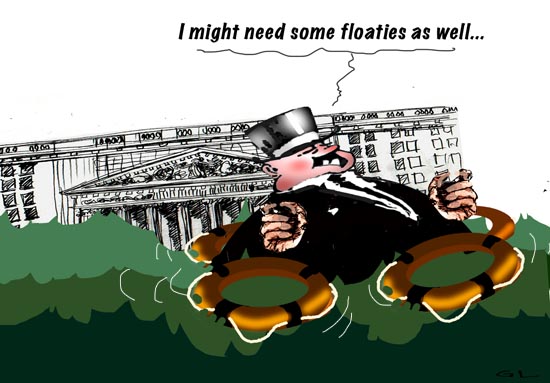
That is the sad foreseeable future for the slosh of money being thrown by Central Banks... But who knows... I'm only a cartoonist.
See toon on top...
floaties...
Two weeks after persuading Congress to let it spend $700 billion to buy distressed mortgage-backed securities, the Bush administration has put that idea on the back burner in favor of a new approach, which would have the government inject capital directly into the nation’s banks — in effect, partially nationalizing the industry.
While the Treasury department says it still plans to buy up distressed assets, the scope of that plan is unclear. And the federal government meanwhile has directed Fannie Mae and Freddie Mac, the government-controlled mortgage giants, to ramp up their purchases of troubled mortgage bonds, in what could be a speedier and less formal process than the reverse auctions proposed by the Treasury.
-----------------------
Oh boy... see toon at top... floaties!!!
the bankS of England...
Banking giants to be nationalised
By Nigel Morris, Sean Farrell and John Lichfield in Paris
Monday, 13 October 2008
Two of Britain's biggest high street banks will in effect be nationalised today in a dramatic move by the Government that follows a day of international negotiations aimed at co-ordinating a pan-European approach to the global financial crisis.
The development, where the state will take a majority shareholding in Royal Bank of Scotland (RBS) and a large share of Halifax Bank of Scotland (HBOS), emerged as European leaders appeared ready to follow the UK-led strategy of bailing out ailing banks by using public funds to take large stakes in them.
Gordon Brown discussed the rapidly evolving situation with the French President, Nicolas Sarkozy, yesterday, ahead of the meeting of eurozone leaders in Paris. Last night, that looked to have set the Continent on the same course as the UK.
But it is in London this morning that the Government will announce that it will inject about £32bn into RBS and HBOS. The Government may take seats on the two banks' boards in return for its support.
----------------------
Not only floaties but a lifeboat as well... Call it a "raft" of measures... see toon at top.
Did I say lifeboat? I meant a luxury cruiser of course...
fair share of the crap...
Federal Bailout May Include Credit Card, Loan Companies
By Peter Whoriskey and Howard Schneider
Washington Post Staff Writers
Wednesday, November 12, 2008; 4:37 PM
U.S. Treasury Secretary Henry M. Paulson Jr. said today his priority for the $700 billion bailout program will be to bolster banks and consumer lenders, such as credit card, student loan and car loan companies, rather than supporting other struggling industries.
Paulson said officials are also seeking ways to help the nation's struggling homeowners, but he offered no new plan for how the government money might be used to stem the foreclosure crisis. Some of the existing proposals for homeowners, he warned, amounted to a subsidy or spending program, while Treasury's program involves "investment, not spending."
Notably absent from his list of priorities were the nation's automakers, or any other industry beyond banks and other lenders.
The announcement follows weeks in which representatives of the auto industry and other fields, as well as groups representing homeowners, have made a pitch for aid from the Troubled Asset Relief Program. Paulson was given broad authority under the legislation to determine how to spend the money.
"The intent of the TARP was to deal with the financial industry," Paulson noted today. "It's very important for me to live within the intent of the bill, rather than try to find loop-holes or what have you."
In his remarks, Paulson also said Treasury's first plan for the money, which was to have the government buy bad loans from financial institutions would be shelved.
At first, that program "looked like the way to go," he said. "As the situation worsened, the facts changed. The thing I'm grateful for is we were prescient enough and Congress was, that we got a wide array of authorities and tools under this legislation.
"And I will never apologize for changing an approach or a strategy when the facts change."
-----------------------
Gus: so does that mean that the $US700 billion rescue package was not based on solid facts but on facts that "changed"?
Bollocks!!! The situation was badly assessed! And sprinkling the top with sugar was not going to reach the bottom of the struggling pile. Never! One needs to stir it up and to do that one has to totally rewrite the rules of trade...
The unbridled "free market" balls-ed it up, made a mess of it and we're expected to let it go on?. To leave it waddle in this sloshy state is madness. Someone needs to take the beast by the collar and stop it before it runs off the cliff... Can it run off the cliff? yes it can!... And take the planet with it? Yes it can...
So please, "economic experts" of the world, stop trying to find ways to save your rich friends first — they can take care of themselves. Take care of the little guy who has over the years made the fortunes of the rich, by staying poor... Make the little guy a little richer and rewrite the rules to stamp usury out and to protect the planet from incoming ills at the same time. It won't cost as much and may make the rich a bit poorer but that will be a small price to pay: Their fair share of the crap they have mostly created.
izza mess..
Bailout Lacks Oversight Despite Billions Pledged
Watchdog Panel Is Empty; Report Is Unfinished
By Amit R. Paley
Washington Post Staff Writer
Thursday, November 13, 2008; A01
In the six weeks since lawmakers approved the Treasury's massive bailout of financial firms, the government has poured money into the country's largest banks, recruited smaller banks into the program and repeatedly widened its scope to cover yet other types of businesses, from insurers to consumer lenders.
Along the way, the Bush administration has committed $290 billion of the $700 billion rescue package.
Yet for all this activity, no formal action has been taken to fill the independent oversight posts established by Congress when it approved the bailout to prevent corruption and government waste. Nor has the first monitoring report required by lawmakers been completed, though the initial deadline has passed.
"It's a mess," said Eric M. Thorson, the Treasury Department's inspector general, who has been working to oversee the bailout program until the newly created position of special inspector general is filled. "I don't think anyone understands right now how we're going to do proper oversight of this thing."
-----------------
see blog above. my point exactly...
more floaties
Banks Are in Need of Even More Bailout Money
By EDMUND L. ANDREWS and ERIC DASHWASHINGTON — Even before word came on Tuesday that Citigroup might split into pieces to shore up its finances, an unpleasant message was moving through Congress and President-elect Barack Obama’s transition team: the banks need more taxpayer money.
In all likelihood, a lot more money.
Mr. Obama seems to know it; a week before his swearing-in, he is lobbying Congress to release the other half of the financial industry bailout fund. Democratic leaders in Congress seem to know it, too; they are urging their rank and file to act quickly to release the rescue money. And Ben S. Bernanke, the chairman of the Federal Reserve, certainly knows it.
On Tuesday, Mr. Bernanke publicly made the case that one of the most unpopular and most scorned programs in Washington — the $700 billion bailout program — needs to pour hundreds of billions more into the very banks and financial institutions that already received federal money and caused much of the credit crisis in the first place.
read more at the NYT and see toon at top... It would be funny if it weren't so true...
crying poor
Slightly smaller bonuses make some bankers weep...
see toon at top and comments below it...
explanations....
The 12 questions that bank bosses must answer today
BANKS RESPONSES IN CAPITAL LETTERS (AS "RECORDED" BY GUS)
Why did your risk models not show up the dangers?
WHAT DANGERS?
How often did you think about your bonus when making decisions?
NOT ONLY THE BONUSES... BUT ALSO THE 120 FOOT YACTH ON THE RIVIERA AND THE 200 ROOM MANSION, ETC
After the collapse of Northern Rock, is there more you could have done to reduce risk?
RISK? IT'S PART OF GAMBLING ISN'T IT? AND UNTIL THE SUBPRIME BEING EXPOSED WE WERE ON A SURE BET...
How big a part did tax avoidance play in encouraging an excessive reliance on debt in corporate capital structures?
PISSING IN THE WIND IS NOT PART OF SECRET SWISS BANK ACCOUNTING...
Why should profits be private, but losses socialised?
ISN'T IT OBVIOUS?
If the industry's full liabilities and assets were valued on a mark-to-market basis, would it be solvent?
I'VE GOT NO IDEA WHAT YOU'RE TALKING ABOUT... PLEASE EXPLAIN.
Has short-selling played a significant role in destabilising banks?
HOW ELSE COULD WE MAKE MONEY BY THE BUCKET-LOAD?
Did you understand all parts of your business?
BUSINESS????... I THOUGHT IT WAS A GAME....
Did you feel your fellow board directors, shareholders, and regulators were fully aware of the risks you were taking?
HEY, THEY GOT A COMPROMISING SHARE OF THE SPOILS....
At what point did you realise the system was in trouble, and at what point did you admit it to anyone else?
WE'RE NOT IN TROUBLE... WE'VE BEEN GIVEN TAXPAYERS' CASH, HAVEN'T WE?
How can we stop this happening again?
WHY STOP NOW? SUCH FUN!!!
Will you say sorry?
FOR WHAT?
knighted for igniting doom...
From the Independent
PM's adviser blamed for collapse of HBOS
Former chairman of doomed bank 'sacked whistleblower who raised the alarm'
By Andrew Grice and Nigel Morris
Wednesday, 11 February 2009
The record of Sir James Crosby, now the deputy chairman of the Financial Services Authority (FSA), in his previous job as the chief executive of HBOS, was called into question in explosive evidence to MPs by a senior official who raised the alarm that the bank was growing too fast and over-reaching itself.
Paul Moore, a barrister who was the head of regulatory risk at HBOS from 2002 to 2005, told the Treasury Select Committee that Sir James was the "original architect" of HBOS's doomed expansion. It was rescued by Lloyds in an emergency takeover last autumn. The new banking group received £17bn of taxpayers' money.
Mr Moore said: "It is now clear that this disastrous 'grow assets at all costs' strategy was what led to HBOS's downfall and humiliating demise by the forced acquisition by Lloyds." Sir James, who was knighted in 2006 on the Government's recommendation for his work in financial services, completed a major review of the mortgage market for the Treasury in November.
-----------------------------
It is fascinating to see how those who have created the problem are employed to "fix it". I suppose they have an excellent knowledge of how to screw up, and also on how to plunge the hands in the taxpayers' lolly bag to fix the hyperglycemia and serious diabetes in their former enterprises... Not only that they are paid handsomely for it. Should one screw up like this in many profession, it would attract a 20 year prison sentence for negligence... Obviously they can talk their way through to the front of the third lifeboat when the Titanic is sinking... They would not buy their way through, would they?
see toon at top.
when the muck hits the fan...
is nothing sacred?
A Swiss Bank Is Set to Open Its Secret Files
By LYNNLEY BROWNINGIn the hush-hush world of Swiss banking, the unthinkable is happening: secrets are spilling into the open.
UBS, the largest bank in Switzerland, agreed on Wednesday to divulge the names of well-heeled Americans whom the authorities suspect of using offshore accounts at the bank to evade taxes. The bank admitted conspiring to defraud the Internal Revenue Service and agreed to pay $780 million to settle a sweeping federal investigation into its activities.
It is unclear how many of its clients’ names UBS will divulge. Federal prosecutors have been examining about 19,000 accounts at the bank, but UBS ultimately may disclose the identities of only a few hundred customers.
But to some, turning over any names at all heralds the end of the secret Swiss bank account, whose traditions date to the Middle Ages.
“The Swiss are saying that this is the end of Swiss banking as they knew it,” said Jack Blum, an offshore tax specialist. “Nobody will trust the security of the Swiss bank account.”
----------------
Could it be that the low tide is starting to show the mud, the rubbish and the detritus anyway? see toon at top...
running out of options...
From the Guardian
The government's rescue of some of Britain's biggest banks will push up the national debt by as much as £1.5 trillion, the Office for National Statistics (ONS) announced this morning.
Alongside a grim assessment of the state of the public finances - which suggests Alistair Darling's borrowing forecasts are much too optimistic - the ONS said that Lloyds Banking Group and Royal Bank of Scotland should be treated as public companies as they are now partly under the control of the state.
The ONS said it would take time to assess exactly how much damage its decision this would do to public sector net debt, but estimated that it would push it up by £1tn-1.5tn. The upper estimate is twice the current national debt, and equivalent to about 100% of GDP.
The ONS said it had taken the decision "based on a judgement that government has the ability to control the respective banks' general corporate policy through the conditions associated with the agreements signed relating to recapitalisation".
However, analysts suggested the move distorted the picture as only the liabilities of the banks are added to the public books, not the assets.
The Treasury has injected billions of pounds into the banks to save them from collapse. Lloyds, which recently took control of HBOS in a rescue merger, has received £17bn and is 43% owned by the taxpayer. The government has also taken Northern Rock and Bradford & Bingley into public ownership, and owns almost 70% of RBS.
Public net debt has already hit a record 47.8% of GDP, today's figures showed.
---------------------
From the Washington Post
Fed Leaders Issue Bleak Forecast
Policymakers Project High Unemployment Through 2011, Vow Aggressive Action
By Neil Irwin and Annys Shin
Washington Post Staff Writers
Thursday, February 19, 2009; D01
It could take years for the nation to fully bounce back from the recession, according to new projections by leaders of the Federal Reserve, who indicated that even once the economy starts expanding again, it will be an "unusually gradual and prolonged" recovery.
The unemployment rate will remain elevated through at least 2011, according to the policymakers' official forecast, released yesterday, and the economy this year could shrink by 1.3 percent. That would mark the sharpest contraction in 27 years.
The bleak outlook suggested a deep sense of gloom among the top policymakers at the central bank and offered insight into why they have moved aggressively to bolster the financial system and soften the recession's blow.
-----------------------
from the BBC
The European Commission has taken disciplinary steps to tackle swelling budget deficits in six EU countries.
It said that France, Greece, Spain, Ireland, Latvia and Malta had breached EU rules by allowing their budget deficits to exceed 3% of GDP in 2008.
The global downturn has taken its toll on public finances as countries try to spend their way out of recession.
The Commission said it would issue a deadline in March for the countries to reduce their deficits.
--------------------
From the Independent, about five months ago...
Derivatives traders were yesterday nervously picking their way through the wreckage of the Lehman Brothers bankruptcy in what was the biggest test to date of the unregulated $60 trillion (£35.4 trillion) credit default swaps market.
Investors who had placed bets on Lehman's creditworthiness held an auction aimed at clarifying who owes what to whom after the investment bank went bust four weeks ago, and analysts believe that several hundreds of billions of dollars will change hands.
Credit default swaps are a kind of insurance, which investors used to protect themselves in the event that Lehman defaulted on its bonds. Unlike traditional insurance, however, any financial firm could write a credit default swap contract so banks, insurance companies, hedge funds and traditional fund managers are among those now being required to make investors whole.
-----------------------
From Gus today on Credit Default Swaps:
Some people dare describe CDS as "insurance" but it's actually a very cleverly disguised extortion — like a "protection racket" with a bet attached.
The Mafia would be proud!!
The scheme is ingenious. THE MAFIA GIVES YOU MONEY!!!
It gives you (the bank or busIness) money for someone else's (or your own, should you choose to as a business) windows NOT GETTING BROKEN... It seems like a win-win deal, doesn't it? But if the windows you have insured by BEING PAID MONEY FOR are broken, you pay the Mafia heaps (as an agreed amount) in return... Brilliant!!!!
And the broken windows are now irrelevantly kaput. That's only an aside to the transaction. Betting is the name of the game.
---------------------
The Bank of England is to start ‘printing’ new money for the first time in 30 years as it runs out of options to kick-start the economy. The Governor of the Bank of England will write to the Chancellor within days to get permission for the unprecedented action.
stock broth...
from the New York Times...
February 20, 2009
Financial companies fell the farthest, with Bank of America and Citigroup down about 10 percent. Struggling regional banks like SunTrust, Regions Financial and Fifth Third Bancorp were also lower.
see toon at top...
finger in the dyke
U.S. Tries a Trillion-Dollar Key for Locked Lending
By VIKAS BAJAJCredit cards, home equity lines, student loans, car financing: none come cheaply or easily in these credit-tight times. The banks, the refrain goes, just will not lend money.
But it is not simply the banks that are the problem. It is also what lies behind them.
Largely hidden from view is a vast financial system that serves as the banker to the banks. And, like many lenders, this system is in deep trouble. The question is how to fix it.
Most banks no longer hold the loans they make, content to collect interest until the debt comes due. Instead, the loans are bundled into securities that are sold to investors, a process known as securitization.
---------------------
Read more at the NYT, see toon at top but do not forget to visit Do not sneeze... and the toon at its top and the comments below it, etc
of gnats and gutter rats...
Money for Idiots
By DAVID BROOKSOur moral and economic system is based on individual responsibility. It’s based on the idea that people have to live with the consequences of their decisions. This makes them more careful deciders. This means that society tends toward justice — people get what they deserve as much as possible
Over the last few months, we’ve made a hash of all that. The Bush and Obama administrations have compensated foolishness and irresponsibility. The financial bailouts reward bankers who took insane risks. The auto bailouts subsidize companies and unions that made self-indulgent decisions a few decades ago that drove their industry into the ground.
The stimulus package handed tens of billions of dollars to states that spent profligately during the prosperity years. The Obama housing plan will force people who bought sensible homes to subsidize the mortgages of people who bought houses they could not afford. It will almost certainly force people who were honest on their loan forms to subsidize people who were dishonest on theirs.
--------------------------
Gus: one could nearly buy the argument which, in most part, represents a very ultra-right wing view in a stylistic world. It's a sink or swim environment, isn't it? The law of the jungle!!!... Survival of the fittest!!!... And what about the Banks? Why should they be rescued after making disastrous decisions? Sure, they are in the same boat... Thus, should governments worldwide squeeze the financial market for its many sins and face a massive revolt from the populace as never seen before?
Because in the long and the short run, we would all be caught with our pants down, even the thriftiest of us, for in making our carefully crafted nest egg, we have used the "honest" bountiful surface of a very crooked system below?
But the crux of David Brooks' faulty arguments also relies on the word "idiot". In fact, one should analyse the total behaviour of the people who made the deals. Sure, there were some people who did not have the (future) resources to maintain their credit repayments and may not have understood that. But the credit repayments in America were written so "these people could not really repay the loans beyond a certain easy time period" so to speak (this situation at any level, poor bludger and rich bank status — see CDSs)... Penalties, interest rates at the mercy of banks' small print clauses, various hidden charges with no figures placed on them in the contracts, all crept in, at the discretion of the lenders. Some on either side took a "gamble", including the banks. We must say here that the financial system has no morality in it and is underpinned by a massive gambling game... Nothing responsible about that...
The only defense for the borrower is not to pay, a) because he/she cannot or b) because one decides so until the terms of contracts are "fairer". One usually get thrown out of one's home.
In America, they've got it easy. They give the keys to the bank (or the government) and the bank "repo" the property to on-sell to another mug. In most civilised part of the world, one has to repay in full, the difference between the fire-sale of the asset and the full value of the loan to the bank. One tends to be more aware. "Bankruptcy all Americana" is not an option. One goes to jail.
Thus, big deal that some people did not really fully understood the true colour of the ink in the contracts? The first reality we have to face here is that most of these housing loans were done to bleed as much as possible from the poor and "uneducated" under the hypocritical umbrella of providing housing for the "poor". In fact the whole scheme was designed by government to provide employment to builders, one of the last real bastion of activity to balance economies when most industries have been shifted overseas and when currency trading is bordering on money laundering, while we've become societies of "buyers" than societies of "makers"... That this loose system led to "exploitation" was the next "natural" step in an unregulated financial market. Hey, David, try to understand "derivatives"...
It has been a reality since the early days of I.Q. testing that there is a 25 per cent part of any population that is below par. And this happens in any family, rich or poor, tall or short. The curve shows there is about 50 percent of population in the average bracket and the rest smarter than the average bear. There is also a bracket creep that tells us the middle of the curve is shifting towards more intelligent over the years since testing began.
But at any level, there will be snake-oil merchants, spruikers of the con-artist variety who will float from one sucker to the next mug, with the intelligence of a gnat but with the cunning smartness of gutter rats.
Some will make billions. Some will sell cocaine at street corners. Some will simply rob you. Some will sell Chinaware seconds for the full price.
We live in a life evolved around the stealing of proteins from something else as its main and only basic purpose.
It is our great privilege that we (humanity) can stylistically invent a better reason for living, including "enjoy life" using the parameters of pain and contentment to minimise pain and increase contentment. In doing so we can invent a duty or not to take care of the less fortunate. Sure these people might exploit out generosity but, in the end, what is so "idiotic" about that... And they may not be all bludgers either. They might work hard, yet life's fortunes do not smile often upon their enterprises... They may have got the boot from a perfectly honest job, for nothing else but that some intelligent bankers screwed up.
Read more at the NYT, see toon at top but do not forget to visit Do not sneeze... and the toon at its top and the comments below it, etc.
Presently, there is a potential 80 trillions dollars hole in our pants... (note: I have used the lower figure 80 trillions, instead of the greater than 500 trillion bux of derivatives floating around. No-one really knows the full bottom risk/value of this unregulated market of ticking time bombs — reverse bets disguised as insurance). We need a total refurbishment of our fundamentals. And we have to take into account that the skies of global warming are angry: imagine temperature of 48 C (±120 F) winds up to 60 miles an hour and a forest that has not seen rain for the last two or three years...
May the dead rest in peace. May we grieve without throwing stones.
May we understand our stylistic ventures so we do not destroy the planet.
kill a bank today
G.O.P. Senators Say Some Big Banks Can Be Allowed to Fail
By J. DAVID GOODMAN and BRIAN KNOWLTONJohn McCain and Richard C. Shelby, two high-profile Republican senators, said on Sunday that the government should allow a number of the biggest American banks to fail.
“Close them down, get them out of business,” Mr. Shelby, the senior Republican on the Banking Committee, told ABC’s “This Week With George Stephanopoulos.” “If they’re dead, they ought to be buried.”
While the Alabama senator did not say which banks to shutter, he suggested that Citigroup might be on that list, saying the bank has “always been a problem child.”
Mr. McCain, appearing on “Fox News Sunday,” echoed that sentiment without identifying any banks. Mr. McCain, who lost the presidential election last November, also accused the Treasury Department of avoiding the “hard decision” to let “these banks fail.”
Investor concern about the future of banks, including Citigroup, have been one issue weighing heavily on the stock market. Financial shares continue to be among the worst hit, despite the trillions that governments are spending to try and restore the system. Citigroup shares, for example, closed at $1.03 on Friday; two years ago, the stock was trading at $55 a share.
-----------------
see toon at top and read comment above...
YES! Kill a bank today!... at least, this would burn out some of the "toxic" debts of derivative that are simmering along nicely in the world finances.
See, the banks saw derivatives as a fantastic way to make cheap money and it was cheap moneys falling on their laps when the world economy was going good. But as soon as there was a small downturn or someone realised that the entire world finances had been mortgaged FIVE (5) times over, the "shit-storm", to quote our august PM Kev, was going to hit the cyclonic fan.
See, derivatives are bets, but asymmetrical bets... As if there were two games being played on the same table. And the odds are that the banks are likely to loose huge after having made some hefty gains. Someone made the calculation that should about 2 per cent of these bets go against the banks, we're in deep shit-storm.
Are we there, yet?
either or...
From Time Magazine
For all the bailout money they've received, some of America's biggest banks are still unwilling to sell many of the toxic assets clogging their balance sheets. The prices being offered, they say, are simply too low, and neither massive government subsidies for buyers nor encouragement from President Obama himself have so far been sufficient to change their minds.
At the March 27 meeting between Obama and the nation's top bankers, the president encouraged the CEOs to participate in programs designed to purge the toxic assets. But after politely voicing support for the programs in principle the bankers said that in practice the prices for the toxic assets were still going to be too low when the programs are launched in coming months, according to one source who was in the room, and confirmed by another who was briefed by participants.
etc...
-------------------
Gus: either the toxic assets are really bad and the banks want more money to hide this fact while getting the government to plug the holes or the toxic assets are not toxic after all and the banks want more money for them anyhow. Either way, they whole process of toxic asset buying is a lazy way to solve a crisis generated by a system that is sick. If one has unprotected sex with someone who has STD, one is likely to catch something bad too.
sex and humanities...
By DAVID BROOKS
When the going gets tough, the tough take accounting. When the job market worsens, many students figure they can’t indulge in an English or a history major. They have to study something that will lead directly to a job.
So it is almost inevitable that over the next few years, as labor markets struggle, the humanities will continue their long slide. There already has been a nearly 50 percent drop in the portion of liberal arts majors over the past generation, and that trend is bound to accelerate. Once the stars of university life, humanities now play bit roles when prospective students take their college tours. The labs are more glamorous than the libraries.
But allow me to pause for a moment and throw another sandbag on the levee of those trying to resist this tide. Let me stand up for the history, English and art classes, even in the face of today’s economic realities.
Studying the humanities improves your ability to read and write. No matter what you do in life, you will have a huge advantage if you can read a paragraph and discern its meaning (a rarer talent than you might suppose). You will have enormous power if you are the person in the office who can write a clear and concise memo.
Studying the humanities will give you a familiarity with the language of emotion. In an information economy, many people have the ability to produce a technical innovation: a new MP3 player. Very few people have the ability to create a great brand: the iPod. Branding involves the location and arousal of affection, and you can’t do it unless you are conversant in the language of romance.
Studying the humanities will give you a wealth of analogies. People think by comparison — Iraq is either like Vietnam or Bosnia; your boss is like Narcissus or Solon. People who have a wealth of analogies in their minds can think more precisely than those with few analogies. If you go through college without reading Thucydides, Herodotus and Gibbon, you’ll have been cheated out of a great repertoire of comparisons.
Finally, and most importantly, studying the humanities helps you befriend The Big Shaggy.
Let me try to explain. Over the past century or so, people have built various systems to help them understand human behavior: economics, political science, game theory and evolutionary psychology. These systems are useful in many circumstances. But none completely explain behavior because deep down people have passions and drives that don’t lend themselves to systemic modeling. They have yearnings and fears that reside in an inner beast you could call The Big Shaggy.
You can see The Big Shaggy at work when a governor of South Carolina suddenly chucks it all for a love voyage south of the equator, or when a smart, philosophical congressman from Indiana risks everything for an in-office affair.
---------------------------
"Ah... the power of philosophy in one's underpants..." would say our friend Sigismund Schlomo Freud...
we know all about banksters on this site...
By BRIAN STELTER
On most cable newscasts, the people who are writing new financial regulations are called congressmen. But on “The Dylan Ratigan Show” on MSNBC, some are called “banksters.”
That term, a twist on gangsters, tells viewers a lot about Mr. Ratigan, a financial news apostate who has transformed himself into an outspoken opponent of too-big-to-fail banks and the politicians whom he calls their servants. In the recent fight over financial reform, he lent a megaphone to people who wanted an end to “too big to fail,” and he called on viewers to lobby the Senators in his imaginary Bankster Party.
All this from a man who, until recently, hosted a stock-picking show on CNBC, the cable personification of Wall Street. Now Mr. Ratigan, who labels himself a taxpayer advocate, rails against the “vampire” banks who “have assumed control of our government.”
“It’s like being the guy who was running the casino, and then having an awakening and realizing that the casino is what’s killing the country,” Mr. Ratigan said in an interview last week.
On Friday, he concluded that the financial overhaul, which Democrats hope to send to President Obama by the end of the week, would not put a halt to what he calls theft by the banks. The bill is “nothing more than window dressing,” he said. On CNBC, meanwhile, there was almost an audible sigh of relief that the reforms were, as Maria Bartiromo put it, “not as strict as many people had feared.”
Both channels are owned by NBC Universal. MSNBC, which leans left in prime time, epitomizes a very different view of the world than CNBC, which is sometimes mistaken for the captain of the stock market cheerleading squad.
The financial crisis and subsequent bailouts have already had a powerful effect on American politics, helping to start the Tea Party movement and putting some proponents of government action on the defensive. The financial crisis also tested cable television’s lucrative financial news channels, which have strained to balance the corporate interests of their audience with government intervention and rising populist anger.
Mr. Ratigan underwent a “Lou Dobbs-like transformation,” from sober-minded journalist to all-out advocate, said Andrew Leckey, the president of the Donald W. Reynolds National Center for Business Journalism at Arizona State University.
see toon at top and read all articles from the top down...
cosy deal for the ratbags......
Banksting the US government
Unknown outside of a few Wall Street legal departments, the A.I.G. waiver was released last month by the House Committee on Oversight and Government Reform amid 250,000 pages of largely undisclosed documents. The documents, reviewed by The New York Times, provide the most comprehensive public record of how the Federal Reserve Bank of New York and the Treasury Department orchestrated one of the biggest corporate bailouts in history.
The documents also indicate that regulators ignored recommendations from their own advisers to force the banks to accept losses on their A.I.G. deals and instead paid the banks in full for the contracts. That decision, say critics of the A.I.G. bailout, has cost taxpayers billions of extra dollars in payments to the banks. It also contrasts with the hard line the White House took in 2008 when it forced Chrysler’s lenders to take losses when the government bailed out the auto giant.
As a Congressional commission convenes hearings Wednesday exploring the A.I.G. bailout and Goldman’s relationship with the insurer, analysts say that the documents suggest that regulators were overly punitive toward A.I.G. and overly forgiving of banks during the bailout — signified, they say, by the fact that the legal waiver undermined A.I.G. and its shareholders’ ability to recover damages.
“Even if it turns out that it would be a hard suit to win, just the gesture of requiring A.I.G. to scrap its ability to sue is outrageous,” said David Skeel, a law professor at the University of Pennsylvania. “The defense may be that the banking system was in trouble, and we couldn’t afford to destabilize it anymore, but that just strikes me as really going overboard.”
“This really suggests they had myopia and they were looking at it entirely through the perspective of the banks,” Mr. Skeel said.
----------------------
see toon at top...
the cost of bank rescue...
By acting to support the banking system through its biggest crisis since the Thirties, governments on both sides of the Atlantic saved their economies from disaster. The downside, which only became clear later, was that by taking on the bloated liabilities of their irresponsible banks, most of them effectively beggared themselves for years to come.
Shock over this has turned to anger as economies across the western world have struggled to cope, let alone recover. Popular outrage at the way the banks, having been rescued from the consequences of their vast incompetence, have blithely returned to their old speculative ways, has not helped.
But what has made the situation especially toxic in the eurozone and the US is that they are deeply divided, not just over what to do next but on the basic principles of how they should be run. As a result, what started as a financial problem has, in both cases, morphed into a wider political crisis.
In the US, the self-proclaimed Tea Party on the Republican right is so viscerally opposed to big government, let alone any hint of a tax rise, that many of them positively welcome the prospect of the US Treasury reneging on its obligations. By their reasoning, if the government is bust it will have no option but to do much less. If you think like that, brinkmanship of the sort we saw this weekend does not seem so frightening.
Read more: http://www.thefirstpost.co.uk/82480,news-comment,news-politics,brinkmanship-it-all-goes-back-to-the-banking-crisis-us-debt-eurozone#ixzz1TuuvckTH
see toon at top...
gimme a banker's job for a day...
A union today pressed Royal Bank of Scotland to explain its use of contractors after a recruitment agency mistakenly emailed the details of hefty pay packets for thousands of temporary staff.
Unite has expressed "serious concerns" over the revelations, inadvertently exposed by an employee of Hays, which are understood to show temporary staff receiving up to £2,000 a day - equivalent to £500,000 a year.
Some 3,000 contractors' names and billing rates were mistakenly attached to an email sent from Hays to 800 RBS staff which was supposed to remind managers to complete timesheets before the bank holiday weekend.
The insight into contractors' wages is likely to provoke outrage as RBS is not only 83% owned by the state but in the process of cutting thousands of permanent staff jobs.
David Fleming, Unite national officer, said: "It is wholly inappropriate that RBS, backed by taxpayers, appears to be throwing money at thousands of contractors."
RBS said it was "disappointed" by the incident, while Hays said it had apologised to the bank for the error and has launched an investigation.
RBS said this month around 2,000 jobs would go at its investment banking arm in the next 12 to 18 months as it unveiled a half-year loss of £794 million.
http://www.independent.co.uk/news/uk/home-news/anger-over-pay-for-rbs-contractors-2342929.html
Gus: gimme a banker's job for a day... I can add, substract ...and fudge if asked to...
see toon at top...
the revolution spring in fall...
For more than three weeks hundreds, at times thousands, of people have gathered in New York as part of the Occupy Wall Street movement.
But in recent days the protests have spread from coast to coast, north to south and even across borders.
Their movement is often amorphous. There is no hierarchy, no obvious leaders and their goals are varied; a reaction to what they see as corporate greed, to unemployment, poverty, debt, the environment, medical costs, low wages or the lack of them.
But just because it is difficult to pin down and label does not mean that it is a movement unworthy of attention.
Some have compared the protesters to a left-leaning version of the Tea Party movement or perhaps an American response to the 'Arab Spring'.
The truth is that it is still too early to know how lasting and influential it will be.
Political risks
There are certainly many of the usual suspects at these gatherings: trade unionists, environmentalists and anti-war protesters.
http://www.bbc.co.uk/news/world-us-canada-15193085
see toon at top...
the banks of england...
75% of the banks’ losses were from their non-UK lending books. As Broadbent points out, the major UK banks were hit 15 times harder by losses on non-UK mortgages than duff UK home loans.
There’s no question that UK banks became perilously overextended in the years after the turn of the millennium. Their total assets reached 350% of our annual GDP, almost doubling over a decade. But let’s be clear: this massive expansion of lending was not a consequence of loans to British households. Much of it was lending to other banks (both here in the UK and abroad) as their casino trading arms engaged in an orgy of socially useless speculation.
http://blogs.independent.co.uk/2012/05/04/did-british-borrowers-crash-the-economy/
and who's going to pay for the fines?...
Senior traders at the Royal Bank of Scotland boasted about operating a "cartel" which made "amazing" amounts of money by rigging interest rates, it has been disclosed.
Internal messages revealed in court documents show how traders claimed they could manipulate Libor - the London interbank offered rate - which is used to set borrowing costs for millions of businesses, consumers and investors.
The messages, some sent just months before the British taxpayer was forced to bail out RBS at a cost of more than £40bn ($A52 billion), suggest the practice was condoned and encouraged by senior executives at the bank, and have now dragged the taxpayer-backed lender to the heart of the Libor scandal.
British MPs have warned that the scale of RBS's involvement in the scandal means it faces an even bigger fine than Barclays, which paid a record £290m in July after admitting attempting to manipulate Libor.
The bank could also be hit with billions of pounds in damages claims.
Read more: http://www.smh.com.au/business/world-business/rbs-traders-boasted-about-liborrigging-cartel-20120927-26mbl.html#ixzz27dQq57v2
-------------------------------------------
And guess who's going to bay the bill?... Not the execs, nor the CEOs, nor the managers.... But the punters who bank their cash with the bank...
the system is broke...
In 2008, the threat of a global economic catastrophe spurred politicians on to take preventive action. But this time around, the will just doesn't seem to be there, writes Alan Kohler.
The OECD said yesterday that the world economy is slipping back towards recession and made it clear where the blame lies: politicians.
Confidence is ebbing away and has been since 2010: "Lack of confidence largely reflects insufficient or ineffective policy responses, both in terms of too little short-term action and a lack of credible long-term strategies."
Moreover, says the OECD, that's not because there's a lack of understanding about what's required, but because there's a lack of consensus.
It's perhaps more a lack of will than a lack of agreement. As Jean-Claude Juncker, the prime minister of Luxembourg and Eurogroup president, explained recently: "We all know what to do; we just don't how to get re-elected after we do it."
http://www.abc.net.au/news/2012-11-28/kohler-the-global-economy-is-failing-once-more/4395930?WT.svl=theDrum
------------------------------------------
It's complicated... The problem lies with everyone, not just the pollies... Throwing more (or less) money at the problem will only displace the time-line when we need to do do something proper and "intelligent"... In fact I blame the mass media far more than the pollies — for dumbing us down. The media is lacking in imagination. It lacks in intelligence... It is hell-bent in making sure the rich gets richer no matter what, while everything else around crumbles. Apart from a few rare cases, the media is mostly designed to be uneducational and to promote unimportant information, selectively ahead of important matters. The media spends most of its energy on "entertainment" (filling time with illusions)... Most media is designed to encourage outrageous consumption, itself dangling from the teats of advertising... The mass media feeds on carcasses and scandals... It's a simplistic summary here but not so far from the truth.
More can be said here and will be properly developed but this for another day...
when the rats leave the sinking ship...
The former chief executive of HBOS has told members of the Parliamentary Commission on Banking Standards that he sold two thirds of his shares in bank in the two years before its near collapse.
Sir James Crosby also admitted that lending by bankers at HBOS was “incompetent” after a heated exchange in which he was challenged on at least 15 separate occasions by Andrew Tyrie, chairman of the Commission.
Sir James earned nearly £8m while chief executive of the bank he brought to life by stewarding the merger of Halifax with Bank of Scotland. He retired on in the middle of 2006 on an index linked pension of £570,000, Commission members were told.
His staggering admission is now likely to put him on a level of Fred Goodwin, former boss of Royal Bank of Scotland, as one of the chief villains of the financial crisis.
Mr Tyrie described the collapse of HBOS as “a terrible catastrophe” and accused Sir James of getting out before the crash.
Sir James said in response: “In effect yes, but not knowingly. I was essentially balancing my portfolio of assets.”
http://www.independent.co.uk/news/uk/home-news/former-hbos-chief-executive-sir-james-crosby-sold-off-shares-in-bank-on-the-eve-of-crash-8376368.html
shady business on the side...
HSBC is to pay a record $1.9bn (£1.2bn) to settle allegations it laundered money for drug cartels and broke sanctions in the US to allow terrorists to move money around the financial system, in the latest embarrassment for Britain's banks.
The bank's chief executive, Stuart Gulliver, said he was "profoundly sorry" as he confirmed the scale of the fine – the largest for such an offence and even greater than the £940m the bank had feared it faced after the allegations first surfaced in the summer.
"We accept responsibility for our past mistakes. We have said we are profoundly sorry for them, and we do so again," he said, insisting Britain's biggest bank was "a fundamentally different organisation" now.
He took the helm two years ago during a management reshuffle caused by the decision by Stephen Green, the chairman, to quit to join the government as a trade minister. David Bagley, the bank's head of compliance, dramatically quit before the US Senate committee hearing into the case in July and on Monday HSBC named a former US official – Bob Werner – as head of group financial crime compliance, a newly created role, as the bank prepared for the fine related to drug allegations.
The penalty includes a five-year agreement with the US department of justice under which the bank will install an independent monitor who will assess the bank's changed internal controls.
http://www.guardian.co.uk/business/2012/dec/11/hsbc-bank-us-money-laundering
bank's gymnastics...
Barclays is under investigation by the UK authorities following allegations that it engineered its rescue during the financial crisis with a series of suspicious loans, according to the Financial Times.
The newspaper said that the Serious Fraud Office and the main City regulator are looking at whether Barclays lent Qatar money to invest in the bank ahead of its battle to stay independent and resist taking government cash.
A loan to Qatar, in effect underwriting the Middle Eastern state's later investment, would have undermined the security of that investment and been ruled out by the regulator.
None of the parties involved in the investigation would comment on the news, which heaps further embarrassment on Barclays boss Anthony Jenkins at a time when he is trying to clean up the bank's image following a run of scandals.
The SFO is already reviewing the methods used by Barclays to prevent its collapse in 2008. The latest allegations are understood to be an extra line of inquiry.
The FT said that Chris Lucas, the finance director, is among four executives being investigated as part of the ongoing review.
Barclays, like several UK and US banks, sought funds from the Middle East at the height of the credit crunch
http://www.guardian.co.uk/business/2013/feb/01/barclays-qatar-serious-fraud-office-fsa/print
See toon at top...
poor little rich banks...
Big banks were still doing it ''tough'', Westpac chief executive Gail Kelly said after Westpac reported a record half-year profit of more than $3 billion and a bumper dividend for shareholders.
But the handsome rewards for bank shareholders have not been passed on to bank customers, with Mrs Kelly hanging tough on her bank's track record of not passing on Reserve Bank interest rate cuts in full to home loan borrowers.
The record profits for Westpac have resulted in fresh calls for a bank super profits tax amid claims of ''gouging'' and strong union criticism of hundreds of Westpac redundancies.
Hot on the heels of a similarly strong result by rival ANZ this week, Westpac on Friday posted a 10 per cent leap in cash earnings to a record $3.525 billion for the half-year.
Read more: http://www.smh.com.au/national/big-banks-doing-it-tough-in-spite-of-huge-profits-kelly-20130503-2iynv.html#ixzz2SO23HxRE
banker was not after money...
Shamed former Barclays boss admits 'I didn't understand Libor' in first interview since he quit
LAST UPDATED AT 11:33 ON Fri 3 May 2013BOB DIAMOND, the former Barclays boss once described as the "unacceptable face of banking" by Peter Mandelson, has claimed he is not motivated by money and doesn't even own a boat.
In a lengthy interview with The New York Times, his first since being ousted from Barclays in the wake of the Libor rate-rigging scandal ten months ago, the American-born banker explains that while it might sound as "arrogant as hell", he "never set money as a goal. It was a result."
Read more: http://www.theweek.co.uk/business/52844/bob-diamond-money-isnt-my-goal-i-dont-even-own-boat#ixzz2SPqke7Aj
And I believe in fairies...
talking us down...
The head of insurer American International Group, which was criticized for insuring risky loans that helped bring down the U.S. economy in 2008, apologized Tuesday for a "poor choice of words" on Tuesday after its CEO equated criticism of banker bonuses with the lynching of African-Americans.
The federal government's attempt to control bonuses at banks after the financial crisis "was intended to stir public anger, to get everybody out there with their pitchforks and their hangman nooses and all that -- sort of like what we did in the Deep South (decades ago)," Chief Executive Bob Benmosche was quoted as saying in an interview in The Wall Street Journal on Monday. "And I think it was just as bad and just as wrong."
His words provoked sharp criticism. Rep. Elijah E. Cummings, a Maryland Democrat, called for Benmosche to resign.
"I find it unbelievably appalling that Mr. Benmosche equates the violent repression of the African-American people with congressional efforts to prevent the waste of taxpayer dollars," Cummings said in a statement.
Public reaction to Benmosche’s statement prompted an apology Tuesday.
"It was a poor choice of words," Benmosche said in a statement. "I never meant to offend anyone by it."
It's not the first time AIG has angered public officials.
http://america.aljazeera.com/articles/2013/9/24/aig-ceo-apologizesforcomparingcriticismofbankerbonusestolynchmob.html
Here we have an "intelligent" man saying something stupid.. and apologising for it or is he?... "He did not mean to offend any one..." So, where the words used by Benmosche "off the cuff"? I believe not... I know not... These words AND IDEAS are high currency in the corridors of powers — amongst other denigrating epithets re workers, females and competitors.... This is one of the games played. The "male" CEO with the biggest dick wins. This fellow is about to collect around $11 million dollars for the privilege of having been in charge of a banking system that was part of a financial loop that crashed the economy of the entire world... These people resent having their pants being pulled down... They prefer pointing the finger back in the direction of "slack" workers... Hiring and firing is the conservatives privilege... so is being stupid and taking the loot home...
We're mugs...
talking us down some more...
see above item and compare with this one:
Eric Pickles has been criticised for furthering mental health prejudices after he told a survivor of alleged child abuse to “adjust your medication” when she accused him of ignoring her.
The Communities and Local Government minister made the comment in a recorded confrontation with constituent Teresa Cooper earlier this month. Ms Cooper was one of at least six women who say they were drugged as teenagers at the Kendall House care home, Kent, in the late 1970s and early 1980s, whose children now have genetic defects.
Confronting Mr Pickles, who is her constituency MP, she said: “Nothing has changed on the Kendall House abuse. Only you have ignored it. You have ignored it.” Pickles then interjected, shouting: “just, just, adjust your medication”.
The two met while at a wildlife event in Ongar, Essex, on 14 September and Ms Cooper recorded the conversation. Ms Cooper, 46, said: “I was shocked to be honest. He’s implying I’m mentally ill which is really rude of him because people do have mental health problems and they should not be spoken to that way.”
She added: “The Conservatives say ‘we need to change attitudes about mental health’ but clearly they need to start with Eric Pickles.”
Paul Farmer, chief executive of the mental health charity Mind, said: “It is disappointing that a minister would use language that can feed the prejudice around mental health. We would encourage everyone to really consider the impact of using mental health language in a way that could contribute to fuelling stigma.”
Mr Pickles’ adviser said that the comment was said in “the heat of the moment” and was his way of giving a blunt piece of advice. Mr Pickles had corresponded with Ms Cooper about some of her concerns but she claims she has been trying to speak to him in person for 16 years.
http://www.independent.co.uk/news/uk/politics/eric-pickles-tells-survivor-of-alleged-child-abuse-adjust-your-medication-8846503.html